13 Kitchen Colour Pops That Work in Any Cabinet Style
There is a particular kitchen frustration that many people share but rarely name precisely. The cabinets are fine — not exciting, but fine. The worktop is serviceable. The layout works. But the room has no personality, no point of difference, nothing that makes it feel like it belongs to the people who cook in it rather than simply to the building it is part of. It looks like a kitchen rather than a home.
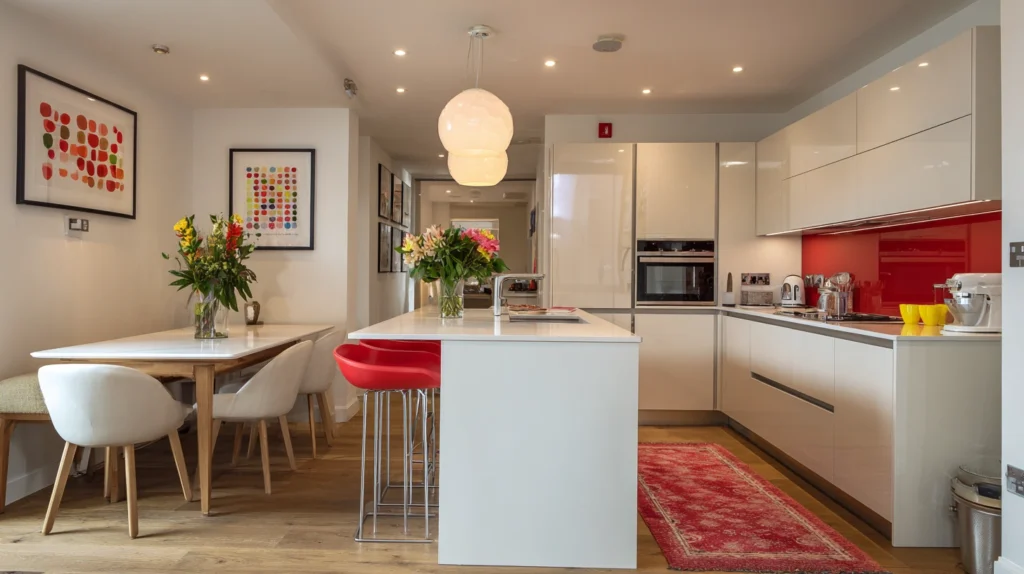
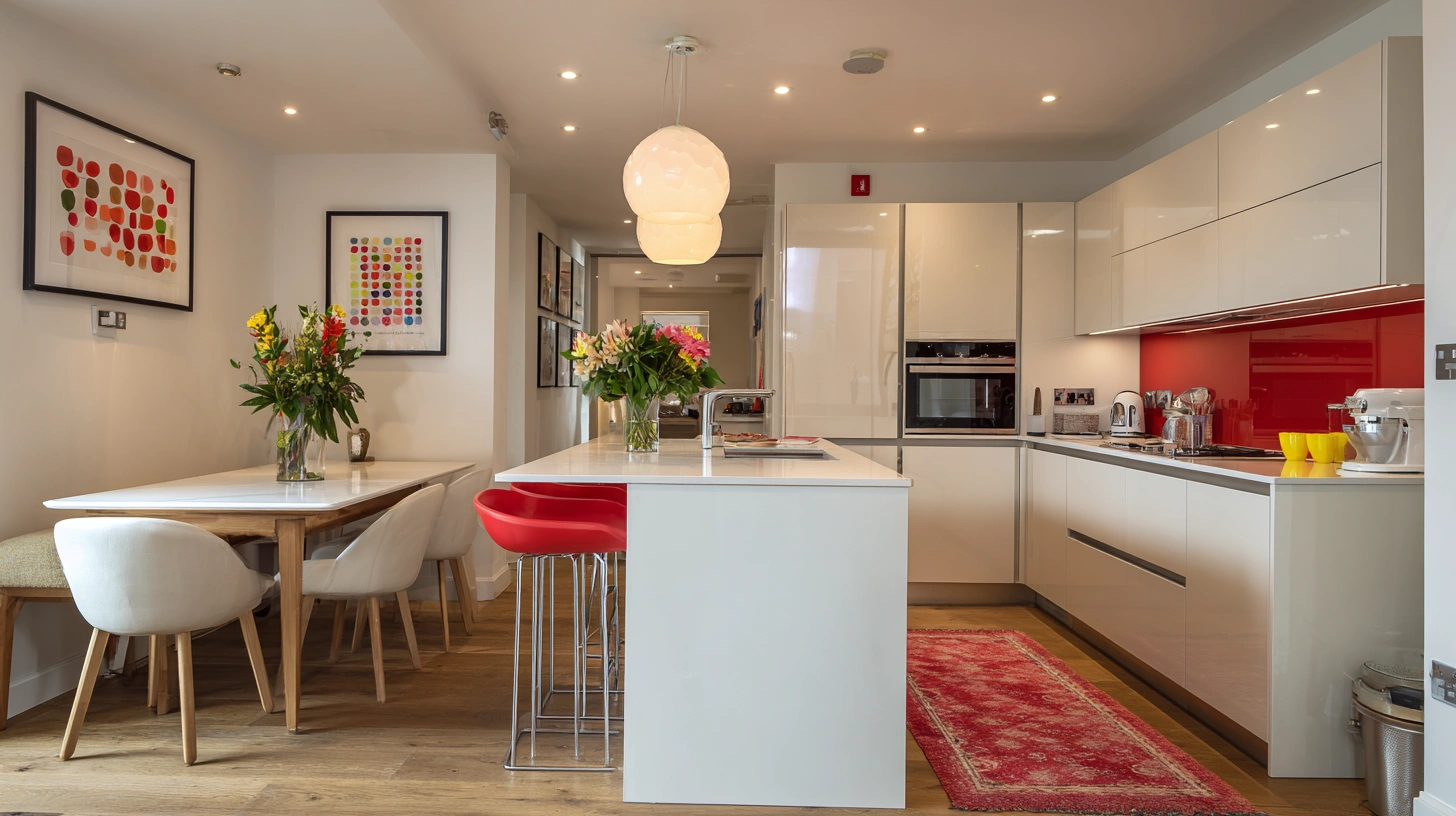
The solution is rarely a new kitchen. It is almost always colour — introduced carefully, in the right places, in a quantity that adds life without overwhelming the space that already exists. A kitchen that works structurally needs only small doses of colour to feel genuinely transformed, and those doses cost a fraction of what any renovation would.
Each idea below works regardless of cabinet colour, cabinet style, or kitchen size. Each includes what you will need, what it will cost, and a practical tip to make it look considered rather than added-on.
1. The Coloured Splashback
Budget: $30 – $200
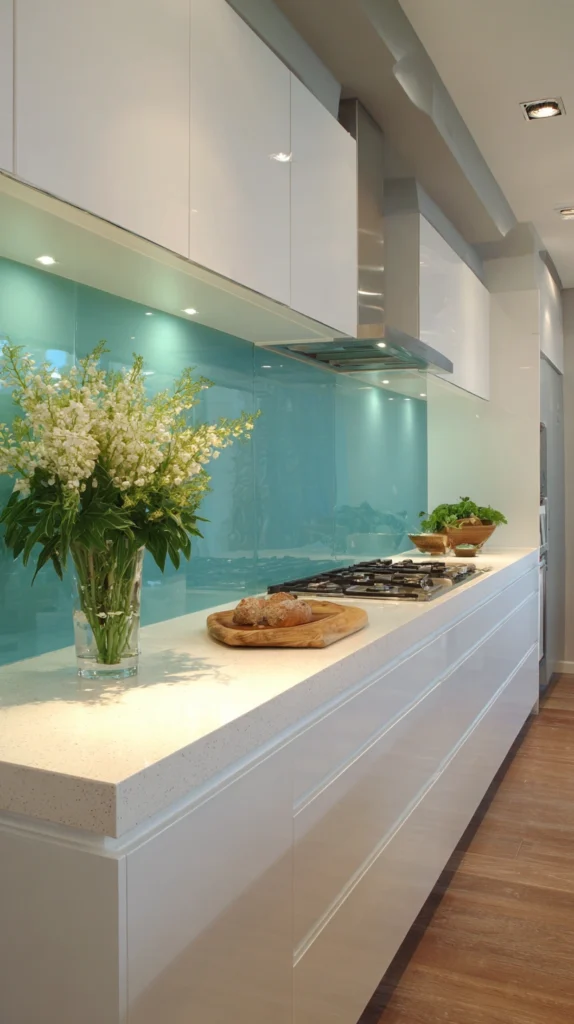
A splashback in a strong, deliberate colour — deep green, cobalt blue, terracotta, warm mustard — is the most visually impactful colour addition available to a kitchen without touching the cabinets. It sits behind the hob or the sink where the eye naturally rests, covers a surface that would otherwise be a neutral tile or plain wall, and makes the kitchen feel designed from the inside out rather than assembled from available parts.
Coloured glass splashback panels cost $60–$200 cut to size. A painted splashback using kitchen or bathroom paint costs $15–$40 and can be completed in an afternoon. Large format coloured tiles run $3–$8 each and provide the most durable and most cleanable surface of the three options. Choose a colour that does not appear anywhere else in the kitchen — the splashback earns its impact by contrast rather than by coordination.
Style tip: Extend the splashback 10–15 centimetres beyond the hob or sink on each side rather than cutting it to the exact width of the appliance. The wider coverage reads as a design decision rather than a functional minimum, and the additional width gives the colour more visual weight in the room.
2. The Painted Interior Cabinet
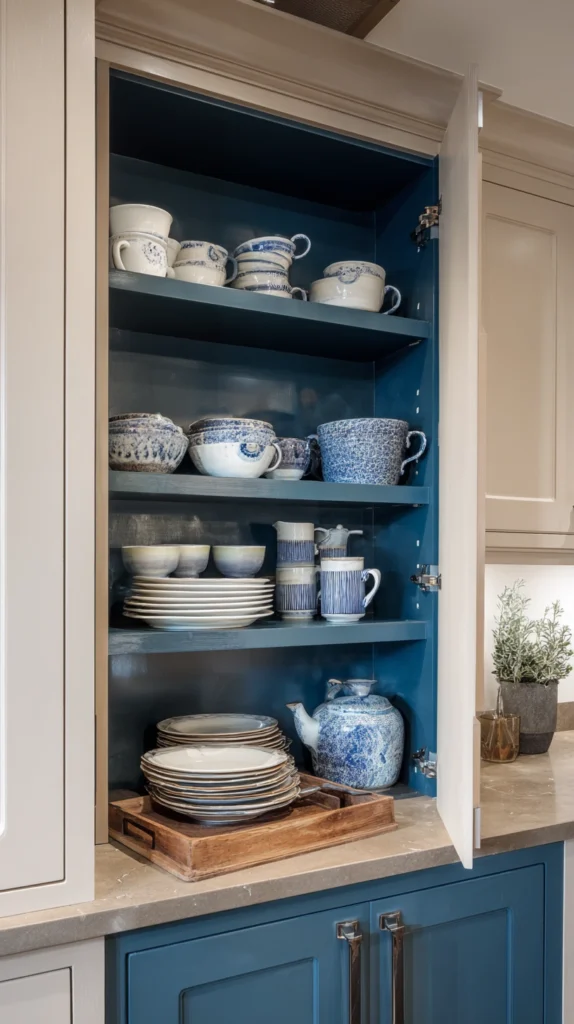
Budget: $15 – $50
Paint the interior back wall of one or two open kitchen cabinets in a colour that contrasts with the cabinet exterior — a dark green inside a white cabinet, a warm terracotta inside a natural wood one, a deep navy inside a grey-painted frame. The colour is visible only when the cabinet is open or when objects are removed from the shelf, which means it reads as a discovery rather than a statement — a detail that rewards looking closely at the kitchen rather than a decoration that announces itself from across the room.
A small tin of sample paint costs $5–$10 and covers the interior of two to three cabinets. No primer is needed if the interior surface is already painted — sand lightly with 120-grit sandpaper, wipe clean, and apply two thin coats. The interior of a cabinet receives no direct sunlight and almost no moisture, which means even a relatively inexpensive paint lasts for years without fading or peeling.
Style tip: Remove the objects from the painted cabinet for 48 hours after painting to allow the paint to cure fully before anything is placed against it. Paint that has dried but not fully cured — a process that takes longer than drying — transfers onto objects placed against it and leaves marks that are difficult to remove from both the painted surface and the object.
3. The Coloured Small Appliance Collection
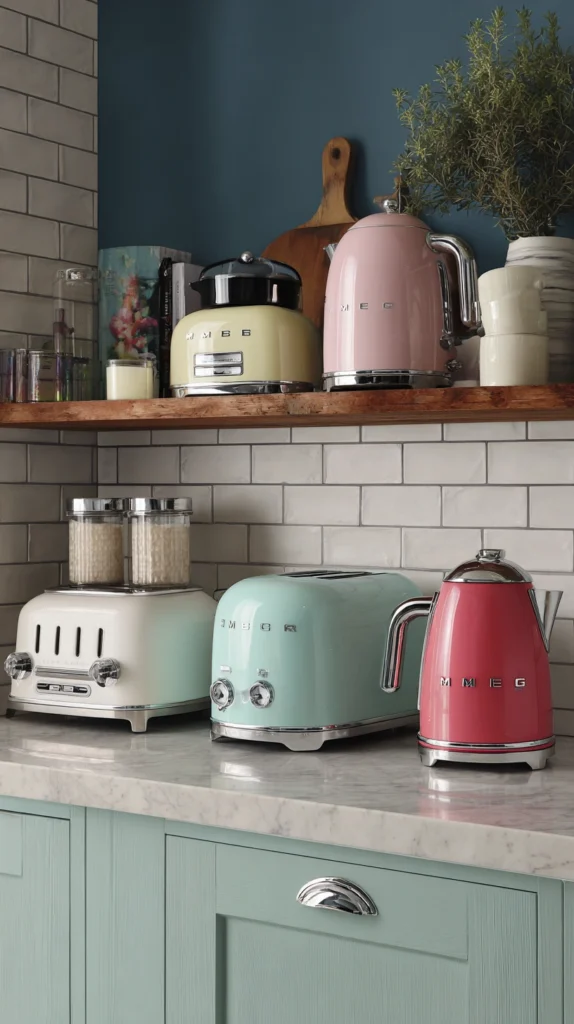
Budget: $30 – $300
A kettle, a toaster, a stand mixer, or a coffee machine in a single strong colour — all matching, or all from the same colour family — sits on the worktop as a permanent, functional colour statement that requires no installation, no painting, and no commitment beyond the purchase. Small appliances in colour are the most reversible colour addition in a kitchen and the most immediately effective on a worktop that is currently occupied by neutral or stainless steel versions.
A coloured kettle costs $25–$60. A matching toaster runs $30–$80. A stand mixer in a statement colour costs $150–$400 but serves as the focal point of the worktop in a way that nothing else at that scale manages. Choose one colour and apply it consistently across every appliance on the worktop — a collection of appliances in four different accent colours reads as a coincidence rather than a decision.
Style tip: Group the coloured appliances together on one section of the worktop rather than distributing them across the kitchen. A cluster of matching appliances in one location reads as a considered collection; the same appliances spread evenly across the worktop read as individual purchases that happen to share a colour.
4. The Coloured Bar Stools
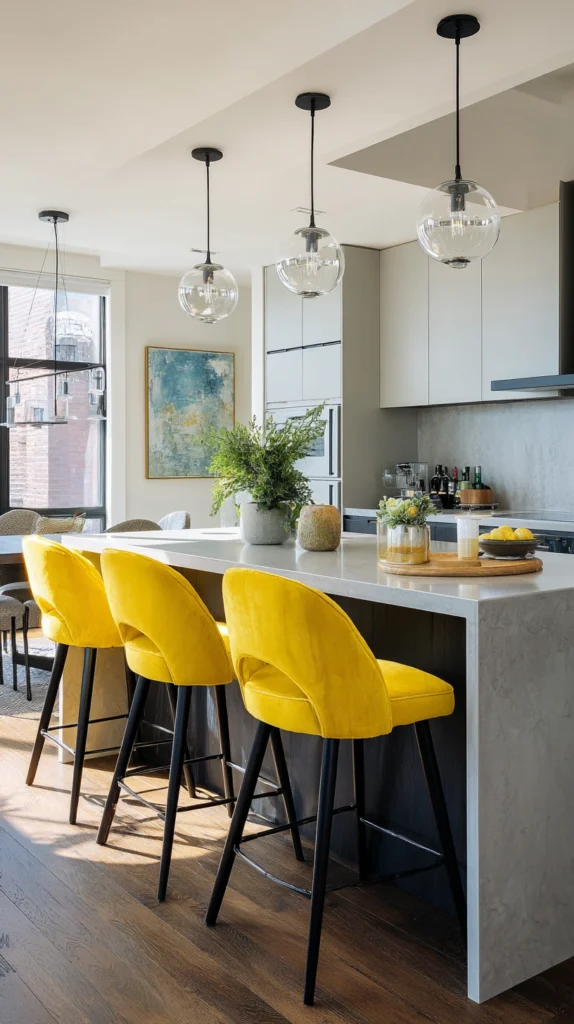
Budget: $40 – $300
Bar stools at a kitchen island or breakfast bar are one of the few pieces of genuinely moveable furniture in a kitchen, which makes them the ideal vehicle for a colour injection that can be changed, replaced, or removed without consequence. A pair of stools in a strong colour — forest green, burnt orange, cobalt, matte black — gives the kitchen a social focal point and a colour anchor that all the other kitchen elements can relate to.
A pair of basic coloured metal bar stools costs $40–$100. Upholstered versions in a coloured fabric run $80–$200 per pair. Wooden stools that can be painted in any colour cost $20–$50 each and are the most customisable option — a coat of floor paint or exterior paint in the chosen colour produces a finish durable enough for daily seating use. Choose a stool height that suits the counter — 65-centimetre stools for a standard 90-centimetre counter, 75-centimetre stools for an island at 105 centimetres.
Style tip: Choose a stool colour that picks up a tone already present somewhere in the kitchen — in the splashback, in a plant pot, in the pattern of a tea towel — rather than introducing an entirely new colour to the room. A colour that echoes something already there reads as deliberate coordination; one that appears nowhere else reads as an addition that has not yet found its place.
5. The Coloured Pendant Light
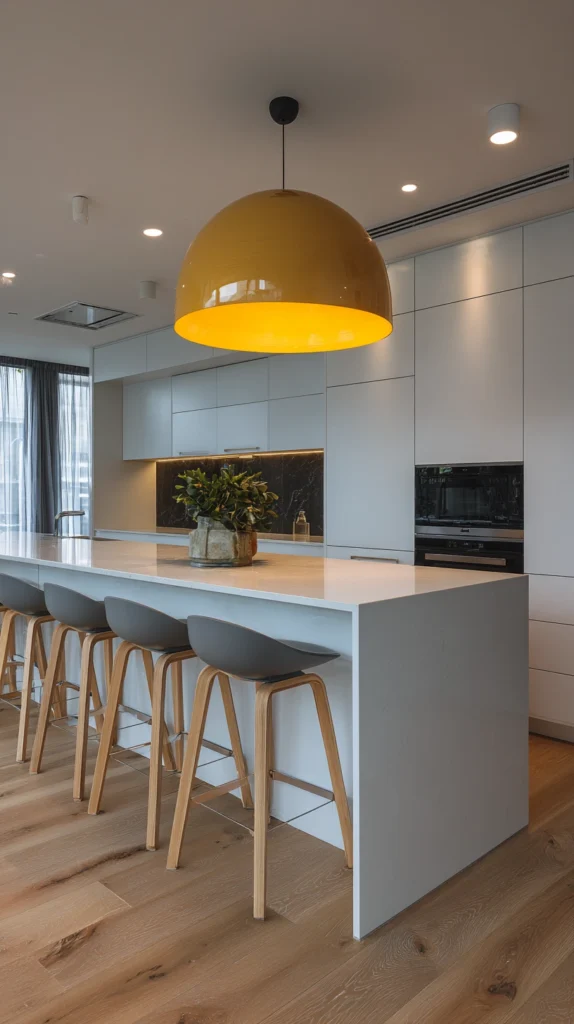
Budget: $30 – $150
A pendant light above the kitchen island or dining table in a coloured shade — mustard, forest green, terracotta, blush — introduces colour at eye height and above it, which is the zone most visual schemes in a kitchen ignore entirely. The light fitting earns its colour twice: when it is off and reads as a coloured object in the room, and when it is on and casts a tinted glow onto the surface below it.
A coloured metal pendant shade costs $30–$80. A ceramic pendant runs $50–$150. Changing a pendant light requires only a screwdriver and the ability to safely connect three wires — live, neutral, and earth — to the new fitting’s connector block, or alternatively a one-hour electrician call-out. Choose a shade colour that works in the room when the light is both on and off — some colours that look rich and warm as an object look sickly when they cast coloured light onto food and faces below them.
Style tip: Hang pendants lower than instinct suggests — 70–80 centimetres above a dining surface, 60–75 centimetres above an island worktop. A pendant hung too high loses its intimacy and its ability to direct light usefully onto the surface below it. The lower position also makes the coloured shade more visible from the seating position, which is where it earns most of its visual impact.
6. The Coloured Tile Trim
Budget: $20 – $100
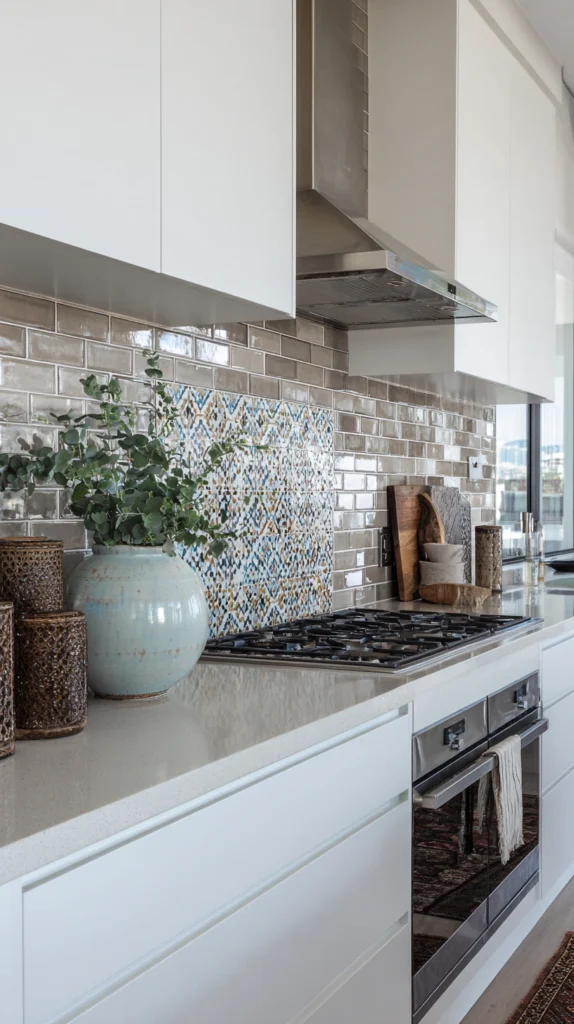
A single row of coloured tiles used as a border, a trim, or a feature strip within an otherwise plain tile scheme — running along the top of the splashback, framing the window above the sink, or used as a grout-width strip between two sections of neutral tile — adds colour with a precision and a permanence that paint cannot match. A coloured tile trim at picture rail height in a kitchen of white tiles reads as an architectural detail rather than a decoration.
Individual coloured tiles cost $1–$5 each — a single trim row requires only twelve to twenty tiles depending on the wall length. Tile adhesive and grout in a matching or contrasting colour run $10–$20. Apply the trim tiles using a small notched trowel and keep the grout joints consistent with the surrounding tiles — a trim that uses different joint spacing from the surrounding field tiles looks misaligned regardless of how carefully it is positioned.
Style tip: Use a grout colour that contrasts with the trim tile rather than matching it. A coloured tile with a white grout joint is more visible and more graphic than the same tile with a matching grout — the grout joint defines the tile edge and increases its visual impact. A contrasting grout is the detail that elevates a simple tile trim from functional to considered.
7. The Coloured Utensil Display
Budget: $15 – $60
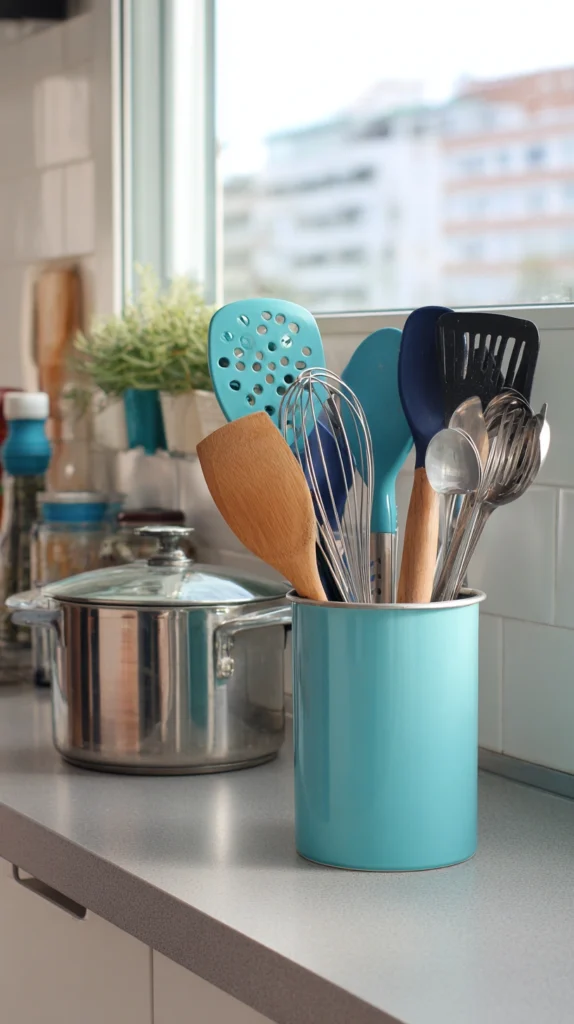
A set of kitchen utensils — spatulas, ladles, spoons, whisks — in a single strong colour displayed in a ceramic pot or a wall-mounted rail on the worktop or above the hob introduces colour through objects that are already in the kitchen and already need to be stored somewhere. The coloured utensil collection is the most functional colour addition on this list and the most invisible in the sense that no one registers it as decoration — it reads as a kitchen that simply has coloured utensils, which is a more natural result than many deliberate colour additions achieve.
A set of coloured silicone kitchen utensils costs $15–$40. A ceramic storage pot in a neutral or contrasting tone runs $8–$20. A wall-mounted utensil rail in brass, black, or coloured enamel costs $15–$40. Choose utensils in one colour only — a mixed collection of differently coloured utensils in the same pot reads as a miscellaneous assembly rather than a considered display.
Style tip: Replace the utensil pot as well as the utensils if the existing pot is a neutral or default choice. A strong-coloured utensil collection in an equally considered pot reads as a complete display; the same collection in a plain white mug or a basic stainless steel container loses half its visual impact to the container that is holding it.
8. The Coloured Blind or Roman Shade
Budget: $30 – $150
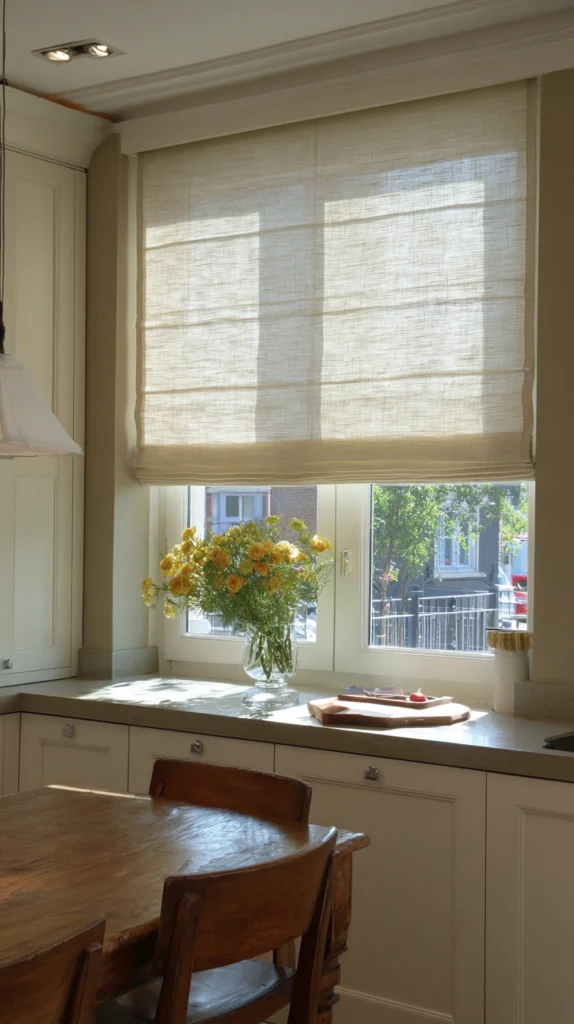
A kitchen window is often the largest expanse of neutral or ignored surface in the room — a white roller blind, a net curtain, or bare glass that contributes nothing to the kitchen’s character. A coloured Roman blind or roller blind in a strong solid colour or a graphic pattern brings the window into the room’s design conversation and gives the kitchen a focal point on its most naturally lit wall.
A coloured roller blind in a standard width costs $25–$60. A Roman blind in a printed or solid fabric runs $40–$150. Kitchen blinds should be moisture and grease-resistant — PVC-coated or polyester fabrics are more practical than linen or cotton in a cooking environment where steam and splatter are daily realities. A blind that is easy to wipe down maintains its colour and its appearance through years of kitchen use; one that stains permanently within a season does not.
Style tip: Choose a blind colour that relates to the splashback or the bar stool colour rather than introducing a third independent accent. Two colour accents in a kitchen that share a relationship — the same family, the same temperature, a complementary pairing — read as a scheme; three independent accent colours read as a kitchen that has been added to rather than designed.
9. The Coloured Shelf Bracket
Budget: $15 – $60
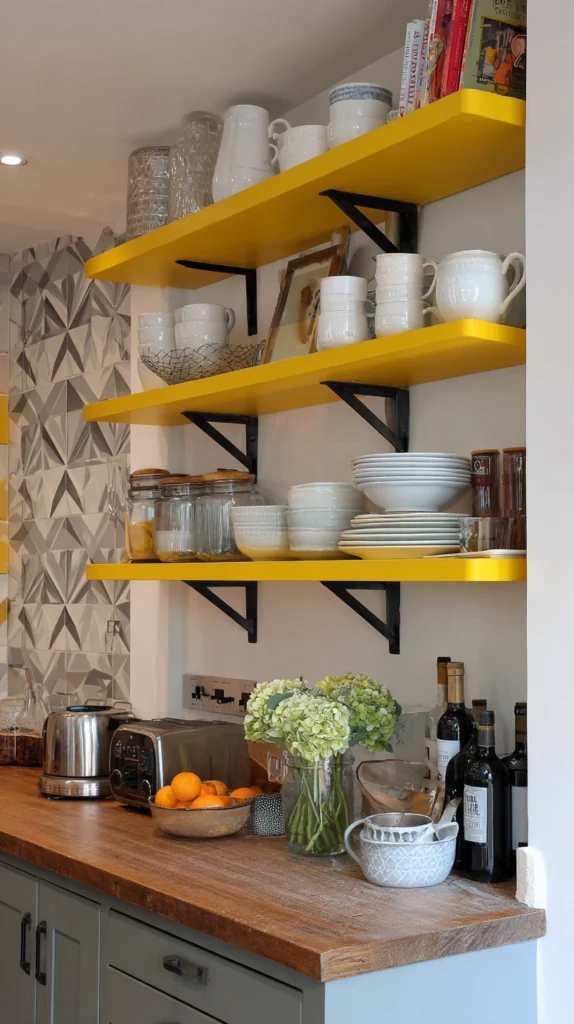
If the kitchen has open shelving, the brackets that support those shelves are a consistently underused opportunity for colour. A bracket in a contrasting colour — black brackets on white shelves, brass brackets on dark shelves, a coloured enamel bracket against a plain wall — gives the shelving a graphic quality and a visual definition that the same shelf with a plain or invisible bracket never achieves.
Coloured metal shelf brackets cost $5–$15 each — a standard open shelf requires two. Powder-coated steel brackets in black, white, brass-effect, or solid colours run $8–$20 each for a more considered version. If the existing brackets are plain metal or painted to match the wall, removing them and repainting in a contrasting colour costs only the paint and an afternoon — spray paint in a satin finish ($8–$12 per can) produces a more even result on metal brackets than a brush applied coat.
Style tip: Use the same bracket colour consistently across every shelf in the kitchen rather than varying it between shelves. A kitchen where every bracket is the same coloured finish reads as a considered detail; one where brackets vary in colour or finish between shelves reads as a collection of shelves that were added at different times without reference to each other.
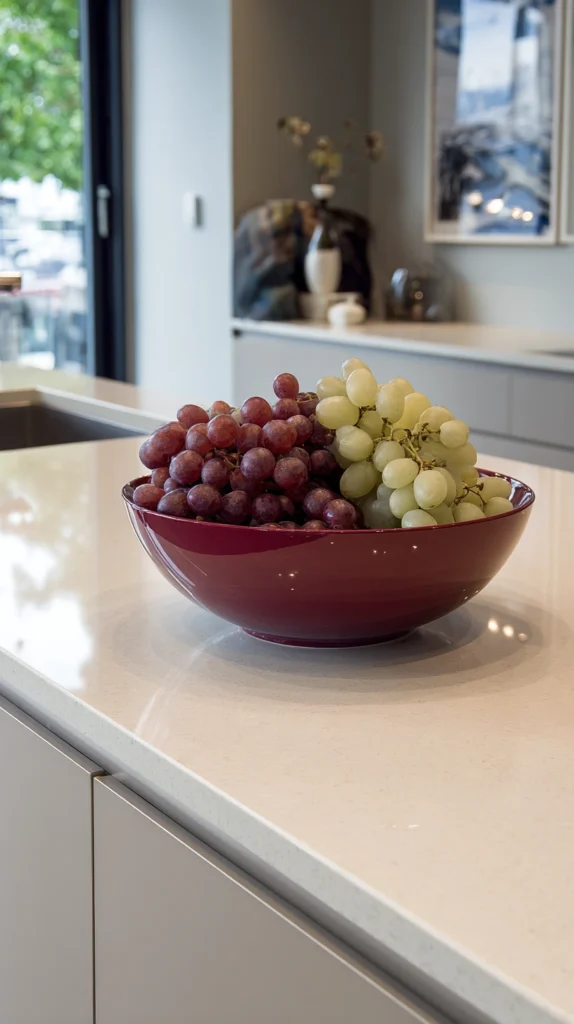
10. The Coloured Fruit Bowl
Budget: $15 – $60
A large, generously sized fruit bowl in a strong colour — placed on the worktop or the kitchen table as the centrepiece of the working kitchen surface — is the oldest and most reliable kitchen colour addition of all. It is also the one that earns its colour most honestly: a bowl that is full of fruit is doing a job as well as providing colour, and the combination of the bowl’s colour with the colours of the fruit inside it produces a display that changes daily and costs nothing beyond the fruit.
A large ceramic fruit bowl in a statement colour costs $15–$50. A hand-thrown studio pottery version runs $30–$80 and has a character that mass-produced ceramics cannot replicate. Size matters more than most people account for — a bowl that is too small for the fruit it holds looks constrained, while a generous bowl that is piled high with fruit looks abundant and intentional. Buy the bowl a size larger than seems necessary and fill it accordingly.
Style tip: Choose a bowl colour that contrasts with the worktop surface rather than sitting within the same tone family. A deep green bowl on a dark worktop disappears; the same bowl on a pale stone or white worktop reads as a strong, deliberate colour statement. The contrast between the bowl and its surface is what gives the colour its impact.
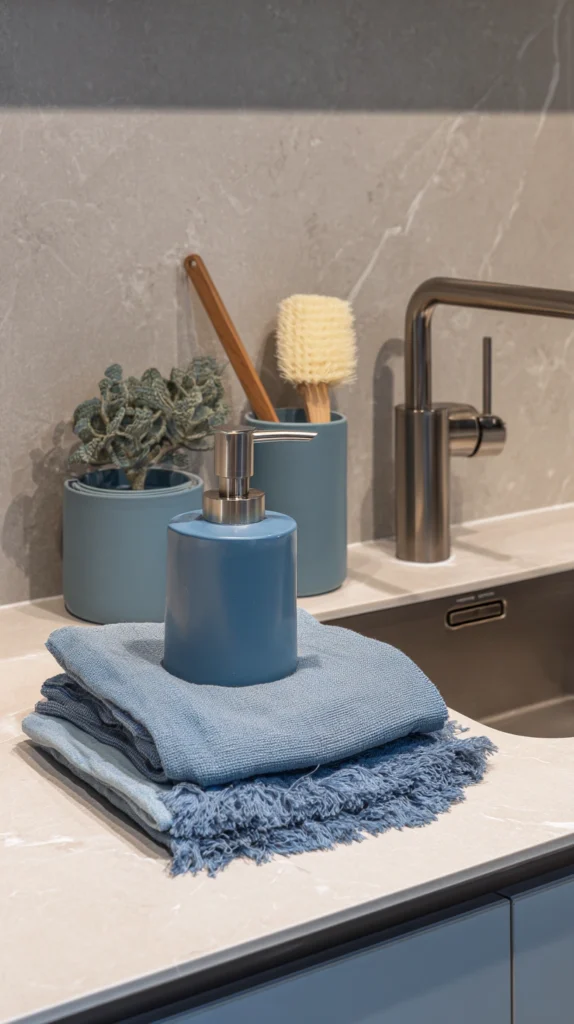
11. The Coloured Soap and Accessories Set
Budget: $20 – $80
The sink area of a kitchen — soap dispenser, washing-up brush, sponge holder, dish rack — is almost universally an afterthought in terms of appearance and almost universally visible from every part of the kitchen. A coordinated set of sink accessories in a single strong colour turns the most functional and least designed part of the kitchen into a small, considered moment that signals the kitchen has been thought about in its details as well as its overall appearance.
A coloured soap dispenser costs $8–$20. A matching dish brush runs $5–$12. A coloured enamel or silicone draining rack costs $15–$40. Buy all pieces in the same colour from the same range or brand where possible — slight colour variations between pieces from different manufacturers are visible at close range and undermine the coordinated effect that makes this idea work.
Style tip: Replace the functional items at the sink at the same time rather than gradually — a coloured soap dispenser beside a white plastic brush holder and a stainless steel draining rack reads as one item that has been changed rather than a considered set. The coordination is the point, and it only reads as coordination when every item participates.
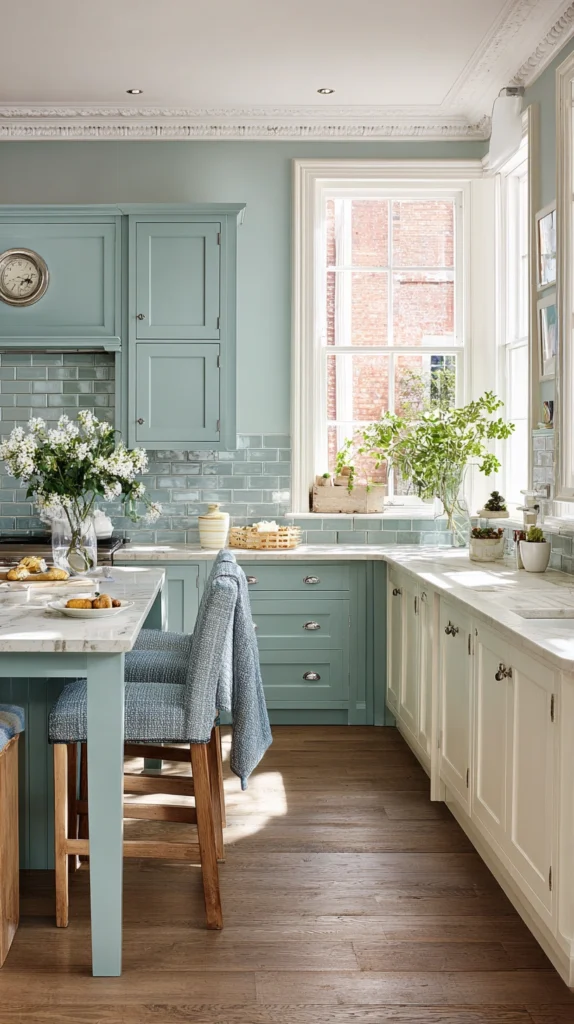
12. The Coloured Tea Towel Collection
Budget: $15 – $50
Tea towels hung from an oven handle, folded over a drawer front, or displayed on a hook rail are the most frequently replaced, most easily changed, and least expensive colour addition available to a kitchen. A set of three or four tea towels in a consistent colour palette — all in the same tone family, or all in a single colour with a contrasting stripe — reads as a collection rather than a miscellany and gives the kitchen a warmth and a domesticity that hard surfaces and appliances alone cannot provide.
A set of three cotton or linen tea towels in a coordinated colour costs $15–$40. Individual printed or woven towels from kitchen shops run $5–$15 each. Replace the entire tea towel collection at the start of each season — faded, stained, or mismatched tea towels undo the effect of every other colour effort in the kitchen, and a fresh set costs so little that there is no argument for keeping worn ones on display.
Style tip: Display only two or three tea towels at any one time rather than every towel in the collection. Two folded towels hung from an oven handle look deliberate; five towels hanging at different lengths and angles look as if they are drying rather than displayed. Rotate the collection from a drawer as the displayed ones are used and washed.
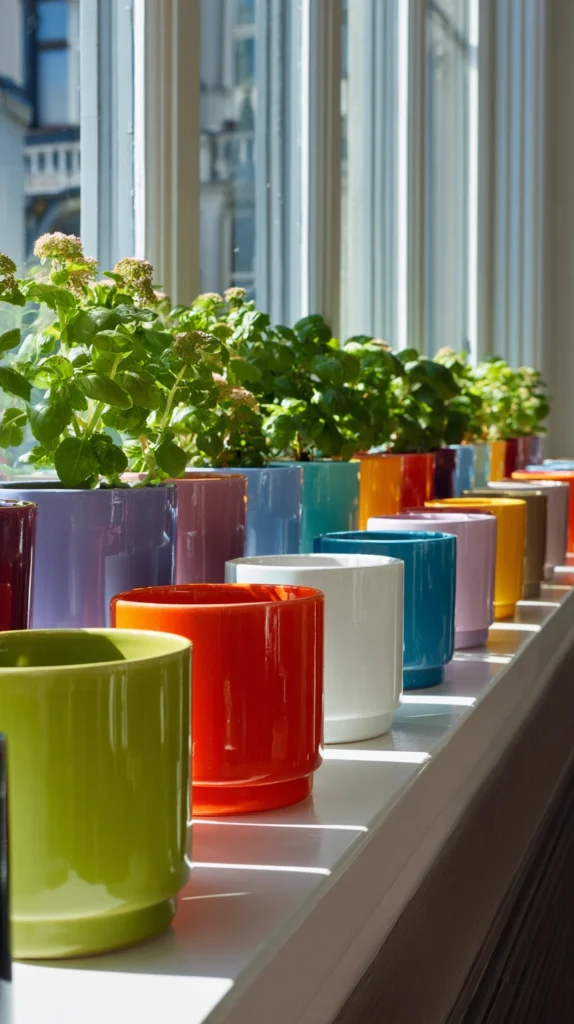
13. The Coloured Herb Pot Row
Budget: $20 – $70
A row of matching coloured pots on the kitchen windowsill — planted with herbs and displayed consistently in terms of pot size, colour, and spacing — is the most natural and most functional colour addition a kitchen windowsill can contain. The colour of the pot, the green of the herb foliage above it, and the light coming through the window behind it combine into a display that is alive, useful, and changing with the seasons in a way that no purchased decoration can replicate.
Matching ceramic herb pots in a consistent size and colour cost $3–$8 each — a row of four costs $12–$32. Herb plants from a garden centre run $2–$4 each. Choose a pot colour that relates to one of the other colour accents in the kitchen — the blind, the bar stools, the splashback — so the windowsill display participates in the kitchen’s overall colour conversation rather than introducing a new and unrelated accent.
Style tip: Use pots that are all the same size rather than graduating sizes along the windowsill. A row of identical pots at the same height reads as a considered display and keeps the windowsill visually calm; a mixed arrangement of sizes reads as a collection of individual pots that happened to end up in the same location. The consistency of the vessel is what transforms a group of herb pots into a display.
The best colour additions to a kitchen are the ones that make the room feel like it was always this way — as if the colour was built in rather than added on, as if the person who cooks in it simply has strong tastes that happen to express themselves in green bar stools and a terracotta blind and a cobalt soap dispenser beside the sink.
That feeling of inevitability is what to aim for. Choose one or two ideas that suit the kitchen and the budget, introduce them at the same time rather than one by one, and step back. A kitchen that has been given its colour in the right places stops looking like a kitchen that is trying and starts looking like one that simply is.