13 Clever Entryway Storage Ideas for Busy Homes
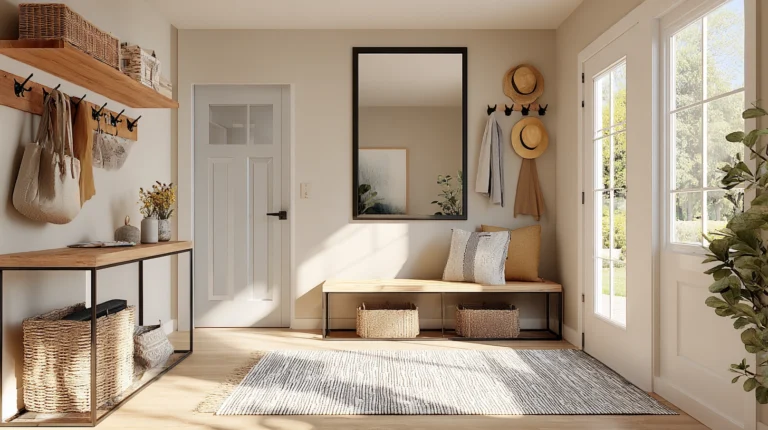
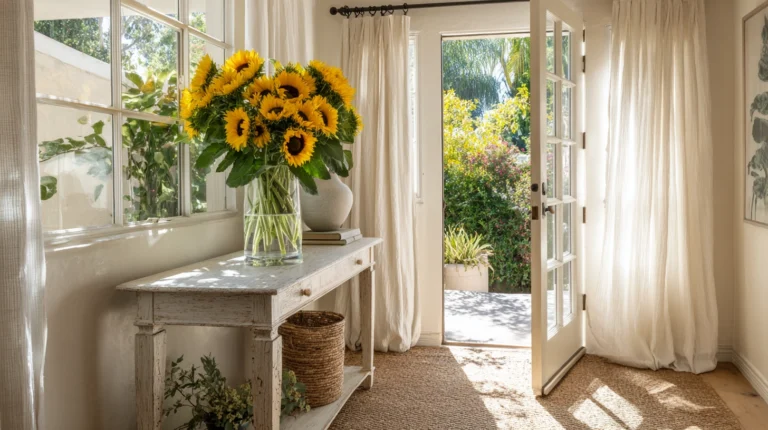
The entryway is the room that works hardest and receives the least design attention in most homes. It is where everything arrives — coats, shoes, bags, keys, post, umbrellas, school bags, sports kit — and where all of it needs to be managed, stored, or at least contained before any of it reaches the rest of the house.
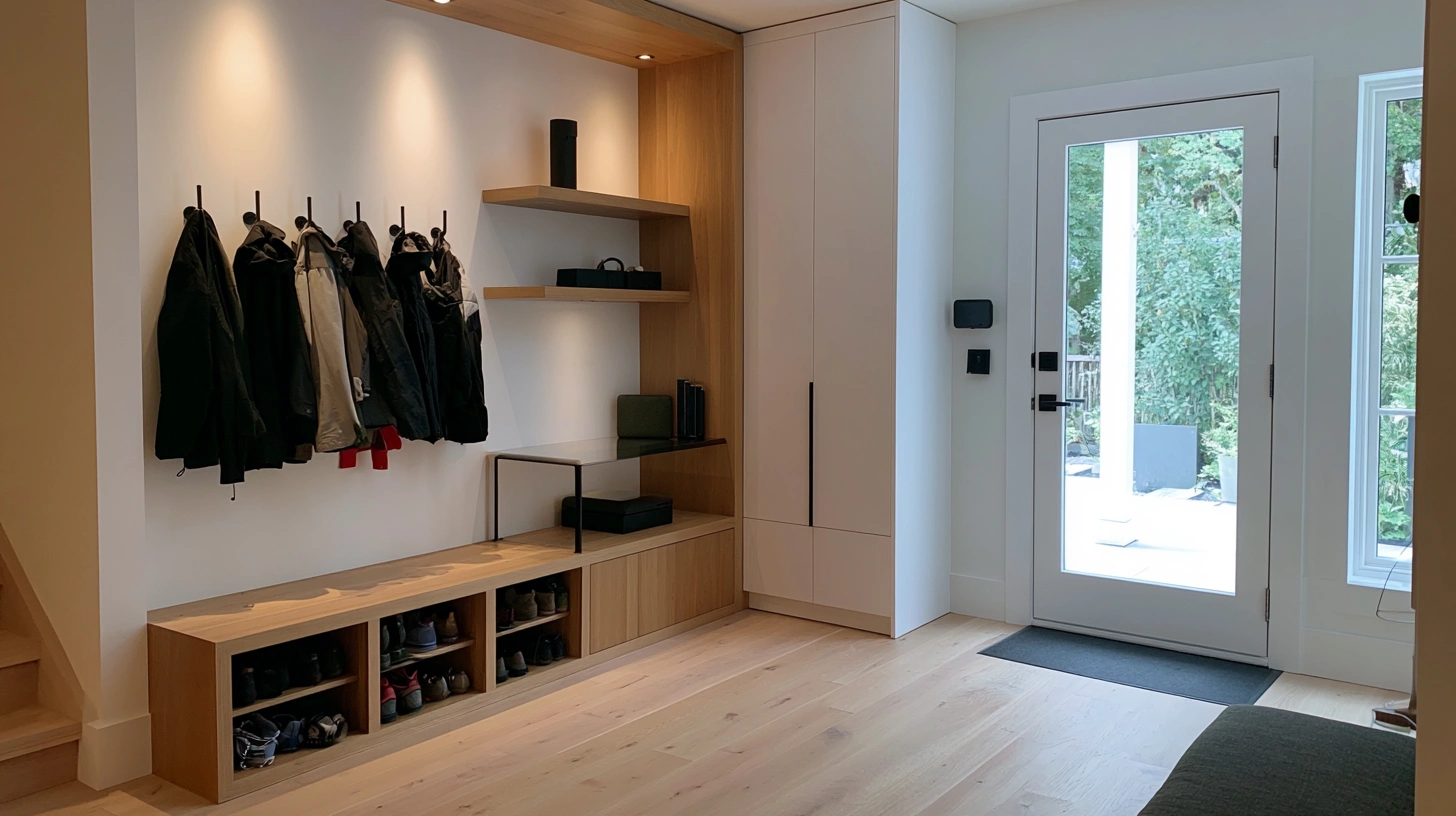
A well-designed entryway does not look like a storage room. It looks like a considered space that happens to contain everything that a busy household needs to function — because every object in it has a specific, well-designed place to go.
The thirteen ideas below cover every scale of entryway storage — from a narrow hallway with thirty centimetres of wall space to a generous boot room with room for a family’s full outdoor kit. Each includes what it costs and a practical tip to help you implement it in the specific entry space you actually have.
1. A Dedicated Key Hook System
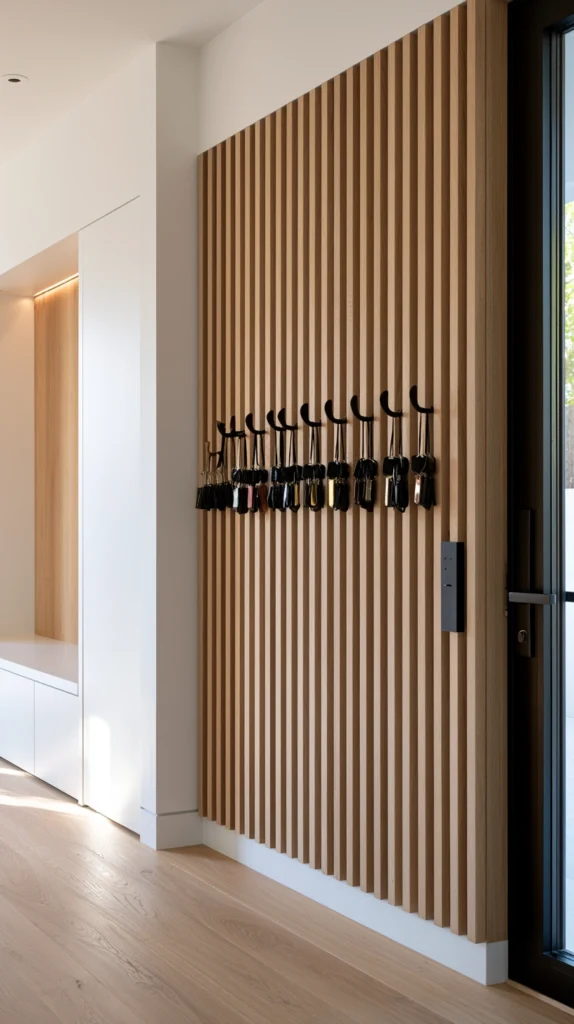
Budget: $15 – $60
Lost keys are the most consistently time-consuming daily frustration in any busy household, and their solution is always the same: a fixed, consistent key hook position at the entryway — visible from the door, within arm’s reach, and containing hooks for every set of keys in the household. The habit of hanging keys immediately on entering is infinitely easier to maintain when the hook is exactly where the hand naturally reaches as the door closes rather than somewhere that requires a deliberate movement to use.
A simple timber key board with five to eight hooks costs $15–$40 from homeware retailers. A small individual hook per key set — each person’s keys on a specific hook at a consistent height — costs $3–$8 per hook. Install at a height of 140–150 cm from the floor — comfortable for all adult household members without stretching. Label each hook with a small name tag or coloured keyring so that missing keys are immediately identifiable by the empty rather than occupied hook.
Storage tip: Install the key hooks within 30 cm of the door lock rather than further along the hallway. The instinct to drop keys is strongest at the moment of entering — the further the key hook is from the door, the more deliberate the movement required to use it and the more frequently keys are set down on the nearest available surface instead. Proximity to the door lock is the single most important variable in whether a key hook system is actually used consistently.
2. A Built-In Bench With Shoe Storage Below
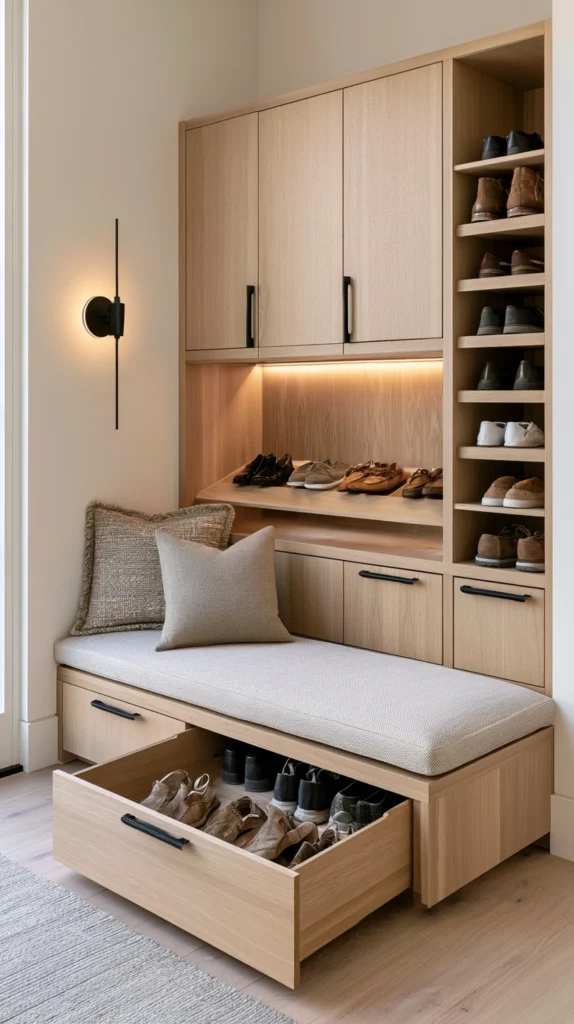
Budget: $150 – $600
A bench at the entryway with shoe storage drawers, pull-out trays, or open cubbies beneath it combines the seating needed for removing shoes with the storage needed for keeping them. It is the single most functional piece of entryway furniture available for a family home — a flat surface for sitting, an organised storage system for the footwear that otherwise accumulates at the door, and a defined zone that prevents shoes from spreading beyond the entry area into the rest of the house.
A purpose-built bench with under-seat shoe storage costs $150–$400 from flat-pack furniture retailers. A custom-built version in painted MDF or plywood costs $200–$600 from a local joiner. The bench depth should be a minimum of 35 cm to accommodate sitting comfortably and a maximum of 45 cm to avoid consuming too much hallway floor space. Store the most-used shoes in the most accessible lower positions and seasonal or occasional footwear at the back and in the upper sections.
Storage tip: Assign one specific cubby or drawer section to each household member rather than sharing the full storage across the family. Individual sections create individual accountability for the tidiness of each person’s shoe storage — a shared heap in a shared storage space is always messier than four individually owned and managed sections of the same total capacity. Labels or colour coding of each section reinforces the system without requiring any ongoing parental management to maintain.
3. A Wall-Mounted Coat Rail With Hooks at Multiple Heights
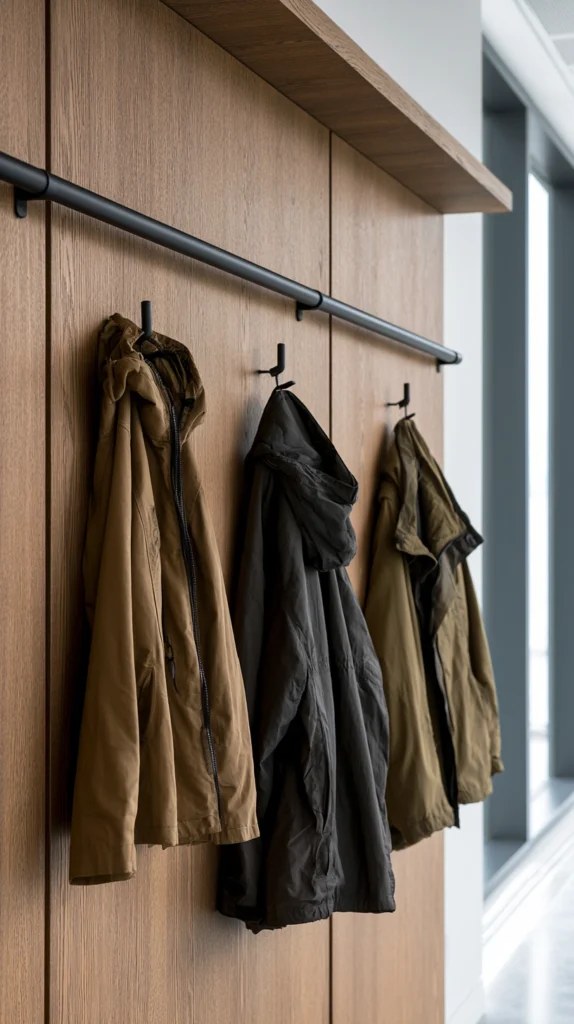
Budget: $30 – $120
A coat rail with hooks at two different heights — adult height at 170–180 cm and child height at 110–120 cm — gives every household member a practical, reachable position for their coat without requiring adult intervention for coat hanging by children. The dual-height rail is the single most effective entryway organisation improvement available for households with children and costs no more than a single-height equivalent to install.
A timber or metal wall-mounted coat rail with six to eight hooks costs $30–$80. Two horizontal rails at different heights cost $60–$120 in materials and take one hour to install. Allow at least 40–50 cm of width per coat position — coats hung at 20 cm intervals bunch together and make individual coats difficult to retrieve, which discourages the habit of hanging rather than dropping. A generous coat rail is always used more consistently than a full one where each additional coat requires wrestling with those already hanging beside it.
Storage tip: Limit the coat hooks in daily use to the number of coats actually worn — not the number of household members multiplied by their full coat wardrobes. A coat hook that is always occupied by three coats is inaccessible as a place to hang the coat being removed on entry. Seasonal coats not in current use should be stored in a wardrobe or cupboard elsewhere in the house, leaving the entryway coat rail with enough empty capacity to always have a clear hook for whatever is being worn today.
4. Floating Shelves Above a Console Table
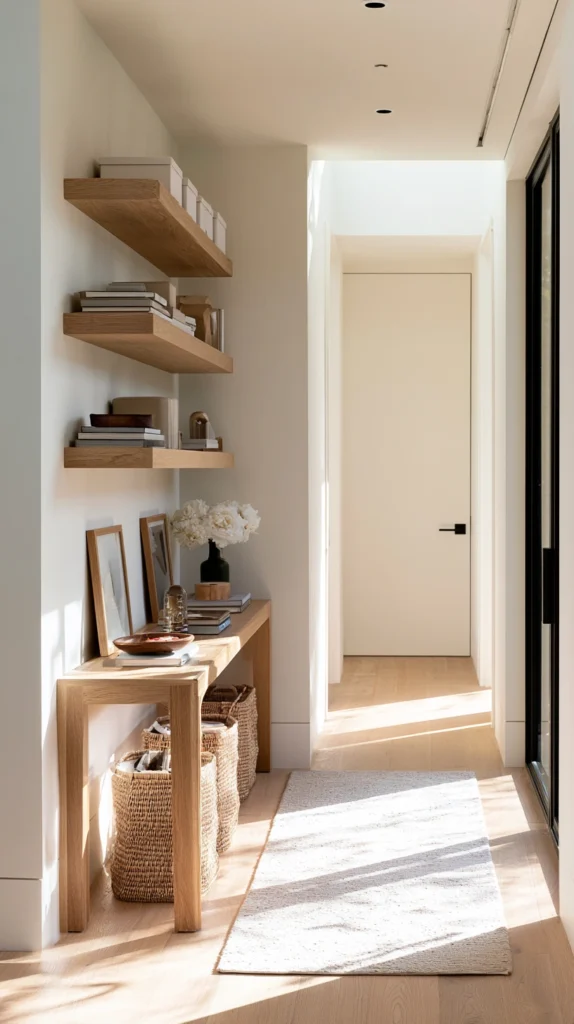
Budget: $80 – $250
A console table in the entryway — with two to three floating shelves mounted above it — creates a small but complete storage wall in a space as narrow as 25 cm depth. The console table provides a surface for keys, post, and objects being taken out. The shelves above provide storage for objects that are needed regularly but not daily — spare batteries, a torch, a toolkit, cleaning materials — all within reach of the front door without consuming any floor space beyond the console table’s own footprint.
A slim console table of 25–30 cm depth costs $80–$200. Floating shelves of the same width cost $15–$40 each, installed. Two shelves above the console provide the storage depth of a full cabinet in the vertical plane of the wall rather than in the horizontal plane of the floor — the most space-efficient storage configuration available in a narrow hallway where floor space is the limiting constraint rather than wall height.
Storage tip: Keep the top surface of the console table clear of storage — reserve it as a surface for the daily deposit of arriving objects (post, keys, bags) that will be dealt with and moved on within the same day. A console table top used for permanent storage loses its function as a landing zone for daily arrivals and the objects that need temporary holding on entry end up on the floor or carried further into the house to find a surface. The landing function of the console is its most important entryway role.
5. A Mudroom Locker System
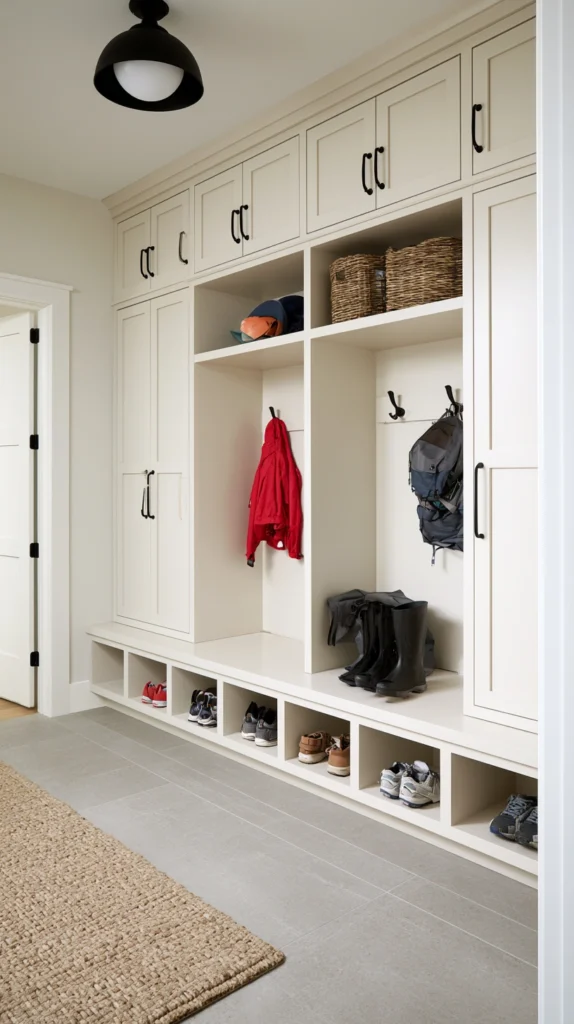
Budget: $200 – $1,000
Individual lockers — one per household member — in the entryway or boot room create the most systematically organised entryway storage available for a busy family home. Each locker contains one person’s complete outdoor kit: coat on a hook inside the door, shoes on a shelf at the base, bag on a hook beneath the coat, and smaller items in a basket on the upper shelf. Everything belonging to one person is in one place and that person is responsible for its organisation.
Flat-pack locker units from IKEA or similar retailers cost $60–$150 per locker in the PAX or similar wardrobe range — customised with internal fittings to suit an entryway rather than a bedroom function. Four lockers for a family of four cost $240–$600 in units and fitting. A custom-built locker system in painted MDF or timber costs $500–$1,500 but provides a fully fitted, visually integrated solution that reads as an architectural feature of the entryway rather than freestanding furniture placed within it.
Storage tip: Add a bench section at the base of each locker column — a 45 cm deep bench surface at 42–45 cm height between the locker units provides seating for shoe changing while integrating the bench into the locker structure rather than requiring a separate freestanding bench alongside the locker installation. The integrated bench uses no additional floor space and completes the locker system as a functional unit that addresses every entry and exit task in a single, defined zone.
6. Over-Door Organisers
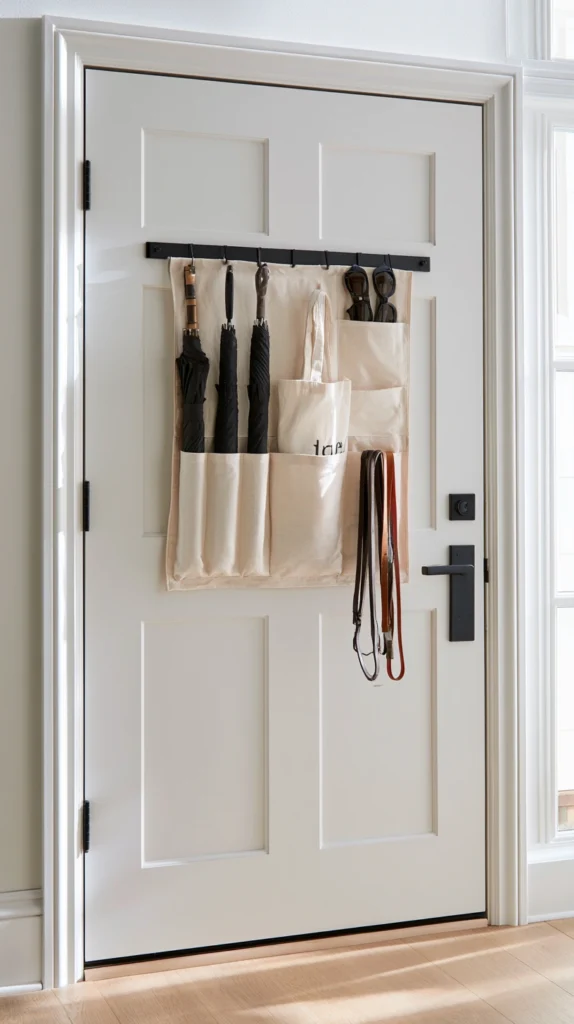
Budget: $15 – $50
The back of the front door — or the back of a coat cupboard door — is one of the most consistently underused storage surfaces in any home. An over-door organiser fitted to the back of the front door provides storage for small, frequently needed items — an umbrella, a reusable bag, dog leads, sunglasses, a torch — in a position that is immediately accessible on leaving the house without consuming any floor or wall space in the hallway itself.
An over-door hook rack costs $10–$25. An over-door pocket organiser in fabric or clear PVC costs $15–$40. An over-door shoe rack for the coat cupboard costs $15–$35. Choose fittings that do not require the door to be closed completely at an odd angle to clear the frame — test the door’s full opening and closing range with the fitting in place before deciding it is installed correctly rather than discovering the problem when a guest tries to close the door from the outside.
Storage tip: Dedicate the over-door space specifically to grab-and-go items — things needed on leaving the house rather than on arriving. An over-door organiser stocked with arriving objects (post, receipts, items to be dealt with) creates a hidden clutter zone that is forgotten and accumulated rather than used and maintained. Grab-and-go items — leads, keys, bags, umbrellas — cycle through the over-door storage continuously and prevent the accumulation that arriving items inevitably produce in any storage position that is not regularly cleared.
7. A Pegboard Entryway Wall
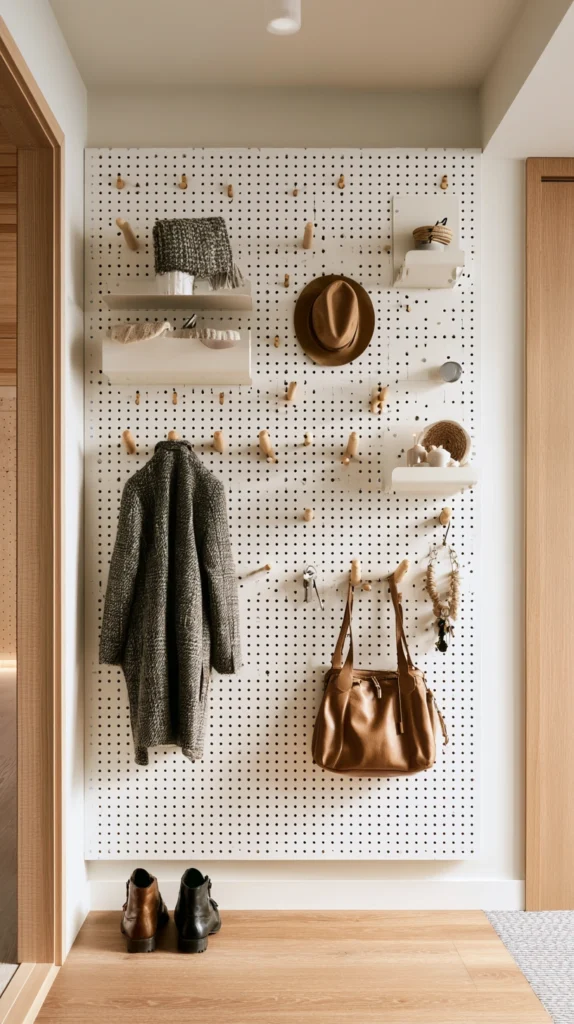
Budget: $30 – $100
A pegboard panel mounted on the entryway wall — with pegs, hooks, and small shelves in any configuration — creates the most adaptable and most completely customisable entryway storage wall available. The configuration can be changed within minutes as the household’s needs shift through the seasons — more hooks for winter, more shelf space for summer bags and sports equipment — without any new fixing or drilling required.
A 60×120 cm MDF pegboard panel costs $15–$30. A set of twenty assorted peg hooks and shelf brackets costs $15–$35. Mount the board with spacer blocks that hold it 2–3 cm from the wall surface — the gap allows peg hooks to be inserted and removed from behind the panel without the wall preventing full hook engagement. Paint the pegboard in the hallway wall colour for the most visually integrated appearance, or in a bold contrasting colour to make it a deliberate design feature.
Storage tip: Install the pegboard at a height where the lowest pegs are accessible to the youngest household member who uses the entryway independently. Entryway storage that children cannot reach independently places the ongoing responsibility for their coat and bag management on adults — which creates the daily friction of the entryway being used as a drop zone rather than a managed storage system. Accessible hooks at child height create the possibility of independent coat hanging from the youngest age at which the habit can be established.
8. A Slim Cabinet With Full-Height Doors
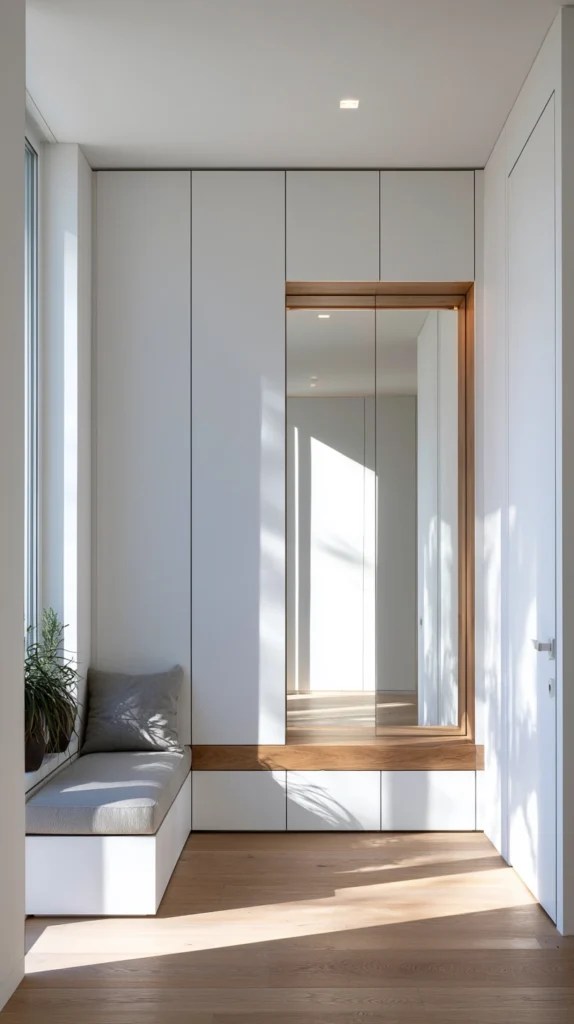
Budget: $100 – $400
A full-height slim cabinet — 25–30 cm deep, with doors that close on the full height of the stored contents — provides the most visually clean entryway storage available. From the hallway the cabinet reads as a door or a section of panelling rather than a storage unit, and the entire contents — coats, shoes, bags, cleaning equipment, and seasonal items — are invisible behind the closed doors. A closed hallway is always more welcoming and more spacious-feeling than an open one where stored contents are visible from the front door.
A slim wardrobe or larder unit of 25–30 cm depth and 200 cm height costs $100–$250 from flat-pack furniture retailers. A built-in version in painted MDF costs $300–$600 from a local joiner. The door finish — painted in the hallway wall colour, in a complementary darker tone, or with a panel detail that references the architectural style of the house — determines whether the cabinet reads as a designed piece of built-in furniture or as a freestanding unit that was placed in the hallway because the hallway is where storage is needed.
Storage tip: Install a full-length mirror on the door of the slim hallway cabinet. The mirror serves the practical function of a last-look check before leaving the house, makes the hallway feel significantly larger and brighter by reflecting available light, and avoids the need for a separate mirror installation on the hallway wall. A mirror door on a storage cabinet does three things simultaneously for the cost of one fitting — which is exactly the principle of efficiency that a well-designed entryway storage system should embody in every component.
9. A Basket System for Each Household Member
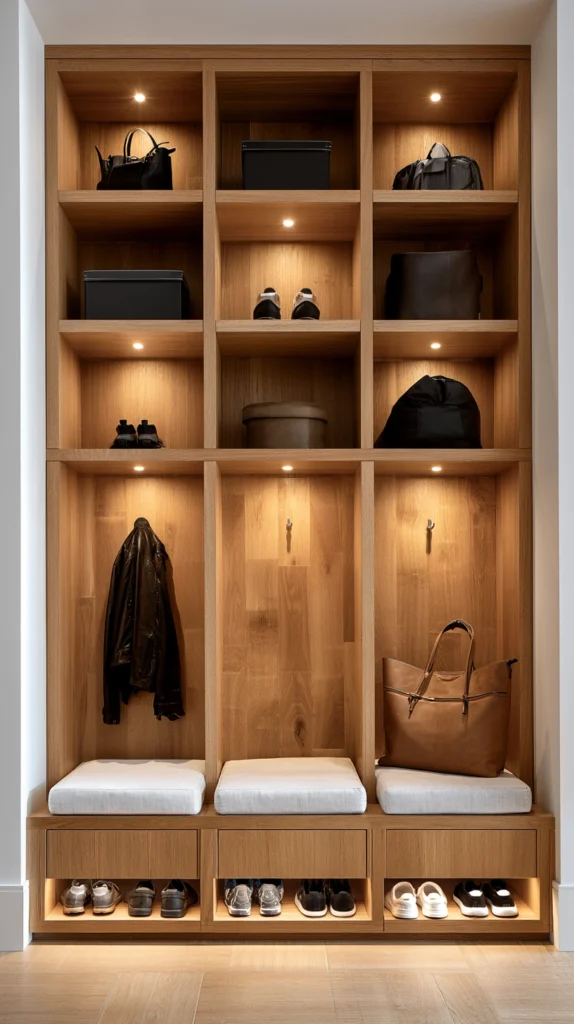
Budget: $30 – $100
One labelled wicker or rattan basket per household member — positioned on a shelf, a bench surface, or on the floor of a coat cupboard — creates the most accessible and most flexible personal storage solution for the entryway. Each basket contains the daily essentials of one person: a reusable bag, sunglasses, a phone charger, a wallet, and whatever other small items that person needs to find quickly on leaving the house. Everything belonging to one person is in one basket and that person knows exactly where to look.
A natural wicker basket of 30×20×15 cm costs $8–$20. Four baskets for a family of four cost $32–$80. Personalise each basket with a small tag or initial label ($3–$5 for a set of ten blank labels). A basket system requires ongoing individual discipline to maintain — the basket is only useful if it is used consistently rather than occasionally. Establish the habit by placing only the most-needed daily items in each basket initially and adding additional items gradually as the habit of returning to and using the basket is established.
Storage tip: Do not use the personal baskets for arriving objects — school letters, receipts, and items brought home should have their own separate landing tray rather than going into the personal departure baskets. A basket that contains both arriving and departing items becomes a general deposit box rather than a curated collection of things needed on leaving — and within two weeks of introduction it will be indistinguishable from the general pile of entryway clutter it was designed to replace.
10. A Mail and Post Station
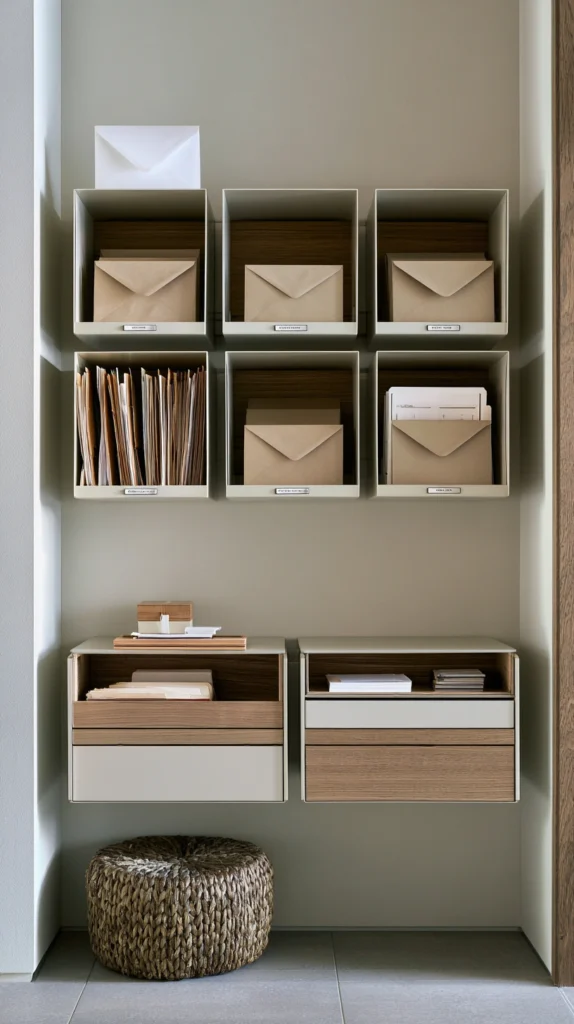
Budget: $20 – $80
A dedicated post management station in the entryway — a small wall-mounted rack with three sections for incoming, outgoing, and to-be-filed — prevents the accumulation of post on the console table, the kitchen counter, and every other horizontal surface between the front door and the recycling bin. The station works because it provides a specific position for every stage of the post management process, rather than leaving post on the nearest surface at the point of arrival and dealing with it when time allows.
A wall-mounted wire or timber letter rack with two to three compartments costs $15–$40. A small clipboard on the wall beside the rack for notes and reminders costs $5–$10. Label the compartments — Incoming, Action Required, Outgoing — and maintain the habit of clearing the Action Required section weekly and the Outgoing section before every postal collection. A mail station that is cleared regularly is a functional system. One that is cleared only when it overflows is a storage unit for accumulated paper that will eventually be dealt with in a stressful session rather than managed as a daily habit.
Storage tip: Place a small recycling bin or a paper recycling slot immediately below the post station — between the letter box and the post rack — so that junk mail and clearly unwanted items can be discarded without being carried any further into the house than the entryway. The proximity of the recycling to the point of arrival is the detail that most directly reduces the volume of post that reaches the rest of the house and the horizontal surfaces where it accumulates most persistently.
11. Hidden Storage in a Stair Riser
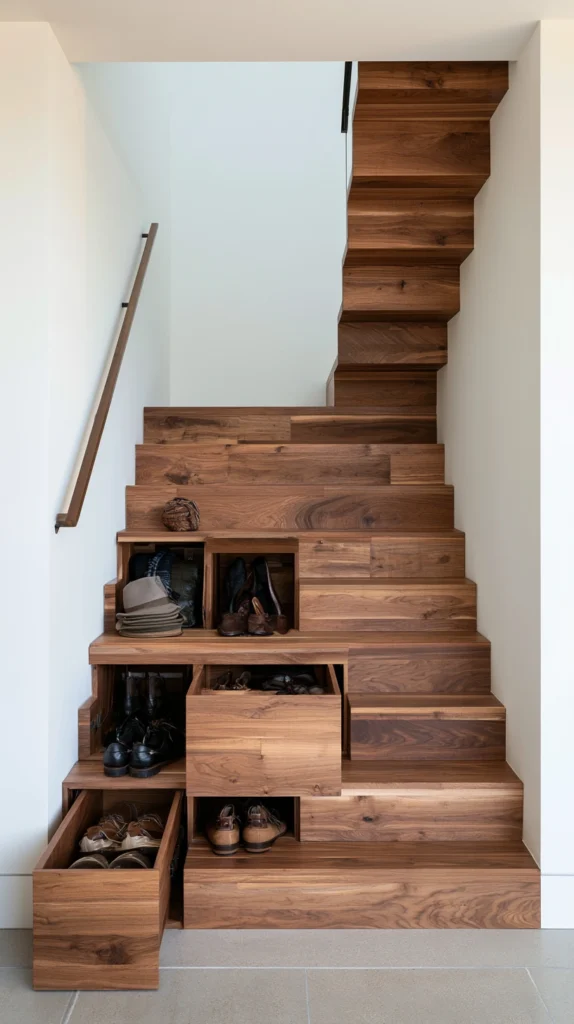
Budget: $200 – $800
In a home where the stairs descend directly into the hallway, the space beneath the staircase is frequently the largest unused volume in the entire entry zone — and in most homes it is either completely inaccessible or used for long-term storage of objects that are never retrieved because the access is too inconvenient for daily use. Converting the stair risers into pull-out drawers or the under-stair void into a properly fitted cupboard with a door flush with the staircase panelling creates entryway storage of extraordinary capacity in a space that currently contributes nothing to the hallway’s function.
Individual pull-out stair riser drawers — fitted to each riser below the first landing — cost $50–$150 per riser in materials and fitting. A fully fitted under-stair cupboard with hanging space, shoe racks, and shelving costs $400–$800 professionally fitted. The under-stair storage investment consistently ranks among the highest-return home improvement projects in terms of the usable space added per pound spent in a home where the alternative is separate storage furniture placed throughout the hallway at greater overall floor space cost.
Storage tip: Fit the under-stair cupboard door with a full-length mirror on the exterior face — the same principle as the slim hallway cabinet door. The mirror serves the hallway while the cupboard door is closed and the cupboard interior serves the household when the door is open. A cupboard that contributes to the hallway’s function whether it is open or closed is always a better investment than one that is simply a storage volume behind a blank door.
12. A Boot Room Addition to a Rear Entry
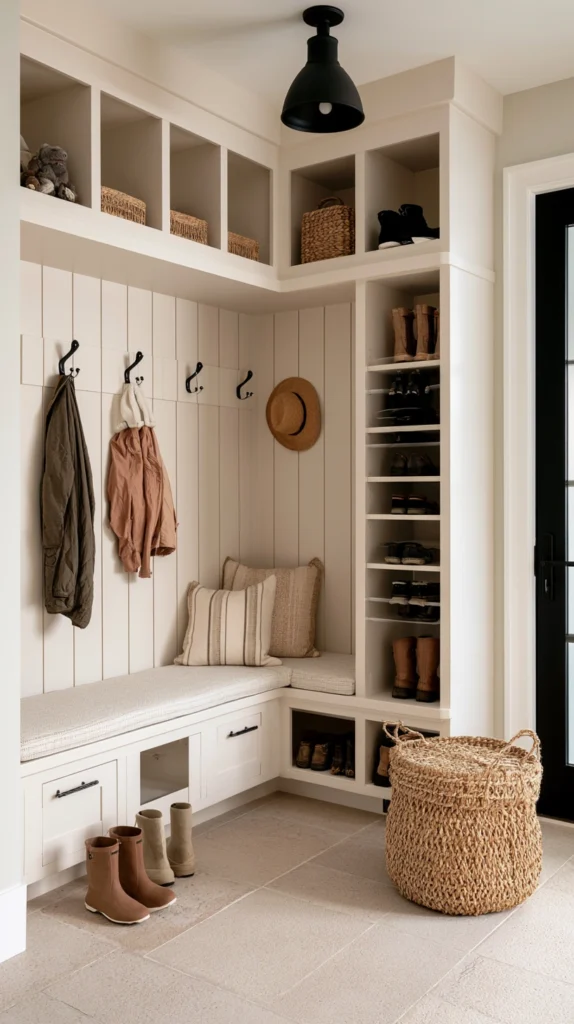
Budget: $500 – $3,000
A dedicated boot room — whether a converted rear porch, a lean-to extension, or a sectioned-off portion of a rear hallway — is the most comprehensively functional entryway storage solution available for a busy family home with access to outdoor space. The boot room separates the outdoor kit — muddy boots, wet coats, dogs, bikes — from the clean interior of the house by creating a dedicated transition space between outside and in. It does not need to be large. It needs to be specifically fitted with the storage infrastructure that allows every item of outdoor kit to have a specific home.
A boot room conversion of an existing rear porch costs $500–$2,000 depending on the extent of the fitting out. A new lean-to boot room addition costs $3,000–$8,000 in construction. The internal fittings — hooks, shoe racks, a bench, a cabinet for smaller items, and a surface for wet items to dry — cost $200–$600 depending on specification. The most important fitting in a boot room is a surface for drying wet coats and muddy boots — a heated drying rail ($50–$150) installed on the wall or a simple open shelf above a boot rack provides the drying function that makes the boot room genuinely effective rather than simply a storage space adjacent to the rear door.
Storage tip: Install a drain in the floor of a boot room if any construction work is being undertaken — a floor drain ($50–$100 installed during construction, $300–$500 retrofitted) makes the boot room genuinely washable. A boot room that can be hosed down at the end of a muddy day is a significantly more functional space than one that must be carefully swept and mopped to avoid spreading mud into the rest of the house. The drain installation cost during construction is negligible relative to its operational value through the lifetime of the boot room.
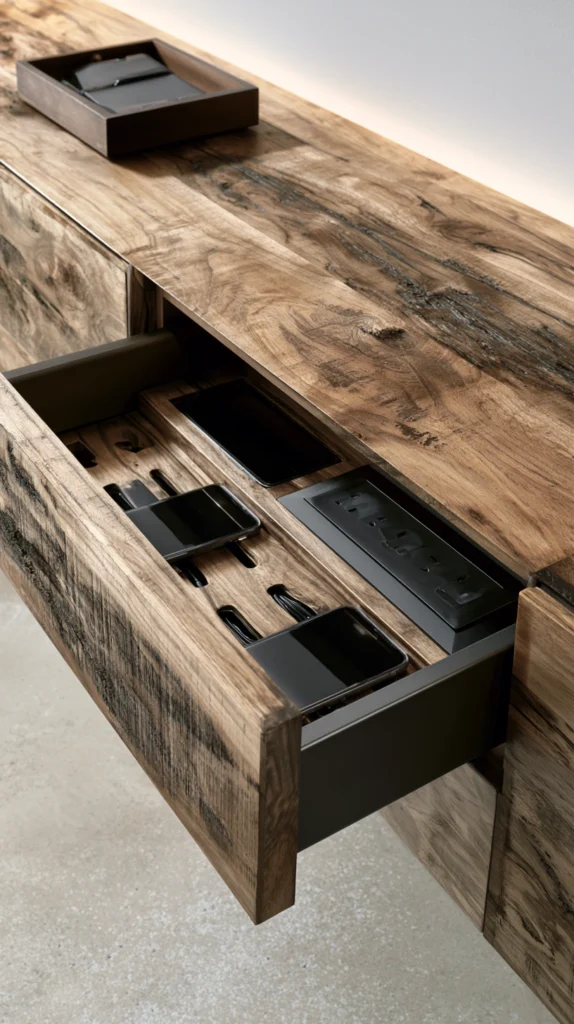
13. A Charging Station Built Into the Entry Console
Budget: $30 – $150
A dedicated phone and device charging station built into or placed on the entry console — with individual charging slots or a multi-port charging hub and enough cable management to keep each cable invisible and in its correct position — creates the entryway habit of charging devices on arrival rather than on the kitchen counter, the bedside table, or whatever surface the phone happens to land on after a long day. The entryway charging station is also the single most effective tool available for establishing a boundary between devices and the rest of the home in the evening hours.
A multi-device charging station with individual slots costs $25–$60. A timber or leather charging organiser with cable management slots costs $30–$80. A custom cabinet drawer with a built-in charging hub costs $80–$150 in materials. Position the charging station at the back of the console table surface so it does not interfere with the daily-use landing zone at the front of the surface — and ensure the cable from the charging hub is routed through the console or behind the console to the nearest socket without crossing the hallway floor at any point where it becomes a trip hazard.
Storage tip: Assign a specific charging slot to each device and household member — the phone always charges in the same position, the tablet always in the same position, and each person’s slot is theirs to use and to maintain. A shared charging station without individual slot assignment becomes a competition for the available charging positions that produces daily friction rather than the household system it was designed to create. Individual assignment eliminates the competition and establishes the habit of using the correct position consistently from the first day the system is introduced.
The entryway that works for a busy home is always the one that gives every arriving object a specific, convenient, and consistently maintained place to go — rather than the one that is tidied periodically when the accumulation becomes uncomfortable and then allowed to accumulate again until the next intervention. The storage system is not the investment. The habit the system creates is the investment, and the habit is only as reliable as the convenience of the specific place provided for each specific object that the household brings through the front door every day.
Start with keys and coats — the two categories that create the most daily friction in the largest number of homes. Install a hook within arm’s reach of the door lock and a coat hook at the right height for every person in the household. Maintain those two habits for two weeks before adding anything else. The entryway that works begins with the two most important habits rather than with the most comprehensive storage system — and the two habits, once established, make every subsequent system addition immediately and consistently more effective.