14 Modern Farmhouse Kitchen Ideas with Warm Character
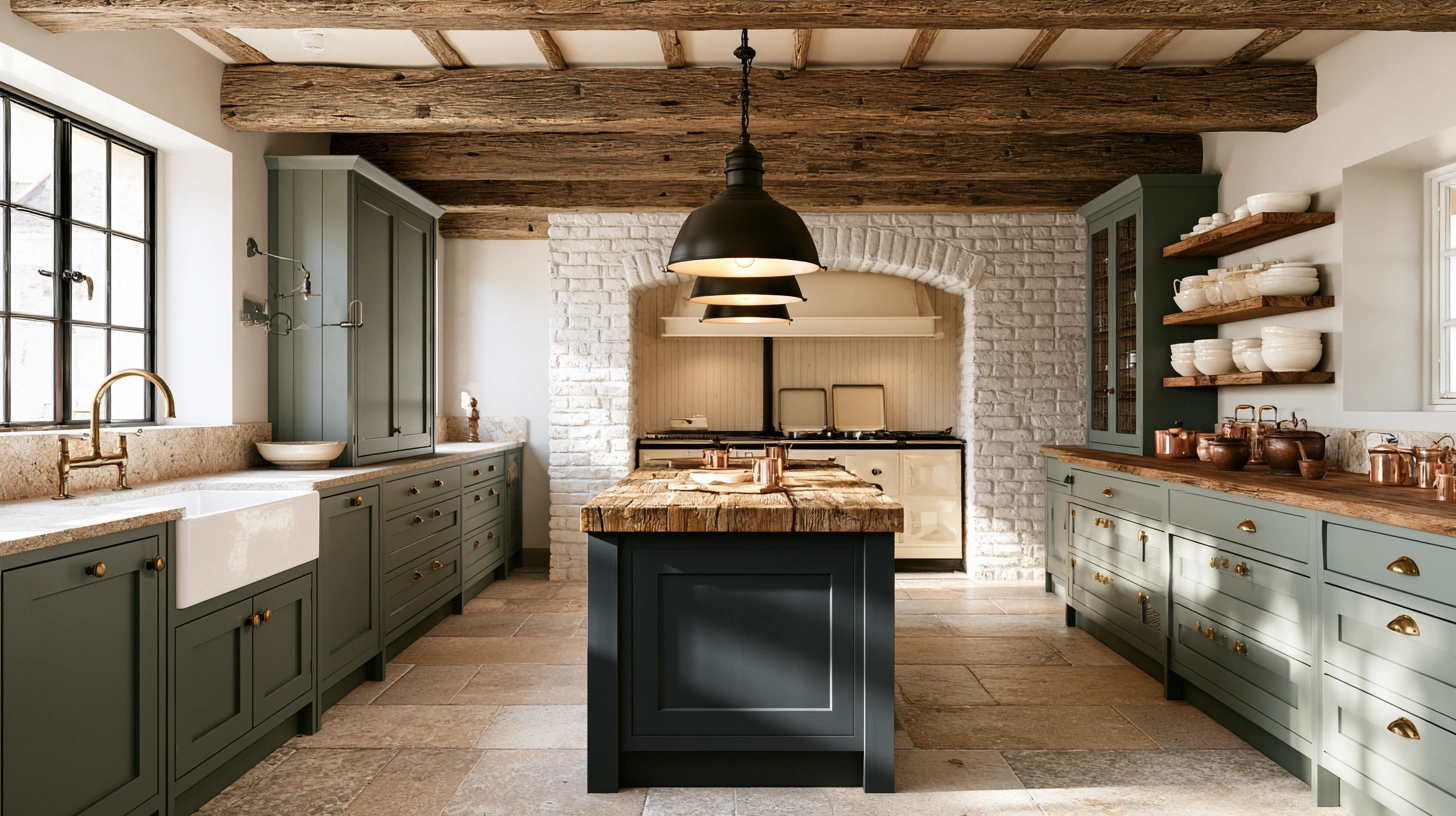
The modern farmhouse kitchen is not a replica of a nineteenth-century working farm — it is a kitchen that draws on that tradition’s most enduring qualities: honest materials, generous proportions, practical surfaces that wear well, and the sense that the room is designed around the people who use it rather than around the impression it makes on guests. It is modern in its function and farmhouse in its spirit — efficient and quietly beautiful rather than showy, and always better the more it is actually cooked in.
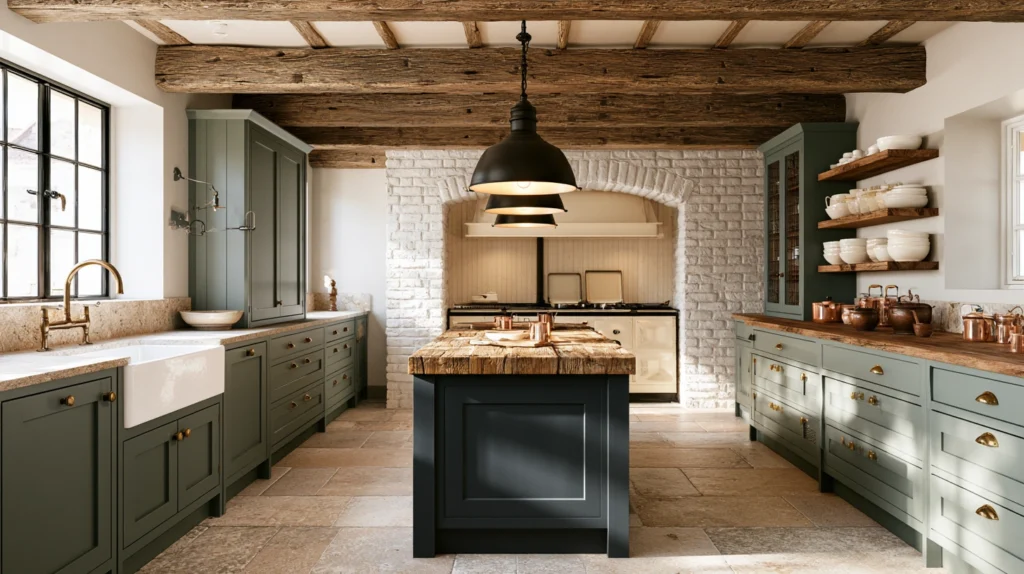
The fourteen ideas below bring every aspect of that aesthetic into a real kitchen — from the cabinetry and worksurfaces to the lighting, the accessories, and the small styling decisions that give a kitchen its character. Each includes what it costs and a practical tip to help you apply it in the kitchen you actually have.
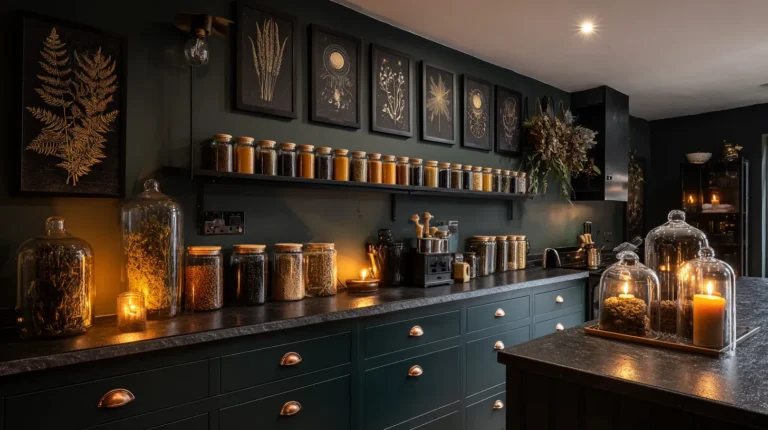
1. Shaker Cabinetry in a Warm Deep Tone
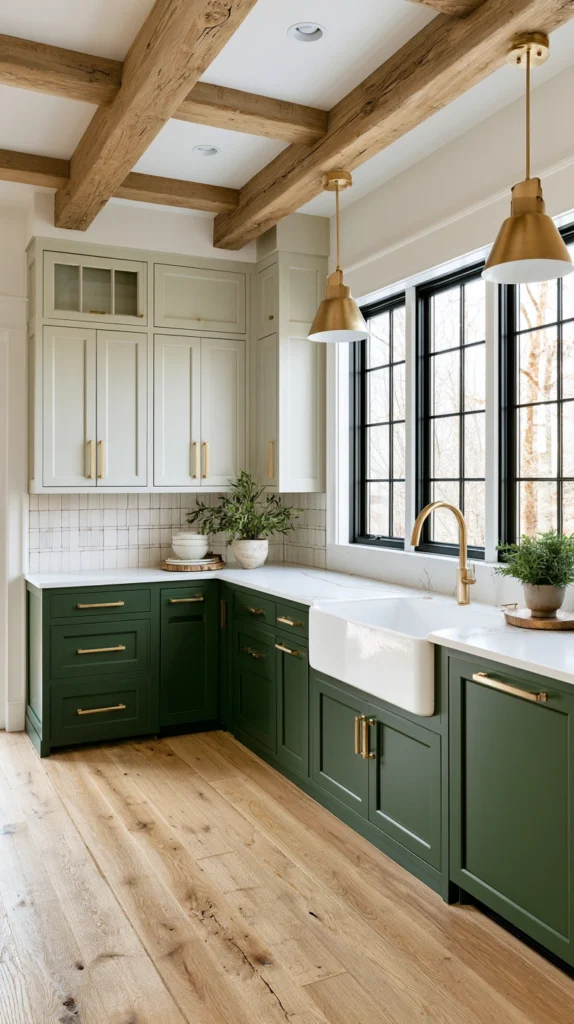
Budget: $3,000 – $15,000 for a full kitchen
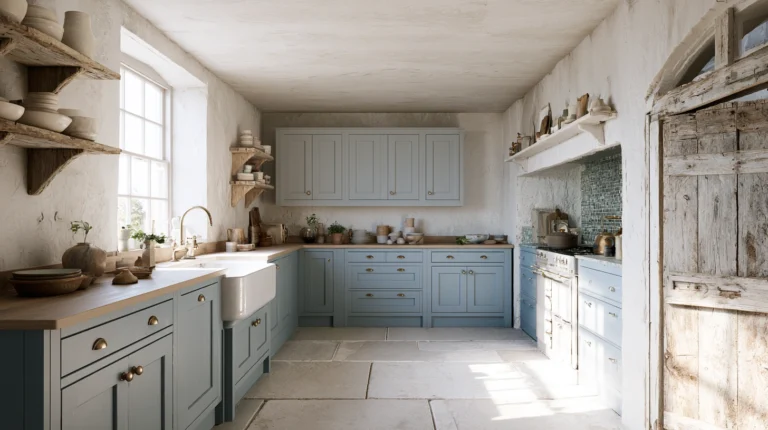
Shaker cabinetry — the recessed-panel door style that has been the most enduringly popular kitchen door profile in British and American domestic architecture for over a century — is the defining cabinet format of the modern farmhouse kitchen. Its combination of flat framing and recessed centre panel is simultaneously traditional enough to reference the farmhouse tradition and clean-lined enough to suit the modern functional kitchen. In a warm deep tone — forest green, navy, warm charcoal, or dusty sage — it creates a kitchen of immediate warmth and considerable character.
Shaker kitchen cabinet units in mid-range retail brands cost $200–$600 per unit. A complete kitchen of twelve to fifteen units costs $3,000–$9,000 in cabinets before worksurface and installation. Custom-made shaker cabinets from a joinery workshop cost $8,000–$20,000. Paint existing flat-front cabinets with a shaker-style applied moulding kit ($8–$15 per door) and chalk paint ($25–$40 per tin) for the most cost-effective shaker conversion available without replacing the cabinet structure.
Kitchen tip: Choose a slightly darker tone for the lower cabinets and a slightly lighter version of the same colour for the upper ones — the two-tone shaker kitchen, with the upper cabinets one shade lighter than the lower, creates the visual effect of a kitchen that is grounded by its lower section while feeling more open and spacious in the upper half. It also references the traditional convention of the dresser-top being painted differently from the dresser-base in historical farmhouse kitchens.
2. A Butler’s Sink
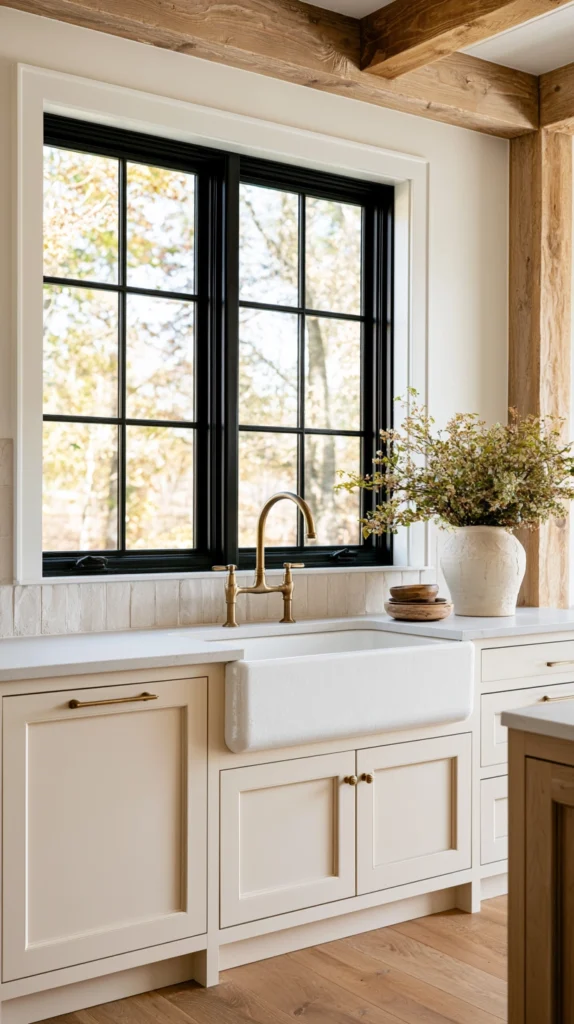
Budget: $200 – $800
A butler’s sink — the deep, rectangular, single-bowl ceramic sink also known as a Belfast or farmhouse sink — is the most immediately recognisable farmhouse kitchen detail and the one that most completely transforms the functional character of any kitchen it is installed in. The generous depth of the bowl, the apron front that extends to the cabinet face below, and the white or cream ceramic finish give the kitchen sink a presence and an honesty that undermounted stainless steel and composite equivalents rarely achieve.
A standard white fireclay butler’s sink in 595 mm width costs $200–$400. A larger 760 mm version runs $300–$600. A genuine Belfast sink in original reclaimed condition costs $150–$400 from architectural salvage dealers. The butler’s sink is deeper than most standard kitchen sinks — ensure the cabinet below is fitted with a plumbing configuration that accommodates the lower waste outlet position that the sink’s depth requires before ordering, as the cabinet modification cost can exceed the sink’s own purchase price if it was not anticipated at the planning stage.
Kitchen tip: Pair the butler’s sink with a traditional pillar tap or a modern bridge tap in brushed brass or antique bronze rather than a contemporary single-lever or pull-down spray tap. The tap format communicates whether the kitchen has fully committed to the farmhouse aesthetic — a sleek chrome spray tap above a white Belfast sink creates a visual conflict between the two aesthetic languages that neither resolves. A traditional pillar tap completes the composition at modest cost ($80–$200 per pair) and zero ambiguity.
3. Open Shelving for Everyday Crockery
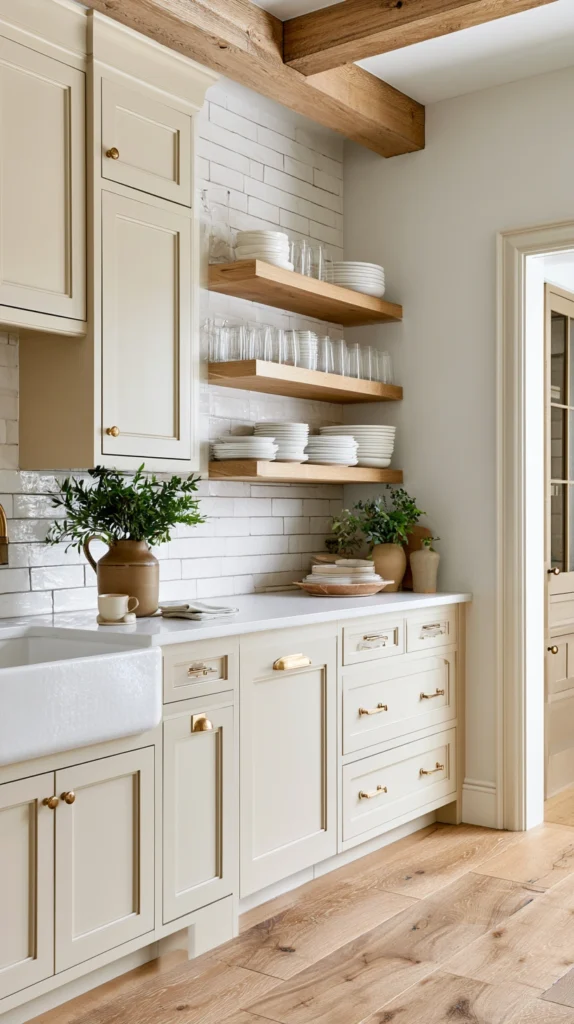
Budget: $60 – $300
Open shelving in place of upper wall cabinets — displaying everyday crockery, glass, and kitchen equipment rather than concealing it behind closed doors — creates the most specifically farmhouse quality in any kitchen by making the tools and the vessels of cooking visible as part of the room’s character rather than hidden behind uniform cabinet fronts. A kitchen where the shelves show good crockery, stacked plates in one colour, and a row of identical jars looks entirely different from one where upper cabinet doors create a uniform, closed surface.
A simple solid timber shelf of 30 cm depth and 120 cm length on two heavy-duty brackets costs $40–$100 installed. Three shelves on one wall cost $120–$300. Use shelves only for objects that are genuinely used daily — crockery, glasses, and cooking equipment that earns its display position by being needed regularly. Objects on open shelves that are not used regularly accumulate dust and create the impression of a cluttered rather than curated kitchen display regardless of how attractive they were when first placed on the shelf.
Kitchen tip: Display crockery and glasses in a consistent colour palette on open shelving rather than in a mixed assortment of different patterns and tones. A shelf of white plates beside white bowls beside white mugs beside cream-coloured storage jars reads as a designed collection. The same shelf space occupied by ten plates in five different patterns, four mismatched mugs, and a variety of storage jars in three materials reads as kitchen equipment stored where there was space for it — which is the quality that open shelving is specifically designed to improve upon.
4. Reclaimed Timber Worksurfaces
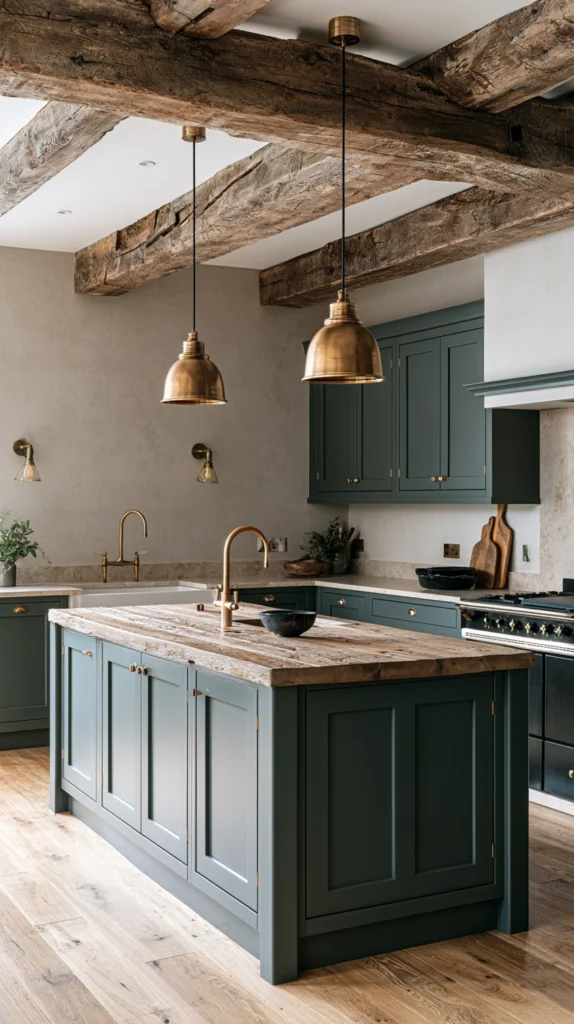
Budget: $80 – $400 per metre
A reclaimed timber worksurface — in oak, elm, or pine — is the most warmly characterful and most genuinely farmhouse kitchen worksurface available. The colour variation, the occasional knot, the slight variation in surface level between adjacent boards, and the patina that develops with use and oiling all communicate a material honesty that laminate and composite alternatives cannot replicate regardless of their colour or texture. A timber worksurface aged by use is one of the most beautiful kitchen surfaces available.
Reclaimed oak worksurface in 40 mm thickness costs $120–$300 per linear metre from specialist timber suppliers. New solid oak worksurface costs $80–$200 per linear metre. Reclaimed elm costs $150–$400 per metre but has a grain character that oak cannot match for visual interest. Oil with a food-safe timber oil (Osmo, Rubio Monocoat) every three to six months to maintain the surface and prevent the drying and cracking that untreated timber worksurfaces develop in the dry heat of a working kitchen.
Kitchen tip: Use timber only where it works — on island surfaces, prep areas, and breakfast bar sections rather than immediately adjacent to the sink where consistent water exposure will deteriorate even a well-oiled surface significantly faster than a properly maintained stone or ceramic alternative. The most successful modern farmhouse kitchens combine timber worksurfaces with a stone or ceramic section around the sink — the material combination reads as considered and practical rather than as a single material applied uniformly regardless of the conditions each surface section is exposed to.
5. A Range Cooker as the Kitchen’s Centrepiece
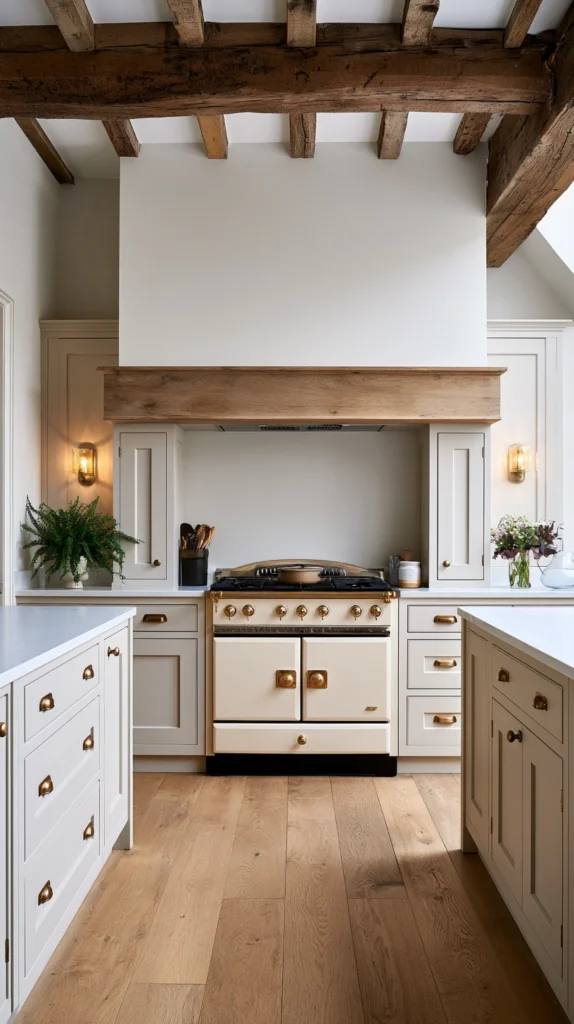
Budget: $800 – $5,000
A range cooker — wider than a standard built-under oven, with multiple burners and a central position on the main kitchen wall — is the farmhouse kitchen’s most significant functional statement. It communicates that the kitchen is a serious cooking space and gives the room a focal point of considerable visual weight that the distributed arrangement of standard appliances rarely creates. Even without an AGA or a Rayburn, a well-chosen range cooker in cream, black, or deep blue gives the modern farmhouse kitchen the centrepiece it needs.
A 90 cm range cooker from mid-range brands (Leisure, Rangemaster) costs $800–$2,000. A 100 cm version from premium brands (Falcon, Lacanche) runs $2,000–$5,000. An AGA two-oven oil or gas-fired cooker costs $5,000–$12,000 new. Position the range cooker in the most prominent position on the main kitchen wall — flanked by cabinets or open shelving on each side that reference the traditional kitchen dresser arrangement — and install a quality extraction hood above it that is proportionate to the cooker’s width and visual weight.
Kitchen tip: Choose a range cooker colour that coordinates with the cabinet colour rather than contrasting with it. A cream range beside sage green cabinets reads as a considered palette. A bright red range beside cream cabinets reads as a decorative statement made at the expense of the room’s overall tonal consistency. The range cooker colour is the most prominent appliance decision in the modern farmhouse kitchen and its relationship to the cabinet colour determines whether the kitchen feels resolved or still in negotiation with itself.
6. Exposed Ceiling Beams
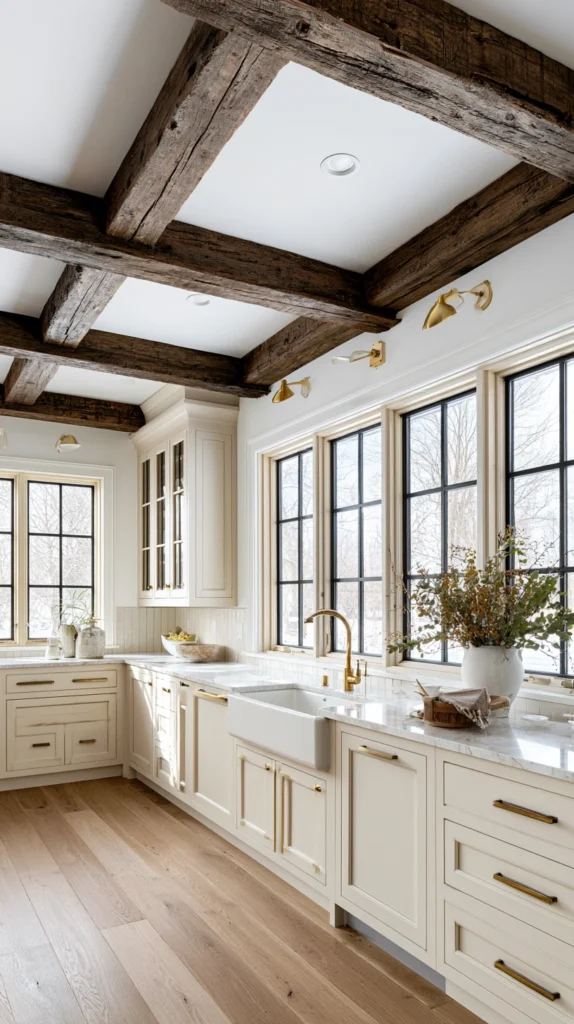
Budget: $200 – $800 for added beams
Exposed ceiling beams — whether original structural timber in an older property or added decorative beams in a newer build — create the most overtly farmhouse quality in the kitchen’s architectural character. The contrast between the pale plastered ceiling and the dark, aged timber of a beam overhead is the specific visual signature of the historical farm kitchen and it is impossible to replicate through any other single architectural detail at comparable cost and with comparable impact on the room’s overall character.
Original exposed beams require only stripping of any applied finish and an application of dark oak or antique pine stain ($15–$30 per tin) to reveal their full quality. Added decorative beams in solid or hollow timber cost $50–$150 per beam supplied and fitted. A kitchen ceiling of three to five exposed beams costs $150–$750 in added beam materials and transforms the room’s architectural character from a standard open-plan kitchen into one with genuine period reference and the specific warmth that timber overhead always adds to a kitchen interior.
Kitchen tip: Hang dried herbs, a copper pan, or a garland of garlic from the exposed kitchen ceiling beams rather than leaving them as purely architectural features. Objects hung from kitchen beams have been a feature of the working farm kitchen for centuries — they communicate active use, seasonal rhythm, and a direct relationship between the kitchen and the food it produces that a purely decorative beam arrangement does not. The hanging should look genuinely used rather than styled, which means the herbs should be real and the pan should be used rather than decorative.
7. Stone or Concrete Floor Tiles
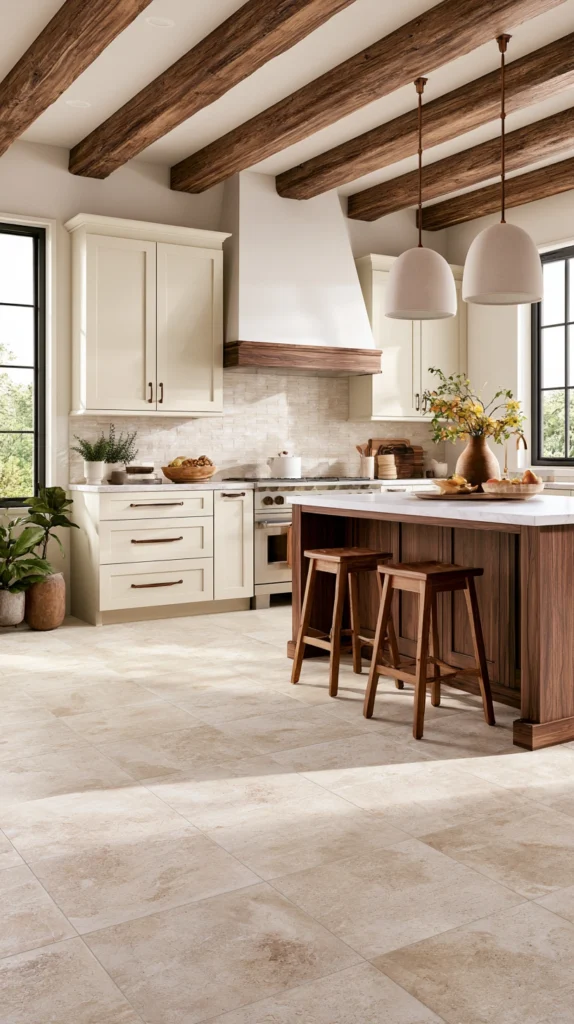
Budget: $30 – $100 per square metre installed
A stone or stone-effect floor — in limestone, slate, encaustic tile, or a quality porcelain with a natural stone finish — is the most appropriate and most enduringly beautiful kitchen floor available for a modern farmhouse aesthetic. The cool, hard surface suits a working kitchen both practically (easy to clean, durable, resistant to water and food spills) and aesthetically (the stone floor has been the functional floor of every farmhouse kitchen in every climate for generations, and it reads as exactly right in a way that timber or vinyl alternatives do not).
Limestone floor tiles cost $40–$80 per square metre. Quality porcelain stone-effect tiles run $25–$60 per square metre. Encaustic cement tiles in a simple geometric or floral pattern cost $60–$120 per square metre. All require a quality primer and adhesive plus professional or very competent DIY laying — a floor tile job that is level, correctly grouted, and properly sealed is the difference between a floor that looks expensive and one that looks like it was laid with insufficient care for the material’s specific requirements.
Kitchen tip: Choose a floor tile with slight tonal variation rather than a completely uniform surface — a tile in which individual pieces vary slightly in shade or surface texture is more forgiving of everyday marks and wear and reads as a more genuine natural material than a perfectly uniform porcelain tile of the same colour at the same price. The slight variation is the quality that gives a stone floor its character and prevents the uniform tile from reading as a printed surface rather than a genuine material.
8. A Kitchen Island in a Contrasting Tone
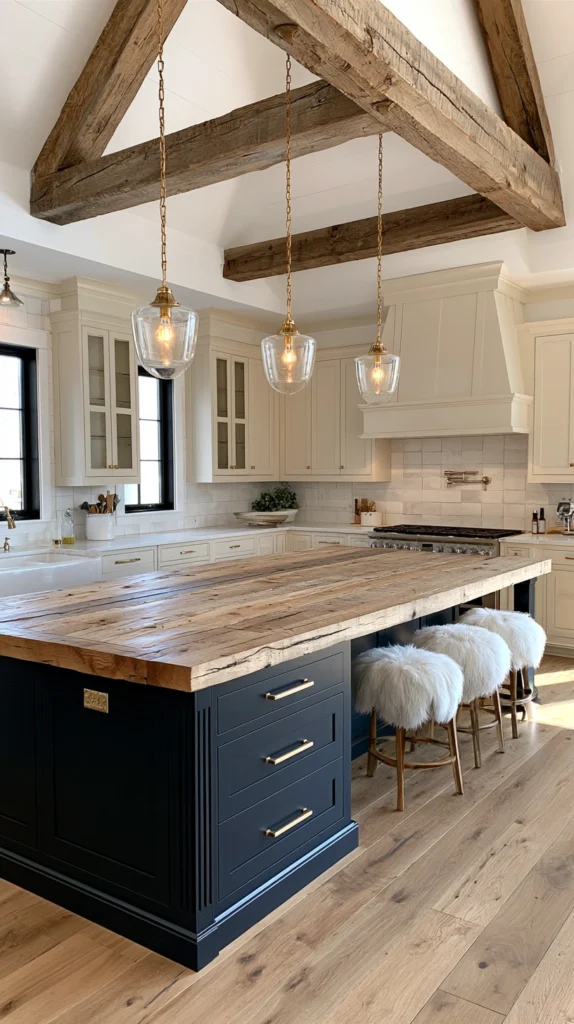
Budget: $300 – $3,000
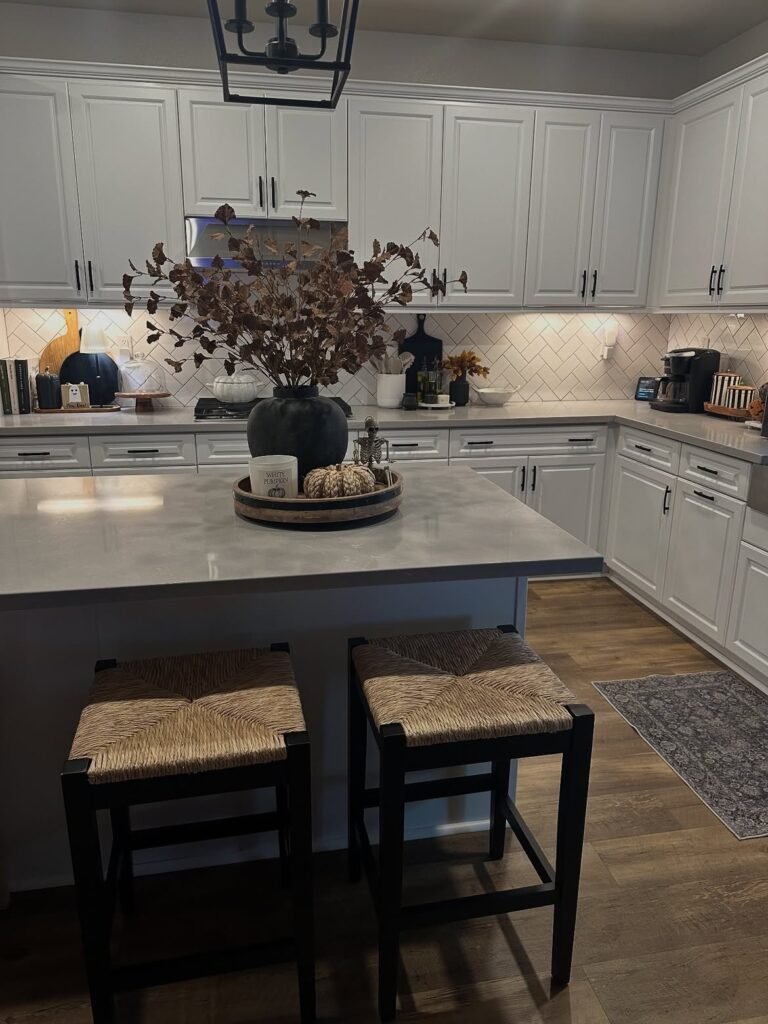
A kitchen island in a different colour from the main perimeter cabinets — the most commonly photographed modern farmhouse kitchen detail in current interior design publishing — creates an immediate sense of layered visual interest and a practical working surface at the centre of the kitchen. The contrasting island communicates that the kitchen was designed with consideration rather than uniformly finished in a single cabinet colour throughout, which is the quality that distinguishes a designed kitchen from one that was simply fitted.
An existing kitchen island painted in a contrasting tone costs $30–$80 in chalk paint and sealer. A freestanding kitchen island in a contrasting painted finish costs $300–$800. A custom-built island with a stone worksurface and painted lower cabinets costs $1,500–$4,000. A warm dark green island beside cream perimeter cabinets, or a midnight blue island beside warm white cabinets, are the two most consistently successful contrasting island colour relationships in the modern farmhouse kitchen — both provide the depth of contrast that makes the island read as a deliberate decision rather than a colour mistake.
Kitchen tip: Choose an island worksurface material that differs from the perimeter worksurface — a timber island top beside a stone perimeter, or a marble-effect ceramic island beside a timber perimeter — reinforces the island’s identity as a distinct element of the kitchen rather than an extension of the perimeter layout. Two different worksurface materials in the same kitchen read as considered when one is the island and the other is the perimeter. The same two materials on the same continuous worksurface read as inconsistent.
9. Vintage-Style Hardware and Fittings
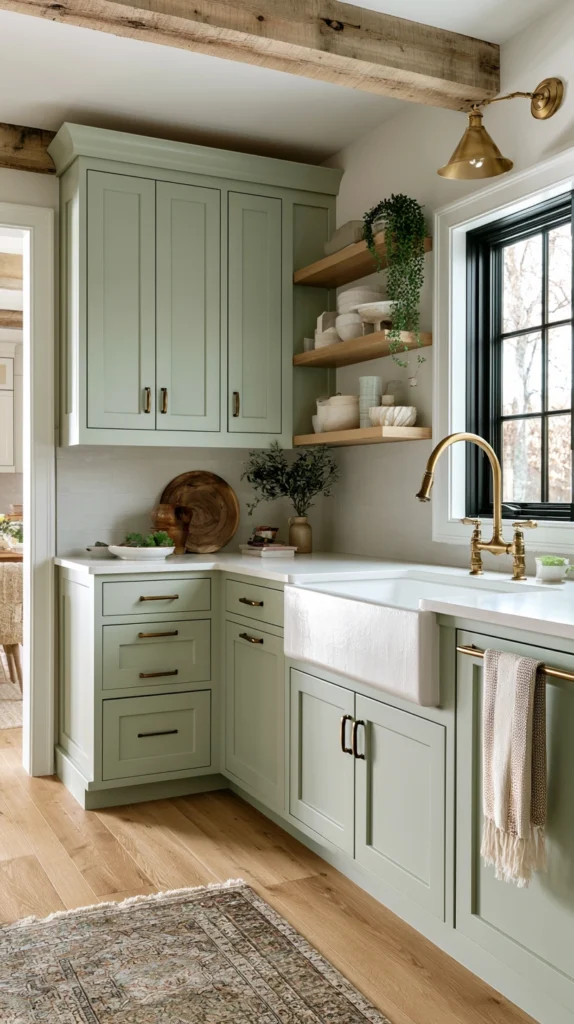
Budget: $50 – $300
The hardware — cabinet handles, drawer pulls, hinges, and tap fittings — is the detail that most immediately communicates whether the modern farmhouse kitchen has been finished or merely installed. Brushed brass, antique bronze, cast iron bar handles, and cup pulls all suit the farmhouse aesthetic with the same authenticity that standard chrome bar handles specifically contradict. New hardware on existing cabinets is one of the most cost-effective kitchen upgrades available — new handles cost $5–$20 each and take thirty minutes to replace across a full kitchen.
Cast iron bar pulls in a 96 mm hole centre cost $6–$12 each. Brass cup pulls run $8–$18 each. Bronze T-bar handles cost $8–$15 each. A full kitchen of fifteen cabinet doors and ten drawers requires twenty-five handles at $150–$450 in hardware — a modest investment that transforms the finished quality of even a standard shaker kitchen into one that reads as specifically chosen and specifically farmhouse in its material language. Replace all hardware in a single session rather than gradually to ensure consistency of finish and hole spacing across the complete installation.
Kitchen tip: Match the hardware finish to the tap finish — both in the same brushed brass, both in the same antique bronze, or both in the same matte black — rather than mixing metal finishes between the two elements that are most visible in the kitchen’s finished state. The tap and the cabinet handles are seen simultaneously from any kitchen viewpoint and their finish relationship is immediately perceptible — a consistent finish creates a resolved kitchen and a mismatched one creates a kitchen that appears to have been fitted in two separate decisions made without reference to each other.
10. A Kitchen Dresser or Display Hutch
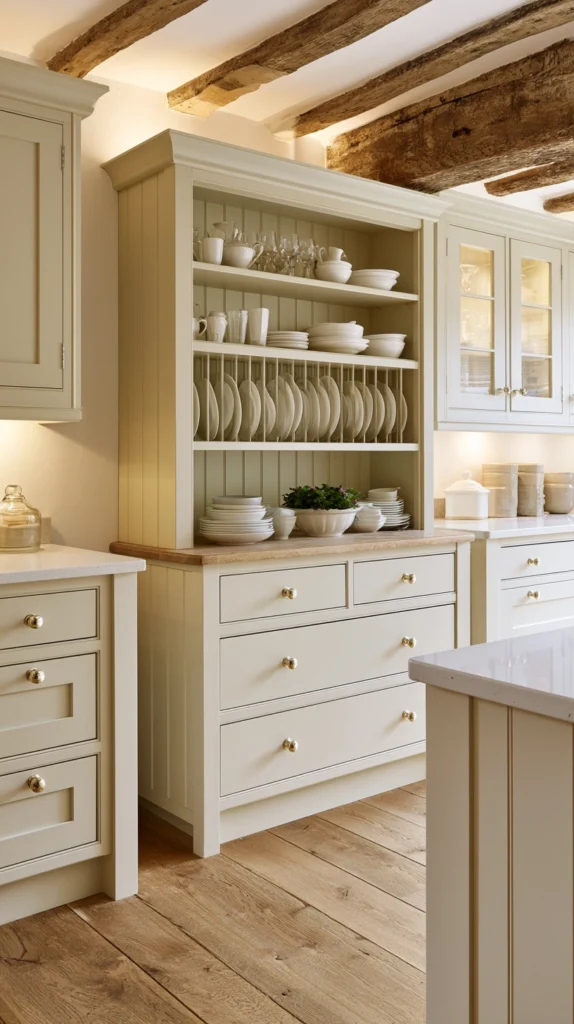
Budget: $200 – $1,200
A kitchen dresser — a freestanding furniture piece with open shelves on its upper section and closed cabinets or drawers on its lower section — is the piece of furniture most specific to the farmhouse kitchen tradition and the one that most completely changes a standard kitchen into a farmhouse kitchen through its physical presence. A genuine antique dresser in a farmhouse kitchen communicates history, use, and the specific aesthetic of a room that has developed over time rather than been installed in a single session.
A painted antique pine kitchen dresser costs $200–$600 from antique markets and estate sales depending on size and condition. A reproduction in painted MDF runs $300–$800. A custom-built dresser-style unit in solid timber costs $800–$1,500 from a local joiner. Position the dresser on the most visible wall — opposite the main entry point or at the far end of the kitchen from the door — where it acts as the kitchen’s primary focal point and visual destination rather than simply as one element among many in a fitted kitchen arrangement.
Kitchen tip: Style the dresser shelves with a mix of functional and purely decorative objects — pitchers, cake stands, stacked plates, and baskets alongside the occasional ceramic, a small plant, and a vase of dried flowers. The farmhouse dresser is not a display cabinet — it is a working surface whose items are also beautiful. Styling it exclusively with beautiful objects that are never used creates the impression of a furniture piece that has been arranged rather than a kitchen dresser that is lived with and used daily.
11. Exposed Brick or Stone Accents
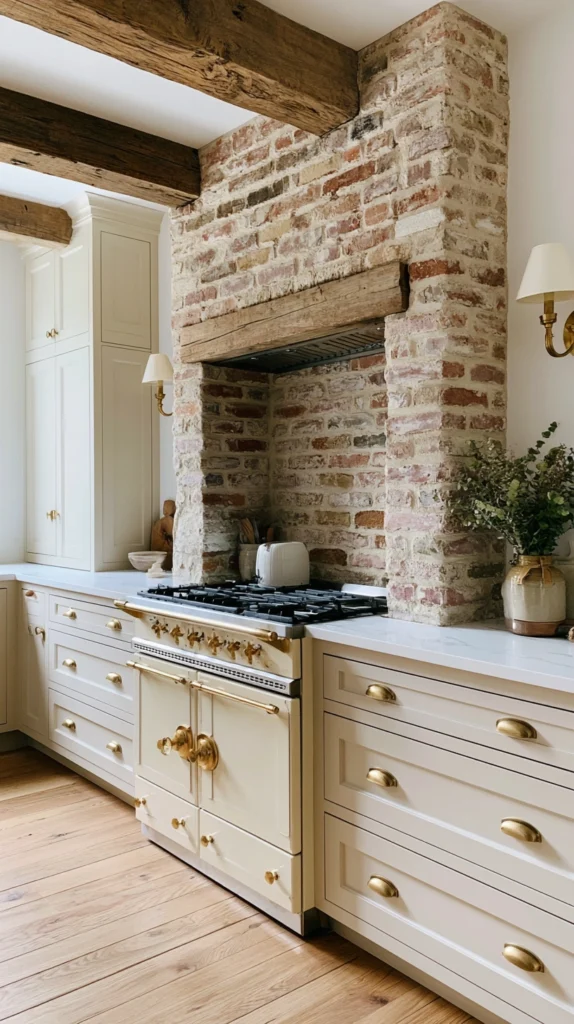
Budget: $50 – $400
An exposed brick or stone section within the kitchen — a chimney breast, a recess around the range cooker, a section of original stonework revealed beneath plaster — introduces the most specifically farmhouse material available in any domestic interior and one that cannot be replicated by any manufactured product with the same quality of authentic age and texture. Uncovering original brick or stone is always preferable to applying a faux brick effect if the original material is present beneath the plaster.
Exposing an original brick chimney breast costs $50–$200 in plaster removal and pointing materials. Applying a thin brick slip tile to a feature wall section costs $30–$80 per square metre in tiles and adhesive. A reclaimed brick fireplace or range alcove surround costs $150–$400 from architectural salvage dealers. Seal exposed brick with a diluted PVA solution ($10–$15 per litre) to prevent dust release while maintaining the natural, slightly rough surface quality that makes the brick visually authentic rather than coated.
Kitchen tip: Expose or install brick specifically around the range cooker — the cooker alcove is the natural home of exposed brick in any kitchen reference to the historical farmhouse tradition where the cooking range sat in the kitchen fireplace. Brick in this specific position reads as architecturally motivated and historically informed. The same brick on an arbitrary wall section reads as a decorative tile effect chosen without a specific rationale, regardless of the quality of the material used.
12. Wicker and Rattan Storage Baskets
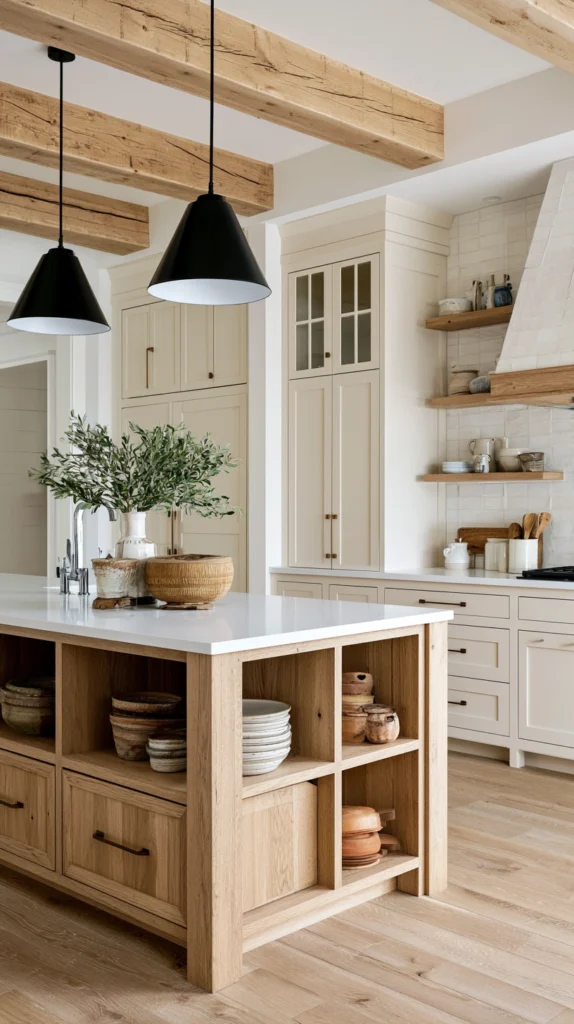
Budget: $30 – $120
Wicker and rattan baskets used as open storage — on open shelves, on the bottom shelf of the kitchen island, in the pantry, and on the kitchen dresser — bring the natural material warmth of the farmhouse tradition into a functional storage context without any construction or installation. A kitchen where storage baskets are genuinely used — for bread, for root vegetables, for tea towels, and for the small domestic items that accumulate on kitchen surfaces — has a warmth and a lived-in quality that no fitted cabinet can produce at the same cost.
A quality wicker basket of 30×20×15 cm costs $8–$20. A set of five matching baskets in graduating sizes costs $30–$80. Use baskets specifically for dry goods and items that benefit from air circulation — bread, fruit, and root vegetables stored in wicker remain fresh longer than the same items in a sealed cabinet or a plastic container. Label each basket with a simple handwritten linen tag or a small blackboard disc to make the contents immediately identifiable from the main kitchen viewpoint without opening or moving the basket to check its contents.
Kitchen tip: Choose baskets with natural unbleached wicker rather than painted or dyed equivalents — the natural warm honey tone of undyed wicker suits the farmhouse kitchen palette more completely than any colour treatment of the same material. An undyed wicker basket beside cream cabinets and timber worksurface reads as a natural material in a natural material context. The same basket bleached white or painted in a fashion colour reads as a decorative accessory that has been chosen for its appearance rather than its material quality.
13. Pendant Lighting Over the Island
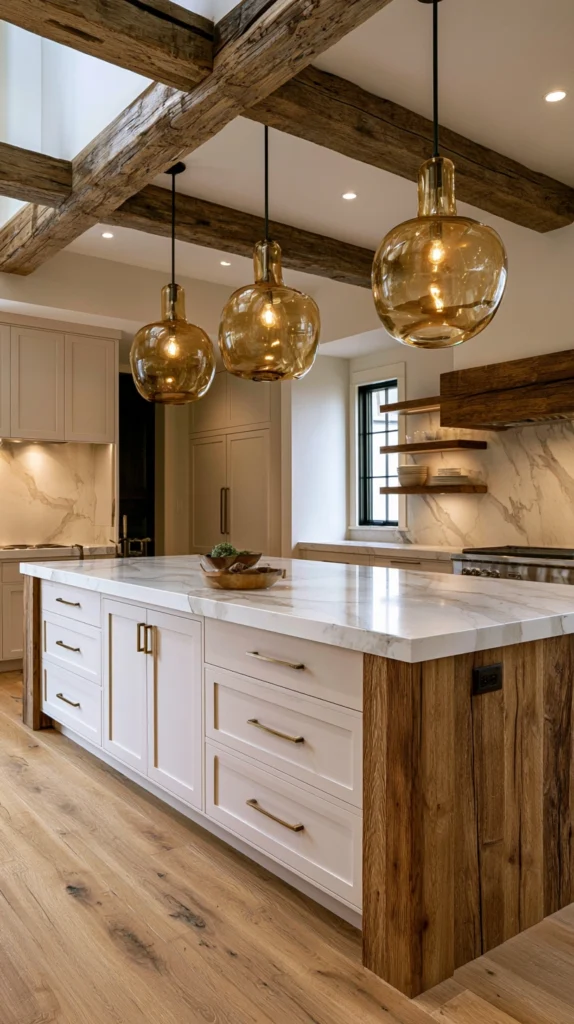
Budget: $80 – $400 per pendant
Pendant lights hanging directly above the kitchen island — two or three at the same height, in a material and form that suits the modern farmhouse aesthetic — create the most visually defining lighting element in the kitchen and the one that most immediately communicates the room’s design intention. The pendant is visible from every position in an open-plan kitchen and dining area and its form, material, and the warmth of the light it produces sets the atmospheric tone of the entire kitchen space.
Woven rattan or abaca pendant lights cost $80–$200 each. Enamel factory-style pendants in cream or black run $60–$150 each. Handblown amber glass pendants cost $150–$400 each. Use two pendants over a standard 120 cm island and three over a larger 180 cm island — spacing them evenly along the island’s length with the outer pendants positioned 20–30 cm from each end. Hang at 70–80 cm above the island worksurface — low enough to create a specific lighting zone above the preparation surface and high enough to allow comfortable sightlines across the island from a standing position on either side.
Kitchen tip: Choose pendant lights that produce warm light (2700K or below) with a shade that directs the light downward onto the island worksurface rather than upward or in all directions. The island pendant that directs warm light downward creates the pool of focused light above the preparation surface that makes the kitchen look genuinely atmospheric in the evening while also fulfilling the functional requirement of adequate task lighting at the island’s working surface level.
14. A Display of Copper and Cast Iron Cookware
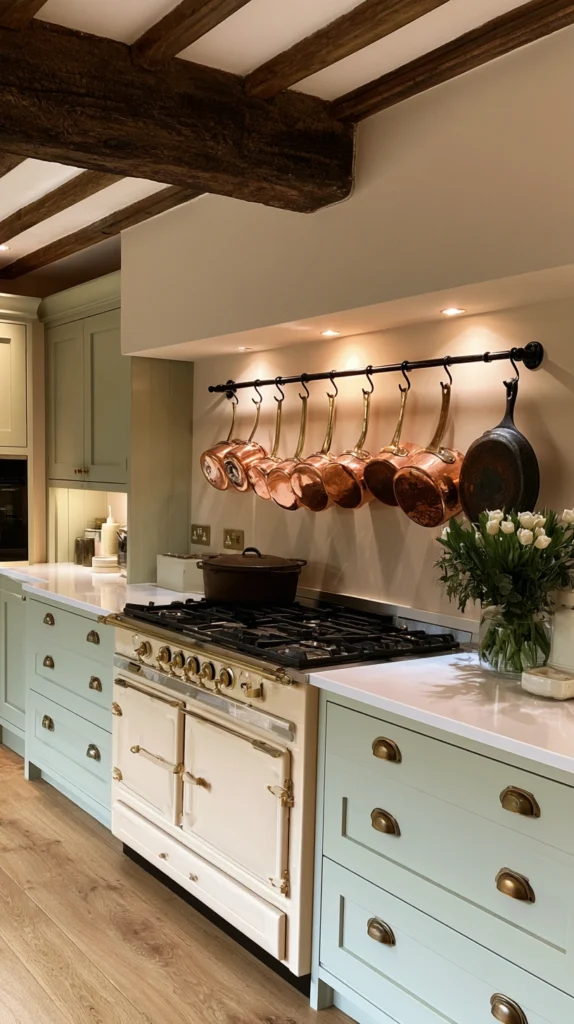
Budget: $50 – $500
The most farmhouse detail in any modern kitchen is the presence of cookware that is beautiful enough to display and used regularly enough to justify the display position — a copper saucepan hanging from a pot rail, a cast iron casserole on the open shelf, a seasoned carbon steel pan on a counter hook. These objects communicate that the kitchen is a working space of genuine purpose and that the cooking that happens within it takes quality equipment seriously. They also add the warm, reflective surface of copper and the dark, seasoned weight of cast iron to a kitchen surface palette that is considerably enriched by both materials.
A copper saucepan costs $50–$200 depending on size and brand. A cast iron casserole in a farmhouse colour — cream, deep red, or marine blue — costs $80–$300. A hanging pot rail for overhead display costs $40–$100. Display only cookware that is genuinely used — a copper pan that is never taken from its hook develops a static, decorative quality that a used and regularly re-polished pan never has. The occasional polish ($10–$15 per tin of copper cleaner) and the regular evidence of use in the pan’s surface are the details that make the displayed cookware communicate genuine kitchen character rather than styled kitchen photography.
Kitchen tip: Group displayed cookware by material rather than by size — all copper together on one rail, all cast iron on one section of open shelf, all carbon steel pans on one hook position. The grouped material display reads as a collection assembled with intention. Mixed materials distributed randomly across the kitchen’s display surfaces reads as equipment stored wherever there was a convenient position — which is the quality the display is specifically designed to avoid communicating in a kitchen that takes its character seriously.
The modern farmhouse kitchen achieves its warm character through the accumulation of honest decisions — materials that wear well and develop character with use, functional objects that are beautiful enough to be visible, and the quality of a room that is designed around the daily pleasure of cooking rather than around the occasional impression it makes on visitors. It is never finished in any absolute sense, because the character of a farmhouse kitchen grows with the cooking that happens in it and the objects that accumulate around that cooking over time.
Begin with the two decisions that most immediately change the room’s character — the cabinet colour and the hardware. Those two choices together, more than any other pair of decisions available in a kitchen renovation or refresh, determine whether the room reads as a modern farmhouse kitchen or as a kitchen that is decorated with farmhouse details. Everything else follows from getting those two choices right.