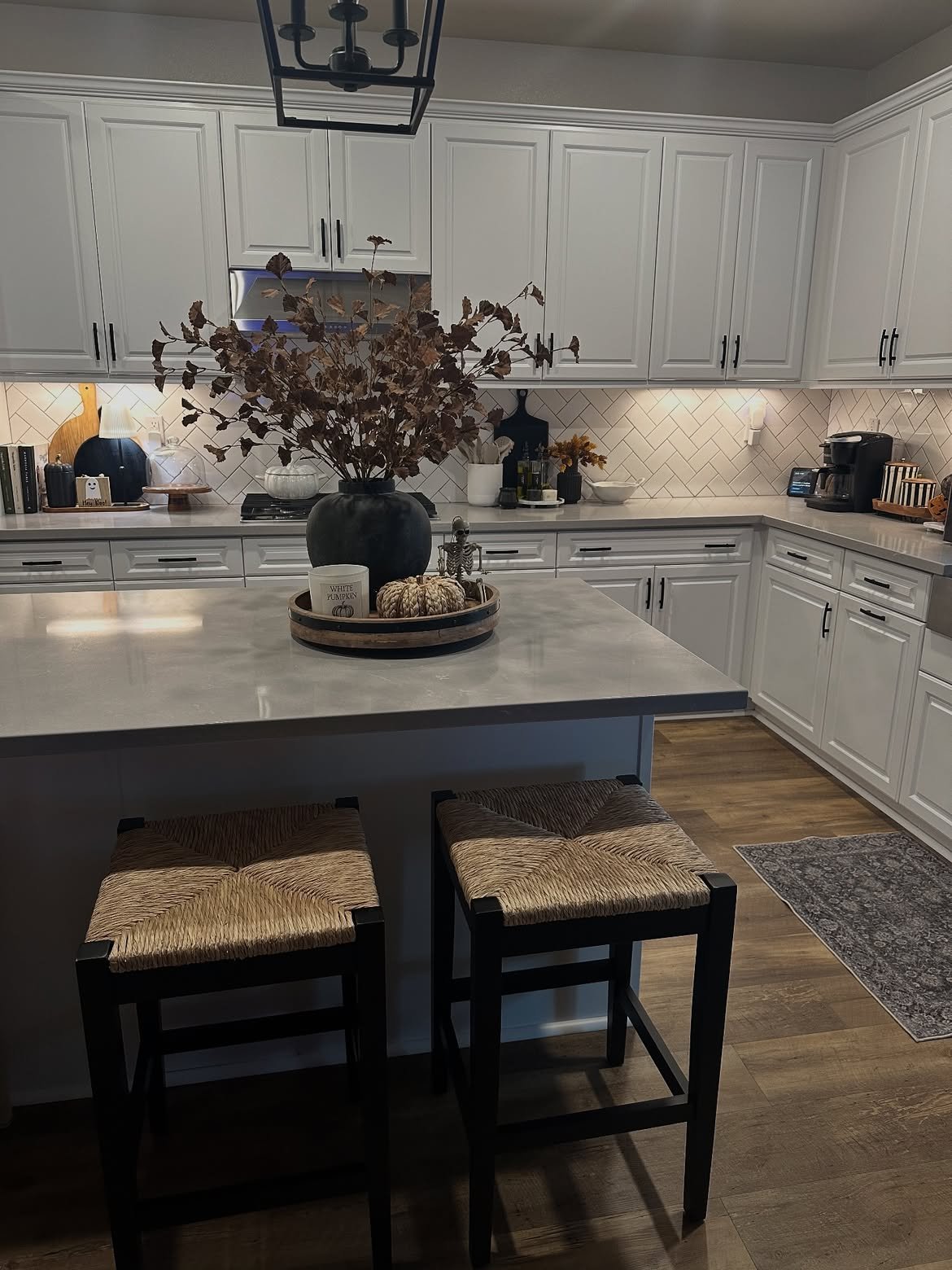
13 Fall Kitchen Decor Ideas to Make Your Home Smell Like Autumn
Most fall decorating focuses entirely on what can be seen: pumpkins, wreaths, deep-toned throw pillows, a wreath on the door. The visual language of autumn is well established, and most homes execute some version of it without much prompting.
What those same homes often miss is that autumn has a scent language just as strong and just as specific as its visual one. The smell of cinnamon and clove warming on a stove, of a dried herb bundle hung near a window, of apple and vanilla from a pot of mulled cider, are recognized and responded to as autumn immediately and before a single decoration has been noticed. Scent registers faster than sight. It’s the first impression a kitchen makes on anyone who walks through the door, and it persists through rooms that haven’t been decorated at all.
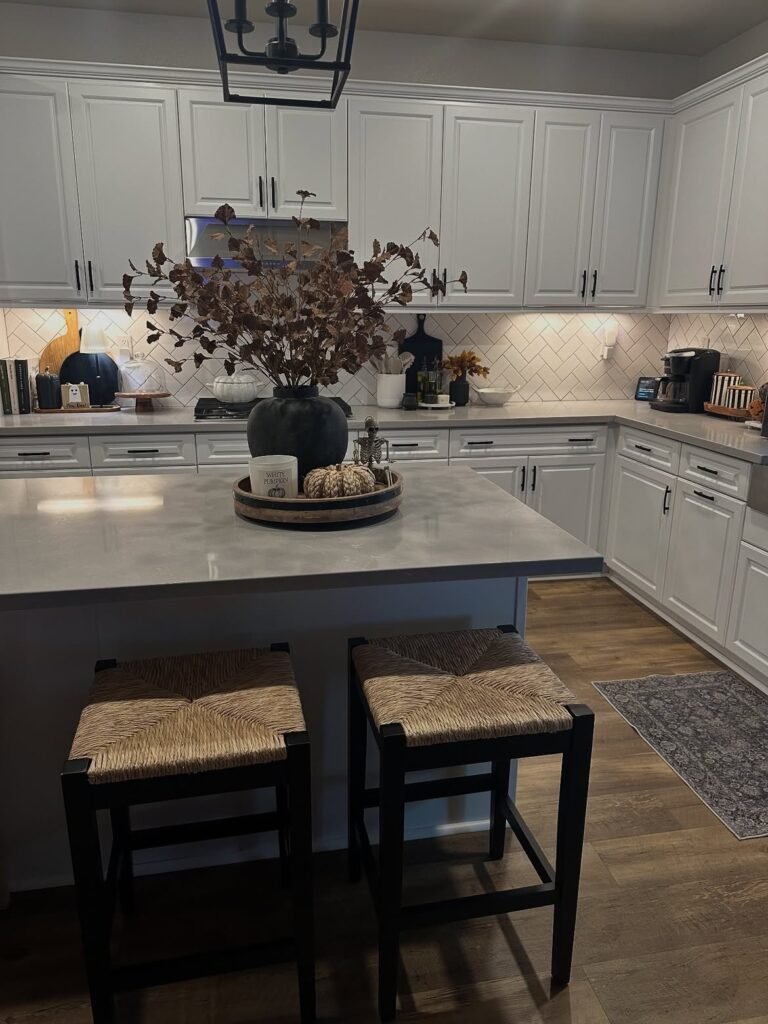
@blessed_and_farmhouse_obsessed/
The best fall kitchen scent doesn’t come from a spray bottle or a plug-in. It comes from objects and ingredients that actually belong in a kitchen — spices, dried botanicals, simmering pots, candles that smell like the season rather than a vague approximation of it — styled and positioned with the same care as any other fall decoration, but doing twice the work because they engage a sense most fall decor never reaches.
Here are 13 kitchen decor ideas specifically built to make a home smell like autumn, while also looking the part.
Why Scent-Forward Decorating Plays by Different Rules Than Purely Visual Decor
The rules are not the same for scent-based decorating as for purely visual styling:
Visual Decor Advantages:
- Lasts indefinitely without needing to be refreshed, replaced, or reactivated
- Can be photographed, shared, and appreciated from a distance
- Requires no ongoing attention once placed — a pumpkin on a step continues doing its job without being touched again
The visual decor comparison: static, lasting, works at distance
Scent-Forward Decor Advantages and Realities:
- Registers within seconds of entering a room, before any visual detail has been consciously noticed
- Affects mood and memory more directly than visual cues, engaging a sense most home decor never considers
- Requires some ongoing attention — a simmering pot needs tending, a candle needs relighting — but rewards that attention with a presence no visual object can create
The key insight:
- Visual fall decor says “autumn” to the eye
- Scent-forward fall decor says “autumn” to something older and more instinctive than sight
- These work together rather than competing — the best fall kitchen engages both simultaneously
The Scent and Sustainability Reality
The most important principle in scent-forward kitchen decorating:
The source-over-synthetic preference:
- Natural scent sources — simmering spices, dried botanicals, beeswax candles — produce a warmer, more complex fragrance than most synthetic alternatives
- A pot of warming apple cider with cloves smells like a kitchen in use, which is different from and better than a cider-scented candle
- Know this distinction — the ideas nearest the top of this list rely on real materials and real processes rather than scent-delivery products, and the difference registers
The “kitchen-appropriate” calculation:
- A kitchen’s scent environment is already affected by cooking, which means any added scent layer needs to coexist with food smells rather than overwhelm them
- Strong synthetic fragrances can make a kitchen smell less like cooking and more like a department store, which is exactly the wrong direction
- Choose scent sources that belong in a kitchen — spices, citrus, herbs, beeswax — rather than ones borrowed from a living room fragrance category
Most kitchen scent decor works best when layered, not concentrated in one spot:
- A single powerful source — a simmering pot — sets the room’s general tone
- Secondary sources — a dried herb bundle, a bowl of spiced fruit — add complexity without competing
- The smallest touches — a cinnamon stick in a candle holder, a few cloves in a seasonal arrangement — fill in the gaps and reward a closer approach
1. The Stovetop Simmer Pot (The Most Powerful Fall Scent Available in a Kitchen)
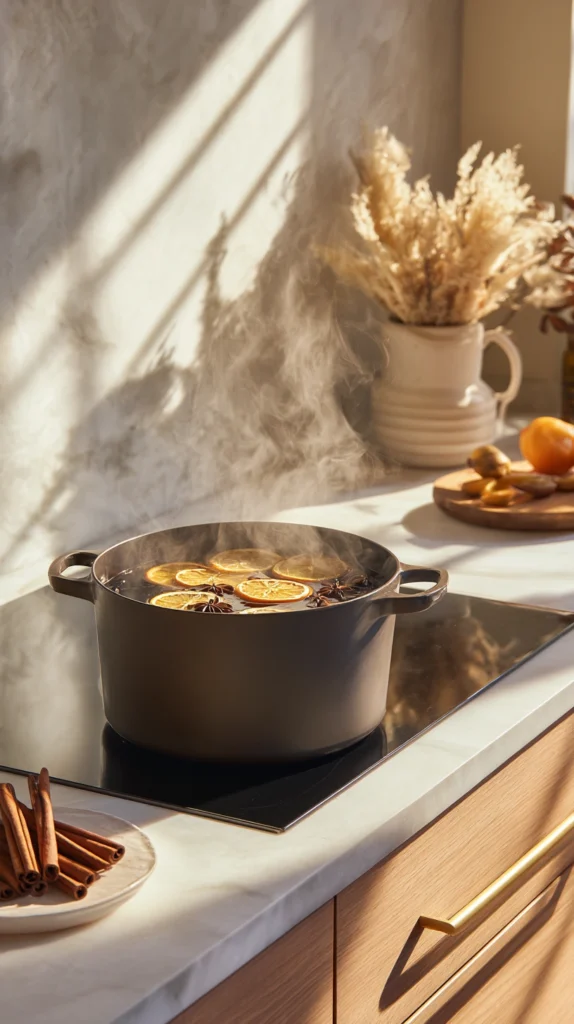
A small pot of water, spices, citrus, and herbs left simmering on a low burner — the simplest and most effective way to fill an entire home with the smell of autumn within twenty minutes of starting it.
Why a simmer pot outperforms every other scent source on this list
- The whole-house reach it achieves: unlike a candle or a bowl of dried botanicals that scents the immediate area, a simmering pot on a stove releases fragrance continuously into the air, carrying throughout the home through natural air circulation
- The active-kitchen association it creates: a home that smells like something is cooking signals warmth and welcome in a way that a purchased scent product, however good, never quite replicates — because a simmer pot actually is cooking, in a sense, even if nothing edible is being prepared
- The almost infinite customization it allows: the combination of ingredients in a simmer pot is a real creative decision with real consequences, and the variations across cinnamon-and-apple, rosemary-and-citrus, and clove-and-vanilla are meaningfully distinct in ways that most candle alternatives can’t match
The options
- Apple, cinnamon stick, whole cloves, and a star anise, the most classically autumnal combination
- Orange and lemon peel, rosemary sprigs, and vanilla extract, for a lighter, more citrus-forward alternative
- Cranberry, cinnamon, and a few strips of orange peel, leaning toward the Thanksgiving end of the fall palette
- Pine needles, cedar chips, and a cinnamon stick, for a more woodland, less culinary interpretation of the season’s scent
The practical execution
- Simmer on the lowest possible setting and check water levels every thirty to forty-five minutes, since a pot that runs dry is both a fire risk and an unpleasant burning smell that undoes everything the simmer was accomplishing
- Refresh the water and add a little more of the dominant spice each time it’s refilled, since the fresh addition releases a burst of new fragrance alongside the existing base note
- Store spent simmer pot materials in the refrigerator between uses for up to two or three days, refreshing rather than replacing, before starting a new combination
Cost breakdown
- A full week of simmer pot ingredients: $5–15
- Total: $5–15 — the most cost-effective scent source on the entire list
The simmer pot started an hour before guests arrive: the only decor decision that changes how the whole house feels before anyone sees a single decoration.
2. The Dried Herb and Botanical Bundle Display (Scent and Texture Together)
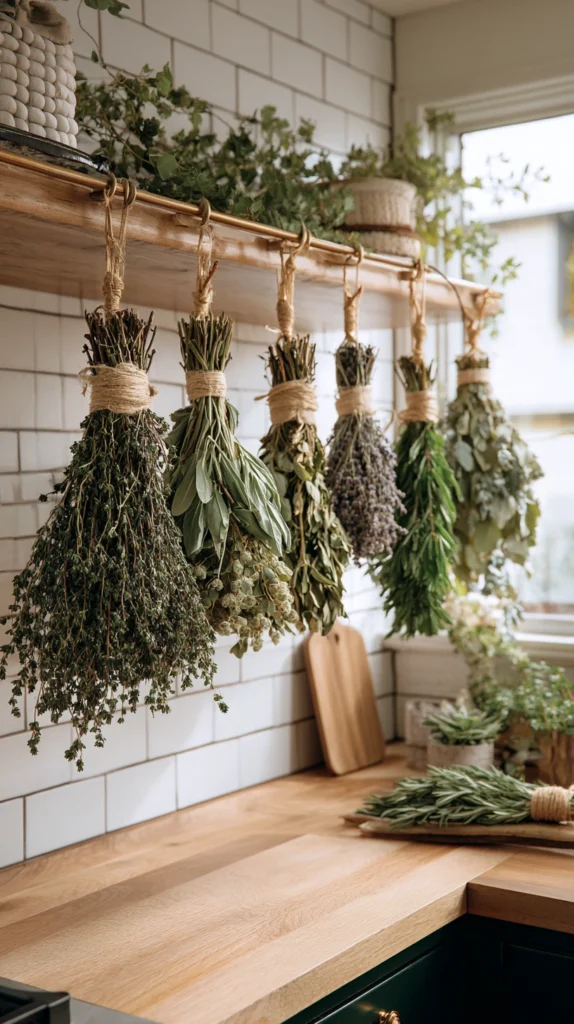
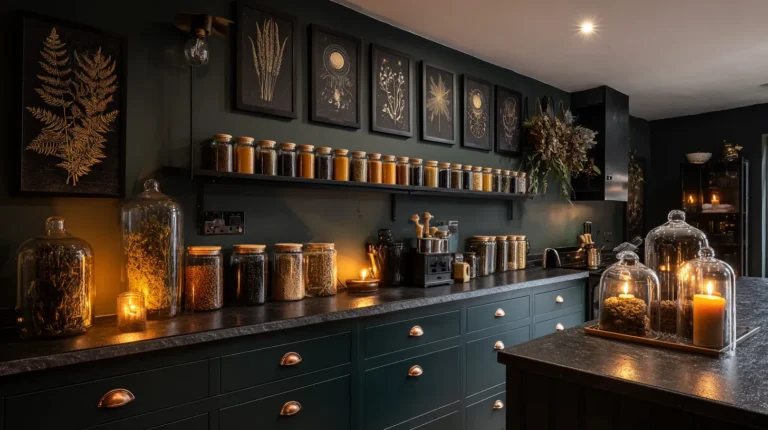
Bundles of dried herbs — rosemary, lavender, sage, bay laurel — tied with twine and hung from a kitchen beam, a hook, or a wall-mounted drying rack, releasing a quiet, constant fragrance while also becoming part of the room’s visual styling.
Why dried herb bundles do two things most single-function decor pieces don’t
- The ambient, low-level fragrance that persists without maintenance: unlike a simmer pot that needs tending or a candle that needs relighting, dried herb bundles release a subtle, persistent fragrance that continues on its own without any intervention
- The connection between kitchen function and seasonal display: dried herbs are genuinely used in fall cooking — roasting, braising, stewing — and displayed bundles are a natural extension of an actual kitchen practice rather than a purely decorative affectation
- The visual texture that dried botanicals bring alongside their scent: a bundle of dried rosemary or sage adds the same rough, organic texture that a farmer’s market vegetable display adds to a kitchen, with the added dimension of fragrance working at close approach
The options
- Rosemary bundles, the most robustly scented option among culinary herbs and long-lasting once dried
- Sage and lavender together, for a more complex, slightly floral-herbal combination
- Bay laurel with a few stems of dried eucalyptus, for a more forest-adjacent scent alongside the herb
- Dried chamomile or calendula, adding a lighter, more floral note to a primarily herb-based display
The practical execution
- Hang stem-up for the most effective drying and the most traditional display presentation
- Position away from direct heat sources like the stovetop, which can scorch dried botanicals or cause them to dry out unevenly
- Replace bundles when the fragrance fades — typically after two to three months of display — refreshing from the garden or a farmers market as the season progresses
Cost breakdown
- Dried herb bundles, a set of 3–4: $10–25
- Twine and hooks, if not already in place: $5–12
- Total: $15–37
3. The Spice Jar and Seasonal Bowl Display (The Kitchen Counter Made Into a Scent Object)
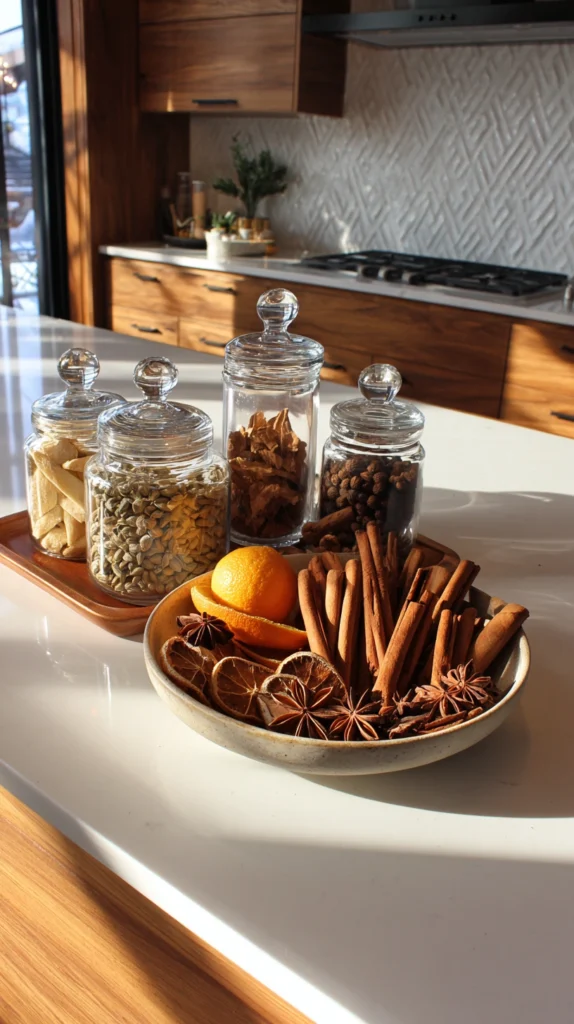
A shallow bowl or tray filled with whole spices — cinnamon sticks, star anise, whole cloves, cardamom pods — placed on the kitchen counter as a decorative object that passively scents its immediate area.
Why a bowl of spices earns its place among the more active scent sources
- The passive, continuous fragrance a bowl of whole spices releases: unlike a candle that needs to be lit or a simmer pot that needs tending, a bowl of whole spices releases a low, constant fragrance simply by existing on the counter, with no maintenance required beyond occasional stirring
- The visual and textural interest of whole spices displayed together: the dark, irregular shapes of star anise beside the pale, fragrant coils of cinnamon, beside the tiny spheres of whole cloves, create a genuinely interesting visual display entirely from kitchen ingredients
- The practical dual-use the ingredients retain: the spices in the bowl are the same ones used for cooking, and a handful can be lifted directly from the bowl into a simmer pot or a recipe rather than being stored purely decoratively
The options
- Cinnamon sticks and whole cloves in a wide, shallow bowl, the most directly autumnal combination
- Star anise, cardamom pods, and dried orange slices, for a more complex arrangement that reads as both spice display and fall still life
- A small wooden bowl of whole nutmeg with a grater resting inside, a more singular, specific display that signals fall cooking directly
- A mix of whole spices layered in a glass cylinder or apothecary jar, for a more contained, vertical display alternative
The practical execution
- Stir the bowl occasionally to release fresh fragrance from the spices’ cut surfaces, since the outermost layer is what evaporates first while the interior retains fragrance longer
- Add a few drops of essential oil to the base of the bowl beneath the spices if the natural fragrance seems too subtle after a few weeks, reinforcing rather than replacing the whole-spice scent
- Replace entirely rather than topping off periodically, since exhausted spices at the bottom of an older arrangement smell stale in a way that undermines the newer material added on top
Cost breakdown
- Whole spices in bulk: $8–18
- A wide shallow bowl, if not already on hand: $10–25
- Total: $8–43
4. The Beeswax Candle Arrangement (The Best Candle Scent for a Kitchen Specifically)
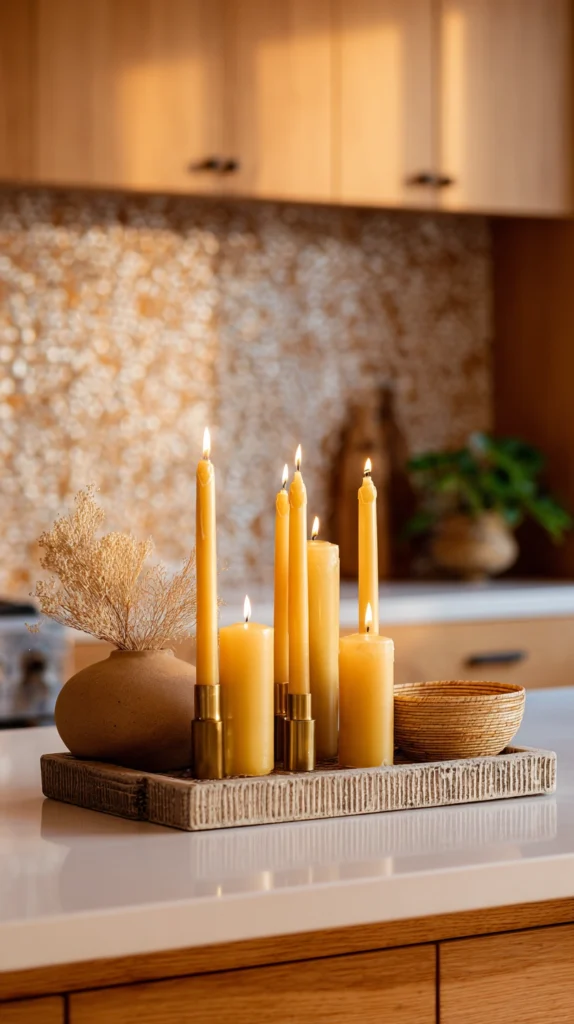
Beeswax candles — pillars, tapers, or votives — placed on the kitchen counter, a windowsill, or an open shelf, chosen specifically for beeswax’s natural, honey-warm fragrance over the stronger synthetic scents of most decorative candles.
Why beeswax is specifically the right candle material for a kitchen
- The complementary relationship beeswax fragrance has with cooking smells: where strongly scented wax candles can clash with food aromas in a kitchen — creating a confusing overlay of vanilla-citrus-candle on top of whatever is being cooked — beeswax’s subtle honey-warmth complements rather than competes with most food smells
- The absence of synthetic additives that cause headaches and olfactory fatigue in some households: beeswax burns cleanly with no added fragrance chemicals, which matters in a room spent time in for cooking and eating
- The warm, amber visual character beeswax candles carry beyond their scent: beeswax’s natural tan-to-golden color coordinates naturally with the warm tones of a fall kitchen palette in a way white paraffin candles don’t
The options
- Beeswax pillar candles, the most substantial and longest-burning option
- Beeswax taper candles in simple holders, for a more elegant, table-adjacent display
- Small beeswax votives, scattered along an open shelf or windowsill for a lower-commitment version of the same effect
- Rolled beeswax sheet candles, which can be hand-rolled into tapers and are a simple kitchen activity alongside the display they create
The practical execution
- Keep candles away from overhead cabinets and any flammable material, particularly important in a kitchen where paper towels, dish towels, and loose packaging are more common than in other rooms
- Trim wicks to a quarter inch before each lighting for a cleaner burn and to prevent excessive soot, which would deposit on kitchen surfaces nearby
- Store unused beeswax candles wrapped in cloth rather than plastic, since beeswax is prone to bloom when wrapped against plastic over time
Cost breakdown
- Beeswax pillar candles, a pair: $20–40
- Beeswax tapers, a set of 4: $15–30
- Total: $15–40
5. The Apple and Citrus Fruit Display (Seasonal Produce as Both Scent Object and Kitchen Decor)
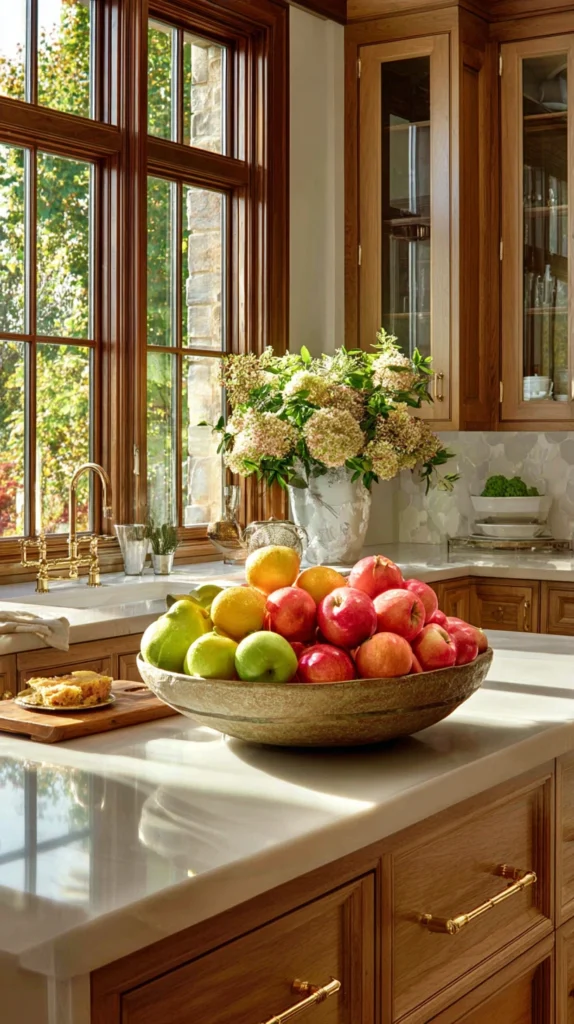
A bowl or tiered stand of fresh apples, quinces, and citrus — oranges, lemons, clementines — displayed on the kitchen counter, releasing the bright, sweet, slightly tart fragrance that is as specifically autumnal as cinnamon.
Why fresh fruit on a counter does scent work most people don’t expect
- The natural fragrance of fruit skin at room temperature: apples and citrus both release a distinct, pleasant fragrance at room temperature that refrigerated fruit doesn’t, making a bowl on the counter a meaningful contribution to the kitchen’s scent environment rather than simply a decorative bowl of produce
- The quintessentially kitchen-appropriate quality of a fruit display: unlike any other scent source on this list, a bowl of fruit belongs in a kitchen by default and requires no explanation or justification as a decorating choice — it simply looks like a kitchen that cooks
- The visual abundance it contributes to the counter: a heaped bowl of mixed fall fruit — red apples beside golden quinces beside dark plums — creates the same harvest-table abundance that formal fall decor tries to suggest through manufactured means, using actual food
The options
- A heaped bowl of mixed apples in red and green, the most straightforwardly autumnal single-variety approach
- A mix of apples and quinces, for more color and fragrance variety than apples alone
- A citrus and clove combination, with oranges studded with whole cloves as pomander balls, combining the citrus scent with the clove contribution from Idea #3
- A tiered fruit stand, displaying apples at the top and a heavier citrus selection below, for vertical interest beyond a single flat bowl
The practical execution
- Keep fruit at room temperature specifically to maximize fragrance release, rotating pieces as needed to prevent any single piece from overripening at the bottom of the bowl
- Refresh regularly, treating the bowl as both decor and usable produce rather than a static display that stays in place indefinitely
- Supplement with a few additional whole spices — a cinnamon stick laid across the fruit, a couple of star anise nestled among the apples — for additional scent layering within the same display
Cost breakdown
- Mixed seasonal fruit, a full bowl: $8–20
- Tiered fruit stand, if adding: $20–45
- Total: $8–65
6. The Potpourri Refresh (Traditional Scent Brought Into the Contemporary Kitchen)
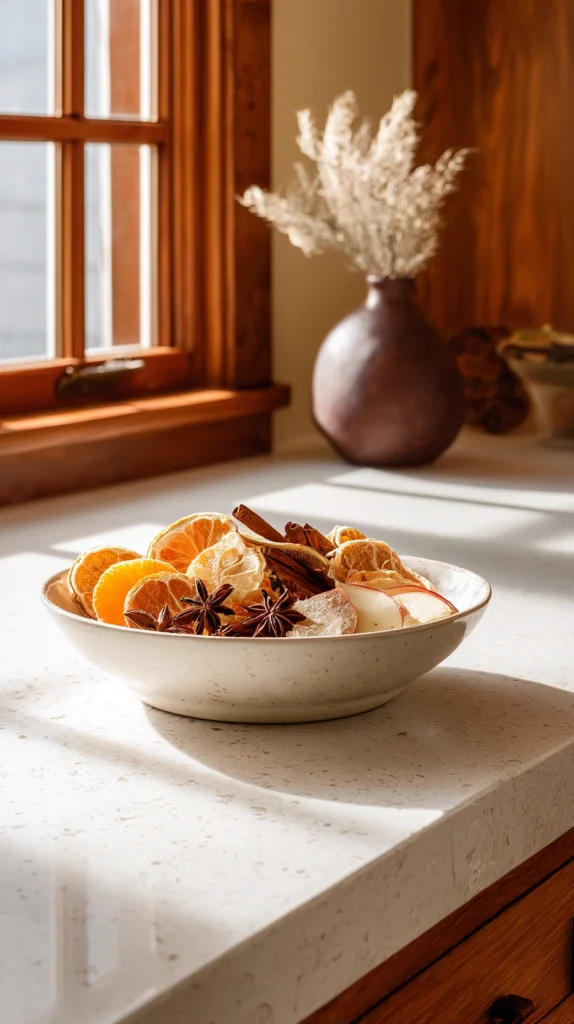
A bowl of homemade or carefully sourced dry potpourri — made from dried orange peel, whole cloves, cinnamon chips, rose hips, and dried leaves rather than the synthetic-scented commercial version — placed on a kitchen shelf or counter.
Why real potpourri differs from the synthetic variety most people remember
- The material authenticity of botanically driven dry potpourri: a mixture of dried orange peel, cloves, cinnamon chips, and dried herbs is a collection of genuinely fragrant natural materials, not a carrier medium sprayed with synthetic fragrance oils, and its scent reflects that distinction with considerably more complexity and warmth
- The visual richness of real botanical materials mixed together: the deep red of dried rose hips, the dark irregular shapes of whole cloves, the papery gold of dried citrus peel, and the warm brown of cinnamon chips create a visually interesting display that rivals any dedicated decorative object
- The flexibility to refresh and customize it seasonally: unlike a store-bought potpourri in a sealed bag, a self-assembled mixture can be adjusted by adding new ingredients, changing the dominant note, or refreshing the fragrance at any point through the season
The options
- Dried orange peel, cinnamon chips, whole cloves, and star anise, the most classically autumnal starting point
- Rose hips, bay leaves, and a few drops of cedarwood essential oil, for a more woodland, less culinary scent direction
- Dried apple slices with cinnamon and nutmeg, leaning toward a baked-goods-adjacent fragrance
- A holiday-leaning blend of clove, orange, and pine, for a blend that bridges fall and the approaching holiday season
The practical execution
- Display in a wide, open bowl rather than a closed vessel, since fragrance releases most effectively from a large open surface rather than a contained space
- Refresh the fragrance every few weeks with a few drops of a complementary essential oil added to the mixture and stirred, since the natural fragrance of dried botanicals fades before the visual display needs refreshing
- Store any reserve mixture in a sealed glass jar, where the concentrated fragrance within the jar actually improves over time as the botanicals continue to release oils into the enclosed space
Cost breakdown
- Bulk dried botanicals and spices for a full bowl: $10–20
- Essential oils for occasional refresh: $8–15
- Total: $18–35
7. The Spiced Warm Drink Ritual (A Recurring Activity That Makes Scent Part of the Daily Routine)
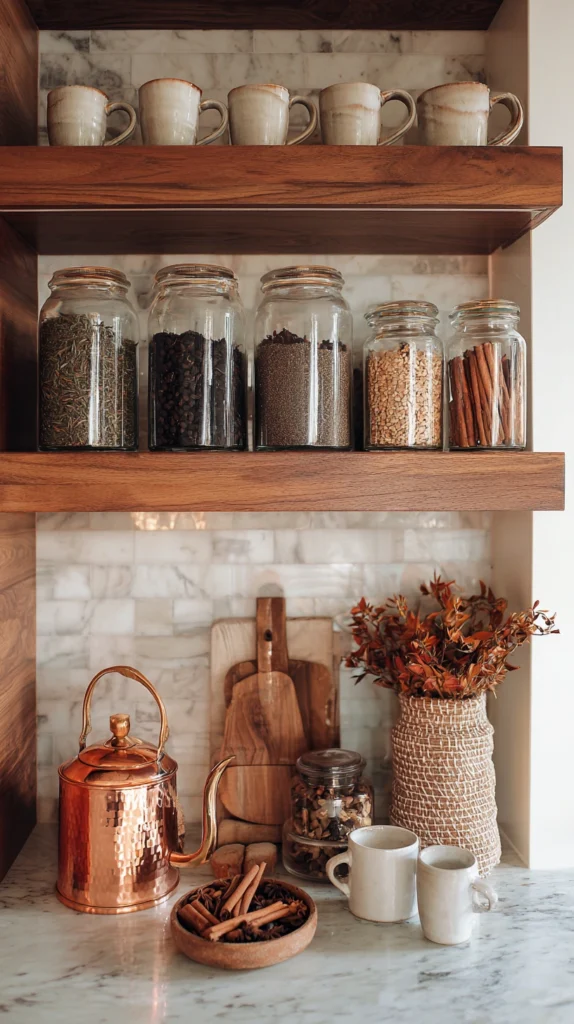
A dedicated station for making spiced drinks — mulled cider, spiced tea, chai, or hot cocoa — positioned on the kitchen counter with the necessary tools and ingredients displayed rather than stored away, turning a daily ritual into a visual and olfactory presence in the room.
Why a drink ritual creates scent in a way static objects can’t fully replicate
- The repeated daily activation of fresh fragrance: each time a cup of spiced cider or chai is prepared, the kitchen fills with an immediate, concentrated burst of autumn fragrance — a more powerful and more convincing scent experience than anything a passive source can provide
- The visual appeal of well-displayed drink-making implements: a copper kettle, a jar of whole spices for chai, a bag of mulling spices in a glass container, and a row of mismatched mugs create a kitchen vignette as appealing as any purely decorative arrangement
- The hospitality signal it sends to anyone who enters the kitchen: a visibly set-up spiced drink station communicates that this kitchen actively makes warming drinks, which is one of the more inviting things a kitchen can communicate in fall
The options
- A mulled cider station, with a jar of ready-made spice blend, a pot for warming, and a ladle
- A chai and spiced tea station, with loose spices in small glass jars and a tea infuser displayed alongside
- A hot cocoa and spice station, mixing cocoa powder with cinnamon and cayenne in a dedicated canister
- A coffee and fall spice bar, with a cinnamon stick holder, a small jar of cardamom, and a vanilla bean in a glass vial displayed alongside the regular coffee setup
The practical execution
- Prepare a dedicated spice blend and jar it at the start of the season, so the station’s tools and materials are immediately usable rather than requiring a search through the spice cabinet before each use
- Style the station’s visible components with the same care given to any other kitchen vignette — matched or intentionally mismatched mugs stacked, spices in glass jars rather than original packaging, a small cloth or tray beneath the whole arrangement
- Make the daily or several-times-weekly ritual actively regular rather than occasional, since the scent only materializes when the station is used
Cost breakdown
- Mulling spice blend, bulk ingredients: $10–20
- Small glass jars for display storage: $10–20
- Total: $20–40
8. The Fresh Herb Windowsill (Living Green With a Kitchen-Appropriate Fragrance)
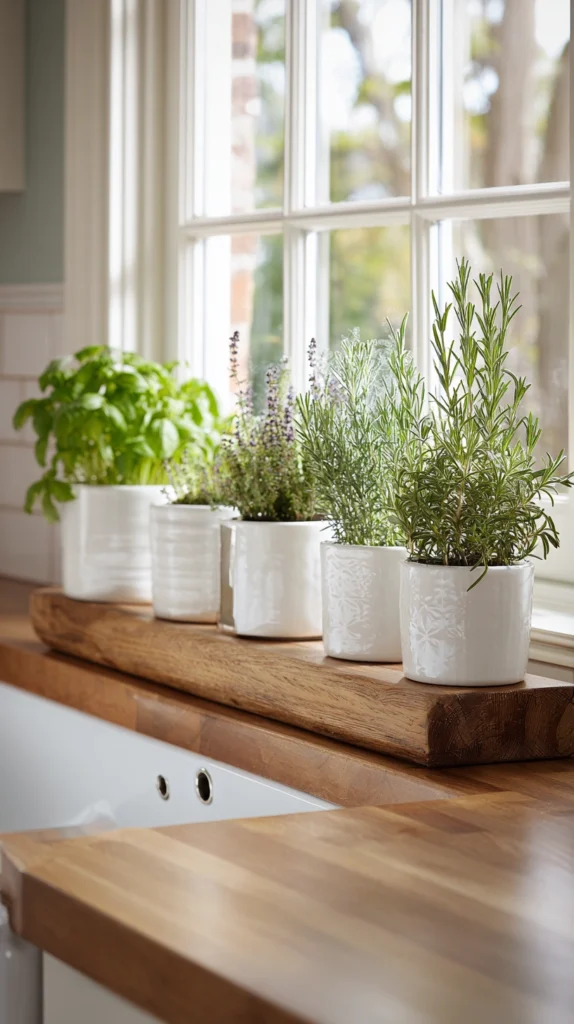
A row of living herbs on the kitchen windowsill — rosemary, sage, thyme, and mint — chosen as much for their fragrance when brushed or harvested as for their culinary use, turning the windowsill into a source of both ongoing scent and fresh ingredients.
Why a living herb windowsill contributes to scent differently than dried bundles
- The brush-to-release fragrance that living herbs provide: dried herbs release fragrance continuously but at a relatively fixed level; living herbs release a burst of concentrated fragrance whenever they’re touched, brushed, or harvested, creating moments of intense scent punctuation throughout a day spent in the kitchen
- The visual freshness and color that living herbs add: a row of living green herbs against a kitchen window adds exactly the same combination of freshness and life that the kitchen herb displays covered in earlier fall articles provide, with the additional dimension of scent as an active component
- The ongoing daily harvest it provides alongside its decorative role: living herbs on the windowsill are used regularly for cooking, ensuring they’re touched and release fragrance frequently rather than remaining a static, untouched display
The options
- Rosemary, sage, and thyme, the most robustly fragrant culinary herbs, all of which hold their scent particularly well in fall’s cooler temperatures
- Mint, for a fresher, lighter scent note than the resinous herbs, harvested easily for hot drinks that connect directly to Idea #7
- A combination of scented geraniums alongside culinary herbs, for a slightly more exotic fragrance contribution from a plant with multiple fall-appropriate varieties
- Lemon verbena, for a citrus-herb note distinct from standard culinary herbs
The practical execution
- Water at the soil level rather than misting the leaves, since wet foliage in a kitchen can develop mold that offsets the herb’s own fragrance
- Harvest regularly and fully, rather than leaving spent or woody growth on the plant, since actively growing herbs release significantly more fragrance than plants that have been allowed to become leggy and overgrown
- Rotate pots so all sides receive light, particularly important for kitchen windows that may not offer full-circle sun exposure
Cost breakdown
- Herb starts, each: $4–8
- A full windowsill row of 4–5 herbs: $20–40
- Total: $20–40
9. The Scented Wreath Inside the Kitchen (A Fragrant Welcome Above the Counter or Near the Entry)
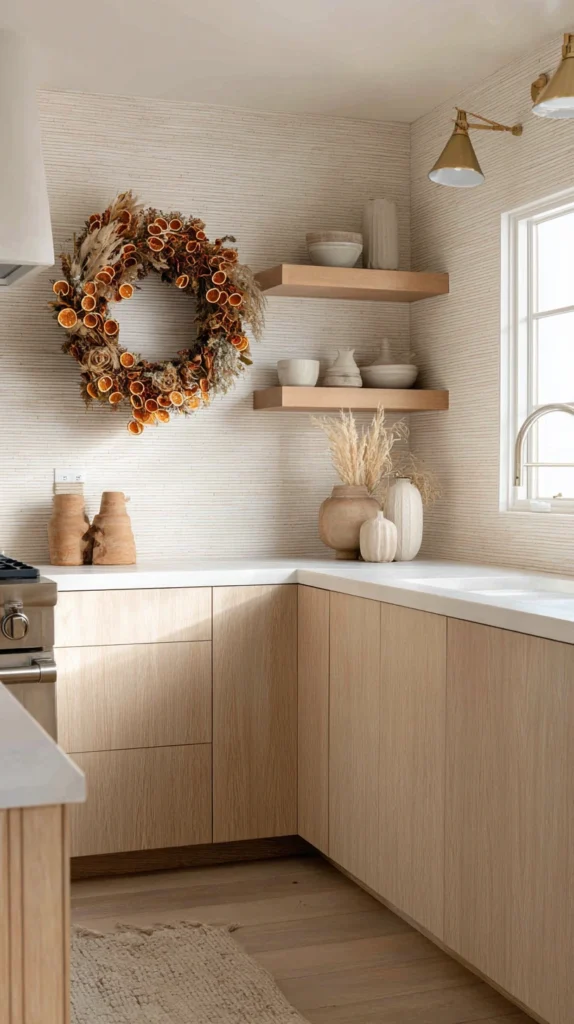
A wreath made from fragrant botanical materials — eucalyptus, dried herbs, pine, or spiced dried orange slices — hung inside the kitchen rather than on the exterior door, bringing the wreath’s fragrance into the room where it can actually be experienced.
Why an interior kitchen wreath works differently than a door wreath
- The enclosed-room fragrance concentration that an indoor wreath benefits from: a wreath hung outside loses most of its fragrance to the open air almost immediately, while the same wreath inside a kitchen fills the room with its scent in a way the outdoor version never could
- The close-range appreciation it allows: a wreath hung above a counter or inside a kitchen doorway is seen and smelled at a far shorter range than an exterior door wreath, making its materials and fragrance both more immediately apparent
- The combination of visual and olfactory effect in the room where it matters most: a fragrant wreath above the kitchen counter is simultaneously decorating the room’s most-seen surface zone and scenting the room most people spend their most time in during fall
The options
- A eucalyptus and dried herb wreath, for a clean, fresh, slightly medicinal fragrance
- A dried orange and cinnamon stick wreath, for a more directly culinary, autumnal scent
- A pine and dried botanical wreath, bridging fall and the approaching winter season
- A sage and rosemary herb wreath, for the most purely kitchen-appropriate, culinary fragrance possible
The practical execution
- Hang with a simple nail or a command hook rated for the wreath’s actual weight, which can be substantial for a full, dried botanical wreath
- Position where the wreath will be naturally disturbed by passing air from movement in the kitchen, since circulating air releases more fragrance from dried botanicals than still conditions do
- Mist very lightly with water if the wreath’s fragrance begins to fade, since a small amount of moisture reactivates volatile oils in dried botanical materials
Cost breakdown
- Fragrant botanical wreath: $20–55
- Total: $20–55
10. The Baked Good Ritual (The Most Ancient and Most Convincing Fall Scent)
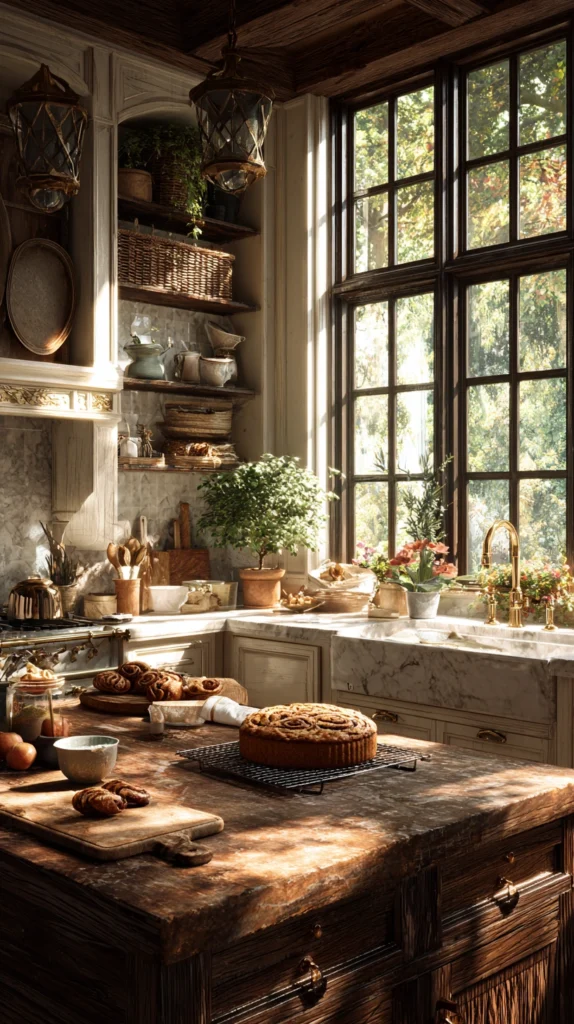
A regular fall baking practice — bread, apple cake, spiced muffins, or even simply warming spiced nuts in the oven — treated as part of the kitchen’s fall decorating plan alongside its function as an actual cooking activity.
Why baking is a scent strategy as much as it is a cooking one
- The whole-home reach of oven-baked fragrance: the smell of cinnamon, butter, and apple baking in an oven distributes through an entire house more effectively than almost any other single fragrance source, including a simmer pot, since the oven’s higher heat releases fragrance compounds that carry further into connected rooms
- The temporal specificity of the experience: a home that smells like baking in October smells specifically like autumn in a way that no purchased scent product fully replicates, because the scent is being produced by an actual seasonal food process rather than approximated by a candle or spray
- The kitchen’s active use that baking simultaneously communicates: a kitchen that smells like baking also sounds and looks like one, creating a total sensory experience of fall kitchen activity that static decor alone cannot replicate
The options
- An apple or pear cake, reliably one of the most recognized and responded-to fall baking fragrances
- Spiced nuts roasted in the oven, a thirty-minute project that fills the house with cinnamon and warm sugar more quickly than most baking recipes
- Homemade bread, whose yeast-and-wheat fragrance carries strongly through a home for hours after the loaf comes out of the oven
- Mulled wine or cider warmed in the oven, a variation on the stovetop simmer pot that uses the oven’s heat and larger enclosed space to distribute fragrance more broadly
The practical execution
- Time baking to precede arrivals by thirty to sixty minutes, since the fragrance released during baking is strongest during and immediately after the oven is open, and a home that smells like something was just baked is more inviting than one where baking happened hours before
- Keep the oven clean throughout the baking season, since accumulated residue from previous meals burns during preheating and adds an off-note to any baking fragrance the oven subsequently produces
- Treat the regular baking schedule as part of the fall decorating plan specifically, rather than as an ad-hoc cooking activity, both for the ritual dimension it adds to the season and for the reliable scent result it delivers
Cost breakdown
- Ingredients for a batch of spiced nuts: $5–10
- Ingredients for an apple cake: $10–20
- Total: $5–20 per baking session — one of the least expensive scent strategies on the list, with the added benefit of something to eat
11. The Essential Oil Diffuser With a Fall Blend (A Low-Maintenance Fragrance Layer for Between Active Sources)
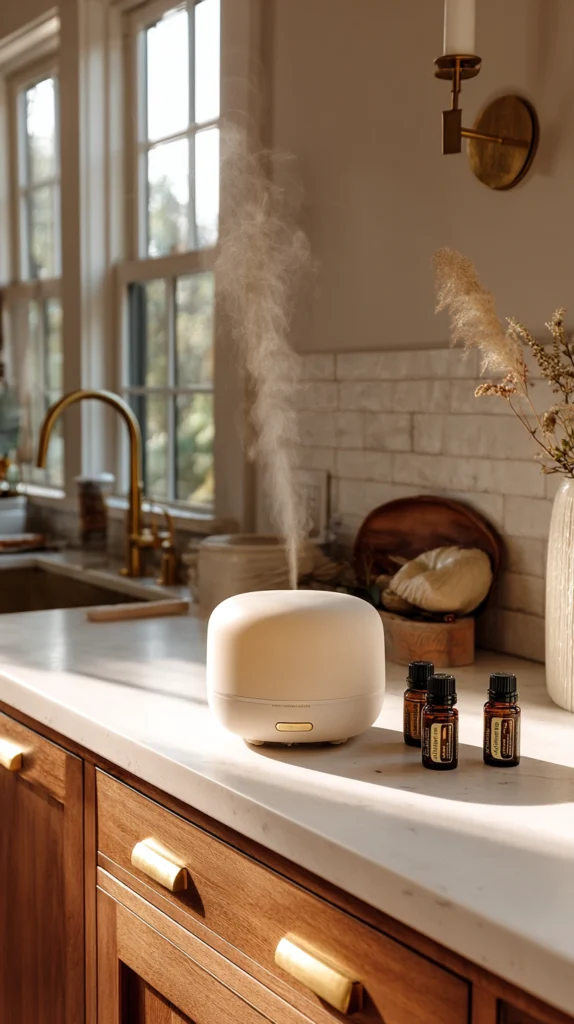
A kitchen-appropriate diffuser running a blend of cinnamon leaf, clove bud, sweet orange, and cedarwood essential oils — a background fragrance layer that maintains the kitchen’s autumn scent during stretches when the simmer pot isn’t running and no baking is underway.
Why a diffuser earns a place on a list that generally favors natural sources
- The fill-in function it serves between active scent events: a simmer pot, baking, and a fresh fruit bowl all require either active attention or a specific time of day; a diffuser maintains a baseline autumn fragrance during the hours between those more active sources
- The control it provides over intensity and blend: unlike a candle, a bowl of spices, or a simmer pot, a diffuser allows precise adjustment of how much fragrance is released, which matters specifically in a kitchen where scent intensity needs to coexist with food preparation
- The clean-burning, water-based nature of ultrasonic diffusers specifically: an ultrasonic diffuser disperses water vapor carrying essential oil molecules, which is the most kitchen-compatible diffuser technology available — no heat, no combustion, no wax residue near food surfaces
The options
- Cinnamon leaf and sweet orange, the most directly autumnal and the most widely available combination
- Clove bud, cardamom, and vanilla, for a warmer, more complex blend with a slight bakery quality
- Cedarwood, bergamot, and a touch of clove, for a woodland-adjacent fall blend distinct from the more culinary options
- Ginger, lemon, and cinnamon, for a bright, spicy combination that reads as fall without being as directly food-associated
The practical execution
- Use a kitchen-safe ultrasonic diffuser rather than a heat-based reed or candle diffuser, since the latter two introduce combustion or heated surfaces into a food-preparation environment where they create additional safety considerations
- Keep essential oil concentrations conservative in a kitchen setting, since strong fragrance in an enclosed kitchen can overlay rather than complement food smells during active cooking
- Run the diffuser between meal preparation times rather than during active cooking, using it to establish and maintain the kitchen’s baseline autumnal scent during non-cooking hours
Cost breakdown
- Ultrasonic diffuser: $25–60
- Essential oils (cinnamon leaf, sweet orange, clove): $15–30
- Total: $40–90
12. The Scented Pine Cone Display (A Natural, Low-Maintenance, Long-Lasting Source)
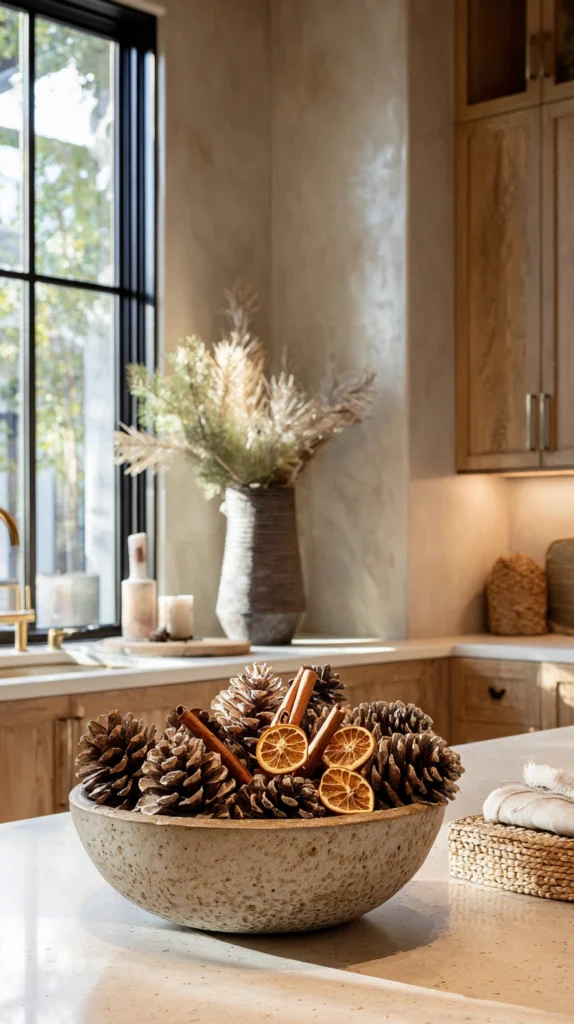
Pine cones, either naturally fragrant or lightly scented with a few drops of cinnamon or clove essential oil, displayed in a large bowl or basket — the most passive and most maintenance-free scent source on this entire list.
Why pine cones earn their own category among scent objects
- The naturally woody, forest-adjacent fragrance fresh or recently gathered pine cones release: pine cones that have been freshly dried carry a faint but unmistakable resinous fragrance that bridges the season’s culinary spice notes with a more outdoors, nature-adjacent scent dimension
- The almost zero maintenance they require as a display object: once placed in a bowl, lightly enhanced with a few drops of essential oil, pine cones continue to release fragrance and look attractive for weeks with no attention beyond an occasional stir
- The textural richness a full bowl of pine cones contributes to a kitchen counter: the varied scales, colors, and shapes of a mixed collection of pine cone sizes create the same kind of organic texture variety that whole spices provide, with more volume and visual presence
The options
- A simple bowl of mixed pine cone sizes, gathered from the yard or sourced from a garden center
- Pine cones scented with cinnamon essential oil, for an autumn-specific fragrance layered onto the pine’s own natural notes
- Pine cones mixed with dried orange slices, cinnamon sticks, and star anise, creating a full potpourri-style display using the pine cones as the base material
- Pine cones in a basket beside the simmer pot station, so they contribute to the same zone of the kitchen already doing the most active scent work
The practical execution
- Dry any freshly gathered pine cones in a low oven (200°F for 30 minutes) before displaying, both to release any insects and to set the cone’s scales open in their most visually interesting position
- Add essential oil to the base of the bowl beneath the pine cones rather than directly onto their surfaces, since oils applied directly can leave visible marks on the scales and discolor lighter-colored cones
- Refresh the essential oil every few weeks, since the pine cones themselves lose fragrance faster than the whole spices in Idea #3
Cost breakdown
- Pine cones, gathered free or purchased: $0–15
- Cinnamon or clove essential oil: $8–15
- Total: $0–30 — among the least expensive options on this list
13. The Kitchen Candle Vignette (A Small, Styled Grouping That Announces the Season at the Counter Level)
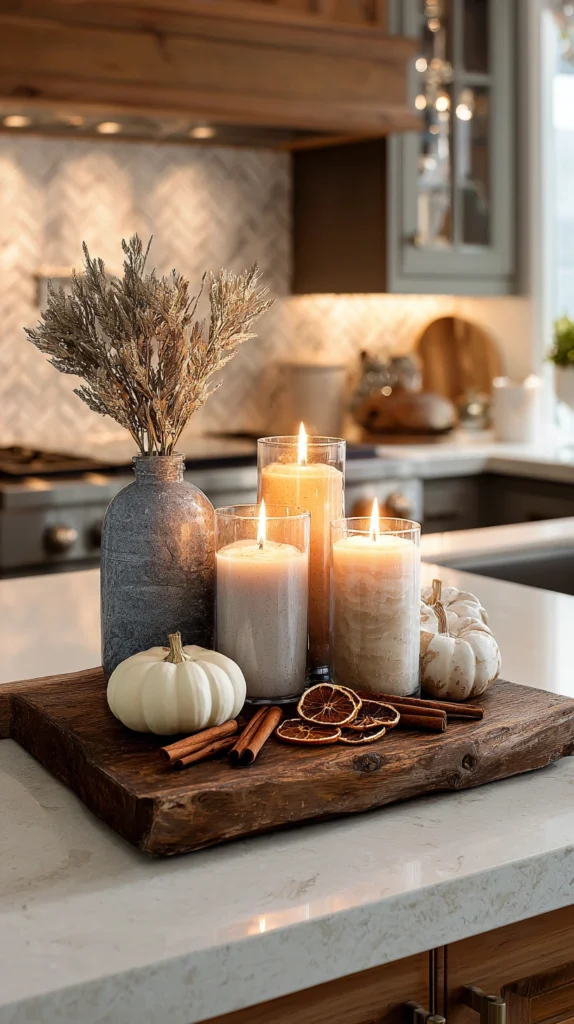
A small arrangement of fall-scented candles — in cedar, clove, baked apple, or amber — grouped with a few seasonal objects on a tray or board at counter level, the kitchen’s permanently visible scent source and visual focal point combined.
Why a styled candle vignette does more than a single candle alone
- The styled-display quality a grouped arrangement delivers over a single candle: one candle on a counter looks placed there; three candles of varied heights on a small tray with a cinnamon stick and a small gourd look styled, and that distinction carries real visual weight in a room where the counter is seen from multiple angles throughout the day
- The layered, slow-release fragrance multiple candles burning together provide: the same wax compound burning in a single candle and in three candles delivers meaningfully more fragrance from three, as the combined melt pools and wick heat interact with proportionally more air
- The evening-specific atmosphere a lit candle grouping creates in a kitchen that switches from a daylight workspace to a gathering space: a candlelit counter corner in the evening changes how a kitchen feels as the light shifts from overhead function to warm, low-source ambiance
The options
- Three candles of varied heights on a small wooden board, in complementary fall scents
- A single large jar candle in an amber or clove scent, as a less formal, single-statement version
- A mix of wax types, with a beeswax pillar from Idea #4 alongside a scented soy jar candle, layering the natural beeswax warmth with the jar candle’s more assertive seasonal fragrance
- Candles in vessels that match the kitchen’s existing palette, using the vessels as decor objects that remain long after the candle inside has burned through
The practical execution
- Place the vignette on a heat-resistant surface and ensure enough clearance from overhead cabinets, since candle smoke can discolor adjacent surfaces over time even without visible flame contact
- Trim wicks and check for debris in the melt pool before each lighting, since a candle lit in a kitchen where cooking has been happening nearby can accumulate particles faster than a candle in a living room
- Light the vignette specifically as an evening ritual rather than throughout the day, both to extend the candles’ burn life and to create a clear temporal signal that the kitchen is shifting into its evening mode
Cost breakdown
- Scented candles, a grouping of 2–3 varied sizes: $25–55
- Small tray or board for the vignette: $10–20
- Total: $35–75
The candle vignette lit on the kitchen counter as dinner finishes: the last small decision of the kitchen’s fall evening, burning quietly in the background of every conversation that happens after the plates are cleared.
The Fall Kitchen Scent Roadmap
The work, sequenced:
Phase One (the most powerful, active sources):
- The stovetop simmer pot (#1), activated ahead of arrivals or when the house needs a full reset
- The baked good ritual (#10), treated as a regular seasonal activity rather than an occasional treat
- The spiced warm drink ritual (#7), activated daily for a repeated burst of fresh fragrance
Phase Two (the persistent, passive background sources):
- The dried herb and botanical bundle display (#2)
- The spice jar and seasonal bowl display (#3)
- The scented pine cone display (#12)
- The fresh herb windowsill (#8)
Phase Three (the light and styled layer):
- The beeswax candle arrangement (#4)
- The kitchen candle vignette (#13)
- The apple and citrus fruit display (#5)
Phase Four (the supporting and filling-in sources):
- The potpourri refresh (#6)
- The scented kitchen wreath (#9)
- The essential oil diffuser with a fall blend (#11)
Getting Started This Weekend
The immediate-impact kitchen scent refresh:
One Sunday afternoon, three additions:
- Start a simmer pot on the lowest burner with apple, cinnamon, and cloves (Idea #1)
- Fill a shallow bowl with whole spices and set it on the counter (Idea #3)
- Hang a bundle of dried rosemary near the stove (Idea #2)
Total cost: $15–35. Time: about twenty minutes. The kitchen will smell specifically and undeniably like autumn before a single visual decoration has been changed.
The structural investment (the next big project):
Making the stovetop simmer pot (Idea #1) a regular habit rather than an occasional special occasion is the single highest-impact habit change available in fall kitchen scenting. A kitchen that simmers a pot of spiced apple and cinnamon weekly, maintains a bowl of whole spices permanently, and burns a beeswax candle in the evenings smells more autumnal than a kitchen that has done a major visual decorating overhaul without addressing scent at all.
What a scent-forward fall kitchen provides that a purely visual one can’t:
The first impression that arrives before any decoration is noticed:
- A simmer pot scenting the whole house twenty minutes after it starts
- A dried herb bundle releasing fragrance whenever air moves past it
- A bowl of whole spices quietly present on the counter at all times
The repeated daily activation that keeps the scent fresh rather than habituated:
- A warm drink ritual producing a burst of fresh fragrance each morning
- A regular baking practice filling the house in the way no candle can replicate
- A living herb windowsill releasing new fragrance each time it’s touched or harvested
The layered complexity that makes the kitchen smell like autumn specifically:
- The simmer pot’s warm base note beneath the dried herbs’ quieter ambient contribution
- The beeswax candles’ honey warmth in the evening alongside the remaining daytime spice
- The fresh citrus from the fruit bowl cutting through the warm spice notes just enough to keep the whole impression from becoming heavy
A kitchen can be decorated for fall without ever addressing how it smells, and it will look the part. It will not feel the part in the same way, because the part is felt in more than one sense. The smell of cinnamon and apple on a slow October afternoon is not a decoration. It’s a signal — the same one that has signaled this exact season to every generation that ever spent a fall afternoon in a kitchen — and no visual arrangement, however considered, sends it in quite the same way.