14 Cozy Fall Bedroom Ideas to Upgrade Your Sleep Space
My bedroom felt like a storage room with a bed in it for three years. White walls, one flat pillow, a single polyester blanket, overhead light on full blast at 10pm.
Tried buying a new duvet cover once. Same cold, bright, lifeless room with a slightly different rectangle of fabric on the bed. Nothing changed.
Then I rebuilt the entire sleep environment around one goal — the best possible fall sleep. Layered bedding, warm amber lighting, seasonal scent, textured walls. The bedroom became the room I wanted to be in from October through December.
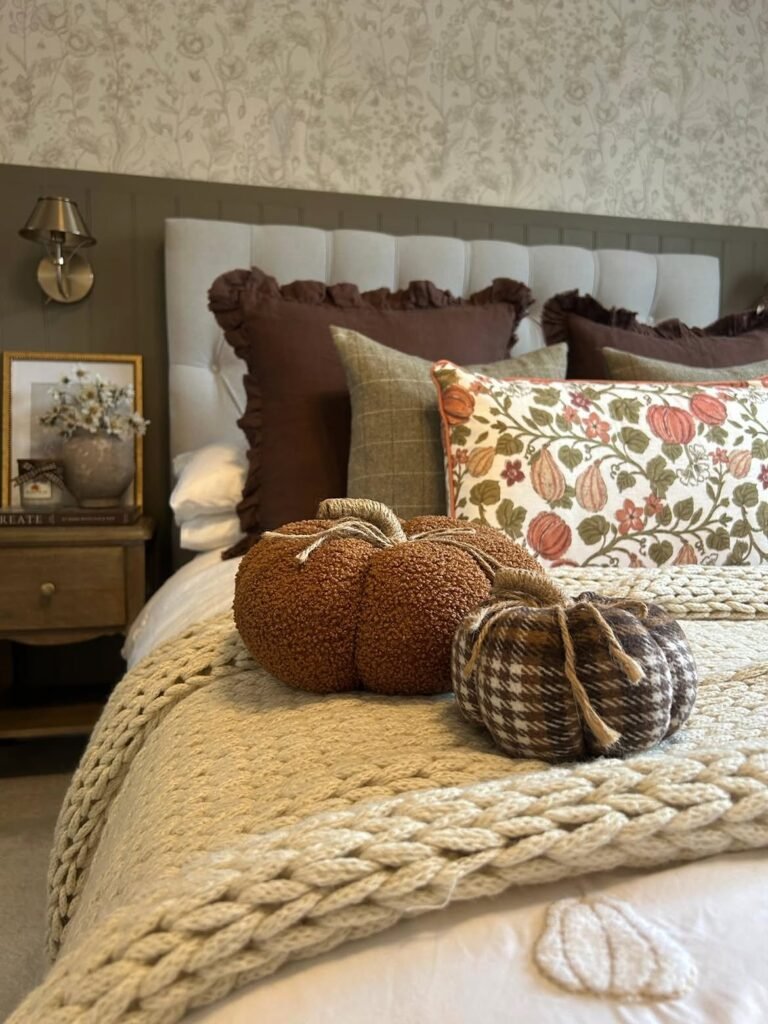
Now I go to bed earlier than I ever have. Not because I am tired. Because the room pulls me in.
Let me show you 14 ideas that transform a functional bedroom into the cozy fall sleep space you actually look forward to every night.
Why Most Bedrooms Feel Wrong in Fall
The seasonal disconnect:
What does not change when fall arrives:
- Same bright overhead light used year-round
- Same summer-weight duvet
- Same single pillow per person
- Same bare walls and minimal surfaces
- Room feels identical in October as in June
What fall sleep actually needs:
The biology:
- Cooler temperatures (bedroom should be 65-68 degrees)
- Darkness earlier (but warm not cold darkness)
- Heavier weight over the body (psychological comfort)
- Scent triggers (warm, spiced, woody — signals rest)
- Visual warmth (amber tones reduce cortisol)
Why the bedroom lags behind the rest of the house:
The common reasoning:
- “It is just for sleeping”
- “Nobody sees the bedroom except us”
- “It does not need to be decorated”
- All three of these are wrong
The sleep quality connection:
Environment affects sleep directly:
- Room temperature (most studied factor in sleep quality)
- Light temperature at night (blue light delays melatonin)
- Psychological comfort (a room that feels cozy reduces anxiety)
- Sensory signals (scent, texture, warmth signal the brain to rest)
My revelation: A cozy fall bedroom is not about aesthetics — it is about building an environment that genuinely helps you sleep better from October through December. The beauty is a side effect of the function.
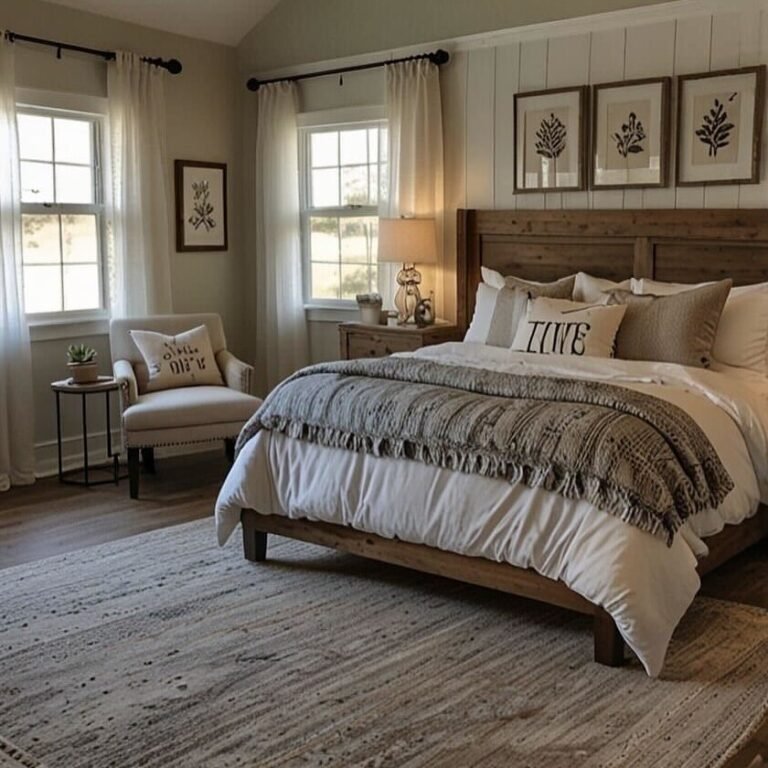
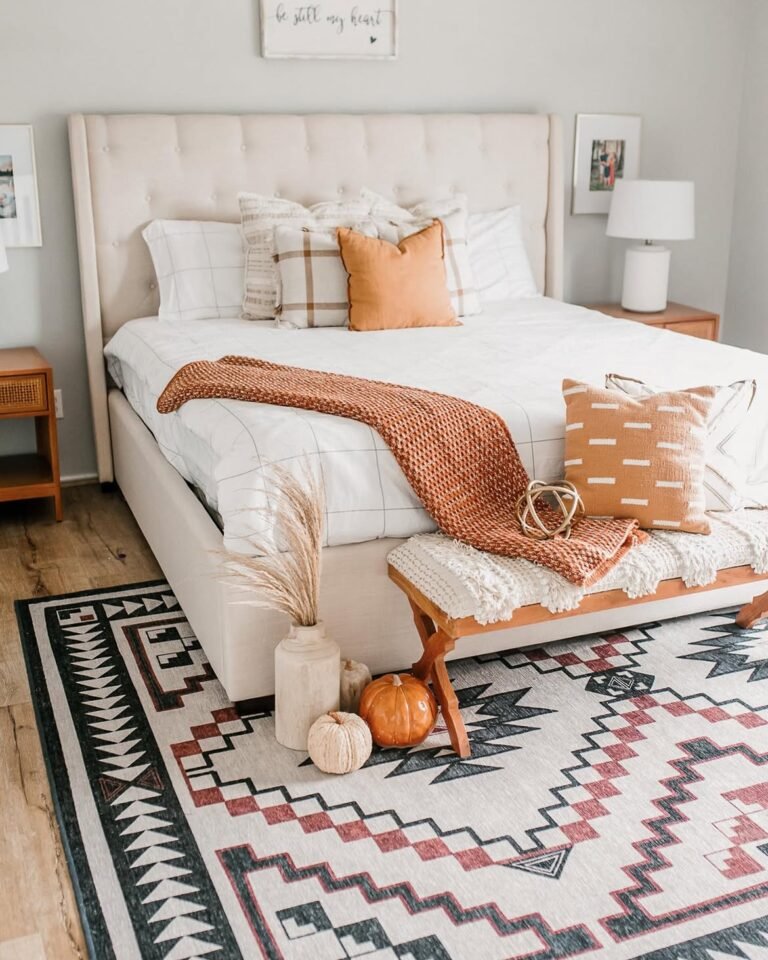
1. The Layered Bedding System (The Foundation of Fall Sleep)
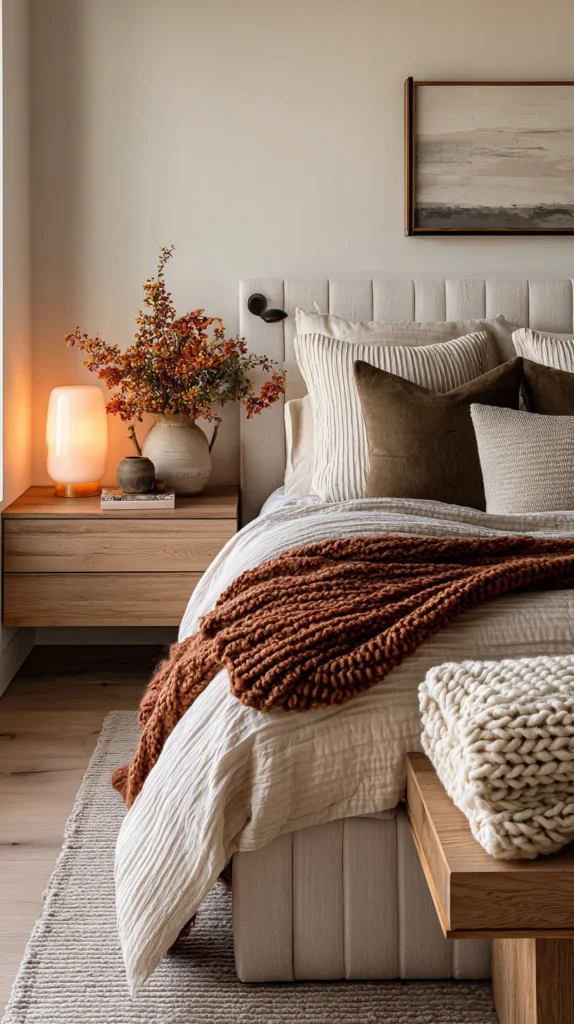
Multiple distinct layers of bedding built for adjustability — the sleep upgrade with the most direct impact on actual rest.
My flat bedding failure:
What I had:
- One duvet, one sheet, one flat pillow
- Too hot some nights, too cold others
- No way to adjust without getting up and searching
- Woke at 2am uncomfortable regularly
The layered bedding solution:
Why layers beat one heavy duvet:
- Body temperature fluctuates throughout the night
- One heavy layer: too hot or too cold with no in-between
- Multiple layers: adjust by pushing one aside without fully waking
- Better sleep quality through temperature self-regulation
The fall bedding stack:
Layer one — the fitted sheet:
- Soft cotton or linen (natural fibers breathe)
- Warm tone (cream, oat, or warm white — not bright white)
- 300-400 thread count (softer without being excessively hot)
Layer two — the flat sheet:
- Same material family as fitted sheet
- Slightly heavier weight than summer sheets
- This layer often gets pushed aside on warmer fall nights
Layer three — the lightweight blanket:
- Waffle-weave cotton or thin wool blanket
- Medium weight (more than a sheet, less than a duvet)
- The transitional layer — most used in September and early October
Layer four — the main duvet or comforter:
- Fall-appropriate fill weight (not the lightest summer option)
- Natural down or high-quality down alternative
- 400-600 fill power for fall (heavier than summer, lighter than winter)
Layer five — the throw or foot-of-bed blanket:
- A visible, styled throw placed at the foot
- Chunky knit, sherpa, or heavy woven
- Decorative and functional — pulled up on coldest nights
Pillow abundance:
More pillows than you think you need:
- Sleeping pillows (two per person minimum, quality matters here)
- Decorative pillows at the headboard (styled but removed at night)
- One body pillow or lumbar for positional support
- Abundance of pillows signals rest and warmth visually and physically
Bedding materials for fall:
Natural fibers always:
- Linen (breathes, softens with washing, gets better over time)
- Cotton percale (crisp, cool to the touch, breathes well)
- Cotton flannel (softest for cold nights, slightly warmer)
- Avoid: polyester (traps heat unevenly, holds moisture)
Fall-appropriate fabric:
- Cotton flannel sheets replace percale from October onward
- Flannel feels warmer at the same temperature
- The switch alone improves sleep perception without changing room temperature
Duvet cover selection:
Fall duvet cover colors:
- Deep rust or terracotta (richest fall choice)
- Warm cream or oat linen (versatile, works all year with fall accents)
- Forest green (sophisticated, pairs with every fall palette)
- Deep mustard (bolder, most clearly seasonal)
- Warm charcoal (modern, works with amber accents)
Sourcing bedding:
Best sources by budget:
- Budget: IKEA DVALA or ULLVIDE sheets, basic duvet ($30-80 per piece)
- Mid-range: Brooklinen, Parachute, Quince ($80-200 per piece)
- Investment: Cultiver linen, Bed Threads ($150-350 per piece)
Cost:
- Flannel sheet set: $40-100
- Fall duvet cover: $40-150
- Throw blanket (foot of bed): $35-70
- Extra pillows and covers: $30-80
- Total: $145-400
My layered bedding result: Waking at 2am to adjust temperature completely stopped, the flannel sheet swap alone improved how quickly I fell asleep, the foot-of-bed throw gets used on colder nights without disrupting the main duvet.
Layered Bedding Tips
The flannel sheet test:
Simple experiment:
- Switch to flannel sheets one week into October
- Sleep quality assessment before and after
- Most people notice improvement within three nights
- The psychological warmth of flannel signals rest even at the same room temperature
Duvet fill weight for fall:
Getting the weight right:
- Too light (kicks it off at night, wakes cold later)
- Too heavy (overheats, disrupts sleep mid-night)
- Fall sweet spot: 400-600 fill power, medium weight
- Down alternative performs nearly identically at lower cost
2. Warm Amber Lighting System (The Sleep Environment Game-Changer)
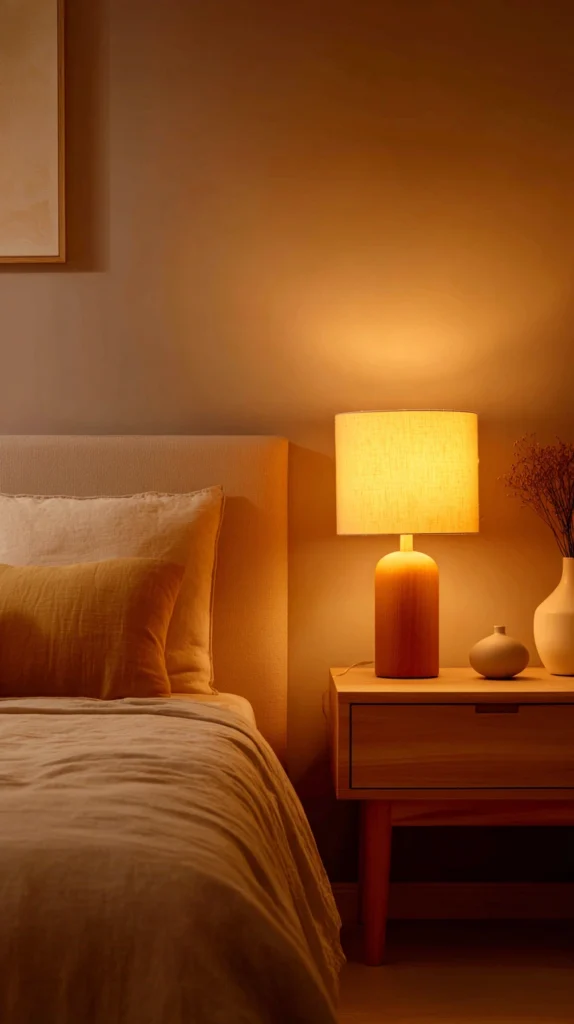
Replacing cool overhead light with warm amber sources at low heights — the change with the most direct effect on sleep quality.
My 10pm overhead light problem:
What I was doing:
- Overhead bright light on until the moment I got into bed
- Cool white bulbs (5000K in some cases)
- Same light used for morning energy as for winding down
- Brain receiving “it is noon” signals at 10pm
The biology of bedroom light:
Why it matters:
- Blue light (cool white, above 4000K) suppresses melatonin production
- Melatonin is the hormone that signals sleep onset
- Bright overhead light at night delays sleep by 60-90 minutes on average
- Amber and warm light below 2700K does not suppress melatonin
The amber lighting solution:
What amber light means:
- 2200K bulbs (candlelight equivalent, most amber)
- 2700K maximum for bedroom use
- The warmest commercially available standard bulbs
- Visual warmth matches biological sleep-promoting effect
Where amber light sources go:
Never overhead for sleep preparation:
- Overhead off at least one hour before intended sleep time
- All light from bedside lamps and floor lamps from that point
- Overhead on a dimmer at absolute minimum (5-10% only)
Bedside lamp selection:
The most important light in the bedroom:
- One lamp per side of the bed (symmetrical function, asymmetric styling is fine)
- Shade that diffuses rather than directs light (fabric shade over metal or glass)
- Warm amber bulb inside (2200-2700K)
- Dimmable (essential — different brightness for reading versus winding down)
Warm light alternatives:
Beyond bedside lamps:
- Himalayan salt lamp (most amber light possible, very low wattage)
- String lights behind the headboard (warm white, low wattage)
- LED strip behind the headboard (warm white bias lighting)
- Small battery lantern on the nightstand (no cords, moveable)
- Plug-in wall sconces on either side of the headboard
Smart bulb advantage:
For automated amber transition:
- Philips Hue or LIFX smart bulbs
- Schedule: cool-white morning, warm-white evening, very amber at 9pm
- Automatic transition removes any effort
- Sunrise simulation for morning waking (gentler than alarm alone)
The lamp beside the bed:
Specific product recommendations:
Affordable:
- IKEA RANARP clip or table lamp ($15-30)
- Target ceramic base lamps ($25-55)
Mid-range:
- West Elm ceramic table lamp ($60-120)
- CB2 brass and marble lamp ($80-150)
Investment:
- Visual Comfort or Arteriors ($150-400)
Candles in the bedroom:
The safest amber sources:
- LED candles only in the bedroom (fire near bedding is serious risk)
- Luminara brand (most realistic flicker, most convincing)
- Timer function (set to turn off at midnight, never worry about extinguishing)
- Grouped on a tray on the dresser or bedside table
Cost:
- Replace bulbs throughout bedroom (2200K): $15-30
- One bedside lamp (if not owned): $25-100
- Smart plug or smart bulb: $15-25
- Battery LED candles (set): $20-40
- Total: $75-195
My amber lighting result: The single change that most improved both the appearance of the bedroom and my actual sleep onset time, fell asleep 30-40 minutes earlier on average after switching to amber-only light after 9pm, guests in the morning ask what kind of lighting I use.
Amber Lighting Tips
The one-hour rule:
Behavioral practice:
- Overhead light off one full hour before target sleep time
- Switch to amber lamps only from that point
- Phone brightness set to lowest and warm-color mode simultaneously
- This single habit change is clinically supported for improved sleep onset
Dimmer installation:
For the overhead:
- Install a dimmer switch on the overhead ($25, 30-minute project)
- Use at absolute minimum (5%) for nighttime navigation only
- This prevents accidentally turning it on full brightness at 11pm
- One of the highest-return home improvements for sleep quality
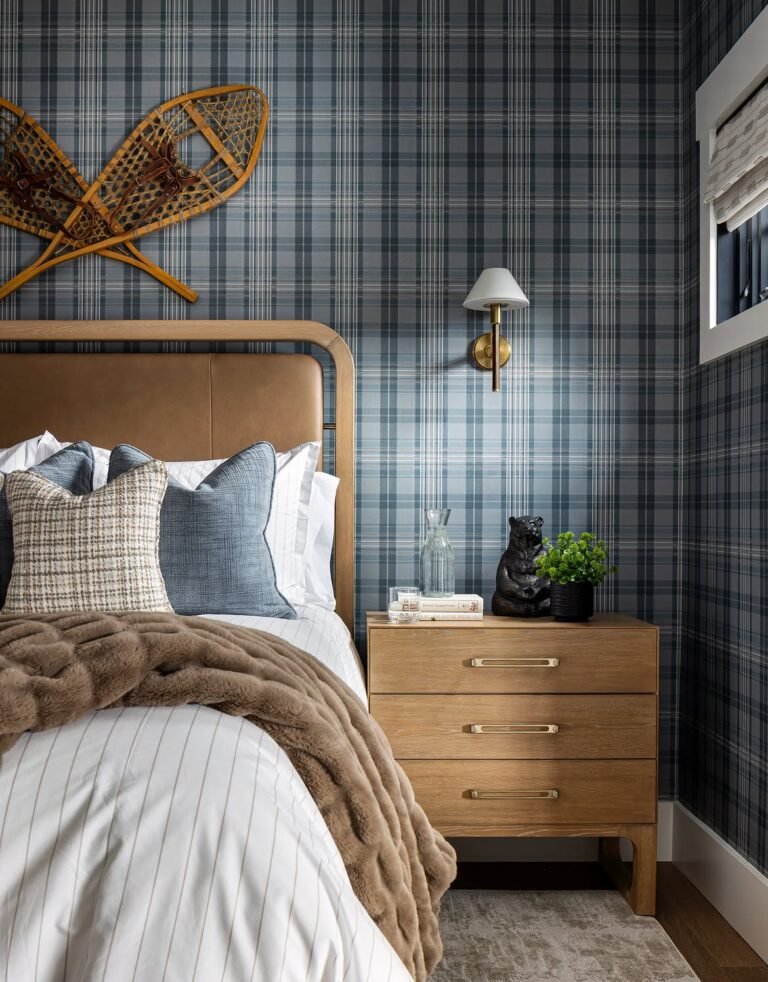
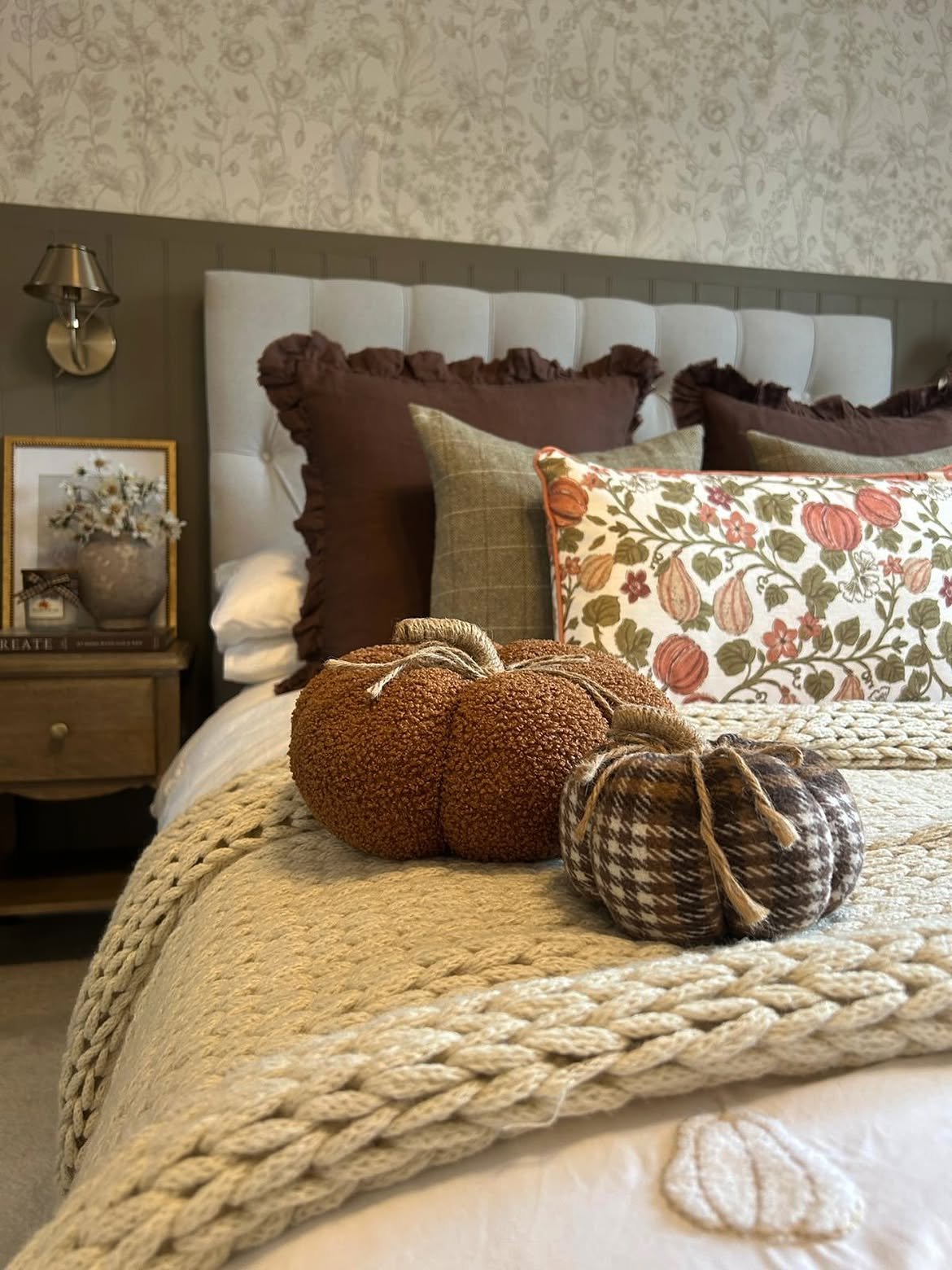
3. The Headboard Wall Treatment (The Bedroom’s Most Important Surface)
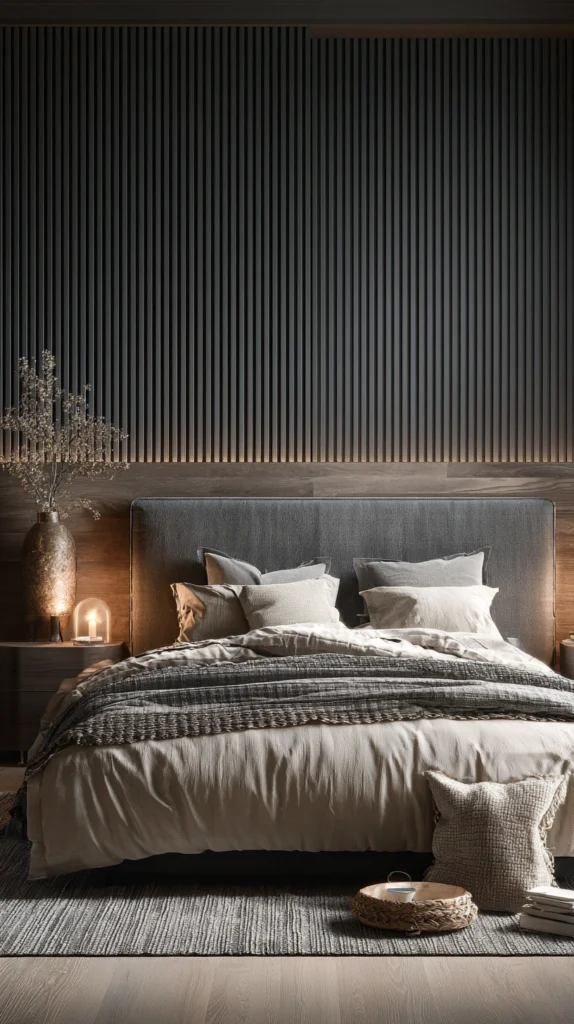
Transforming the wall behind the bed into a warm, textured backdrop — the visual anchor that defines the entire room.
My bare headboard wall:
What was there:
- Plain white painted drywall
- Nothing above or beside the headboard
- Bed looked parked against a hospital wall
- The most visible surface in the room, completely ignored
Why the headboard wall matters most:
The visual hierarchy:
- First thing seen upon entering the bedroom
- Last thing seen before closing eyes
- Backdrop for every photograph taken in the room
- The visual anchor everything else relates to
Headboard wall treatment options:
Warm paint color:
- The first and most impactful change
- Deep, saturated fall color (forest green, terracotta, deep rust, warm charcoal)
- One wall only (most common) or full room (most enveloping)
- Matte or eggshell finish (no gloss in a bedroom)
Specific fall bedroom wall colors:
- Farrow and Ball Mole’s Breath (sophisticated warm gray-brown)
- Sherwin-Williams Cavern Clay (terracotta, most fall-specific)
- Benjamin Moore Newburyport Blue (deep, moody)
- Farrow and Ball Railings (deep navy, the darkest comfortable choice)
- Sherwin-Williams Rookwood Dark Green (forest, enveloping)
Vertical slat paneling:
The wood accent wall:
- Pine or MDF vertical strips painted same color as wall (tone-on-tone)
- Creates shadow lines and texture without pattern
- Most modern headboard wall treatment
- Weekend DIY project ($80-200 in materials)
Wallpaper:
The most dramatic option:
- Pattern or texture on the headboard wall only
- Dark botanical (most fall-appropriate)
- Grasscloth (tactile, warm, quiet luxury)
- Linen-look textured paper (subtle texture, warmer than flat paint)
Fabric panel headboard wall:
Softness behind the bed:
- A large piece of fabric hung on the wall
- Velvet, linen, or wool in a fall color
- Mounted with a wooden dowel at the top
- Adds warmth that paint cannot — actual softness on the room’s main wall
Art arrangement:
Gallery above the headboard:
- Three to five framed pieces in warm tones
- Hung as a horizontal grouping above the headboard
- All in warm wood or gold frames
- Consistent mat color (cream or warm white throughout)
Cost:
- Paint (one wall): $30-60
- Vertical slat paneling (DIY): $80-200
- Wallpaper (headboard wall): $150-500
- Fabric panel (DIY): $40-100
- Art grouping (thrifted frames plus prints): $50-150
- Total range: $30-500
My headboard wall result: Painting just the wall behind the bed in Farrow and Ball Mole’s Breath transformed the entire bedroom before I changed a single piece of furniture or bedding, the deep warm gray-brown made the room feel like a sanctuary rather than a room with a bed in it.
Headboard Wall Tips
Extend past the headboard:
Full wall not just behind the headboard:
- Painting only the headboard-width section looks like a mistake
- Always paint the full wall from corner to corner
- The headboard is in front of the wall, not the boundary of it
- Full wall treatment is what reads as designed not accidental
Sample the color in the room’s actual light:
Critical step:
- Bedroom lighting is often dimmer than living areas
- Colors look different in bedroom light than in full daylight
- Sample on the actual wall, observe for three days
- Assess specifically at night under your lamp light (the condition that matters most)
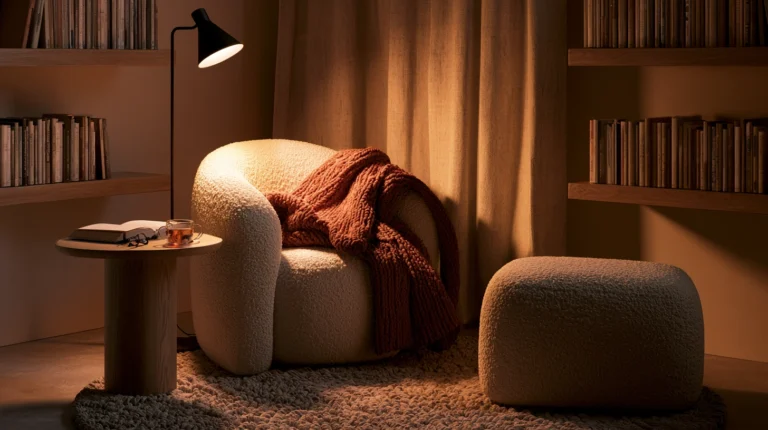
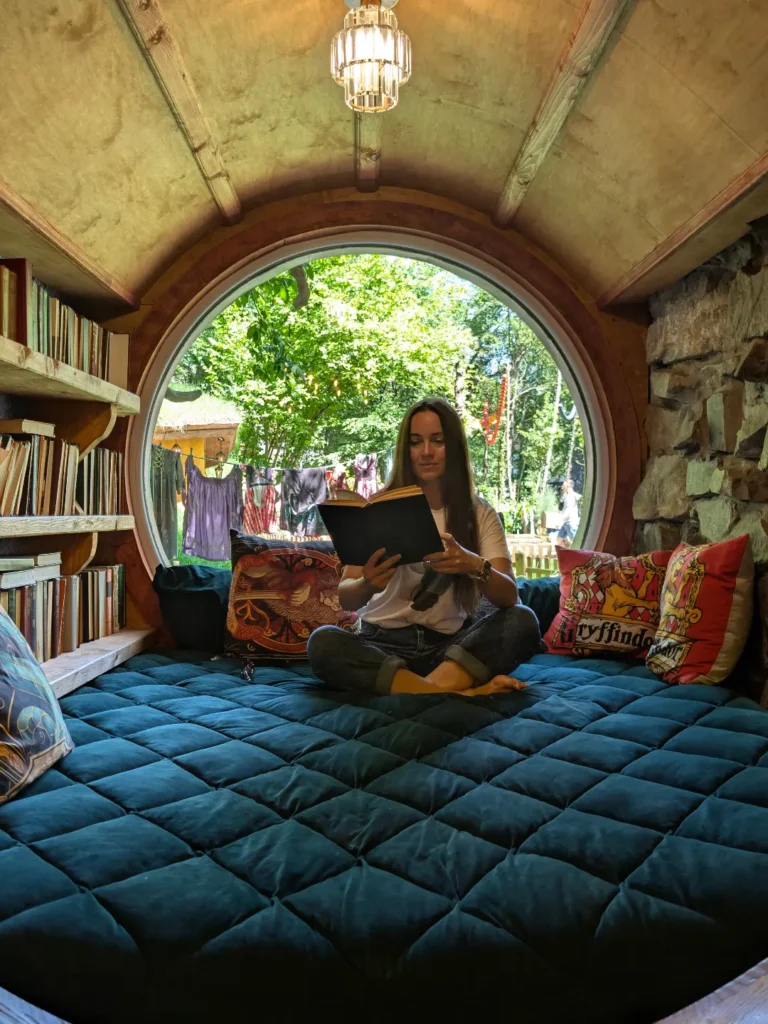
4. The Cozy Reading Corner (A Bedroom Destination Beyond the Bed)
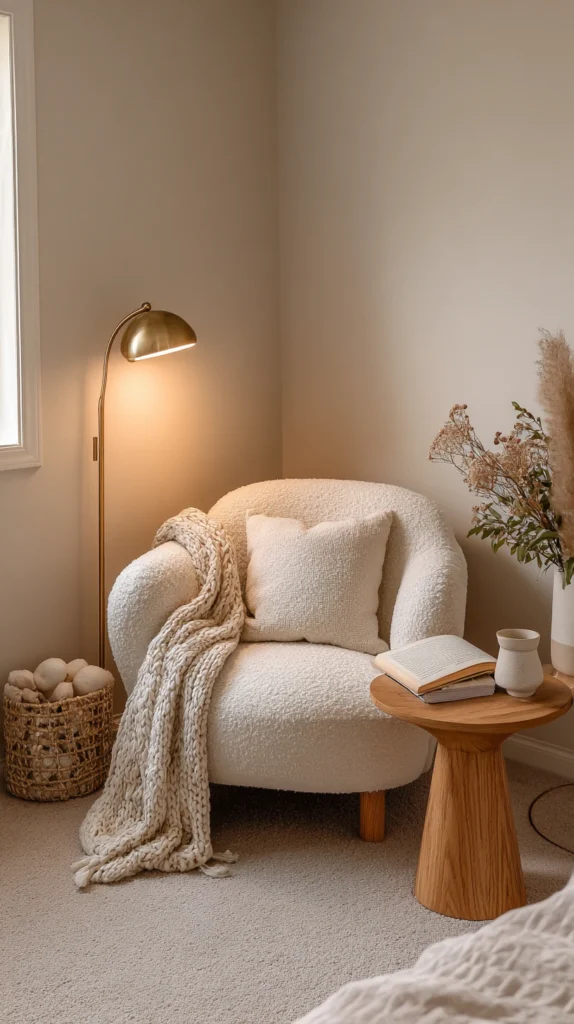
A small seating area created for evening reading within the bedroom — extending the room’s function and cozy quality beyond the mattress.
My one-purpose bedroom:
What was missing:
- Bed was the only place to be in the room
- No reason to enter the bedroom until sleep time
- Room held no invitation to linger
- The coziness had nowhere to build from
Why a bedroom reading corner improves sleep:
The sleep science connection:
- Going to the bedroom only when ready to sleep (bed-sleep association)
- A reading chair creates a pre-sleep wind-down zone
- Move from chair to bed when genuinely sleepy (not just tired from screen)
- This behavioral pattern is recommended by sleep specialists for insomnia
The corner setup:
Essential elements:
- One comfortable chair (armchair or wingback)
- One small side table within reach (for tea, book, lamp)
- One reading lamp at shoulder height when seated
- One throw blanket draped over the arm of the chair
- A small stack of current reading material beside it
Chair selection:
For a bedroom reading corner:
- Smaller footprint than a living room chair (space preservation)
- Fully upholstered (visual warmth, no hard surfaces)
- Deep enough seat for comfortable reading positions
- Footstool or pouf if space allows
Fall chair fabrics:
- Velvet (most fall-appropriate, catches warm lamp light)
- Boucle (textural, modern, very current)
- Worn leather or faux leather (warm and aged)
- Heavy linen in a fall color (most versatile)
The lamp for reading:
Task light requirement:
- Must be bright enough to read by without strain
- But warm enough (2700K) to not disrupt wind-down
- Positioned at shoulder height when seated (not above, not below)
- Halogen or LED reading bulbs at 2700K hit both requirements
Fall textiles in the corner:
Making it unmistakably seasonal:
- Deep rust or forest green velvet chair
- Cream chunky knit throw over the arm
- One pillow in a fall color on the seat
- A small plant on the side table (fern or pothos)
The pre-sleep routine this creates:
The behavioral sequence:
- Change and prepare for sleep
- Sit in the corner chair with a book and herbal tea
- Read until genuinely sleepy (not a set time)
- Move to bed at the peak of sleepiness
- Fall asleep faster because of the behavioral association
Cost:
- Secondhand armchair: $50-200
- Small side table: $25-80
- Reading lamp: $30-100
- Throw and pillow: $50-80
- Total: $155-460
My reading corner result: The corner chair became where the evening actually happens, getting into bed now means I am genuinely ready to sleep not just lying there hoping, sleep onset noticeably faster since adding the pre-bed wind-down zone.
Reading Corner Tips
Location within the bedroom:
Placement:
- Near a window if possible (natural light for daytime use)
- Away from direct view of the bed (visual separation of activities)
- In a corner rather than a wall (enclosure, cozier)
- Not in the path of regular foot traffic (it should feel like a destination)
The no-phone rule:
Making the corner work:
- The corner is for reading, not scrolling
- Phone charger on the other side of the room or outside the bedroom entirely
- The chair holds a book, not a device
- This distinction is what makes the behavioral sleep benefit work
5. Weighted Blanket Integration (The Physical Comfort Upgrade)
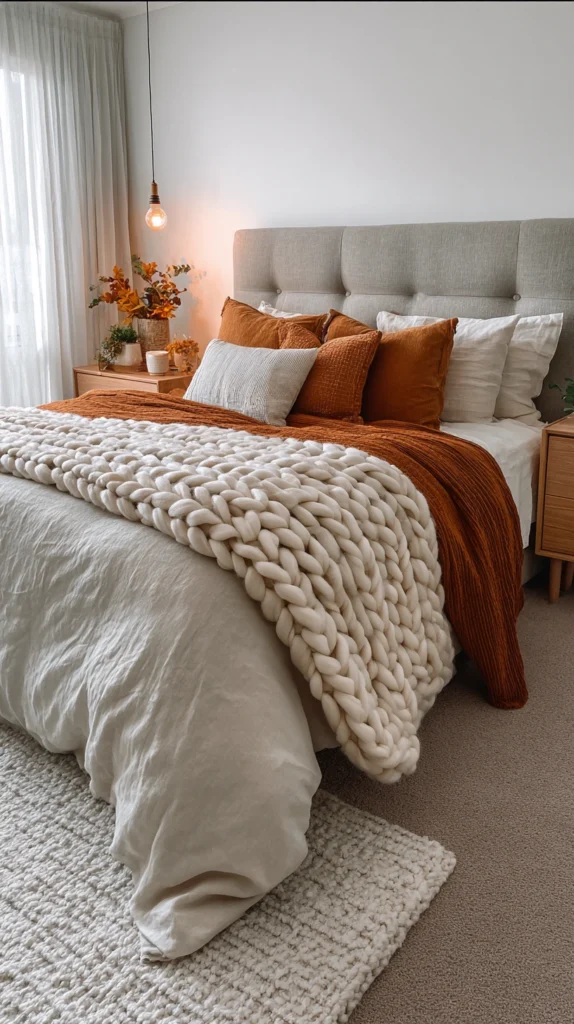
A quality weighted blanket incorporated into the bedding layer system — the sleep upgrade backed by the most research.
My restless night problem:
What kept happening:
- Waking frequently without clear reason
- Feeling vaguely anxious before sleep
- Restless movement throughout the night
- Never fully settled
The weighted blanket solution:
The science:
- Deep pressure stimulation (the sensation of being held or hugged)
- Increases serotonin and decreases cortisol
- Activates the parasympathetic nervous system (rest response)
- Particularly effective for anxiety-related sleep disruption
- Most studied non-pharmaceutical sleep intervention currently
Choosing the right weight:
Weight selection formula:
- 10% of body weight is the standard recommendation
- 150 lb person: 15 lb blanket
- 200 lb person: 20 lb blanket
- Going too heavy (uncomfortable, not beneficial)
- Going too light (insufficient pressure, less effect)
Cover material for fall:
Seasonal covers:
- Cotton cover (most breathable, best for those who run warm)
- Minky fabric cover (softest, warmest, most popular)
- Linen cover (breathable and beautiful, premium feel)
- Flannel cover (fall and winter specific, coziest feeling)
Replacing covers seasonally:
The swap system:
- Purchase one weighted blanket with multiple seasonal covers
- Summer: cotton or bamboo (breathable)
- Fall and winter: minky or flannel (warm and cozy)
- Covers cost $30-60, cheaper than a second full blanket
Weighted blanket position:
How to integrate into the layered system:
- Weighted blanket over the flat sheet, under the duvet
- Or: weighted blanket on top of everything as the final layer
- Personal preference determines which works better
- Starting position: over the flat sheet, under the lighter layers
Fall-appropriate weighted blankets:
By budget:
- Budget: YnM or Luna weighted blanket ($40-80)
- Mid-range: Bearaby (knitted, beautiful, very warm) ($149-249)
- Investment: Gravity or Coop Home Goods ($150-250)
The Bearaby specifically:
Why it fits the aesthetic:
- Chunky knitted cotton construction (beautiful as decor during the day)
- Available in earthy fall tones (olive, rust, oat)
- Looks like an oversized knit throw but functions as a weighted blanket
- Doubles as the styled foot-of-bed throw from idea 1
Cost:
- Standard weighted blanket: $50-150
- Quality seasonal cover: $30-60
- Bearaby (combined blanket and aesthetic piece): $149-249
- Total: $50-249
My weighted blanket result: Waking frequency dropped significantly in the first week, the restless quality of my sleep before falling into deep sleep essentially disappeared, the Bearaby in olive green is also the most complimented piece of bedding in the room.
Weighted Blanket Tips
Adjustment period:
First two weeks:
- Some people find the pressure unfamiliar initially
- Start with shorter use periods (a few hours, not all night)
- Most people fully adjust within one to two weeks
- If it never feels comfortable: wrong weight or wrong person (not universal)
Partner considerations:
Sharing the bed:
- Weighted blankets work best as individual pieces (one per person)
- A shared weighted blanket often means one person gets more weight than the other
- Two lighter individual blankets better than one heavy shared blanket
- This also solves the temperature regulation conflict between partners
6. Warm Scent and Aromatherapy (The Invisible Bedroom Upgrade)
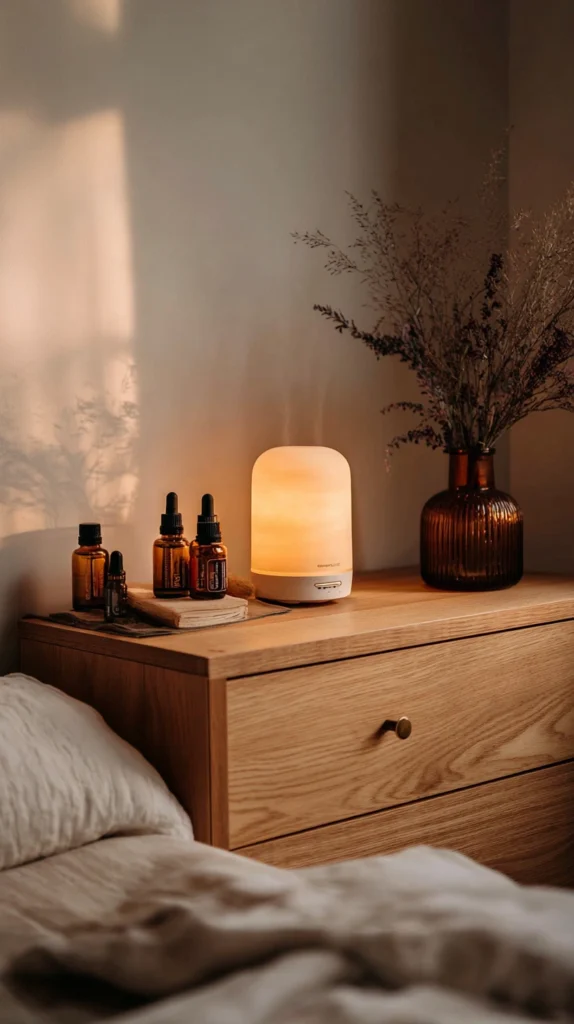
Scent specifically chosen to support fall sleep — the sensory layer that works while you sleep.
My unscented bedroom:
What I was missing:
- Bedroom smelled like laundry detergent at best
- Nothing signaling rest, warmth, or season
- No olfactory cue to the brain that rest was beginning
- Missing one of the five sensory environments for sleep
Why bedroom scent matters:
The olfactory-sleep connection:
- Scent is processed by the limbic system (directly connected to emotion and memory)
- Certain scents have measurable effects on relaxation and sleep onset
- Lavender specifically reduces cortisol and heart rate (clinical evidence)
- Warm, spiced, and woodsy scents signal the body to rest in fall
The best sleep scents for fall:
Clinically supported:
- Lavender (most studied, genuine cortisol-reducing effect)
- Bergamot (reduces anxiety, promotes calm)
- Cedarwood (woodsy, grounding, sleep-promoting)
- Sandalwood (deepens relaxation)
Seasonally appropriate additions:
- Vetiver (deeply earthy, grounding, sophisticated)
- Frankincense (ancient and resinous, meditative quality)
- Clary sage (warm, slightly herbal)
- Vanilla (warm, psychologically comforting)
Scent delivery methods for the bedroom:
Ultrasonic diffuser:
- Most effective scent distribution
- Doubles as a quiet white noise source (slight hum)
- Set a timer (runs during wind-down, off after an hour)
- Use 100% pure essential oils only (not fragrance oils)
Pillow spray:
- Lavender mist sprayed directly on pillow
- Most direct delivery method for sleep benefit
- DIY: lavender essential oil plus water in a small spray bottle
- Cost: $8-15 for a DIY pillow spray
Reed diffuser:
- Consistent low-level scent (no on/off)
- Appropriate for background bedroom fragrance
- Replace reeds monthly to maintain scent throw
- Place on the dresser rather than the bedside table
Scented candles (LED only in bedroom):
- As established in idea 2, only LED candles in the bedroom
- A lightly scented wax warmer with a bedroom-appropriate scent
- Off before sleep (set on timer)
- The scent lingers after the warmer turns off
Linen spray:
- Sprayed on sheets and pillowcases before bed
- Most popular form for immediate bedtime use
- Brands: This Works Deep Sleep Pillow Spray ($34), Feather and Down pillow spray ($25)
- DIY version equally effective at a fraction of the cost
Sachets inside the pillow:
The traditional method:
- A small muslin bag of dried lavender inside the pillowcase
- Releases scent with warmth from head
- Replace annually (dried lavender loses potency)
- Most gentle, most continuous delivery method
Fall-specific bedroom scent blend:
A seasonal combination:
- Cedarwood and lavender (woodsy plus calming)
- Sandalwood and bergamot (grounding plus uplifting)
- Vetiver and vanilla (earthy plus warm comfort)
- Choose one combination and stick with it (olfactory memory builds)
Cost:
- Ultrasonic diffuser: $20-40
- Essential oils (fall sleep blend): $15-30
- Pillow spray (DIY): $8-15
- Lavender sachet: $5-10
- Total: $30-85
My bedroom scent result: The cedarwood and lavender combination has become such a consistent sleep trigger that the scent alone begins the relaxation process before I have even changed into pajamas, olfactory conditioning is more powerful and faster than most people expect.
Bedroom Scent Tips
Consistency builds the conditioning:
How it works:
- The brain associates a specific scent with a specific state (sleep)
- The more consistently used, the stronger the association
- Use the same scent every night for two weeks before assessing effectiveness
- Changing scents frequently prevents this conditioning from building
Essential oil quality:
Purity matters:
- 100% pure essential oils (not fragrance oils or blends with synthetic compounds)
- Synthetic fragrance does not carry the same biochemical effect
- Brands: Plant Therapy, Rocky Mountain Oils, Eden’s Garden (quality at accessible prices)
- Avoid: grocery store “essential oil” blends (often mostly carrier oil with minimal active content)
7. Seasonal Textile Refresh (Transforming the Bedroom in One Afternoon)
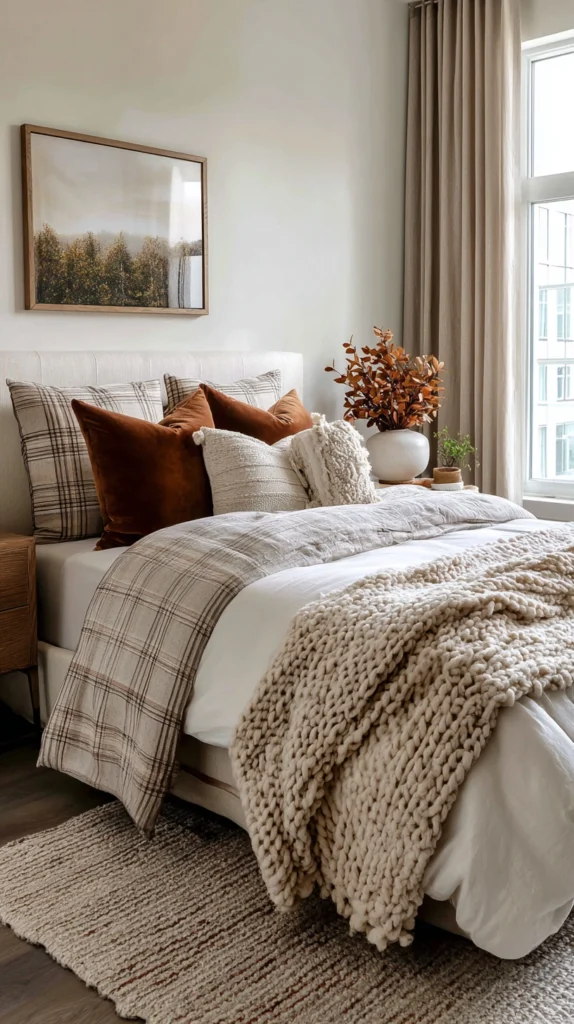
Swapping lightweight summer textiles for heavy, rich fall equivalents — the fastest bedroom transformation possible.
My year-round textile problem:
What never changed:
- Same duvet cover January through December
- Same two decorative pillows every season
- Same lightweight throw year-round
- Room looked identical regardless of the month
The textile swap system:
The philosophy:
- Two complete sets of bedroom textiles (summer and fall-winter)
- Stored in labeled bins between seasons
- Swap takes one afternoon
- Room transforms completely for under $200 the first year, free in subsequent years
What changes in the fall textile swap:
Out (summer set):
- Light percale or bamboo sheets (swap for flannel)
- Light cotton duvet cover (swap for linen or heavier fabric)
- Minimal pillow count (add more)
- Lightweight throw (swap for chunky knit or sherpa)
In (fall set):
- Flannel or warm cotton sheets
- Linen or cotton sateen duvet cover in a fall color
- Two additional decorative pillows in fall palette
- Chunky knit throw at the foot plus a smaller throw on the chair
Pillow cover swap strategy:
The most affordable textile refresh:
- Keep all existing pillow inserts (do not replace)
- Buy only new pillow covers for fall
- Covers cost $10-25 each versus $30-60 for a cover-and-insert set
- Fall covers stored flat in a bin between seasons
Fall pillow palette for the bedroom:
Specific color approach:
- Two sleeping pillows in warm white or cream (always)
- Two Euro pillows against the headboard in deep fall color (forest green, rust, charcoal)
- Two decorative pillows in a fall pattern or texture (plaid, botanical, chunky knit)
- One lumbar pillow in a warm accent
Throw placement on the bed:
Styling the foot of the bed:
- Fold in thirds and lay across the foot of the bed
- Or drape over the bed corner (more casual)
- The throw should be visible even from the doorway
- It signals warmth before anything else in the room
Curtain consideration:
The bedroom curtain swap:
- Summer: light linen sheers (cool and bright)
- Fall: heavier linen or velvet panels (darker, warmer, better light-blocking)
- Blackout lining added to any panel (clip-on, no sewing)
- Heavier curtains also reduce draft and noise
Fall curtain colors:
- Deep forest green (most impactful fall choice)
- Warm charcoal or deep taupe (sophisticated and warm)
- Burgundy or wine (richest, most evening-appropriate)
- Avoid: bright colors, prints (bedrooms benefit from solid, calm tones)
Storage for off-season textiles:
The practical system:
- Two labeled bins (Summer Bedroom, Fall-Winter Bedroom)
- Cedar blocks inside (moth prevention)
- Wash before storing (prevents set-in smells)
- Stack with the most recently used on top (ready for next season)
Cost:
- Flannel sheet set: $40-100
- Fall duvet cover: $40-120
- Three fall pillow covers: $30-75
- Chunky knit throw: $35-70
- Heavy curtain panels (pair): $50-150
- Total: $195-515 (primarily first-year cost, reused every fall)
My textile swap result: The afternoon I switched from summer to fall textiles transformed the bedroom more completely and for less money than any furniture purchase I have ever made, guests who see the room in summer and fall assume I redecorated.
Textile Tips
Wash before storing:
The non-negotiable:
- Body oils and sweat in stored textiles cause irreversible yellowing
- Always wash before storing, not after taking out
- Store clean, take out clean (no washing required before immediate use)
- This single habit extends the life of expensive textiles significantly
The throw rotation:
Keeping it looking fresh:
- Two throws at the foot of the bed (different textures, swap weekly)
- Prevents one throw from becoming visually permanent
- Each fresh appearance of a different throw makes the bed feel renewed
- Small effort, significant impression of a constantly refreshed bedroom
8. The Nightstand Vignette (The Last Thing You See Before Sleep)
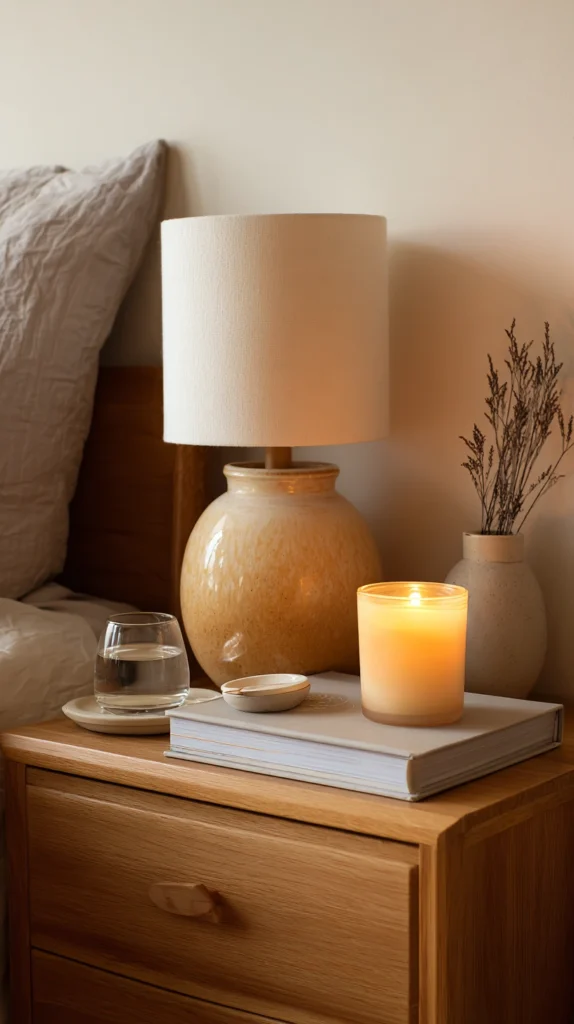
A carefully styled bedside surface that is also completely functional — the combination of beauty and utility that makes the last moments of the day pleasant.
My cluttered nightstand:
What was on it:
- Water glass (important)
- Phone charger (everywhere)
- Three books (I read one at a time)
- Old receipts, lip balm, a headphone case
- One lamp, barely visible behind the chaos
Why the nightstand matters:
The psychological impact:
- Last surface seen before closing eyes
- First surface seen upon waking
- Chaos there contributes to mental clutter at the worst time
- A calm, beautiful, intentional surface contributes to psychological rest
The nightstand vignette formula:
What belongs on a fall nightstand:
Functional essentials (cannot be removed):
- The lamp (per idea 2, warm amber)
- A glass of water or small carafe
- Current reading material (one book maximum visible)
- Phone or charger (where it must be)
Fall seasonal additions:
The beauty layer:
- One small plant or botanical element (pothos cutting, a small succulent, or dried botanical sprig)
- One LED candle (per idea 2, with timer)
- A small dish for jewelry or nighttime essentials
- One small object with personal meaning
What to remove:
Editing the nightstand:
- More than one book visible (cluttering, feels unfinished)
- Any receipts, trash, or non-bedroom items
- More than one phone or device (one maximum)
- Anything purely functional and visually ugly
The tray as organizer:
Containing the vignette:
- A small tray on the nightstand (wooden or ceramic)
- Everything functional lives within or beside the tray
- The tray creates a visual boundary
- Items inside the tray look curated, items scattered outside look abandoned
Fall nightstand objects specifically:
Seasonal touches:
- A small dried botanical sprig in a tiny vase
- One small ceramic pumpkin or gourd (minimal, not Halloween)
- A sprig of dried eucalyptus resting against the lamp base
- A small candle in a fall scent (LED, per safety rule)
The carafe and glass:
Replacing the basic water glass:
- A small glass carafe with a matching glass
- Both in warm-toned glass (amber, green, or clear)
- More beautiful than a standalone glass, holds more water
- Small upgrade, large impact on the nightstand’s visual quality
Cost:
- Small wooden or ceramic tray: $15-30
- Glass carafe and cup: $20-40
- Small dried botanical in tiny vase: $10-20
- LED candle: $8-20
- Small fall ceramic object: $10-25
- Total: $63-135
My styled nightstand result: The shift from cluttered to vignette-styled nightstand changed how I feel when I get into bed, visual calm on the last surface seen genuinely contributes to a calmer mental state, guests always comment on the nightstand before anything else in the room.
Nightstand Tips
One-in, one-out rule:
Maintaining the vignette:
- Every item added requires one item removed or relocated
- This discipline prevents drift back to cluttered status
- The vignette only works at a specific maximum density
- Weekly reset takes three minutes
Phone placement decision:
Sleep quality consideration:
- Phone on the nightstand (temptation to check in the night)
- Phone on the other side of the room (better sleep, alarm still audible)
- Phone outside the bedroom entirely (best option, requires a separate alarm clock)
- The nightstand vignette is significantly easier to maintain without a phone occupying space
9. A Statement Headboard (The Bedroom’s Largest Decorative Object)
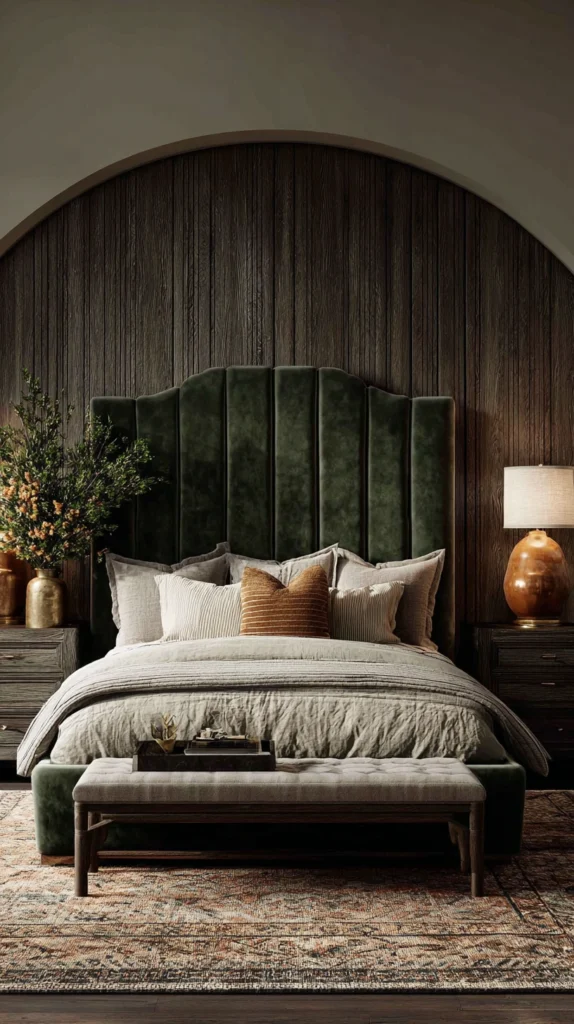
Replacing a basic headboard or adding one where none exists — the furniture piece that changes the room’s entire personality.
My no-headboard situation:
What my bed looked like:
- Mattress on a basic metal frame
- No headboard
- Pillows stacked against the bare wall
- Bed looked like a guest room that was not ready yet
Why a headboard transforms the bedroom:
The anchoring function:
- Headboard makes the bed look intentional, not temporary
- Creates a focal point for the entire room
- Defines the bed’s visual boundary (where bed ends, wall begins)
- Affects how every other element in the room relates
Fall headboard styles:
Upholstered headboard:
- Most popular and versatile
- Soft and warm (literally padded fabric)
- Fall-appropriate fabrics: velvet, bouclé, linen in earthy tones
- Available in almost every price range
Cane or rattan headboard:
- Natural material (texture and warmth)
- Works with every fall palette
- Currently very fashionable in bedroom design
- Often more affordable than fully upholstered
Reclaimed wood headboard:
- Raw and natural material
- Warm grain and imperfection
- Pairs beautifully with heavy linen bedding
- DIY-able from reclaimed barn wood
Arched headboard:
- Most current shape (arch repeating throughout as in hobbitcore idea)
- Available in every material (upholstered, wood, cane)
- Draws the eye upward (makes ceilings feel taller)
- Pairs with the arched mirror referenced elsewhere
Paneled wall as headboard:
No actual headboard:
- The vertical slat paneling from idea 3 replaces a physical headboard
- Sconces mounted on the panel replace bedside lamps
- The panel itself reads as a headboard without the physical piece
- Often more dramatic than a traditional headboard
Sizing:
Getting the proportion right:
- Headboard should be wider than the mattress (queen bed, headboard 66-70 inches)
- Height: minimum 24 inches above the mattress top for king or queen beds
- Tall headboards (48-60 inches above mattress): most dramatic option
- Low headboards: more casual, works in low-ceiling rooms
Fall color and material pairings:
Most fall-appropriate combinations:
- Rust velvet headboard with cream bedding
- Forest green linen headboard with natural bedding
- Warm cognac leather with chunky knit throw
- Warm wood with linen layers
Cost:
- Budget (IKEA MALM or basic upholstered): $80-200
- Mid-range upholstered: $200-500
- Quality velvet or bouclé: $400-800
- Reclaimed wood DIY: $80-200 in materials
- Total range: $80-800
My velvet headboard result: A deep forest green velvet arch headboard turned what felt like a sleeping space into a sanctuary, the velvet in evening lamp light is extraordinary, the single most transformative furniture purchase in the bedroom.
Headboard Tips
Mounting height:
The critical measurement:
- Headboard bottom flush with or slightly above mattress top
- Too high: pillows float in a gap between mattress and headboard
- Too low: headboard disappears behind pillows
- Test height before final mounting
Velvet care:
Maintaining the finish:
- Velvet has a nap (directional pile)
- Brush gently in one direction periodically
- Avoid getting wet (water marks velvet)
- Rotate or reorganize any pillow placement that crushes the velvet repeatedly
10. Plants and Botanicals for Fall Sleep (Green Elements That Work at Night)
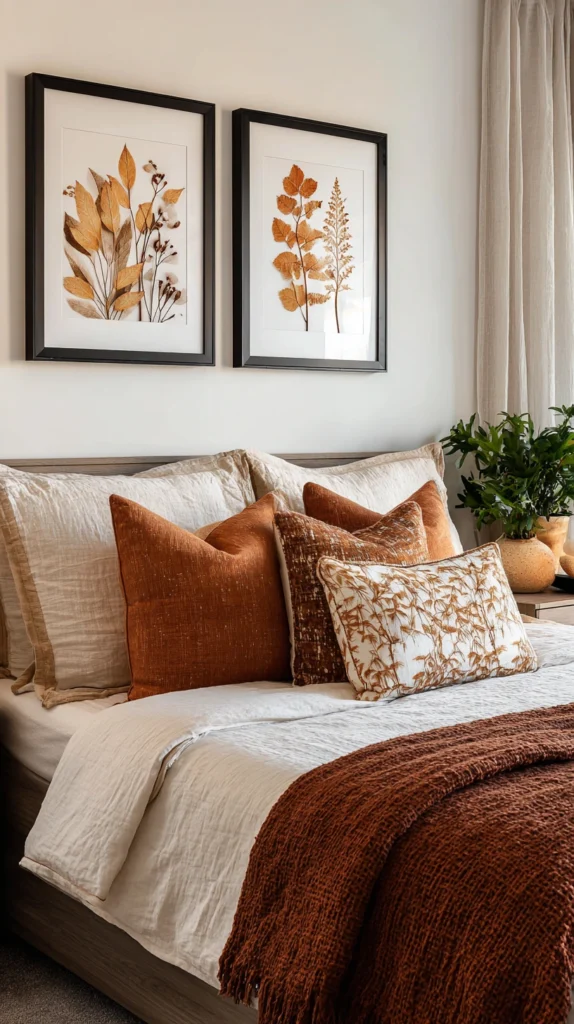
Specific plants chosen for air quality and calm, plus dried botanicals for seasonal warmth — the living and dried layer that connects the bedroom to the season.
My plant-free bedroom:
Why I had avoided plants:
- Heard that plants release CO2 at night (partially true but overstated)
- Worried about maintenance adding stress
- Never considered plants as part of a sleep environment
- Both concerns resolved with the right plant selection
The CO2 concern addressed:
The science:
- Some plants do release small amounts of CO2 at night (photosynthesis pauses)
- The amount is negligible compared to the CO2 exhaled by a sleeping human
- Several plants specifically do the opposite: release oxygen at night
- These night-oxygen-releasing plants are the ones to choose
Best bedroom plants for fall:
Night oxygen releasers:
- Snake plant (most recommended, virtually indestructible, releases oxygen at night)
- Aloe vera (releases oxygen at night, prefers bright light but tolerates indirect)
- Pothos (near-indestructible, air purifying, requires minimal light)
Air-purifying specifically:
- Peace lily (removes airborne toxins, prefers low light, beautiful in fall)
- Spider plant (highly effective air purifier, easy to maintain)
- English ivy (powerful air purifier, drapes beautifully from a shelf or nightstand)
Fall-appropriate plant aesthetics:
Plants that look like fall:
- Rubber plant (dark burgundy-green leaves, most fall-appropriate leaf color)
- Burgundy oxalis (deep purple-red foliage, unmistakably autumnal)
- Croton (orange and red variegated leaves, literal fall color palette)
- ZZ plant (deep green, glossy, dramatic and low-maintenance)
Placement for fall bedroom:
Where bedroom plants go:
- On the nightstand (one small plant, grounding presence beside the lamp)
- On a shelf or dresser (mid-height, visible from the bed)
- Floor corner beside the reading chair (large statement plant)
- On the windowsill (the most light, best for plants that need it)
Pot selection for fall:
Container aesthetics:
- Terracotta (always appropriate, warm and natural)
- Deep-glazed ceramic in earthy tones (forest green, rust, dark brown)
- Woven basket pot cover (warm texture, hides utilitarian nursery pot)
- Avoid: white geometric modern planters (wrong temperature for fall bedroom)
Dried botanicals in the bedroom:
Beyond live plants:
- A small bunch of dried lavender on the nightstand (scent plus visual)
- Dried eucalyptus sprig behind the lamp (architectural, fragrant)
- A single dried pampas grass stem in a small vase (texture without maintenance)
- Pressed botanical framed above the reading chair (permanent, beautiful)
Cost:
- Snake plant (medium): $15-35
- One or two smaller supporting plants: $10-25 each
- Terracotta or ceramic pots: $8-20 each
- Dried botanicals (lavender, eucalyptus): $10-25
- Total: $43-130
My bedroom plant result: The snake plant on the dresser and the trailing pothos near the reading corner made the room feel genuinely alive rather than just decorated, the rubber plant’s dark leaves are unexpectedly perfect for fall, sleep quality improved in the first week of having plants (possibly the oxygen, possibly the calming psychological effect of living things, likely both).
Bedroom Plant Tips
Low maintenance is the requirement:
The bedroom plant test:
- Any plant that requires daily attention is wrong for a bedroom
- The bedroom should reduce stress not add plant-care obligations
- Snake plant, ZZ plant, and pothos: water every 2-3 weeks
- These three choices require almost nothing and deliver consistently
Humidity benefit:
An overlooked fall advantage:
- Heating systems in fall dry the air significantly
- Dry air disrupts sleep (nasal passages, throat)
- Plants add modest humidity to the air
- A small humidifier beside the plant grouping amplifies this effect
11. The Bedroom Scent Wardrobe (Dedicated Fall Fragrance Storage)
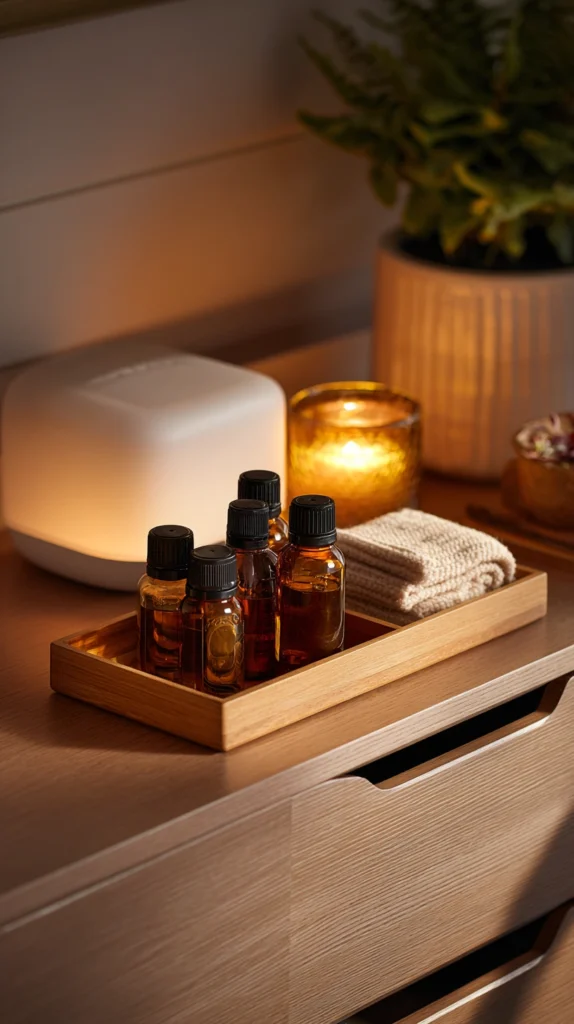
Organizing all bedroom fragrances in one beautiful, accessible display — the functional decor piece that keeps the scent system working consistently.
My scattered fragrance problem:
What the fragrance situation looked like:
- Essential oils in a drawer (forgotten)
- Pillow spray on the floor beside the bed (ugly)
- One candle on the nightstand (wasted space there)
- Diffuser tucked away (barely used because inconvenient)
Why accessibility matters for the sleep routine:
The psychology of use:
- Objects stored out of sight stop being used within a week
- Objects displayed and accessible get used automatically
- A beautiful display of the fragrance system makes it part of the routine
- The display itself becomes a calming visual element
The scent wardrobe concept:
A dedicated small tray or shelf:
- One spot in the bedroom for all sleep-related fragrance items
- Styled like a perfume tray or apothecary display
- Beautiful enough to be seen, accessible enough to be used nightly
What to include:
The fall sleep scent collection:
- One ultrasonic diffuser (center, the functional anchor)
- Three to four essential oils in their original bottles (styled upright)
- One pillow spray (in a beautiful small bottle)
- One small sachet or dried lavender bundle
- One small fall-scented candle (LED, decorative, adjacent to the system)
Display options:
Where the scent wardrobe lives:
- The dresser top (most space, most visible)
- A small floating shelf dedicated specifically to this
- A corner of the nightstand (if space allows)
- On a small decorative tray that unifies the collection
Tray selection:
Containing the display:
- Wooden tray (warm, natural, appropriate to fall)
- Marble slab (elegant, contrast to organic oils)
- Woven tray (textural, cottage-core adjacent)
- All items within the tray read as a collection not a scatter
Fall fragrance rotation:
Within the scent wardrobe:
- Keep three to four fall-specific oils or sprays available
- Rotate every two weeks (prevents olfactory habituation)
- Too consistent: nose stops registering the scent
- Regular slight variation maintains effectiveness while building seasonal association
Labeling beautifully:
Making it functional and styled:
- Small labels on oil bottles if original labels are ugly
- A small card listing the blend recipe
- Adds the apothecary quality that makes the display compelling
Cost:
- Wooden or marble tray: $15-35
- Small shelf if adding one: $20-40
- Essential oil selection: $20-45
- Pillow spray: $10-25 (or DIY for $8)
- Small decorative element on tray: $10-20
- Total: $55-125
My scent wardrobe result: Everything visible and organized on the dresser, the diffuser gets used every single night now compared to occasionally when it was hidden in a cabinet, the tray display itself was the first thing complimented by a guest staying in the room.
Scent Wardrobe Tips
The diffuser as the center:
Placement principle:
- Diffuser sits centrally (it is the functional anchor)
- Everything else arranged around it
- The display hierarchy mirrors the use hierarchy
- Visual center equals functional center
Refilling ritual:
Making maintenance part of the routine:
- Keep a small bottle of distilled water on the tray
- Refill the diffuser as part of the evening routine
- Two-minute task that becomes automatic
- Ritual builds a stronger behavioral association with rest
12. A Bedroom Canopy or Draped Ceiling Treatment (The Enclosure That Transforms Everything)
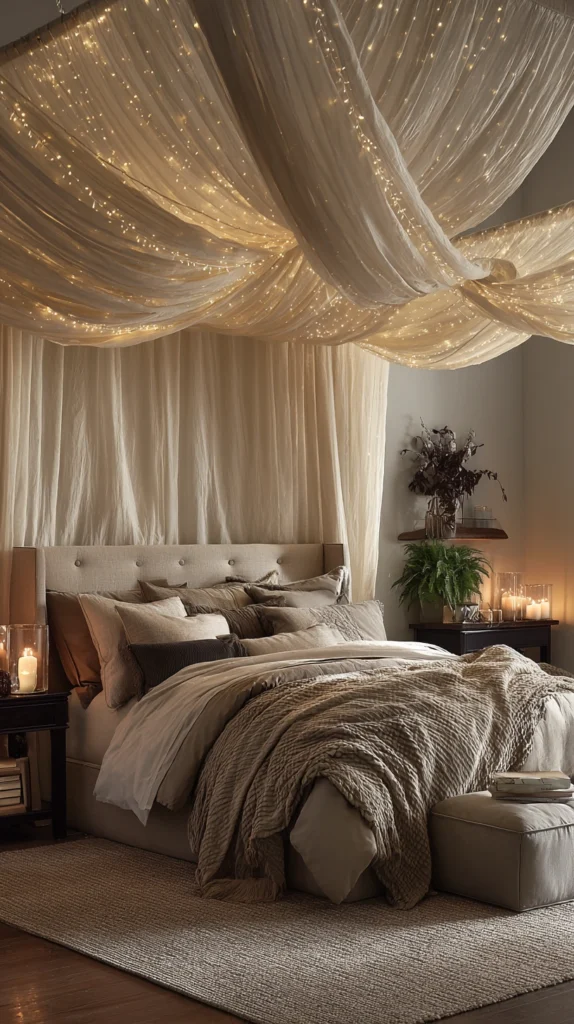
Fabric or string lights creating a canopy effect above the bed — the treatment that makes the bed feel like a specific, sheltered destination.
My open ceiling problem:
What was missing:
- Bed was open to the full ceiling above (8 feet)
- No sense of enclosure or nestling
- The sleep space had no boundary overhead
- Missing the psychological shelter that improves sleep
Why enclosure improves sleep:
The nest psychology:
- Humans instinctively sleep better with overhead shelter
- Four-poster beds and canopies have existed for millennia for this reason
- A canopy treatment creates the psychological equivalent of a nest
- Enclosed space signals safety to the brain’s sleep-governing systems
Canopy options:
Fabric canopy panel:
- A single large piece of fabric hung from the ceiling directly above the bed
- Falls on all four sides (fully enclosed feeling)
- Or falls on two sides from a wall mount (more accessible for most ceilings)
- Most dramatic option
Sheer curtain canopy:
- Four sheer panels hung from ceiling hooks at each corner of the bed
- Sheers do not block view but create the visual enclosure
- Most romantic and traditional interpretation
- Works in any room height
Baldachin or crown canopy:
- A decorative crown mounted to the ceiling above the headboard
- Fabric hangs down from the crown on two sides
- Most formal option
- Beautiful with velvet or linen panels
String light canopy:
- Warm fairy lights hung across the ceiling above the bed in a grid
- Creates visual ceiling without any fabric
- Most flexible and easiest to install
- Set on a timer (on when getting ready for bed, off when sleeping)
The renter-friendly approach:
No ceiling drilling:
- Tension rod between walls (works in narrow rooms)
- Fishing line and removable adhesive ceiling hooks
- Canopy hung from the headboard itself rather than the ceiling
- Sheer fabric draped over a curtain rod behind the headboard
Fall fabric for canopies:
Material selection:
- Sheer linen or cotton gauze (lightest, most romantic)
- Heavier linen (more fall-appropriate, warmer visual)
- Velvet panel on the back side only (richest, most dramatic)
Fall colors for canopies:
Appropriate tones:
- Warm cream or ivory (most versatile, works with every palette)
- Dusty rose or blush (romantic, soft)
- Deep burgundy or forest green panels (most dramatic, specific fall commitment)
- Avoid: pure white (too crisp), bright colors (stimulating not calming)
String light canopy grid:
Installation for string lights:
- Measure ceiling area above the bed
- Install adhesive ceiling hooks at the four corners and intervals
- String warm white lights (2200K) in parallel lines from one side to the other
- Plug into a smart plug with a timer
Cost:
- Sheer curtain panels (four): $40-100
- Ceiling hooks and hardware: $10-25
- String light canopy: $20-40 in lights
- Fabric panel canopy (DIY): $40-100 in fabric
- Crown canopy mount: $60-150
- Total: $40-175
My string light canopy result: The grid of warm fairy lights above the bed changed the bedroom from a functional room into a sanctuary, the 8-foot ceiling appeared to lower to 6 feet (in the best possible way), guests who see the bedroom photograph it immediately.
Canopy Tips
Light on a timer:
The string light rule:
- String light canopy must be on a timer (smart plug, $12)
- Lights on at 8pm (creates the atmosphere for wind-down)
- Lights off at 10pm or midnight (no disturbance during sleep)
- This automated sequence removes any decision fatigue
Weight of hanging fabric:
Ceiling load consideration:
- Adhesive hooks have weight limits (check rating before use)
- Heavier fabric needs more substantial anchoring (stud-mount hooks)
- Sheer and lightweight fabric safe for adhesive hooks rated at 5 lbs
- Velvet and heavier fabrics require proper ceiling anchoring
13. The Fall Bedroom Gallery Wall (Warming the Walls While You Sleep)

A curated arrangement of artwork on one or two bedroom walls — the visual warming of surfaces that surround sleep.
My bare bedroom walls:
What I had rationalized:
- “The bedroom is for sleeping, not looking at art”
- Walls completely bare except for the headboard wall treatment
- Room felt unfinished every time I entered
- Missing the warmth that art brings to a sleeping space
Why art in the bedroom:
The visual environment during waking hours:
- The bedroom is experienced for approximately two to three hours of waking time daily
- Getting ready in the morning, reading at night, dressing
- Bare walls affect that experience despite the time being brief
- Art that feels personal and warm significantly changes how the room feels during those hours
Bedroom gallery wall approach:
Smaller and more intimate than living room:
- Living room gallery: bold, many pieces, seen from distance
- Bedroom gallery: smaller, more personal, seen up close
- The bedroom warrants art that would be too quiet for a living room
- Intimate subject matter, smaller scale, personal significance
What to hang in a fall bedroom:
Subject matter:
- Botanical prints (pressed flower, vintage illustration)
- Landscape photography in warm tones (golden fields, forest paths)
- Abstract art in the room’s fall palette (rust, olive, warm cream)
- Personal photographs in warm frames
- A small framed piece of meaningful text or poetry
Frame selection:
Bedroom frames:
- Warm wood (natural or walnut-stained)
- Aged brass or gold
- All frames in the bedroom from the same finish family
- Never: chrome, modern geometric, conflicting finishes
Gallery wall placement:
Where in the bedroom:
- Above the dresser (most common, naturally a display surface)
- Beside the reading corner chair (seen during reading time)
- On the wall opposite the bed (seen from bed while waking)
- Never on the headboard wall (competes with the main treatment from idea 3)
The fall palette for bedroom art:
Color in bedroom art:
- Warm tones only (rust, ochre, cream, olive, warm brown)
- Nothing with cool blues or stark contrast
- Art with organic shapes (botanical, landscape)
- Muted and soft, not graphic and bold
Sourcing bedroom art:
Finding the right scale and tone:
- Print your own from free art archives (Art Institute Chicago, Rijksmuseum collections)
- Print at office supply store: $5-15 per piece
- Thrift frames and reframe existing prints
- Etsy prints in digital form ($5-15), print locally
Hanging arrangement:
Bedroom gallery layout:
- Horizontal row above dresser (most organized, easiest to execute)
- Staggered arrangement beside the chair (more casual, collected feeling)
- All centered at 57-60 inches from floor (gallery standard)
- Consistent spacing (3-4 inches between frames in bedroom)
Cost:
- Art prints (print your own, five pieces): $25-75
- Thrifted frames for all five: $25-50
- Total: $50-125
My bedroom gallery result: Five small botanical prints in warm wood frames above the dresser added more warmth to the bedroom than the mirror that had been there before, the scale of the art matched the intimate quality of the space, botanical subjects feel appropriate for a bedroom in a way that other subjects sometimes do not.
Bedroom Gallery Tips
Keep the scale intimate:
Bedroom versus living room art:
- Living room: 24×36 or larger prints make sense
- Bedroom: 8×10 or 5×7 prints feel correctly scaled
- Large prints in a bedroom feel like a statement rather than a sanctuary
- Intimacy of scale matches intimacy of the space
Personal photographs specifically:
Why they belong in the bedroom:
- The bedroom is the most private room in the home
- Personal photographs here feel appropriate, not self-indulgent
- Fall-toned frames around meaningful images
- The bedroom should reflect the people who sleep in it
14. The Complete Fall Bedroom Scent, Sound, and Temperature System (The Total Sleep Environment)
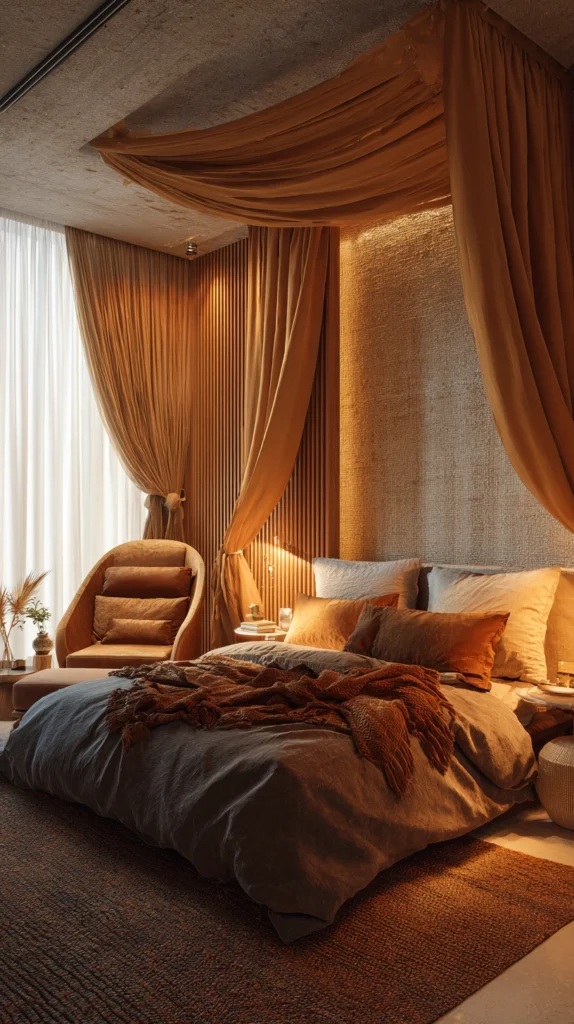
The final integration of scent, white noise, and temperature control — the invisible trifecta that determines actual sleep quality.
My piecemeal environment:
What I had addressed separately:
- Scent: covered partially (idea 6)
- Light: covered (idea 2)
- Bedding: covered (ideas 1, 5, 7)
- Temperature: never deliberately addressed
- Sound: never deliberately addressed
The complete system:
Why these three work together:
- No single element determines sleep quality alone
- All three interact: scent conditioning works better in the right temperature
- White noise masks disruption that light and temperature cannot address
- Together they create an environment where the body genuinely relaxes
Temperature control:
The optimal sleep temperature:
- 65-68 degrees Fahrenheit (most research agrees on this range)
- Body needs to drop 1-2 degrees in core temperature to initiate sleep
- A cool room facilitates this temperature drop
- Fall naturally provides this through cooling outdoor air
Practical temperature management:
For fall specifically:
- Open window slightly before bed (fresh cool air)
- Layer bedding (rather than set thermostat high)
- Heated mattress pad on low (warms the bed itself, not the room)
- Wool bedding (regulates temperature naturally)
The heated mattress pad:
Fall-specific comfort:
- Warms the bed before entering (psychological comfort signal)
- Set on a timer (warm before sleep, off after an hour)
- Wool mattress topper alternative (natural temperature regulation, no electricity)
- Brands: Sunbeam, Biddeford (budget), Sleep Number (investment)
- Cost: $40-150
White noise or sound management:
Why sound matters:
- Fall brings wind, rain, and heating system sounds
- Partner breathing, outside traffic, building sounds
- Consistent background sound masks variable disruptive sounds
- More effective than silence in most living environments
White noise options:
Sound sources:
- Dedicated white noise machine (most consistent)
- Fan (creates white noise plus mild air circulation)
- Streaming app (Calm, Rain Rain, White Noise app)
- Brown noise (deeper, warmer than white, preferred by many for fall)
Fall sound specifically:
Beyond standard white noise:
- Rain sounds (most popular, matches fall weather)
- Crackling fire (matches the fireplace reference throughout)
- Wind through trees (nature-connected, grounding)
- Distant thunderstorm (more dramatic, personally polarizing)
Recommended sound machines:
Budget to investment:
- LectroFan ($50-70): most adjustable, excellent quality
- Dohm by Yogasleep ($45-65): mechanical fan-based, most consistent
- Hatch Rest ($80-130): light plus sound plus timer in one device
- Phone app: free (but phone in the bedroom undermines sleep, trade-off to consider)
The integration:
The full fall sleep environment sequence:
One hour before sleep:
- Overhead light off (amber lamps only)
- Diffuser on (cedarwood and lavender blend)
- Reading corner activated (idea 4)
- Herbal tea prepared
Thirty minutes before sleep:
- Heated mattress pad on (warms the bed)
- White noise machine on
- String light canopy timer activates
- Pillow spray applied
At sleep time:
- Move from reading chair to bed
- Layered bedding system in use (adjust as needed)
- Heated mattress pad turns off (timer)
- String lights turn off (timer)
- White noise continues throughout the night
This sequence:
- Takes no willpower after two weeks (fully habitual)
- Creates approximately 20 behavioral cues signaling sleep
- The cumulative effect far exceeds any single change
Cost:
- White noise machine: $45-130
- Heated mattress pad: $40-150
- Temperature management (minor adjustments): $0-30
- Total: $85-310
My complete system result: The individual changes each helped. The complete system together produced the best sleep of my adult life. The sequenced ritual removed almost all sleep-onset difficulty, and the scent conditioning now works so powerfully that the smell of cedarwood alone begins to make me drowsy.
Complete System Tips
Build the habit before assessing:
The two-week rule:
- Sleep habits take two weeks to show measurable improvement
- Assess the complete system after 14 consistent nights
- Any individual night may not represent the pattern
- Consistency is the variable that most determines outcome
Logging sleep to track improvement:
Simple assessment:
- Note sleep onset time (when you think you fell asleep)
- Note wake time and quality (rested, partially rested, unrestored)
- Note any mid-night waking
- After two weeks, compare to the same notes kept before the system was implemented
- Most people see measurable improvement in at least two of the three metrics
Choosing Your Fall Bedroom Priority
By sleep impact (highest to lowest):
Prioritize these first:
- Warm amber lighting (idea 2): most direct sleep quality impact
- Layered bedding system (idea 1): physical comfort and temperature regulation
- Bedroom scent and aromatherapy (idea 6): biochemical sleep support
- Complete environment system (idea 14): integrating all the elements
- Weighted blanket (idea 5): most researched physical sleep aid
Then add these:
- Reading corner (idea 4): behavioral sleep hygiene improvement
- Seasonal textile refresh (idea 7): fastest visual transformation
- Plant selection (idea 10): air quality and psychological calm
Finally the aesthetic elements:
- Headboard wall treatment (idea 3)
- Statement headboard (idea 9)
- Canopy treatment (idea 12)
- Nightstand vignette (idea 8)
- Bedroom gallery wall (idea 13)
- Scent wardrobe (idea 11)
By budget:
Under $100:
- Warm bulb replacement throughout ($20)
- Pillow spray DIY ($8-15)
- Nightstand vignette reorganization ($20-40)
- One fall throw blanket ($35-70)
$100-300:
- Flannel sheet swap plus fall duvet cover
- Weighted blanket
- White noise machine
- Plant selection and botanicals
$300-600:
- Reading corner (secondhand chair)
- Headboard wall paint
- String light canopy
- Full textile refresh
$600+:
- Statement velvet headboard
- Full bedroom gallery wall
- Heated mattress pad plus complete sound system
- New statement bedside lamps plus smart lighting
By room starting point:
Already has decent bedding:
- Focus on lighting (idea 2) and scent (idea 6) first
- These do the most for sleep quality when bedding is adequate
Already has warm lighting:
- Layer the bedding system more deeply (idea 1)
- Add the weighted blanket (idea 5)
- Build the reading corner (idea 4)
Starting from scratch:
- Warm the light, layer the bedding, add one fall scent
- Everything else builds from this foundation
Maintenance Through Fall
Weekly (10 minutes):
- Refresh the pillow spray or refill diffuser
- Reset the nightstand vignette
- Launder the throw blanket (if used heavily)
- Water bedroom plants
Monthly:
- Wash the duvet cover and pillow covers
- Refresh the dried botanicals
- Assess bedding layers (getting too warm or still too cold as fall deepens)
- Clean the diffuser per manufacturer instructions
End of fall (late November):
- Store fall-specific textiles (labeled bin)
- Keep weighted blanket and amber lighting year-round
- Transition dried botanicals to evergreen elements
- Assess what worked for sleep and what to replicate next fall
My Complete Fall Bedroom Build
What I changed over two falls:
Fall one, week one ($65):
- Replaced all bulbs with 2200K warm amber
- Turned overhead off permanently at 9pm
- Immediate sleep improvement in the first week
Fall one, week three ($140):
- Flannel sheets
- Fall duvet cover in deep rust
- Chunky knit throw at foot of bed
- Room looked and felt like fall for the first time
Fall one, month two ($180):
- Weighted blanket (Bearaby in olive)
- Cedarwood and lavender diffuser routine
- Nightstand vignette organization
- Sleep onset time dropped from 40 minutes average to 12 minutes
Fall two ($380):
- Reading corner (secondhand velvet chair, $90)
- Headboard wall in Farrow and Ball Mole’s Breath
- String light canopy above the bed
- White noise machine
- Complete sleep environment system
Total investment: $765 across two falls Sleep quality change: Most significant improvement since college Main lesson: Lighting and scent improved sleep before anything looked different, beauty followed function
Getting Started This Week
Start with the light, not the look.
This week:
Day one — Replace the bulbs ($20):
- Every bulb in the bedroom replaced with 2200K warm amber
- Overhead on a dimmer or removed from the routine entirely
- The room looks different tonight, sleep improves within three nights
Day two — Make the pillow spray ($8):
- Small spray bottle, distilled water, 15 drops lavender essential oil
- Spray on pillow before getting into bed
- Begin building the olfactory conditioning immediately
Day three — Switch to flannel sheets if possible ($40-60):
- Or at minimum, add one more throw blanket to the bed
- Physical warmth and weight change how quickly sleep arrives
Day seven — Assess and plan:
- After one week of amber light and lavender pillow spray
- Note sleep onset time and quality
- Decide what to add next based on what still feels missing
My recommendation:
The non-negotiables first:
- Amber bulbs ($20)
- Pillow spray ($8)
- One additional blanket layer ($35-70)
- Total: under $100
- Sleep improvement: measurable within one week
Everything else adds to a foundation that already works. The bedroom does not need to look different to sleep better. But once sleep is better, making it beautiful becomes something to look forward to rather than a luxury.
Now go build the fall bedroom that pulls you toward sleep instead of pushing you away from it.
Quick Summary
The 14 fall bedroom ideas:
Sleep-first ideas (highest direct impact on rest):
- Layered bedding system (idea 1): adjustability and physical comfort
- Warm amber lighting (idea 2): biological sleep support
- Bedroom scent and aromatherapy (idea 6): biochemical relaxation
- Weighted blanket (idea 5): deep pressure stimulation
- Complete sleep environment system (idea 14): integrating everything
Behavioral sleep support:
- Reading corner (idea 4): pre-sleep wind-down zone
- Nightstand vignette (idea 8): last surface seen before sleep
Seasonal and aesthetic:
- Seasonal textile refresh (idea 7): fastest room transformation
- Headboard wall treatment (idea 3): most impactful single visual change
- Statement headboard (idea 9): anchoring the room’s personality
- Bedroom plants and botanicals (idea 10): living elements and air quality
Details and finishing:
- Scent wardrobe (idea 11): fragrance system that actually gets used
- Bedroom canopy (idea 12): overhead enclosure and psychological shelter
- Fall bedroom gallery wall (idea 13): warming the walls during waking hours
The non-negotiable rules:
Always:
- Warm amber light (2200-2700K) from the moment the overhead goes off
- Overhead light off at least one hour before sleep
- Natural fiber bedding (cotton, linen, wool — not polyester)
- Scent consistent every night for olfactory conditioning to work
Never:
- Cool white light in the bedroom after 7pm
- Phone on the nightstand where it can be checked at night
- A single flat layer of bedding (layering is the system)
- Overhead on full brightness at any point in the evening
The sleep quality formula:
Amber light + layered natural bedding + consistent sleep scent + cool room temperature + white noise = the sleep environment that works with the body not against it.
Common mistakes:
- Changing only the aesthetics without addressing the light (looks better but sleeps the same)
- Using synthetic fiber bedding (traps heat unevenly, disrupts sleep)
- Inconsistent scent use (prevents the olfactory conditioning that makes it work)
- Bright overhead light until the moment of getting into bed (most common, most impactful mistake)
- Weighted blanket too heavy for body weight (uncomfortable not comforting)
- Reading on a phone in bed rather than a book in the reading corner (blue light plus behavioral bed-activity confusion)
- Skipping the layered system for one heavy duvet (no temperature adjustment without fully waking)
- Art and decor chosen only for appearance not for calming effect (stimulating art in a bedroom is counter-productive)
Remember: The amber light change costs twenty dollars and improves sleep within three nights making it the single most effective investment on this entire list, the lavender pillow spray takes two minutes to make and begins working in two weeks of consistent use, layered bedding is a system not just more blankets and each layer serves a specific temperature regulation purpose, the reading corner works only if it is actually used for reading not scrolling so the no-phone rule is the piece most people resist and the piece most essential to the benefit, a cozy fall bedroom is ultimately a sleep environment first and a beautiful room second and the best ones are both simultaneously.