13 Stylish Cabana and Pool Shade Ideas to Turn Your Backyard Into a Luxury Lounge
There is a specific quality that the best pool environments possess and that most backyards with pools do not. It is not the size of the pool or the colour of the water or the quality of the paving. It is the sense that the space around the pool has been designed for the people using it — that somewhere to get out of the sun has been considered, that a place to sit with a drink has been provided, that the transition between the water and the land has been thought about rather than simply paved over.
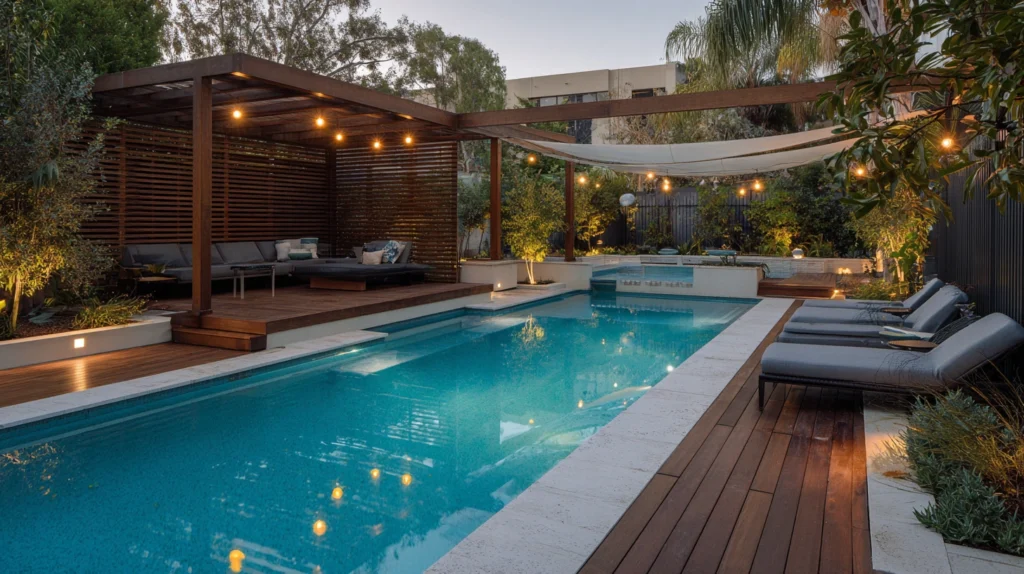
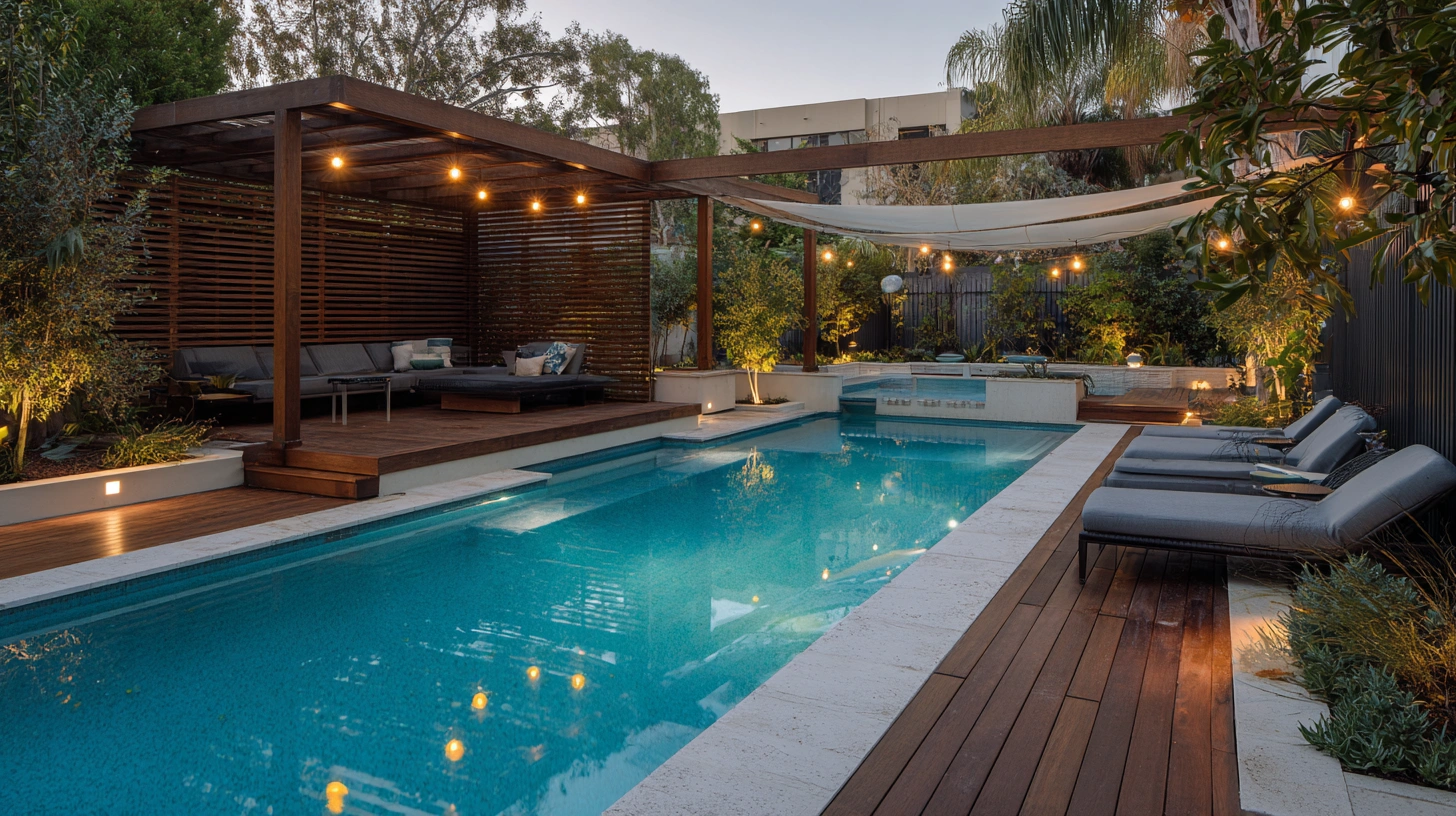
A pool without shade is an exercise facility. A pool with a well-considered cabana, a sail shade, a canopy, or a planted enclosure is a resort — a place where the afternoon can be spent without the sun making it unpleasant, where the lounger is in shadow at the right time of day, where the cold drink stays cold because it is not sitting in direct sun on a concrete coping.
Each idea below addresses the area around the pool rather than the pool itself, because the pool is already there and it is the surround that determines how it is experienced. Each includes what you will need, what it will cost, and a practical tip to make the whole thing work as well as the luxury it is reaching for.
1. The Classic Timber Cabana
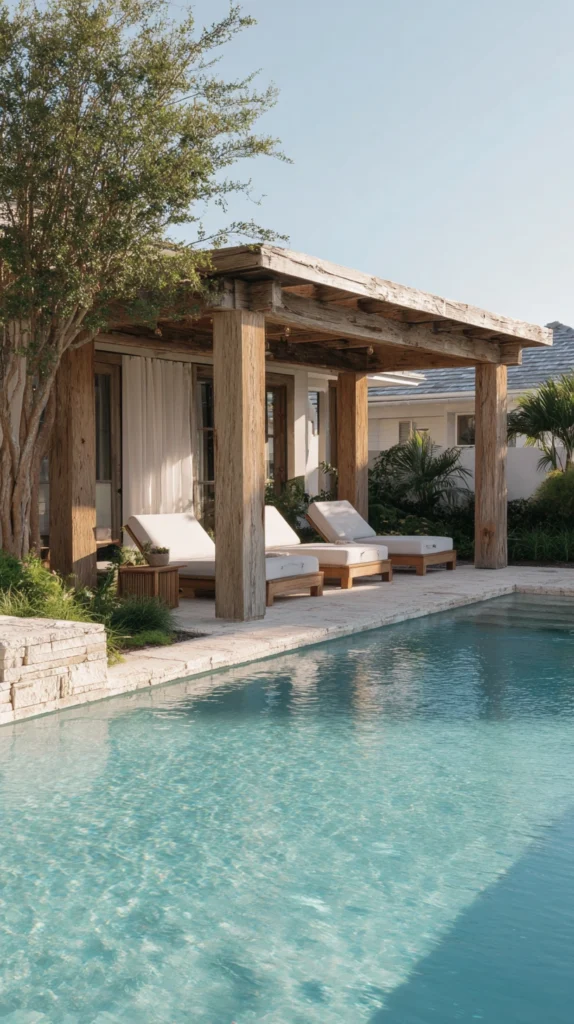
Budget: $500 – $3,000
A purpose-built timber cabana at the pool edge — a covered structure with an open front, bench seating or sun loungers inside, and a defined floor of decking or stone — is the most complete pool shade solution available and the one that most directly produces the resort quality that a well-designed pool area should have. It is simultaneously a shade structure, a changing area, a social space, and a visual anchor for the entire pool surround.
A basic freestanding timber cabana structure in a 3 by 3 metre footprint costs $500–$1,500 in materials and basic construction. A more considered version with a cedar shingle roof, built-in bench seating, and a decked floor runs $1,500–$3,000. The positioning of the cabana relative to the pool determines its value — a cabana on the western side of the pool provides afternoon shade at the time of day when the sun is most direct and the shade is most needed. A cabana on the eastern side provides morning shade at the time when the pool is coolest and most inviting.
Style tip: Furnish the cabana before assessing whether it needs structural additions. A bare timber structure looks unfinished and temporary regardless of its quality; the same structure with a pair of sun loungers, an outdoor rug, a side table, and a string of lights overhead looks complete and genuinely luxurious at a cost that is a fraction of any structural addition. The furnishing is the transformation, and the structure is only the frame it happens within.
2. The Sail Shade System
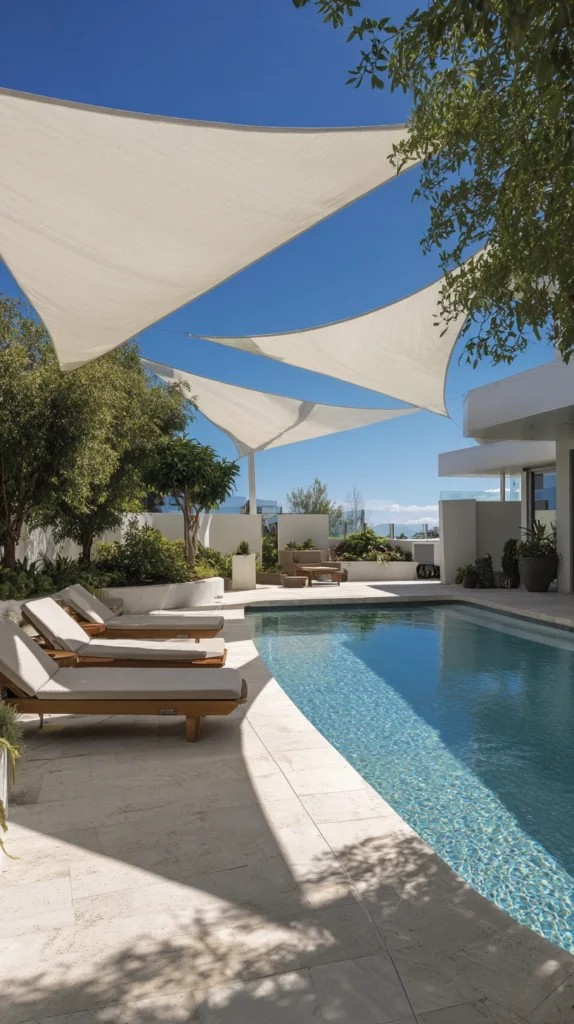
Budget: $60 – $400
A tensioned shade sail — or a system of two or three overlapping sails at different heights — provides flexible, architectural shade over the pool deck without the visual bulk of a pergola or the permanence of a built structure. Shade sails filter rather than block the sun, maintaining the brightness that makes a pool area pleasant while reducing the direct heat that makes it unbearable. A well-positioned sail system covers the lounger area through the hottest hours and leaves the pool itself open to the sky.
A triangular shade sail of 3.6 metres per side costs $30–$80. A rectangular version at 3 by 4 metres runs $50–$150. Stainless steel anchor hardware — D-rings, turnbuckles, and wall plates — costs $25–$50 for a complete set. Angle each sail so it is higher on one side than the other — a level sail collects water at its centre during rain and the accumulated weight strains the fixing points permanently. An angled sail sheds water to the lower edge and maintains the tension that keeps it effective.
Style tip: Use a high-density UV-blocking fabric rather than the standard weight. Pool deck shade sails carry a specific requirement that garden shade sails do not — the reflected UV from the pool water surface adds to the direct UV from above, and a sail that blocks 90 percent of UV from above while the pool surface reflects a further 20 percent upward provides considerably less protection than the single figure suggests. A 95-percent UV-block rating is the appropriate specification for a pool deck shade sail.
3. The Pergola with Retractable Canopy
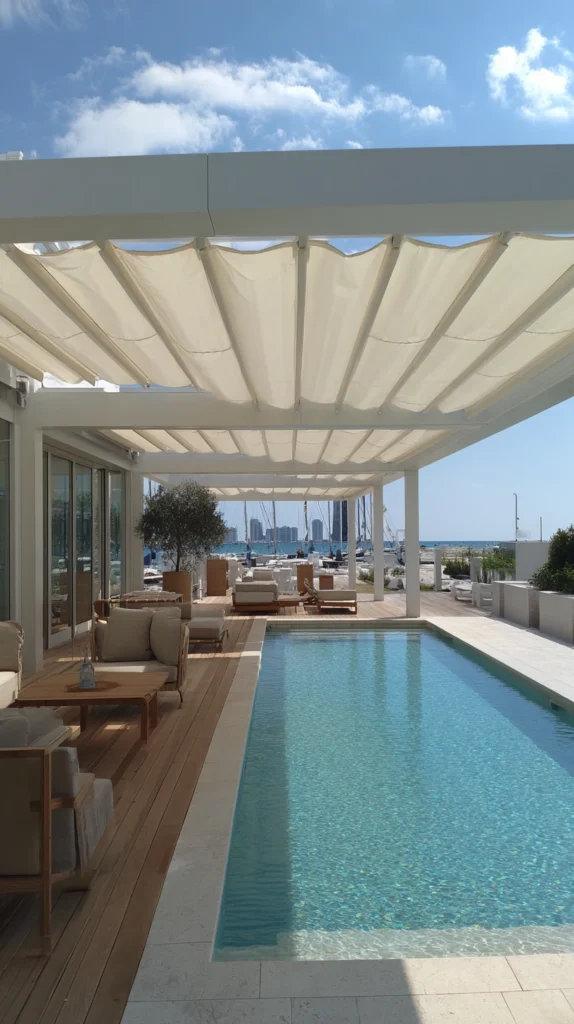
Budget: $400 – $2,500
A pergola frame fitted with a retractable canopy — fabric that rolls or folds back when shade is not needed and extends to full cover when the sun is direct — provides the most controllable shade solution for a pool deck that is used across a full day. Open canopy in the morning when the pool is inviting, extended canopy in the afternoon when the sun reaches its full intensity, open again in the evening when the light is golden and the temperature has dropped: the retractable system provides shade precisely when it is needed and absent when it is not.
A freestanding pergola frame of 3 by 4 metres costs $300–$800. A manual retractable canopy kit for the frame runs $150–$400. A motorised version with a remote control adds $200–$500 to the canopy cost and is worth considering for a regularly used pool area where the canopy is adjusted multiple times daily. Use a solution-dyed acrylic canopy fabric rather than polyester — acrylic retains its colour under sustained UV exposure considerably longer, and a canopy above a pool deck that fades and bleaches within two seasons requires replacement at a cost that makes the initial saving on fabric irrelevant.
Style tip: Install the canopy fabric with a slight slope rather than horizontally — a 5-degree pitch toward the garden rather than toward the pool ensures that rain water sheds away from the pool deck rather than dripping onto it. A retractable canopy that directs rain onto the pool deck is a canopy that cannot be left extended during light rain, which limits the shelter it provides in the transitional weather of early and late season when shelter is most needed.
4. The Louvred Pergola System
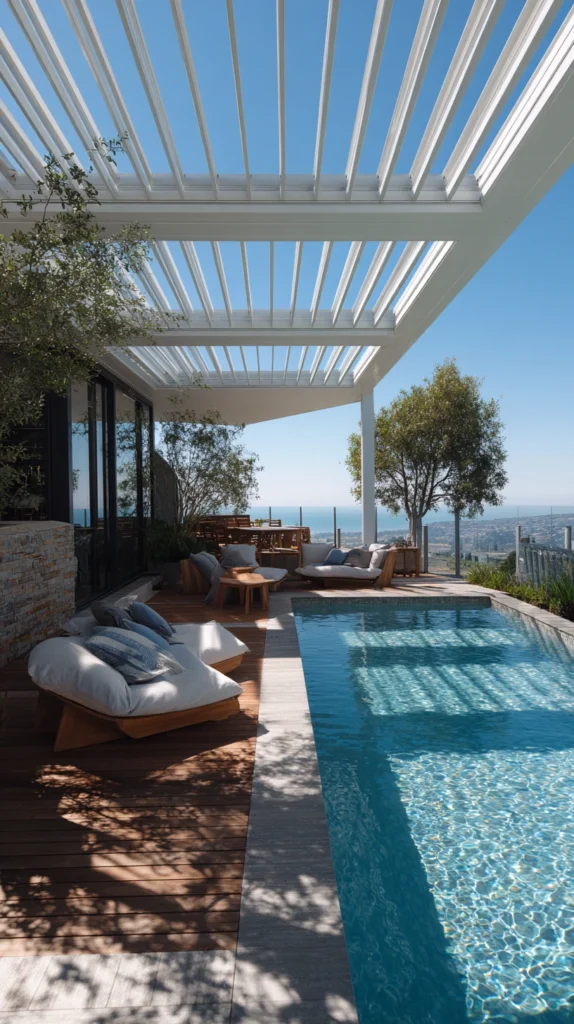
Budget: $800 – $4,000
A louvred pergola — a frame fitted with horizontal aluminium slats that rotate from fully open to fully closed — is the most weather-capable and most architecturally considered shade solution available for a pool area. Open louvres in the morning let the full sky through; partially open at midday filter the direct heat; fully closed in a summer storm provide complete overhead protection. The louvred system does what every other shade solution approximates and none fully achieves: genuine on-demand weather management for an outdoor space.
A manual louvred pergola in a 3 by 3 metre configuration costs $800–$2,000. A motorised version with rain sensor — louvres that close automatically when rain is detected — runs $2,000–$4,000. Choose powder-coated aluminium in a dark colour — charcoal, anthracite, dark bronze — rather than white or silver. Dark louvres absorb heat rather than reflecting it downward and read as a considered architectural element rather than a conservatory addition.
Style tip: Integrate lighting and drainage into the louvred pergola structure at the installation stage rather than retrofitting both afterward. Most louvred systems have integrated drainage channels in the perimeter beams and pre-formed cable conduits in the posts — using these at installation produces a clean, finished structure where the lighting wire is invisible and the rainwater is directed to a specific drain rather than finding its own route across the pool deck.
5. The Day Bed Canopy Station
Budget: $150 – $800
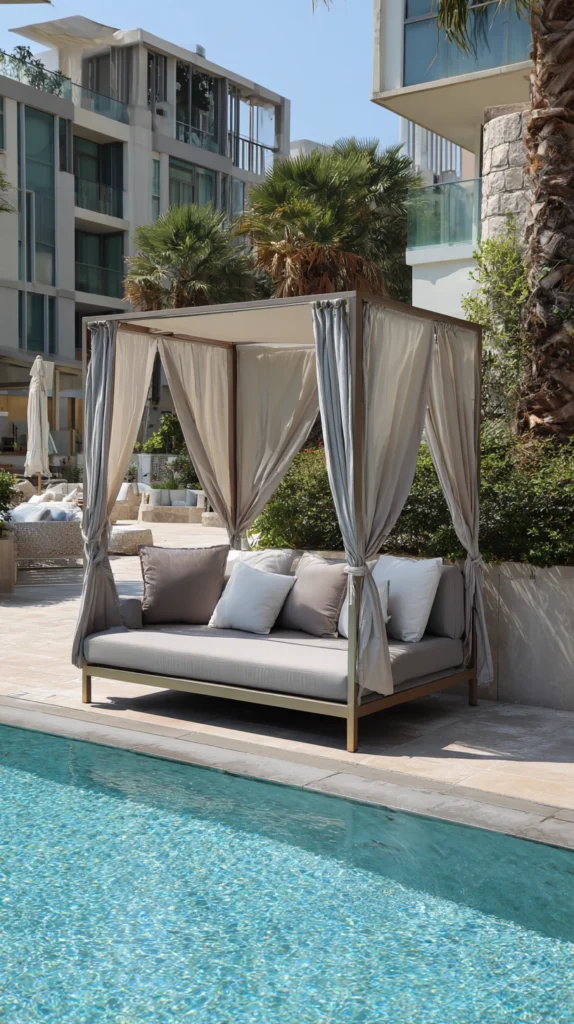
A freestanding canopy daybed — a sun lounger or daybed with its own integrated fabric canopy on a frame — creates a private shade zone at pool level that can be positioned anywhere on the deck and repositioned as the sun moves. The daybed canopy is the most personal scale of shade solution on this list: shade for one or two people, where they want it, when they want it, without requiring the rest of the deck to be shaded at the same time.
A basic outdoor canopy daybed costs $150–$400. A luxury version in teak or powder-coated aluminium with a thick weatherproof mattress runs $400–$800. The canopy fabric on most commercial daybed canopies requires replacement every two to three seasons under sustained pool deck UV exposure — choose a model with a canopy that is sold as a separate replacement component rather than one that is fixed to the frame and requires replacing the entire piece when the fabric deteriorates.
Style tip: Position the daybed canopy perpendicular to the sun’s path rather than parallel to it. A daybed oriented east to west means the canopy shades the torso while the legs and feet receive direct sun through most of the afternoon — uncomfortable and impractical. One oriented north to south allows the canopy to shade the full length of the body throughout the afternoon as the sun moves across rather than along the length of the bed.
6. The Planted Pool Surround
Budget: $80 – $400
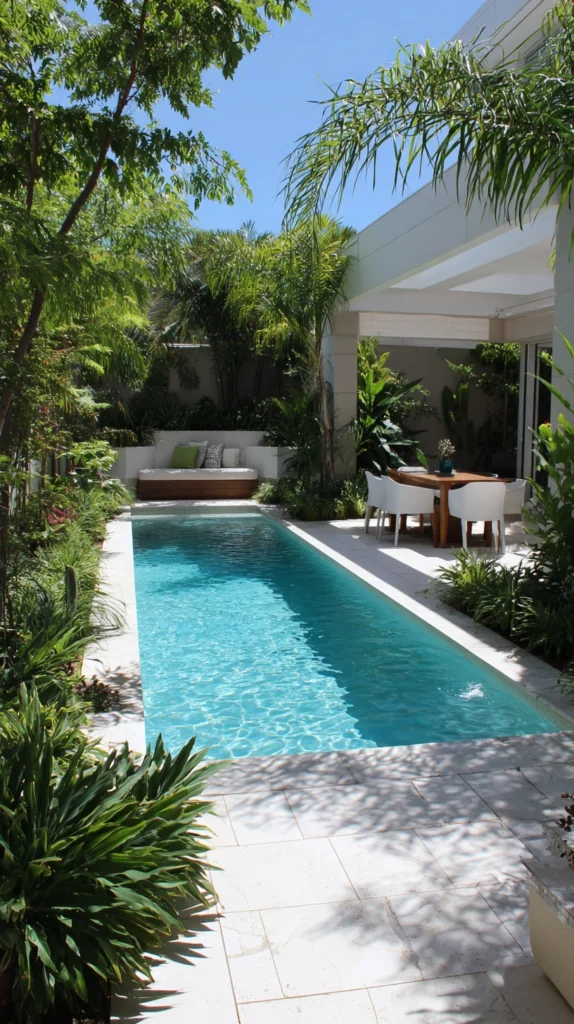
Tall, lush planting around the boundary of the pool area — in large pots or in purpose-built raised beds integrated into the pool deck — creates natural shade on the sun-facing sides of the deck, provides privacy from outside the garden, introduces the visual softness that water and stone alone cannot achieve, and gives the pool area the tropical garden quality of a resort environment. The plants are the decoration, the privacy screen, and the shade structure simultaneously.
Large architectural plants — bird of paradise, phormium, bamboo, tall ornamental grasses — cost $20–$80 each in pot sizes suitable for immediate visual impact. Large fibreclay or concrete planters of 50 centimetres or above cost $40–$120 each. A raised planter bed integrated into the pool decking costs $80–$200 in materials. Position the tallest plants on the western boundary of the pool area — the afternoon sun comes from the west and the plants that block it provide the most valuable shade.
Style tip: Choose plants that tolerate the specific conditions of a pool surround — reflected UV from the water surface, chlorine splashback, the heat absorbed and re-radiated by the surrounding stone or concrete, and the barefoot traffic that passes close to the pot bases. Drought-tolerant architectural plants — phormium, agapanthus, certain ornamental grasses — handle these conditions significantly better than lush, moisture-loving species that look beautiful in a nursery and decline steadily in the conditions beside a pool.
7. The Cabana Curtain Wall
Budget: $60 – $300
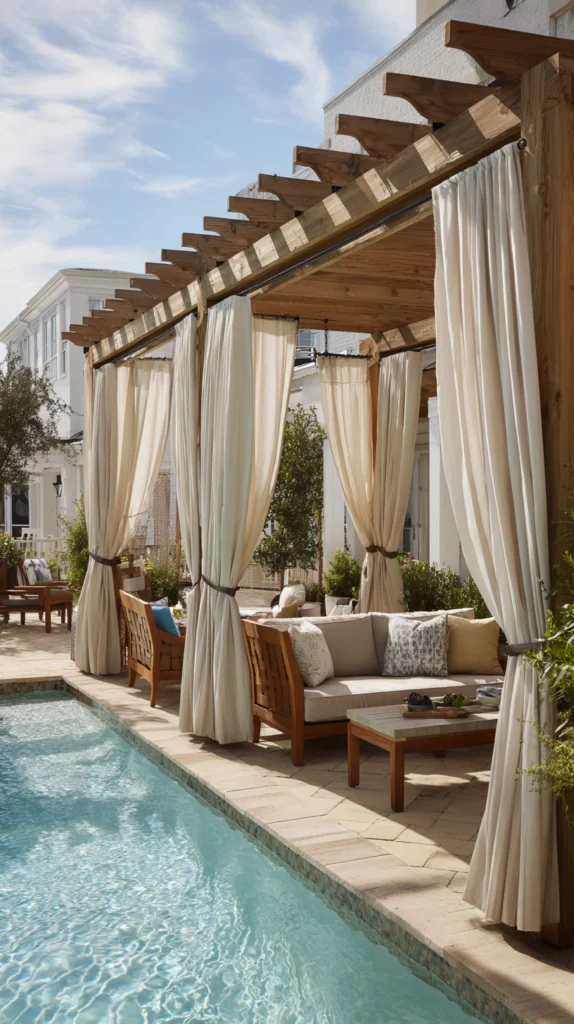
Hanging outdoor curtain panels from an existing pergola or a simple tensioned wire along one or two sides of the pool area creates a soft, fabric privacy and shade wall that moves in the breeze, filters the direct sun into something diffuse and golden, and gives the pool deck the drapery quality of a luxury resort without the cost of a built structure. Fabric walls are the most dramatic transformation available to a pool area for the least structural investment.
Outdoor canvas or acrylic curtain panels in a 250-centimetre drop cost $20–$60 each. A stainless steel tension wire for a 4-metre span costs $15–$30. A heavy outdoor fabric of at least 300 grams per square metre provides meaningful shade — lighter fabrics move beautifully but allow too much direct sun through to function as anything other than decoration. Choose a fabric colour that relates to the pool water colour: pale aqua curtains beside a blue pool, warm white beside a natural stone-lined pool, deep green beside a dark-tiled pool.
Style tip: Use twice as many curtain panels as the span strictly requires and gather them back to one end when not in use. A gathered curtain panel has a fullness and a luxury that a single flat panel stretched across its full width lacks entirely — the resort quality of fabric around a pool comes from the generosity of the fabric, and that generosity is created by using more of it than is strictly functional.
8. The Poolside Umbrella Collection
Budget: $80 – $600
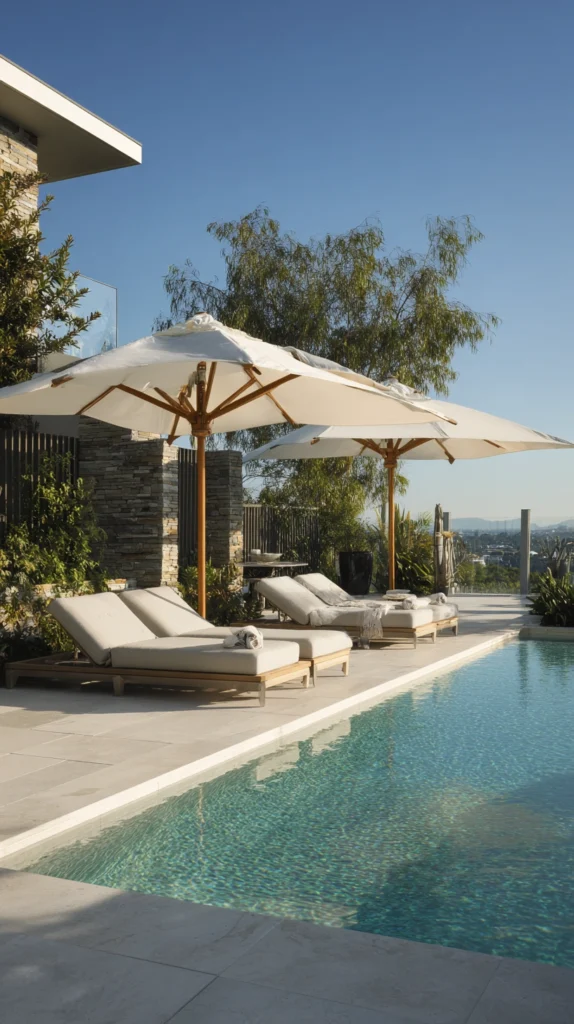
A collection of large pool umbrellas — two or three positioned at the lounger zone, all in the same colour and the same design — creates a cohesive, considered shade environment that reads as a designed collection rather than individual pieces of shade equipment assembled without reference to each other. The matching format is the detail that elevates the umbrella from poolside furniture to poolside design.
A large outdoor pool umbrella of 3 metres in diameter costs $80–$200. A cantilever version — offset, with no central post in the way of the lounger — runs $150–$400. Three matching umbrellas with matching weighted bases ($40–$80 each) produce the collection effect. Cantilever umbrellas provide better coverage per square metre of deck than centre-post versions because the offset position allows the shade to be directed precisely over the lounger rather than around a central obstruction.
Style tip: Close and lower all umbrellas when the pool area is not in use rather than leaving them open in their standard position. An umbrella left open on an unattended pool deck is a wind hazard and a fabric deterioration risk; one that is routinely closed and lowered when the area is vacated lasts three to four times longer than one left permanently open through the season. The habit of closing adds thirty seconds to leaving and saves the cost of premature replacement.
9. The Shade Trellis and Vine Canopy
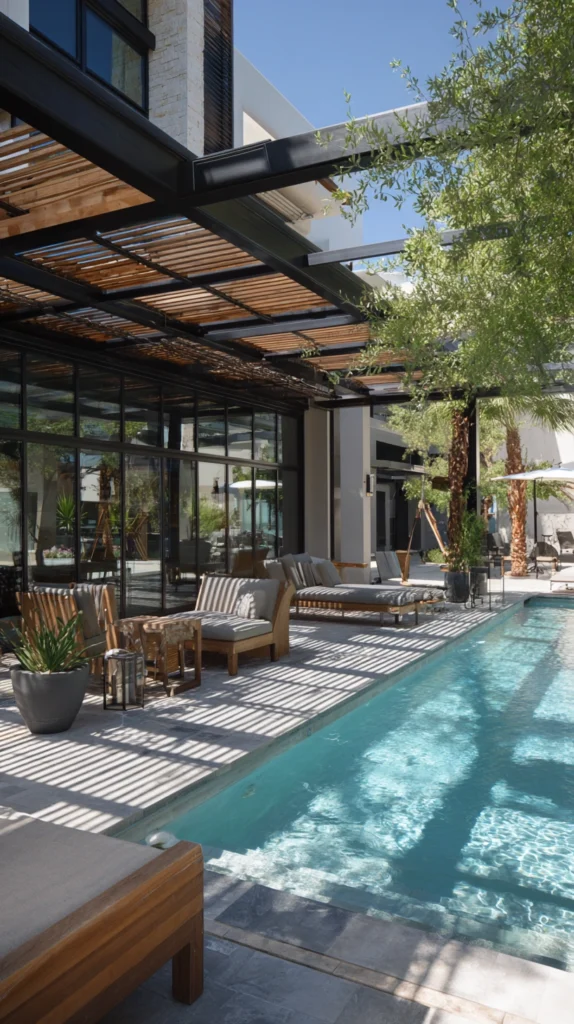
Budget: $100 – $500
A timber or steel trellis structure over the pool deck — planted at each upright with a fast-growing vine — creates a living canopy of foliage that provides dappled shade of a quality and a naturalness that no manufactured shade structure achieves. A grapevine or a wisteria covering a trellis above a pool deck produces the Aegean resort quality — filtered sun through large green leaves, the smell of the plant in the heat, the sound of the leaves in the breeze — that is the most evocative pool environment of all.
A steel trellis structure for a 3 by 4 metre area costs $200–$600 in materials. A timber version runs $150–$400. A grapevine in a 10-litre pot costs $15–$35 — one per corner post, trained outward across the roof beams. The grapevine is the best pool deck vine because it drops its leaves in winter to admit the low-angle winter sun, provides dense shade in summer when it is needed, and in a productive variety yields fruit as a secondary benefit.
Style tip: Fix horizontal training wires across the trellis roof beams at 25–30 centimetre intervals before planting. Without wires the vines grow straight up the corner posts and then have nothing to grip at the roof level — they fall back or grow upward rather than across. The wires are the invisible infrastructure that determines whether the trellis becomes a canopy or a structure with four vines on its posts.
10. The Outdoor Cinema Cabana
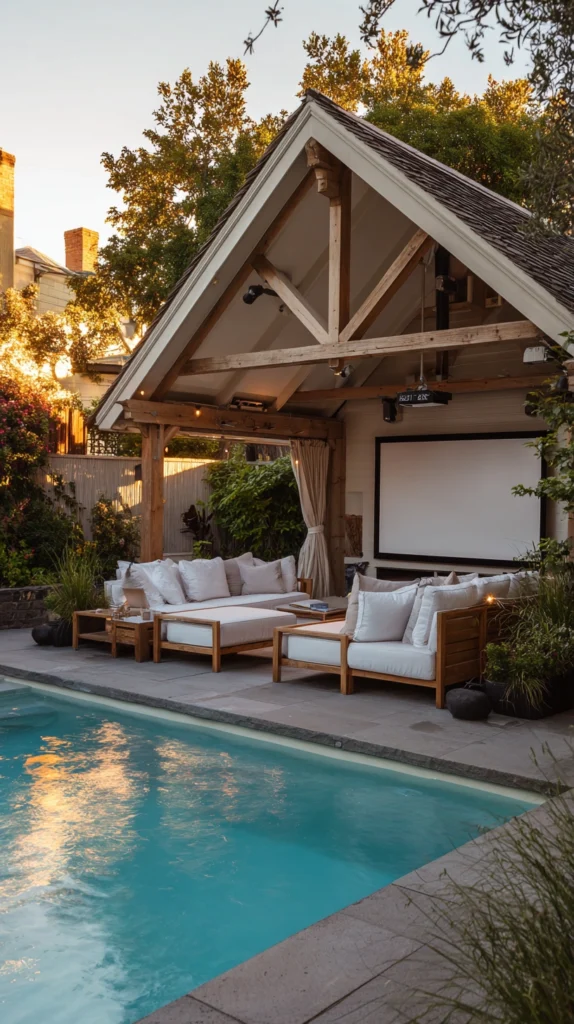
Budget: $200 – $1,000
A cabana fitted with a weatherproof screen and a projector — or an outdoor television rated for covered outdoor installation — converts the pool shade structure from a daytime retreat into an evening entertainment destination. A pool cinema cabana used in the evening, when the water is warm and the air has cooled, combines two of the best things a garden can offer: the pool and the film, in the same space, at the same time.
A weatherproof outdoor projector costs $150–$400. A pull-down outdoor projection screen of 100 inches runs $80–$200. An outdoor television rated for covered outdoor use starts at $300. Position the screen at the back of the cabana structure so the pool is in the viewer’s peripheral vision — a screen that requires turning away from the pool to watch defeats the purpose of combining the two experiences.
Style tip: Begin the film after full dark rather than at dusk. The projected image on a pull-down screen is visible in diminishing ambient light from about 30 minutes after sunset; it is genuinely cinematic only in full darkness. Starting the film at dusk produces a washed-out image for the first 20 minutes that improves as the sky darkens — starting after dark produces a properly vivid image from the first frame.
11. The Luxury Lounger Zone
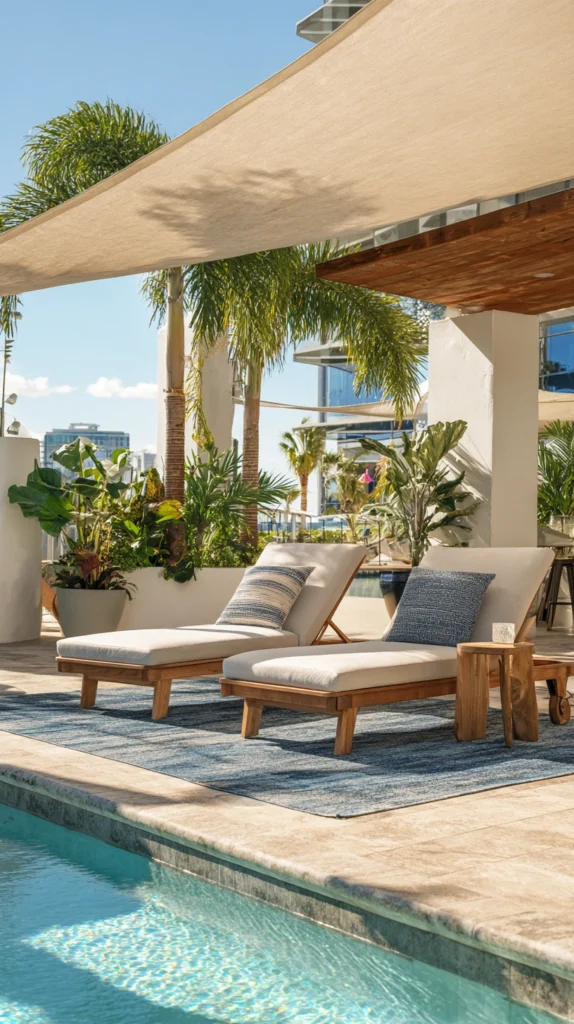
Budget: $200 – $1,200
A defined lounger zone — a specific section of the pool deck furnished with premium sun loungers, an outdoor side table between each pair, an outdoor rug defining the zone boundary, and a shade sail or umbrella overhead — creates the resort experience that an individual lounger on an undifferentiated deck surface never achieves. The zone is the key concept: a defined area with its own furniture, its own shade, and its own surfaces creates a room within the larger pool deck.
Premium outdoor sun loungers cost $80–$300 each. A pair with a side table between them runs $180–$650. An outdoor rug for the zone costs $40–$120. A shade sail or umbrella overhead runs $50–$200. The outdoor side table between the loungers is the detail most consistently absent from pool decks and most consistently present in the resort environments they aspire to — it is the surface that holds the cold drink, the sun cream, the book, and the phone simultaneously without requiring the lounger occupant to lean to the floor or the coping.
Style tip: Position the lounger zone at an angle to the pool edge rather than parallel to it. A lounger parallel to the pool looks directly at the edge of the pool rather than across the pool surface — the view from the side is of water edge and coping rather than water. A lounger angled 15–30 degrees from parallel looks across the pool surface diagonally, which is both the better view and the more interesting position.
12. The Changing Cabana with Amenities
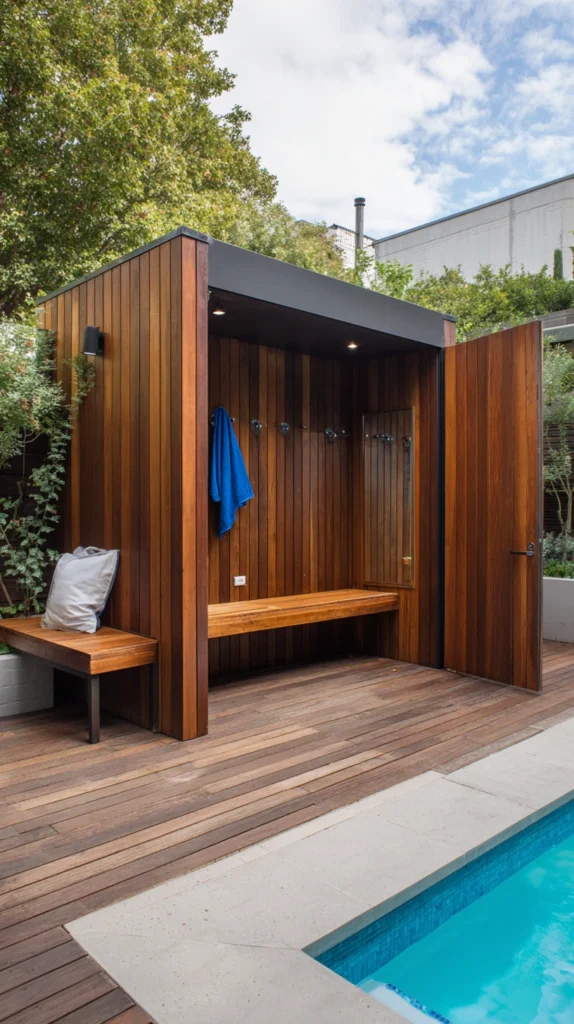
Budget: $300 – $2,000
A changing cabana — a private enclosed structure beside the pool with a changing area, a hook rail, a mirror, a shelf for toiletries, and an outdoor shower connection — provides the full resort infrastructure that turns a pool from a swimming facility into a destination. The changing cabana addresses the practical elements of pool use — where to change, where to shower, where to hang the wet towel — in a way that brings them into the pool area rather than requiring return trips to the house.
A basic timber changing cabin of 1.5 by 1.5 metres costs $150–$500. A more considered version with built-in bench seating, a mirror, hook rail, and shower connection runs $400–$1,500. Adding an outdoor shower to the cabin adds $80–$200. Keep the changing area ventilated — a closed timber cabin beside a pool accumulates moisture from wet swimwear and bodies without ventilation, and the combination of persistent moisture and warmth produces mould on the interior surfaces within a single season.
Style tip: Install a small hook rail at child height as well as adult height inside the changing cabin. A cabin with only adult-height hooks requires children to either reach above their height or place their dry clothes on the bench — a minor inconvenience that becomes a consistent irritant across a season of daily pool use. The child-height rail costs one additional hook and thirty seconds of thought.
13. The Evening Ambient Zone
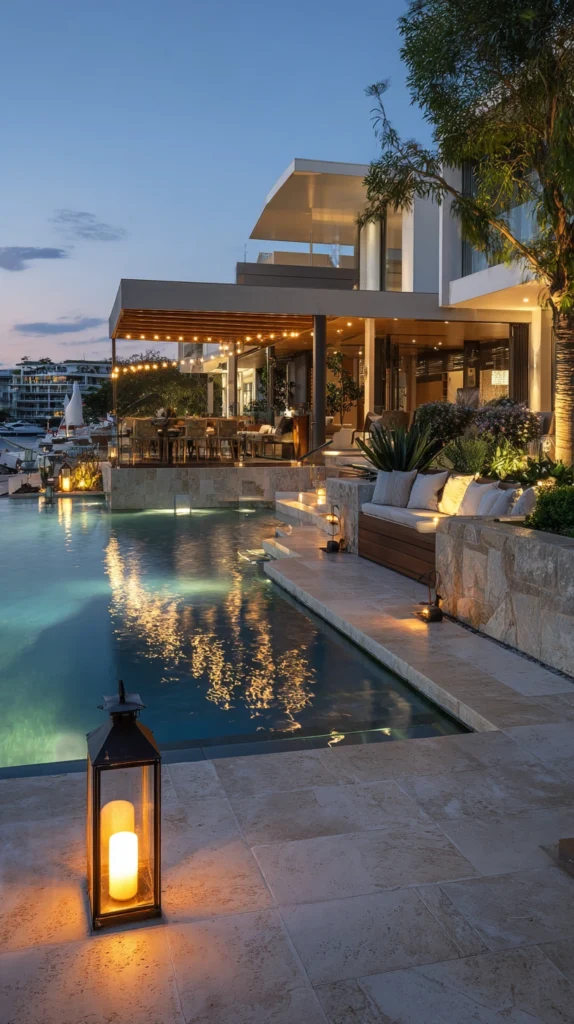
Budget: $60 – $400
A pool deck that is genuinely luxurious in the evening — with warm, layered lighting at multiple levels, candles or lanterns on the coping and the surrounding surfaces, outdoor heaters if the climate requires them, and the pool’s own lighting setting the water as the glowing centrepiece — is the pool area at its most aspirational and most achievable. The evening transformation of a well-designed pool deck, when the sun has gone and the water catches the warm light from every surrounding source, is one of the most beautiful things an outdoor space can produce.
Outdoor festoon lights for the pergola or cabana cost $20–$50 for a 5-metre reel. Floor lanterns at the pool coping run $10–$25 each. An outdoor patio heater costs $80–$300. Waterproof LED strip lights beneath the pool coping — the warm glow at water level — run $15–$40 per reel. The pool’s own LED lighting set to warm white rather than blue or colour-changing mode contributes to the ambient warmth that the surrounding lights are creating — a pool lit in blue in an otherwise warm-lit environment is the one jarring element that disrupts the cohesion of the evening atmosphere.
Style tip: Dim or eliminate any overhead security lighting during planned evening pool use. Security lighting — typically at full brightness, cool white, triggered by movement — is the fastest way to disrupt the ambient atmosphere of an evening pool area. A separate circuit for the pool area lighting, switchable independently from the security circuit, allows the functional and the atmospheric to coexist without one permanently overwhelming the other.
The best pool retreat is not the most expensively equipped or the most completely furnished — it is the one that makes every hour beside the water more comfortable and more pleasant than the previous one. The shade that appears at the right time, the lounger that faces the right direction, the light that comes on at dusk without being asked — these are the details that separate a pool that is used from a pool that is visited.
Invest in the surround first and the pool second, because the pool is already there and already doing its job. What it needs is a setting worthy of it, and a setting, assembled thoughtfully over a season or two, costs less than any pool upgrade and lasts considerably longer.