14 Luxury Marble Partition Design Ideas That Divide Space With Elegance
There is a particular problem that open-plan interiors create and that most furniture arrangements only partially solve. The space is undivided in a way that was intended to feel generous and has come to feel undefined — the living zone bleeds into the dining zone, the home office has no acoustic separation from the kitchen, the entrance hall opens immediately into the most private area of the home without any sense of threshold or transition. A wall would solve all of this and sacrifice the openness that made the space appealing. What is needed is something between a wall and nothing.
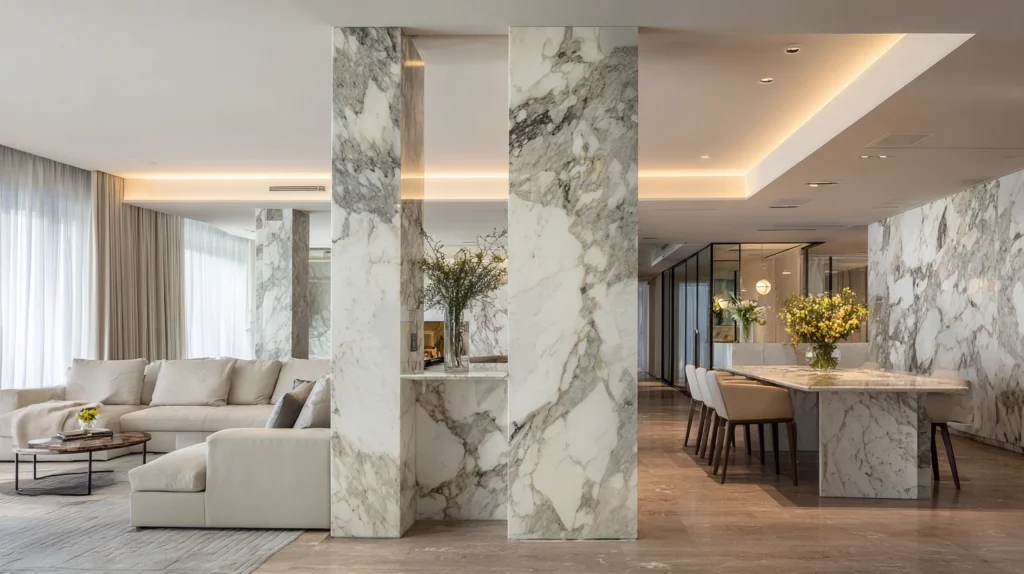
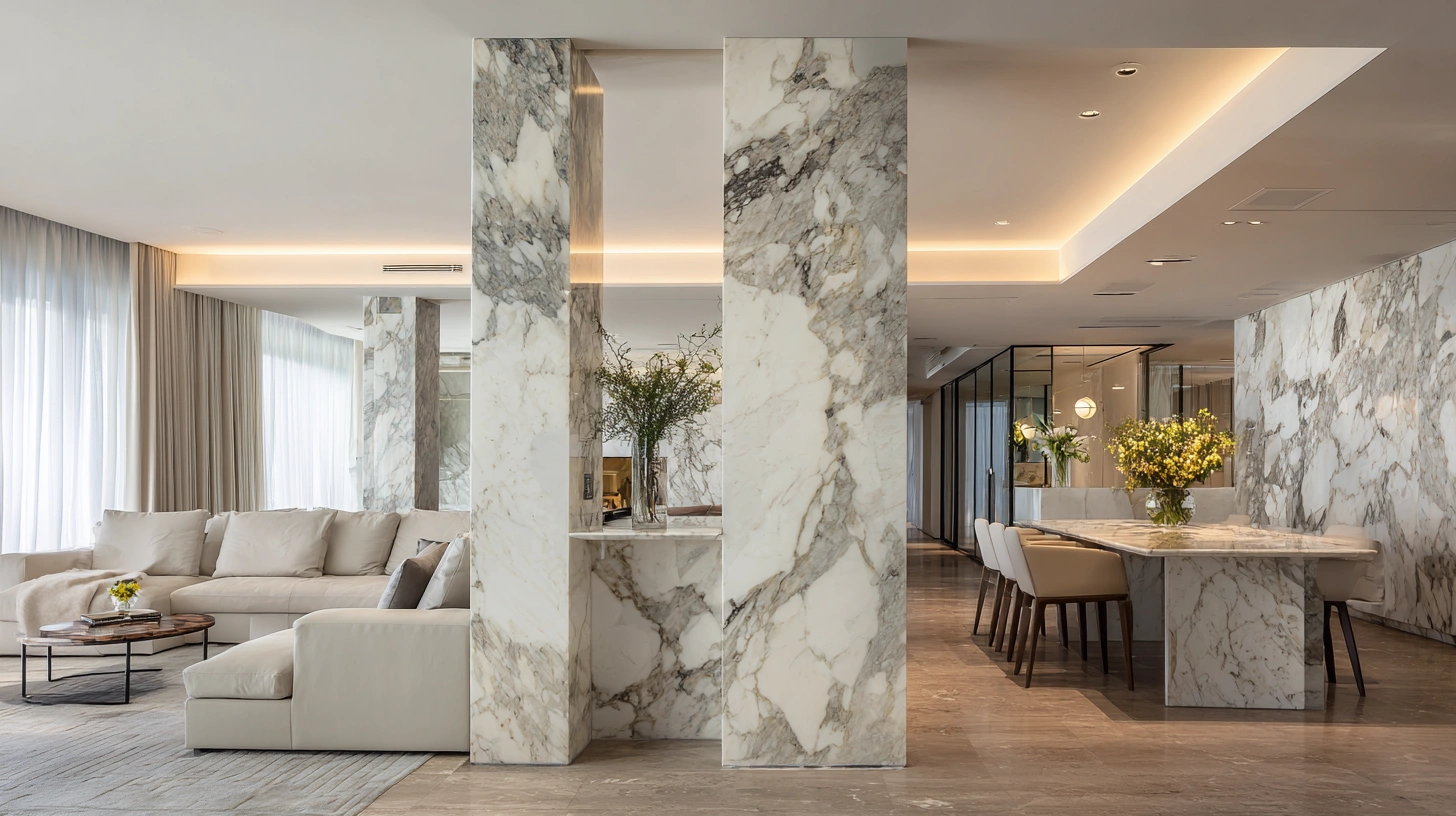
Marble as a partition material sits at the most considered end of the available solutions. It divides without enclosing, defines without domesticating, and brings to the task of spatial separation a visual weight and a material quality that drywall, glass, or timber screen equivalents cannot match. A marble partition is not a compromise between a wall and an open plan; it is a design element that earns its position in the space through the quality of what it is made from and the precision with which it is placed.
Each idea below is a specific marble partition design approach — its form, its marble selection, its finish, and its relationship to the space it divides. Each includes what you will need, what it will cost, and a practical tip to make the partition work as well as the luxury it represents.
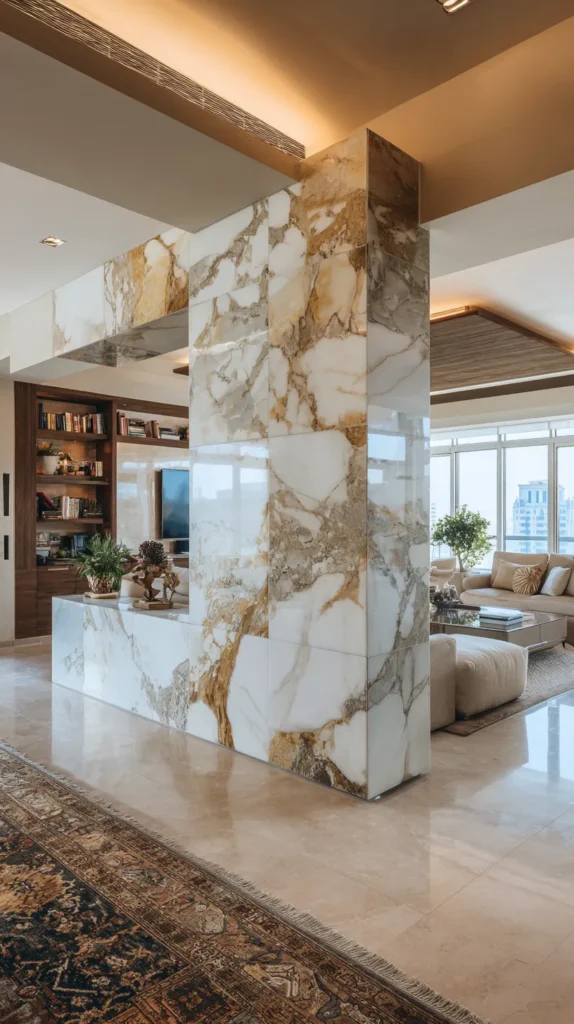
1. The Full-Height Book-Matched Marble Slab
Budget: $3,000 – $15,000
Two mirrored slabs of the same marble block — cut and opened like the pages of a book so the natural veining creates a symmetrical, butterfly pattern across the face of the partition — create the most dramatic and most materially spectacular marble partition available. Book-matching exploits the geological record of the stone: the veining that formed over millions of years appears as a perfect bilateral symmetry that no fabricated material can replicate.
Carrara white marble in a book-matched configuration costs $150–$400 per square metre for the stone alone. Calacatta marble — with its more dramatic gold and grey veining — runs $300–$800 per square metre. Structural support, fixing, and finishing by a specialist stone contractor adds $1,000–$4,000 to the total. The book-matched slab partition requires the full-height stone to be cut from the same block, which limits the choice of marble to varieties available in sufficiently large slab sizes.
Style tip: Position the partition so the symmetrical axis of the book-matched veining aligns with the most important sightline in the room — the view from the front door, from the primary sofa position, or from the kitchen — so the geological symmetry is experienced at its maximum compositional impact. A book-matched partition seen from an oblique angle misses its defining quality; one that is encountered head-on reveals the full bilateral symmetry that makes the design decision worthwhile.
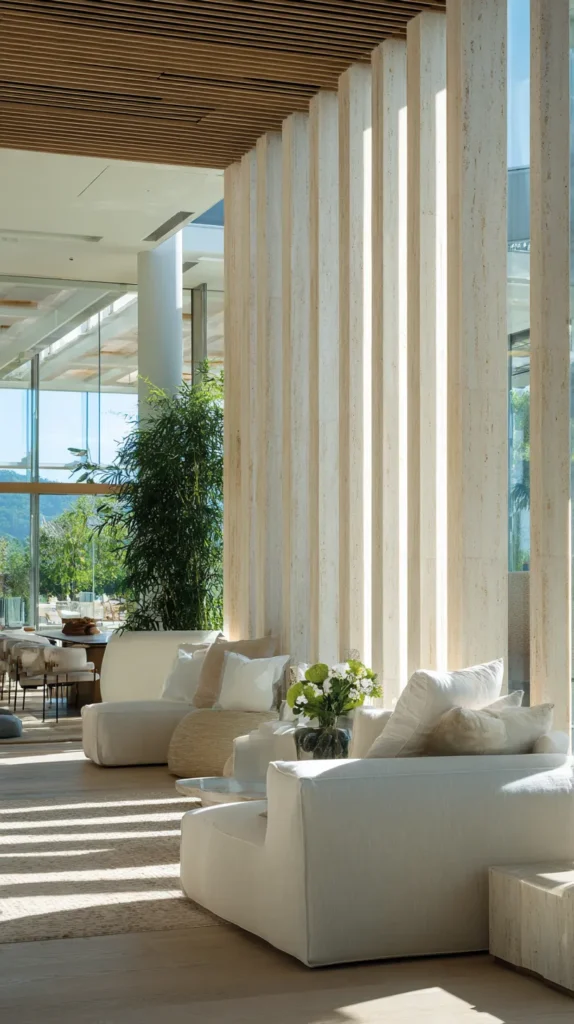
2. The Fluted Marble Column Partition
Budget: $2,000 – $10,000
A series of vertical fluted marble columns — standing at full height or at three-quarter height, spaced at regular intervals, not touching each other but collectively defining a zone boundary — creates a partition that is permeable to light and air while clearly communicating the spatial division between the areas on each side. The fluted surface of each column catches and redirects light, creating a rhythm of highlight and shadow across the partition face that a flat slab does not produce.
Fluted marble columns in a standard 20-centimetre diameter cost $400–$1,200 each for the stone and the machining. A partition of five columns spanning a 2-metre opening costs $2,000–$6,000 in stone, plus installation. Travertine — a marble-adjacent stone with a warmer tone and a more open surface texture — costs $200–$600 per column and produces a softer, more organic fluted surface than the hard clarity of pure marble.
Style tip: Space the columns so the gap between them is slightly narrower than the column diameter — a 20-centimetre column with a 15-centimetre gap creates a partition that reads as predominantly solid with defined intervals of openness. Wider gaps than column width produce a different and less resolved effect — a series of columns with too much space between them reads as individual objects rather than as a partition that happens to be permeable.
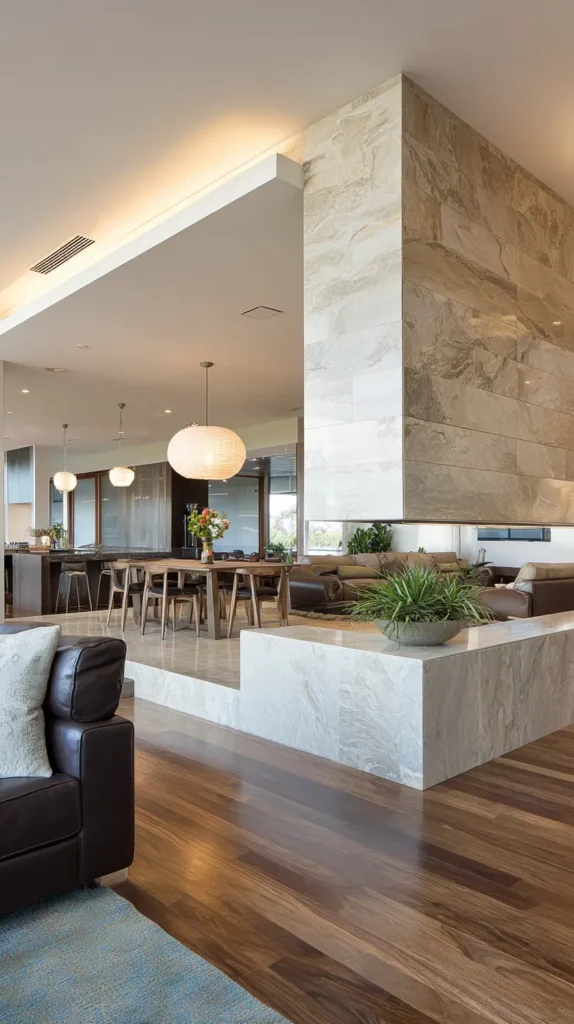
3. The Low Marble Plinth Divider
Budget: $1,000 – $6,000
A low marble plinth — running continuously across the floor at 60–90 centimetres in height, functioning as a half-wall that defines the zone boundary without interrupting the view or the ceiling — creates one of the most versatile and most spatially generous marble partition formats. The low plinth defines the separation between zones while maintaining the visual connection above it, and its top surface functions simultaneously as a partition, a display ledge, and a bar or counter if positioned between a kitchen and a dining zone.
A continuous marble plinth of 2 metres in length and 60 centimetres in height, fabricated from 30-millimetre-thick slab with mitred corners, costs $1,500–$5,000 in Carrara marble. Marquina black marble — a dense, near-black stone with white veining — costs $2,000–$8,000 for the same configuration and produces the most dramatic low plinth available. The plinth requires a structural base of steel or concrete block beneath the marble — the weight of full marble slabs at this scale is significant and the floor structure must be assessed before specification.
Style tip: Extend the marble plinth to the full width of the zone it divides rather than stopping it short of the walls on each side. A plinth that runs wall to wall reads as an architectural element of the room; one that stops short of the walls reads as furniture placed between two zones. The wall-to-wall run is the detail that makes the difference between a partition that was designed into the space and one that was inserted into it.
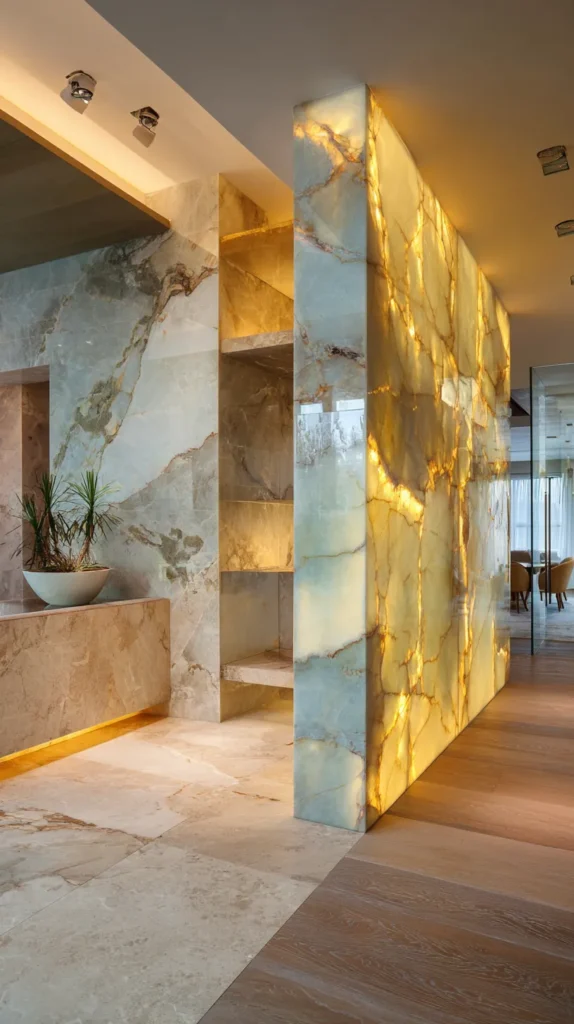
4. The Backlit Marble Panel
Budget: $2,500 – $12,000
A marble panel with LED strip lighting behind it — positioned against a steel frame, with the light source concealed at the edges and the illumination passing through the stone — reveals the translucent quality that thin marble panels possess when back-illuminated. Marble backlit from behind shows its internal structure — the veining becomes luminous, the crystals within the stone glow, and the partition becomes a light feature as well as a spatial divider.
Thin marble panels of 10–15 millimetres in thickness (the thickness that allows backlit translucency) cost $100–$300 per square metre. A steel frame to support the panel and conceal the LED strip runs $500–$1,500 for a standard partition size. LED warm white strip lights cost $20–$50 per metre. Choose onyx rather than standard marble for the most dramatic backlit effect — onyx is translucent at standard slab thickness and produces a far more vivid backlit result than marble, at a higher material cost of $400–$1,200 per square metre.
Style tip: Use a 2700K warm white LED strip rather than a cool white or daylight temperature. Marble backlit in cool white produces a clinical, commercial quality; the same marble illuminated in warm white produces a warm, amber-toned glow that complements the natural tones of the stone and reads as atmospheric rather than functional. The LED colour temperature is the specification that most determines whether the backlit panel looks like a spa or like a supermarket.
5. The Marble and Steel Frame Partition
Budget: $2,000 – $10,000
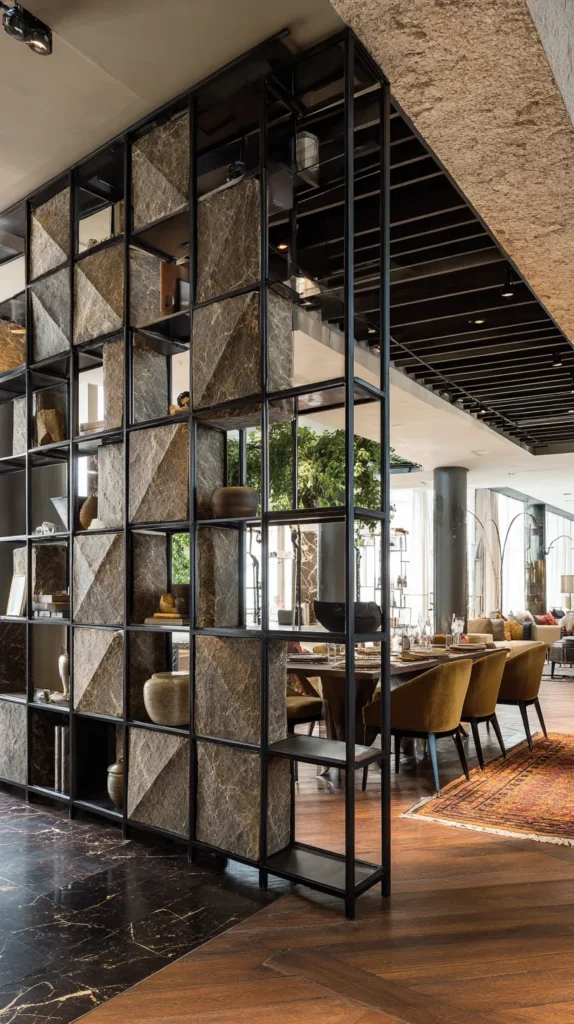
A steel frame — in powder-coated matte black or a raw brushed finish — infilled with marble panels creates a partition that combines the material weight of stone with the graphic precision of metalwork. The steel frame provides the structural support that allows marble panels to be used at heights and widths that freestanding stone could not achieve, and the combination of black steel and white or grey marble is one of the most refined material pairings in contemporary interior design.
Steel frame fabrication in a standard partition size of 2.4 by 2 metres costs $800–$3,000. Marble infill panels cost $100–$400 per square metre depending on the marble type. The total for a full partition in Calacatta marble with a matte black steel frame runs $3,000–$10,000. The frame design determines the character of the partition as much as the marble — a frame with wide steel sections creates bold graphic grid lines; one with narrow sections creates a delicate grid that allows the marble to read as the primary element.
Style tip: Align the steel grid of the frame with the scale of the marble veining rather than using a standard grid module. If the marble has bold, wide veining, a wider grid that allows each panel to contain a complete vein movement reads as designed; a narrow grid that cuts across the veining reads as generic. The relationship between the grid and the stone pattern is the detail that distinguishes a designed marble partition from an installed one.
6. The Curved Marble Screen
Budget: $4,000 – $20,000
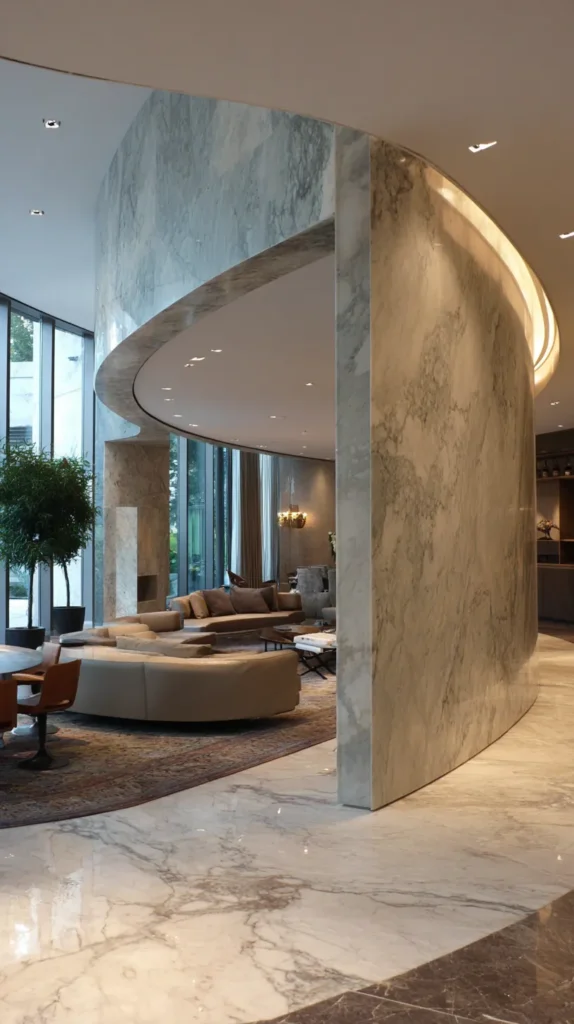
A partition that curves in plan — rather than running straight across the space — softens the division between zones and creates a more dynamic spatial relationship between the two areas on either side. A curved marble partition is more expensive to fabricate than a straight one because each stone panel must be cut to a slightly different angle, but the spatial quality it produces — the gentle enclosure of one zone, the curved reveal of the other — is worth the additional complexity.
Curved marble partition fabrication costs $400–$1,200 per square metre for the stone alone, plus the additional machining cost for curved cutting. A 3-metre radius curve spanning a 2.5-metre opening runs $6,000–$18,000 installed. The curve radius determines the spatial quality — a tight curve produces an enclosure that feels embracing; a shallow curve produces a gentle separation that reads almost as a straight partition at first glance and becomes apparent only as the viewer moves through the space.
Style tip: Finish the curved face of the partition that faces the more private zone in a honed or brushed finish and the face that greets the entrance or the primary circulation in a polished finish. The polished face catches the light and presents the marble’s veining with maximum clarity; the honed face is softer and more intimate in quality, which suits the private zone it is oriented toward.
7. The Marble and Timber Combination Screen
Budget: $1,500 – $8,000
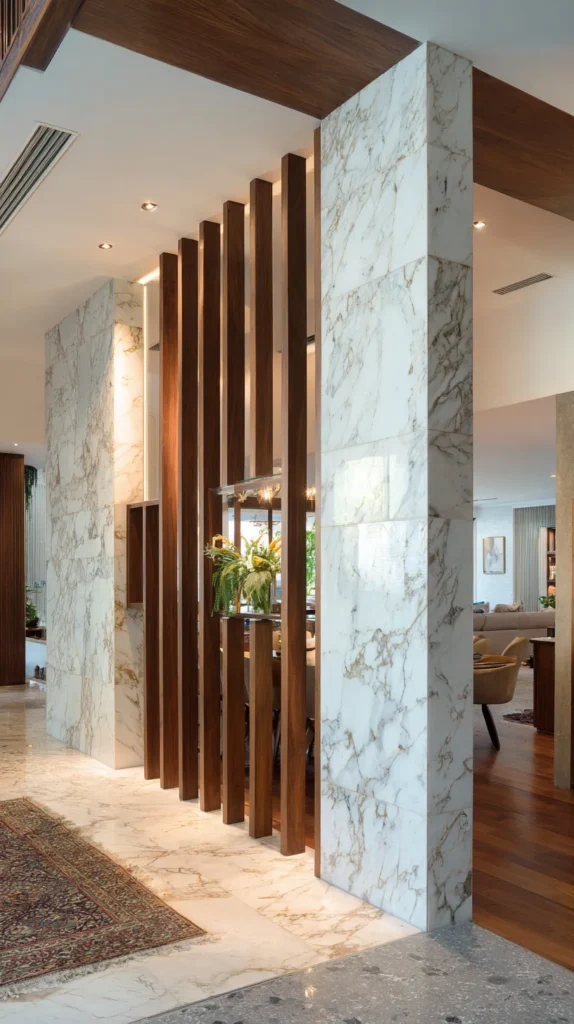
A partition that combines marble panels with vertical or horizontal timber elements — warm oak, dark walnut, or smoked timber — produces a material combination that offsets the coolness of stone with the warmth of wood in the specific balance that makes both materials read better than either does alone. The marble provides the visual weight and the material significance; the timber provides the warmth and the human scale that pure stone partitions can lack.
Marble panels for the partition cost $100–$400 per square metre. Solid timber vertical dividers in a complementary width — typically 80–120 millimetres — cost $50–$150 per linear metre. The combination partition requires a joinery specialist rather than a stone contractor alone, since the timber and marble junction requires precision detailing to avoid the slight gaps and misalignments that make combination material partitions look amateurish rather than considered.
Style tip: Use the timber at the base and top of the partition — as a plinth and a cap — with the marble spanning the middle section, rather than alternating marble and timber in vertical strips. A marble partition with a timber base and cap reads as a stone element that has been given a furniture-like quality; alternating vertical strips of marble and timber read as a feature wall rather than a spatial divider.
8. The Travertine Partition with Open Pores
Budget: $1,500 – $7,000
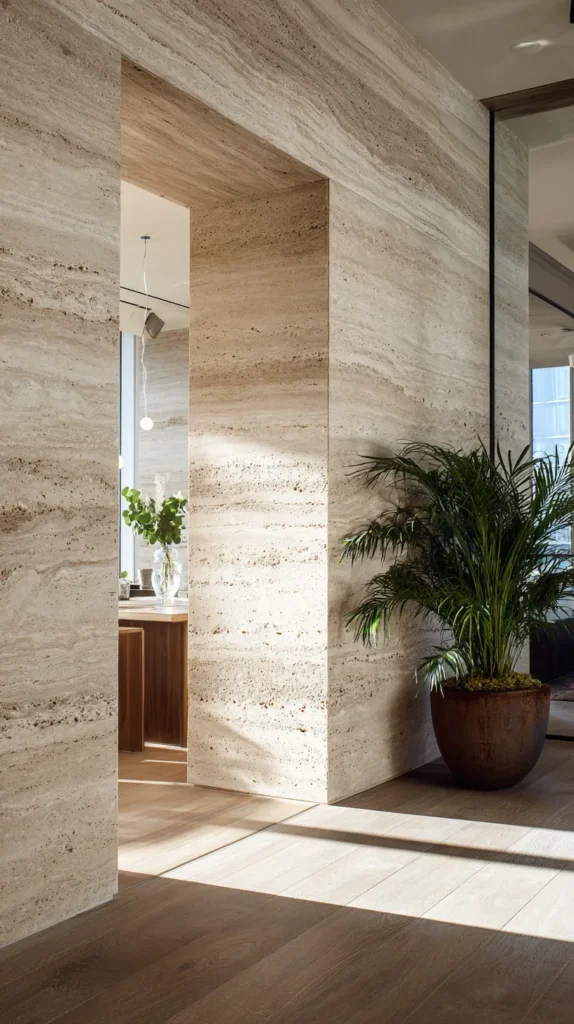
Travertine — technically a form of limestone rather than marble but belonging to the same natural stone family and used in identical applications — brings a warmer, more textural alternative to pure marble that suits residential interiors where the clinical perfection of polished Carrara might feel too cold. Travertine’s characteristic open pores and warm cream-to-gold tones create a partition surface of organic texture that aged and softened in a way that polished marble does not.
Unfilled travertine — with its natural open pores left unsealed — costs $80–$200 per square metre. Filled and honed travertine, where the pores are grouted to create a smoother surface, runs $100–$250 per square metre. A full partition in Roman travertine — the warm golden version quarried near Rome — costs $2,000–$8,000 installed. Seal the travertine surface with a penetrating stone sealer annually to prevent organic matter from accumulating in the open pores in a residential setting.
Style tip: Orient travertine slabs with the vein running vertically rather than horizontally. Horizontal travertine vein suggests stratified stone — geological rather than architectural — which suits a floor or a low plinth. Vertical vein in a partition reads as ascending, as structural, as intentional — the stone doing what walls do rather than what floors do, which is the quality a partition requires.
9. The Marble Partition with Integrated Fireplace
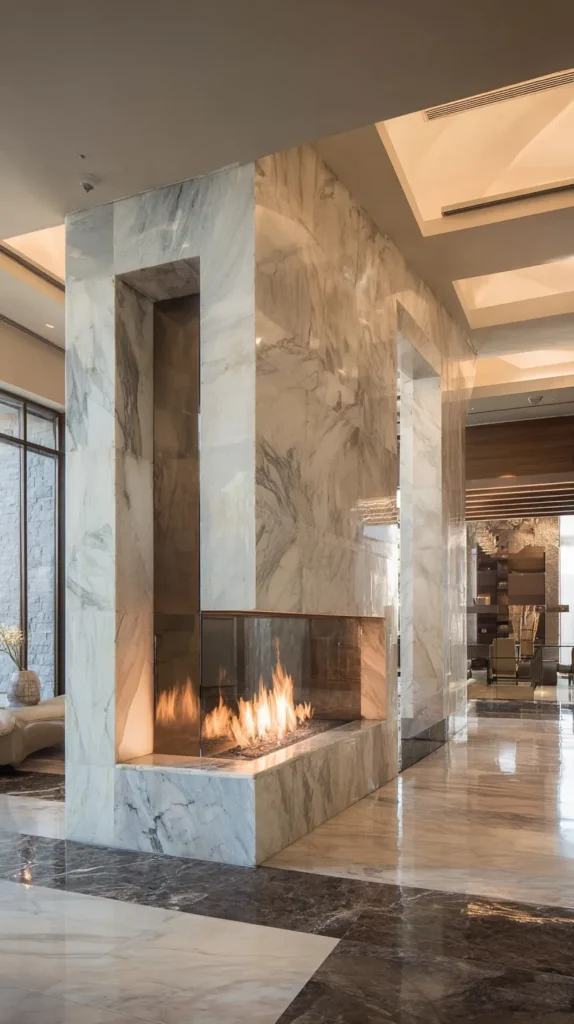
Budget: $5,000 – $25,000
A marble partition with a double-sided fireplace built into it — the fire visible from both the zones it separates — is the most functionally complete and most architecturally significant partition on this list. The fire provides light, warmth, and the focal quality that a partition alone cannot, and the combination of a marble surround with a double-sided flame visible through the stone creates the kind of interior set piece that defines the entire character of the space it occupies.
A double-sided gas fireplace insert costs $2,000–$6,000. The marble partition structure to contain and frame it runs $3,000–$12,000. A full installation — fireplace, marble partition, gas connection, flue — costs $8,000–$25,000 for a considered residential installation. Choose a marble with relatively subtle veining for a fireplace partition — the movement of the fire provides more than enough visual activity, and a heavily veined marble competes with the flame rather than framing it.
Style tip: Design the marble partition so the fireplace opening sits off-centre rather than at the exact midpoint of the partition. A centred fireplace produces a symmetrical composition that is resolved but static; an off-centre one creates asymmetry that makes the partition more dynamic and gives the space on each side of it different characters — the zone with more marble beside it feels more solid and enclosed; the zone with less marble and more fire feels more open and active.
10. The Slatted Marble Louvre Partition
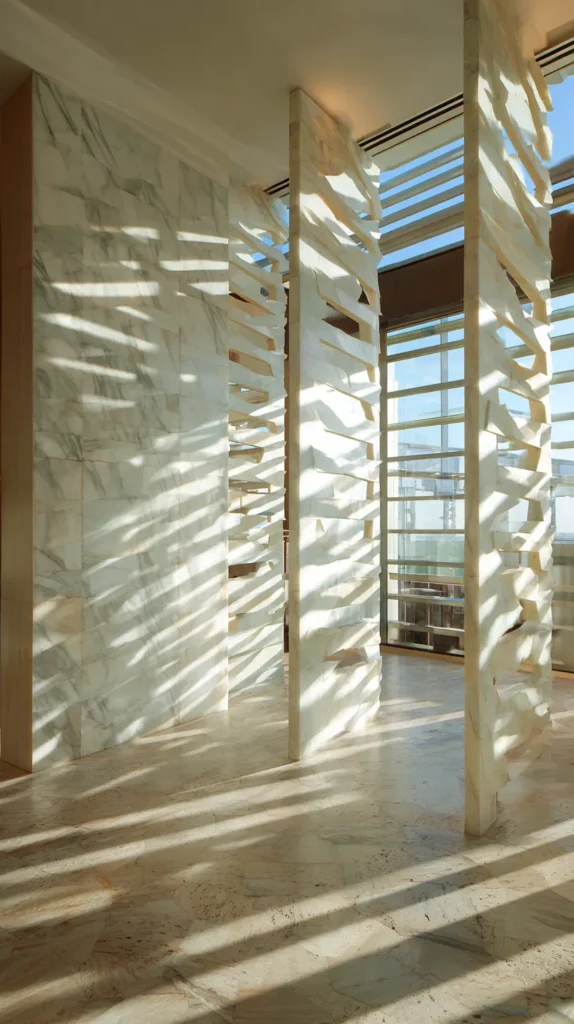
Budget: $3,000 – $14,000
Horizontal marble slats — cut to a consistent depth and thickness, fixed at a uniform angle of 30–45 degrees to the plane of the partition, revealing alternating views and concealment depending on the viewer’s position — create a partition of extraordinary visual complexity that changes in character as the viewer moves through the space. From one angle the partition is nearly opaque; from another it reveals the zone behind it completely.
Marble slat fabrication costs $200–$500 per square metre for the cutting and finishing. A steel or aluminium supporting framework runs $500–$1,500 for a standard partition size. The installation requires a specialist fabricator who can achieve the precision of angle and spacing that makes the louvre effect work — slats that vary by even 2–3 degrees from the intended angle disrupt the visual pattern that the partition’s entire effect depends on.
Style tip: Choose a marble with a consistent, relatively even tone for a louvre partition rather than one with bold veining. The louvre format relies on the interplay of angle and light to create its visual effect — a marble with bold veining adds a competing visual pattern that complicates rather than enriches the louvre’s optical quality. A Pietra Serena — a fine-grained grey sandstone related to marble — or a consistent Bianco Puro white marble suits the louvre format better than Calacatta or Arabescato.
11. The Marble Bookcase Partition
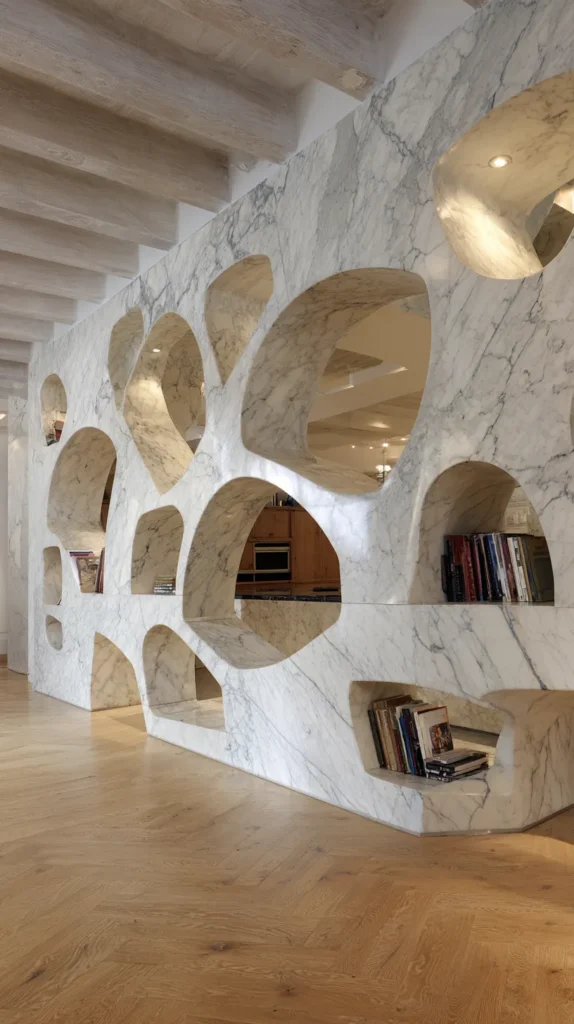
Budget: $4,000 – $18,000
A marble partition with integrated open shelving on one or both faces — the shelves cut from the same marble as the partition structure, or in a contrasting stone for definition — creates the most functional version of the marble partition: a spatial divider that also organises books, objects, and display items for the zones on each side of it. The marble bookcase partition replaces both the partition and the freestanding shelving unit with a single architectural element.
Marble shelving in a partition structure costs $300–$800 per linear metre of shelf. A full partition with integrated shelving on both faces runs $6,000–$18,000 for a complete residential installation. Choose a marble with a honed rather than polished finish for shelves that will hold books and objects — a polished shelf shows every contact mark, every water ring, every sliding friction mark from daily use.
Style tip: Vary the shelf heights rather than using equal intervals throughout the partition. A bookcase partition with varied shelf heights — one large opening for oversized books or artwork, several medium openings for books and ceramics, one very narrow shelf for small objects — reads as designed for the specific collection it holds rather than as a standard shelving unit executed in expensive material.
12. The Marble Arch Partition
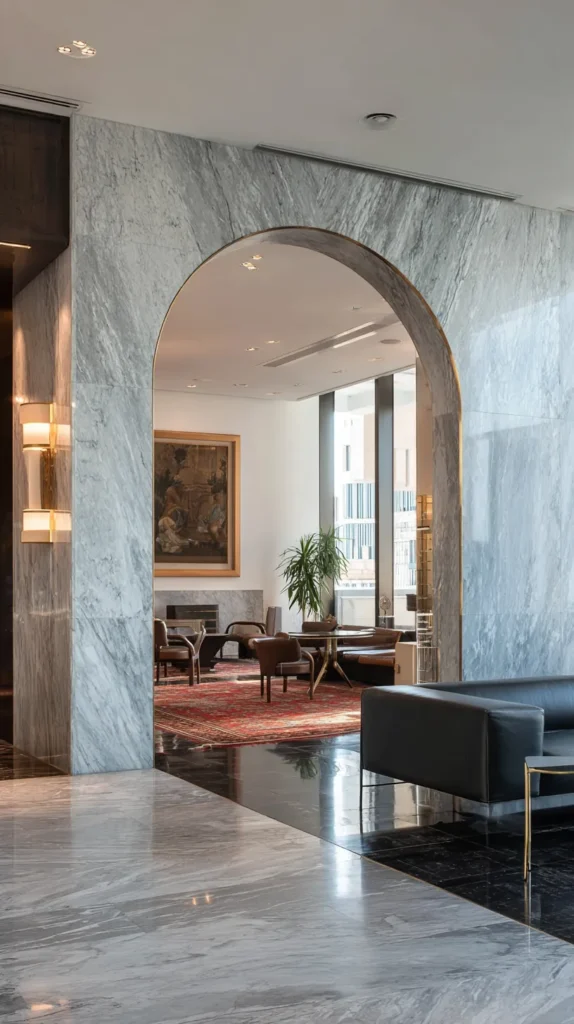
Budget: $3,000 – $12,000
A marble arch — either a full semicircular arch or a pointed arch, standing freestanding or incorporated into a partial height partition — frames the transition between two spaces with the most architecturally resonant form available to stone construction. The arch is the structural form that marble’s compressive strength naturally suits, and a marble arch partition references the entire history of stone architecture in a domestic interior without historicising the space around it.
A solid marble arch in Carrara white, fabricated from voussoir segments and assembled over a temporary former, costs $3,000–$8,000. A marble-clad steel arch — more structurally straightforward and considerably less expensive — runs $1,500–$5,000. The arch requires a structural engineer’s assessment if it is bearing load, or a structural steel frame if it is a cladding exercise rather than a true masonry arch.
Style tip: Keep the proportions of the arch classically correct — the arch width should be no more than twice the arch height for a semicircular arch, and the jamb height (the straight wall below the springing point) should be at least one-third of the total arch height. Arch proportions that deviate significantly from classical norms produce an effect of wrongness that the viewer feels without necessarily identifying, and the wrongness undermines the architectural authority that the marble was chosen to provide.
13. The Green Marble Feature Partition
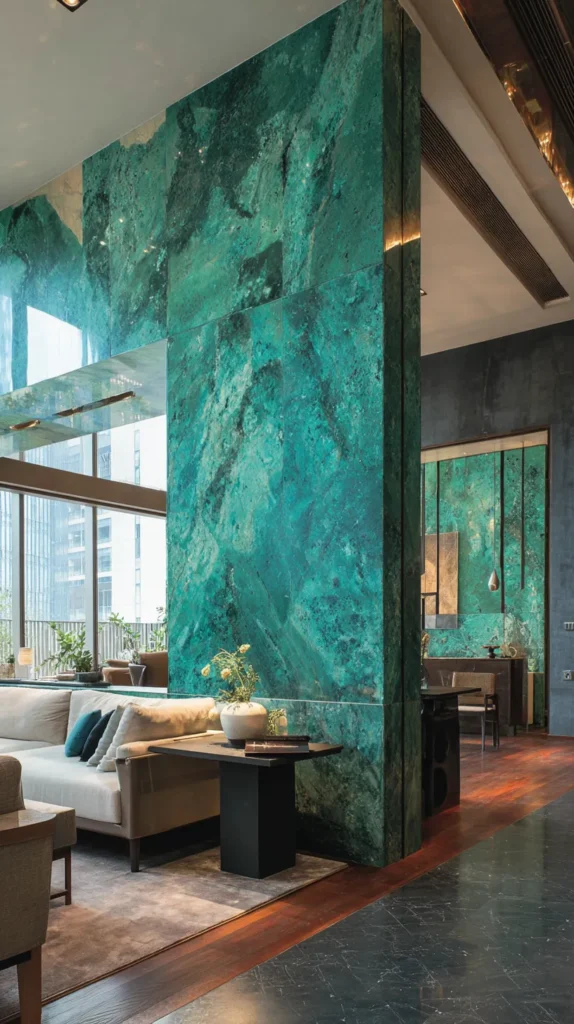
Budget: $2,500 – $12,000
Verde Guatemala, Empress Green, or Verde Alpi — the deep forest green marbles with their white and gold veining — produce a partition of extraordinary colour depth and biological reference that white and grey marbles cannot match. A green marble partition brings the visual language of the natural world into the interior through the geological rather than the botanical route — the stone’s colour references forest and moss and deep water in a way that is entirely distinct from painted surfaces or decorative wallpaper.
Verde Guatemala marble costs $200–$600 per square metre. Empress Green — a Chinese green marble with more uniform colour and less dramatic veining — runs $150–$400 per square metre. A full partition in green marble costs $3,000–$12,000 installed. Green marble requires particularly careful sealing — the stone is more porous than white varieties and more susceptible to staining from oils and liquids that the green tones make visible in ways that white marble conceals.
Style tip: Pair the green marble partition with brass or antique gold metalwork — fixtures, frame elements, lighting fittings adjacent to the partition — rather than the chrome and matte black that suit white marble. The warm metallic tones against the deep green read as verdant and organic; cool metal finishes against green marble create a combination that reads as period rather than contemporary.
14. The Thin Stone Veneer Partition
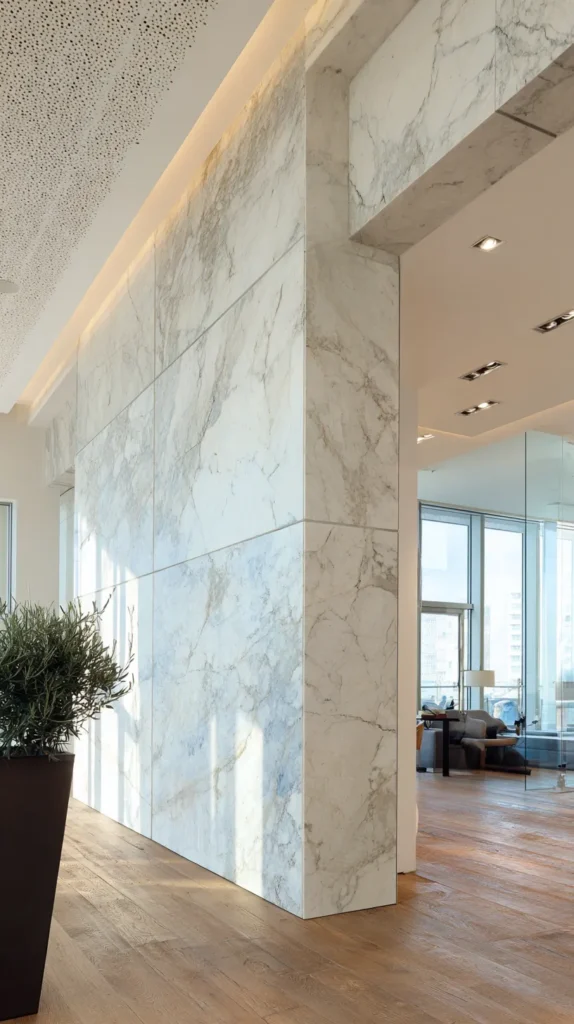
Budget: $800 – $5,000
A partition framed in timber or steel and clad in thin stone veneer — marble or travertine in 3–5 millimetre sheets bonded to a honeycomb aluminium backing — achieves the visual quality of a full stone partition at a fraction of the weight and cost. Thin stone veneer technology allows marble cladding on partition surfaces that could not structurally support full stone — upper floors, lightweight steel-framed structures, or domestic settings where the floor loading capacity of solid marble would be problematic.
Thin stone veneer panels in Carrara marble cost $80–$200 per square metre. A complete partition in thin stone veneer — framed, clad, and finished — runs $1,500–$6,000 for a standard residential partition size. The honeycomb backing that allows the veneer to be used in thin sections also makes it resistant to the cracking and splitting that solid thin marble panels are vulnerable to, and the backed veneer is considerably more durable in daily use than equivalent solid marble at the same thickness.
Style tip: Use the same stone for the veneer partition as for an adjacent floor or other surface detail to create a continuous material narrative through the space. A partition in the same marble as the bathroom floor or the kitchen counter reads as an intentional material thread running through the interior; one in a different marble reads as an additional material introduced specifically for the partition, which adds visual complexity rather than coherence.
The best marble partition is not the most expensive or the most dramatically veined — it is the one that solves the spatial problem it was designed to address while contributing a material quality to the room that justifies the investment in stone rather than in a less considered alternative. Marble divides with authority, reflects light in ways that manufactured materials cannot, and ages in the direction of greater character rather than greater deterioration — which is the specific quality that makes natural stone the right choice for a partition that is meant to last as long as the building that contains it.
Choose the marble for the space it will occupy — the warm travertine for a residential bedroom zone, the dramatic Calacatta for a formal living space, the deep green for a room where colour depth is the design intention — and work with a specialist stone contractor who understands both the material and the installation requirements that make the difference between a marble partition that performs at the level of the stone and one that merely uses it.