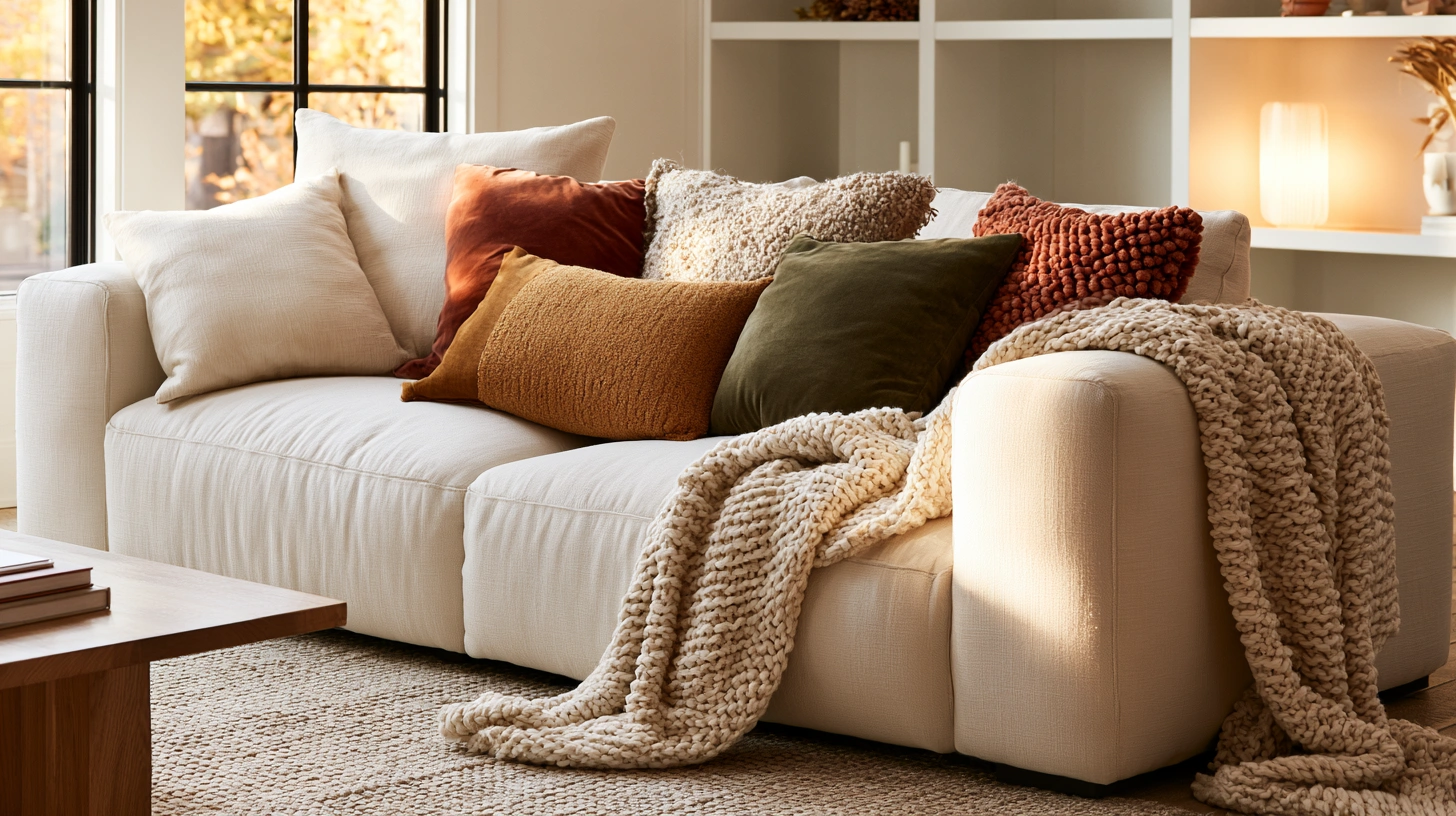
14 Layered Throw Blanket and Pillow Combos for Autumn
My sofa had one flat pillow and zero throws for years. Single beige cushion, nothing draped anywhere, sofa looked like a showroom floor model nobody wanted to sit on.
I tried adding one more pillow. Looked random, not styled. Two beige pillows is not a combination, it is an accident.
Then I learned to layer textiles the way stylists do — varying texture, height, and tone in a deliberate formula. The sofa transformed from forgettable to the room’s best feature.
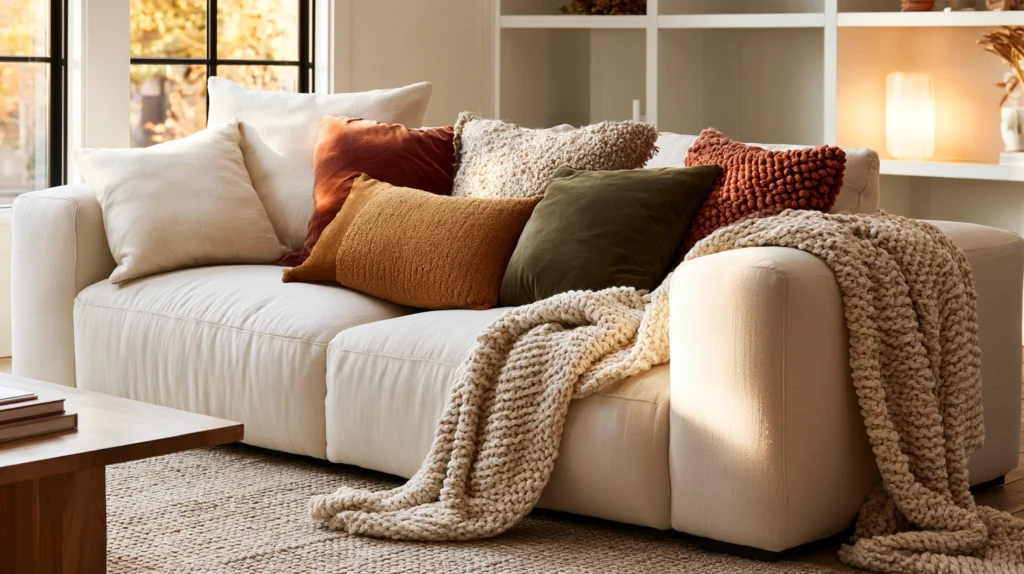
Now guests sink into it and do not get up. Same sofa, same frame, completely different feeling. The combination did everything.
Let me show you 14 throw blanket and pillow combinations that turn any sofa into the coziest seat in the house this fall.
Why Most Pillow Arrangements Fail
The common mistakes:
The matching set trap:
- Bought a pillow set (all identical)
- No texture variation
- No height variation
- Looks purchased not curated
The single throw problem:
- One thin blanket (not enough)
- Folded too neatly (unused, untouchable)
- Wrong texture for the season
- Sofa looks finished but feels cold
Too much or too random:
- Eight pillows crammed (overwhelming, no room to sit)
- Or one pillow floating (insufficient, looks unfinished)
- No formula behind the choices
- Pillows fighting each other instead of working together
Result:
- Sofa looks staged not lived-in
- Guests perch instead of sink in
- Room feels unfinished despite having “stuff” on it
- No sense of seasonal warmth
After learning the formula:
What changed:
- Consistent pillow count and size formula
- Texture variation deliberate not accidental
- Throws draped not folded
- Color story unified across pillows and throws
Immediate difference:
Sofa became inviting:
- Guests sink in immediately
- Texture visible from across the room
- Looks intentional and considered
- Feels finished and cozy simultaneously
Cost:
- Most combinations under $150 total
- Many use pillow covers only (reuse existing inserts)
- Thrift and sale sourcing keeps costs low
- Highest impact per dollar of any seasonal change
My revelation: A great pillow and throw combination is a formula, not luck. Once you know the formula, every sofa looks styled.
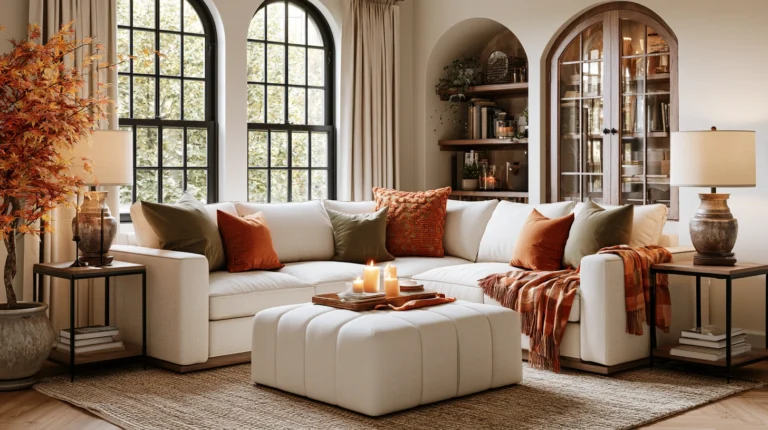
1. The Classic Five-Pillow Formula (The Foundation Everyone Should Know)
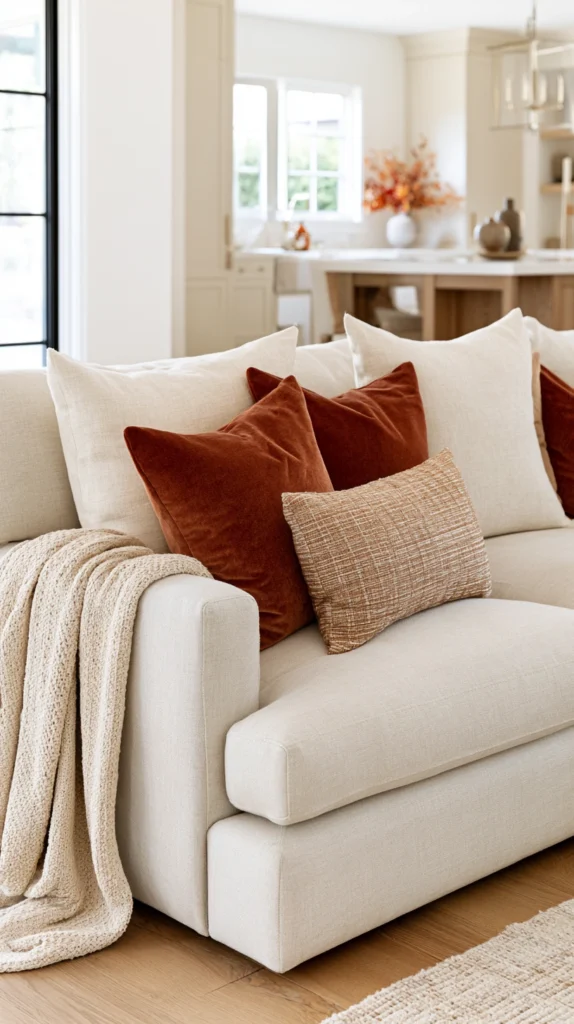
Two large, two medium, one lumbar — the arrangement that works on every sofa, every time.
My starting point:
What I learned first:
- Five pillows is the universal number for a standard three-seat sofa
- Three sizes create rhythm
- This formula underlies every combination on this list
- Master this before attempting anything more complex
The formula breakdown:
Two large pillows (20-22 inch):
- One at each end of the sofa
- Largest pillows, anchor the arrangement
- Solid color or subtle texture (let them ground)
- Placed flat against the sofa arm
Two medium pillows (18 inch):
- Inside the large pillows, angled slightly forward
- Can carry pattern or bolder color
- Leaned at a slight angle (not perfectly flat)
- Creates the layered depth
One lumbar pillow (14×22 inch):
- Center, in front of or between the others
- Often the most patterned or textured piece
- Smallest in height, adds the final layer
- Optional but elevates the arrangement significantly
Fall execution of this formula:
Large pillows:
- Warm cream or oat linen (foundation color)
- Solid, no pattern (let them recede)
- One per side
Medium pillows:
- Burnt orange or rust velvet (the fall color)
- Solid but rich texture (velvet catches light)
- Inside position, angled toward center
Lumbar pillow:
- Textured weave or subtle pattern (rust and cream stripe, or small fall print)
- Center placement
- Ties the large and medium pillows together
Why this formula always works:
The size logic:
- Eye reads large to small (natural visual flow)
- Three distinct sizes (never flat or matched)
- Odd total number (five, always odd)
- Proven formula used by professional stylists
Insert sizing rule:
Critical detail:
- 20-inch pillow cover needs 22-inch insert
- 18-inch cover needs 20-inch insert
- Always size up the insert (plump not flat)
- Flat pillows look cheap regardless of cover quality
Where to source:
Covers (most economical):
- HomeGoods and TJ Maxx ($8-18 each, best value)
- Target Threshold and Studio McGee ($15-30 each)
- Amazon (search by color, check reviews) ($10-25 each)
Inserts:
- IKEA (cheapest quality inserts, $6-10)
- Amazon down-alternative inserts ($8-15)
- Buy once, reuse with seasonal covers forever
Cost:
- Five pillow covers (mixed sources): $60-120
- Five inserts (if needed): $40-75
- Total: $60-195 (less if inserts already owned)
My five-pillow formula result: This single arrangement taught me everything else on this list, sofa went from flat to dimensional, every fall combination since has built on this foundation.
Five-Pillow Formula Tips
Angle, do not just place:
The styling secret:
- Pillows placed flat (looks unstyled)
- Pillows angled at the corner, leaned slightly (looks intentional)
- Medium pillows lean forward against large pillows
- Five minutes of angling makes the difference
Reusing inserts seasonally:
The system:
- Buy quality inserts once (they last years)
- Swap only the covers each season
- Store off-season covers flat in a bin
- Most economical long-term approach to seasonal styling
2. Chunky Knit Throw Plus Velvet Lumbar (Textural Contrast)
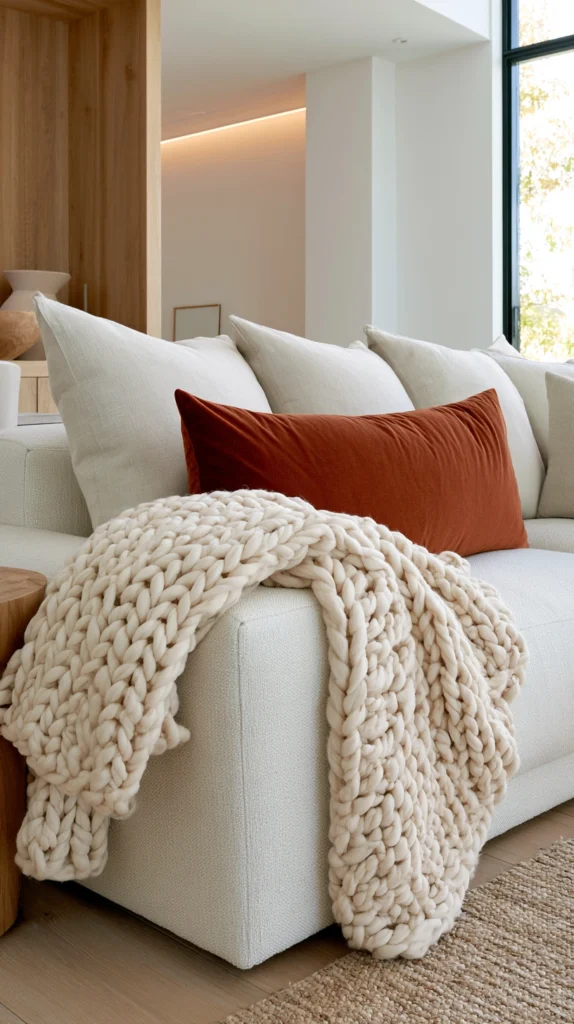
One heavily textured throw with one smooth accent pillow — the combination built on contrast.
My textural awakening:
What I was missing:
- All my pillows were the same smooth cotton
- Throw blanket was also smooth cotton
- Nothing for the eye or hand to differentiate
- Room felt flat despite having color
The contrast principle:
Why opposite textures work together:
- Smooth beside rough (each enhances the other)
- Velvet looks more luxurious next to chunky knit
- Chunky knit looks cozier next to smooth velvet
- Sameness is the enemy of interesting styling
The specific combination:
Chunky knit throw:
- Oversized cable or waffle knit
- Heavy yarn, large visible stitches
- Cream, oat, or warm camel color
- Draped over the sofa arm, not folded
Velvet lumbar pillow:
- Smooth, light-catching surface
- Rust, burnt orange, or deep burgundy
- Placed centrally among other pillows
- The textural opposite of the throw
Why this pairing specifically:
The visual logic:
- Knit throw provides the texture story (bulky, visible, tactile)
- Velvet pillow provides the color and shine story
- Together they cover both senses (sight and touch)
- Neither competes; each does a different job
Building around this pair:
Supporting pillows:
- Two large pillows in warm linen (neutral, lets the contrast pair shine)
- One additional medium pillow in a third texture (boucle or woven)
- The chunky throw and velvet lumbar remain the stars
Throw placement technique:
The cascade drape:
- Fold throw in half lengthwise
- Drape over one arm of the sofa
- Let it cascade down, not symmetrical
- One corner higher than the other (casual asymmetry)
Color combinations that work:
Cream knit with rust velvet:
- Classic fall pairing
- High contrast in texture, harmonious in warmth
- Most universally appealing combination
Camel knit with burgundy velvet:
- Richer and more sophisticated
- Deeper tone pairing
- Evening-appropriate warmth
Oat knit with forest green velvet:
- Most unexpected pairing
- Sophisticated and current
- Less obviously “fall” but reads as autumnal
Cost:
- Chunky knit throw: $35-70
- Velvet lumbar pillow: $25-50
- Total: $60-120
My chunky knit and velvet combination: The throw alone changed how the sofa felt to sit near, the velvet pillow catches lamp light beautifully in the evening, texture contrast is now the first thing I consider with any new pillow.
Texture Contrast Tips
The 70-30 split:
Proportion rule:
- 70% one texture family (smooth: velvet, linen, cotton)
- 30% contrasting texture (chunky: knit, boucle, sherpa)
- Reversing the ratio (more chunky than smooth) reads as messy
- This proportion keeps contrast intentional not chaotic
Touch test before buying:
- Feel the throw and pillow together in store if possible
- Online: read material descriptions carefully
- “Chunky knit” should specify yarn weight (the bulkier, the better for contrast)
- Thin knit defeats the purpose of textural contrast
3. Faux Fur Accent With Linen Base (Maximum Coziness)
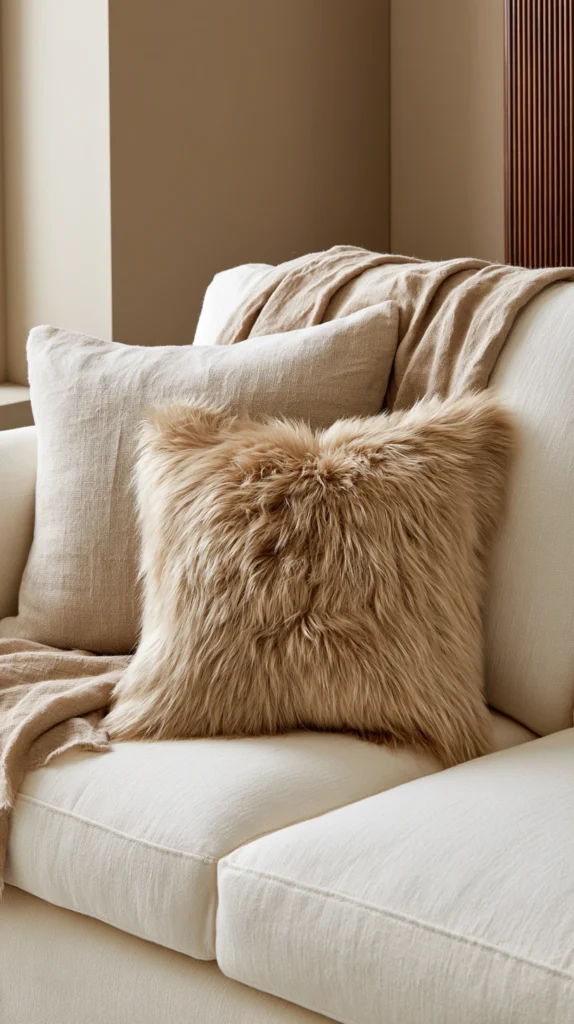
One dramatic faux fur pillow or throw against simple linen — the combination that signals luxury.
My faux fur discovery:
Why I resisted at first:
- Worried it would look excessive
- Concerned about maintenance
- Thought it was only for bedrooms
- One small faux fur pillow changed my mind completely
The restraint principle:
Why only one faux fur piece:
- Faux fur is the most dramatic texture available
- One piece reads as luxurious accent
- Multiple pieces reads as overdone or costume-like
- Restraint makes the statement piece work
Linen as the necessary base:
Why linen specifically:
- Linen’s understated texture lets fur stand out
- Natural fiber grounds the dramatic faux fur
- Without a quiet base, fur competes with everything
- Linen is fall’s most versatile textile partner
The specific combination:
One faux fur element:
- Large lumbar or 18-inch pillow in faux fur
- Cream, camel, or warm gray fur
- Single statement piece, not paired with another fur piece
- Positioned centrally for maximum visibility
Linen pillows surrounding:
The supporting cast:
- Two large linen pillows (oat or natural)
- One medium linen pillow (can have subtle texture, never another fur)
- All in warm neutral tones
- Quiet enough to let fur be the star
Linen throw blanket:
Completing the base:
- Natural or warm white linen throw
- Lighter weight than chunky knit
- Drapes more elegantly than knit (different cozy quality)
- Folded loosely over the sofa back
Fur color selection:
Best fall fur tones:
- Cream or ivory (classic, versatile)
- Warm camel (matches many fall palettes)
- Charcoal or warm gray (sophisticated contrast)
- Avoid: bright white (too cold), black (too harsh for fall warmth)
The single statement rule:
Where to place the one fur piece:
- Center of the arrangement (most visible spot)
- Or on an accent chair if the sofa already has enough pieces
- Never two fur pieces in the same vignette
- Let it be found, not competed with
Cost:
- One faux fur pillow: $30-65
- Three linen pillow covers: $45-75
- Linen throw: $35-65
- Total: $110-205
My faux fur and linen result: The single fur pillow gets touched by every guest who sits down, linen keeps the whole arrangement from feeling excessive, the restraint is what makes it feel luxurious rather than costume-like.
Faux Fur Tips
Quality matters disproportionately:
Cheap vs quality faux fur:
- Cheap faux fur (looks like a costume, sheds, flattens quickly)
- Quality faux fur (looks genuinely luxurious, holds its loft)
- Worth spending more on this one piece than anywhere else
- Pottery Barn, West Elm, or specialty pillow shops over generic options
Fluffing maintenance:
- Faux fur flattens with use
- Fluff by hand weekly (shake and pat)
- Keep away from direct heat sources (can damage fibers)
- Worth the small maintenance for the payoff
4. Plaid and Solid Pairing (Traditional Fall Done Right)
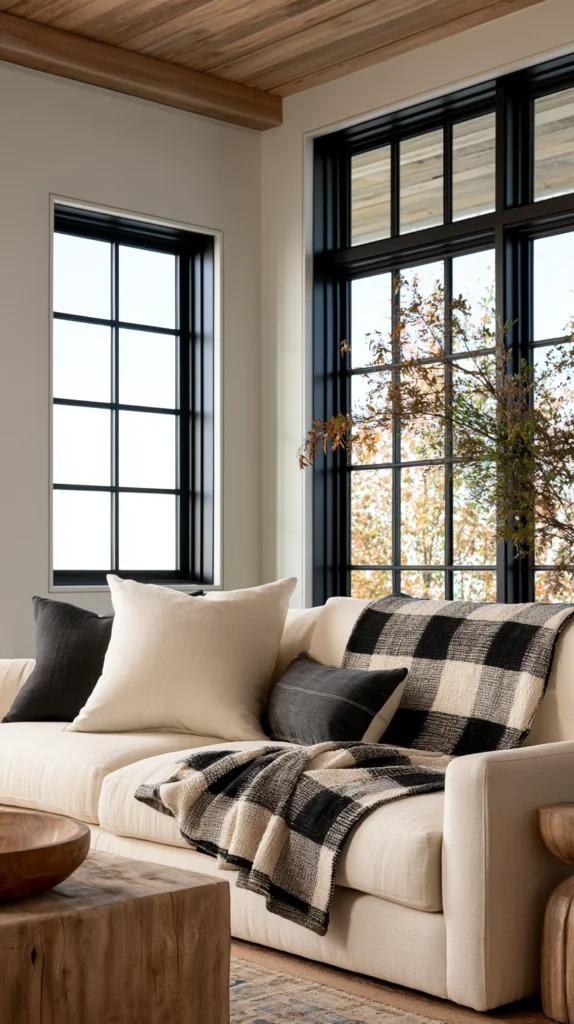
One plaid throw with solid-color pillows — the most recognizable fall pattern, styled with restraint.
My plaid overcorrection:
The mistake I made first:
- Plaid pillows AND plaid throw AND plaid table runner
- Looked like a flannel shirt exploded
- Too much pattern competing with itself
- Had to remove almost everything and start over
The restraint principle:
One plaid piece only:
- The throw blanket carries the plaid
- Every pillow remains solid
- Plaid gets to be seen clearly, not buried in more pattern
- This is the single most important rule for this combination
Choosing the right plaid:
Plaid styles for fall:
Buffalo check (most popular):
- Large two-color check (often black and red, or black and cream)
- Bold and graphic
- Most recognized “fall plaid”
- Works in farmhouse and traditional rooms
Tartan:
- Multi-color traditional pattern
- More formal and complex
- Best in traditional or English-inspired rooms
- Richer color story than buffalo check
Windowpane plaid:
- Subtle grid pattern, more refined
- Works in modern and transitional spaces
- Less obviously “rustic” than buffalo check
- Sophisticated alternative to bold plaid
Color selection:
Best fall plaid colors:
- Black and cream buffalo check (classic, high contrast)
- Rust and cream tartan (warmer, softer)
- Forest green and navy tartan (richer, more traditional)
- Camel and white windowpane (subtle, sophisticated)
The solid pillow strategy:
Pulling colors from the plaid:
- Identify the two or three colors in the plaid
- Choose solid pillows in those exact colors
- One pillow per plaid color (creates cohesion)
- Never add a fourth unrelated color
Example execution:
Black and cream buffalo check throw:
- Two cream linen pillows (large, pulled from the cream in plaid)
- Two black or charcoal velvet pillows (medium, pulled from the black)
- One textured lumbar in cream or black (ties it together)
Throw placement:
Showing off the plaid:
- Drape fully open across the back of the sofa (not folded)
- Pattern needs visibility to register
- Or draped over an ottoman as a secondary display
- Folding hides the pattern entirely; avoid this
Cost:
- Plaid throw blanket: $30-60
- Four solid pillow covers (matching plaid colors): $50-90
- Total: $80-150
My plaid and solid result: The single plaid throw reads as intentional and classic rather than overdone, guests immediately recognize the fall reference without it feeling like a costume, the rule of “one pattern only” transformed how the whole room felt.
Plaid and Solid Tips
Scale of the plaid:
Bigger check, better in larger rooms:
- Large-scale buffalo check (bold, needs space to read)
- Small-scale tartan (more detail, works in smaller rooms too)
- Match plaid scale to room size
- Tiny plaid in a large room disappears; huge plaid in a small room overwhelms
Avoiding the lumberjack cliché:
- All red and black (reads as costume)
- Black and cream, or rust and cream (more sophisticated)
- Mixing in unexpected solid colors (navy, sage) elevates it further
- Color choice separates “cozy fall” from “Halloween flannel”
5. Stripe and Solid Layering (Modern Fall Graphic)
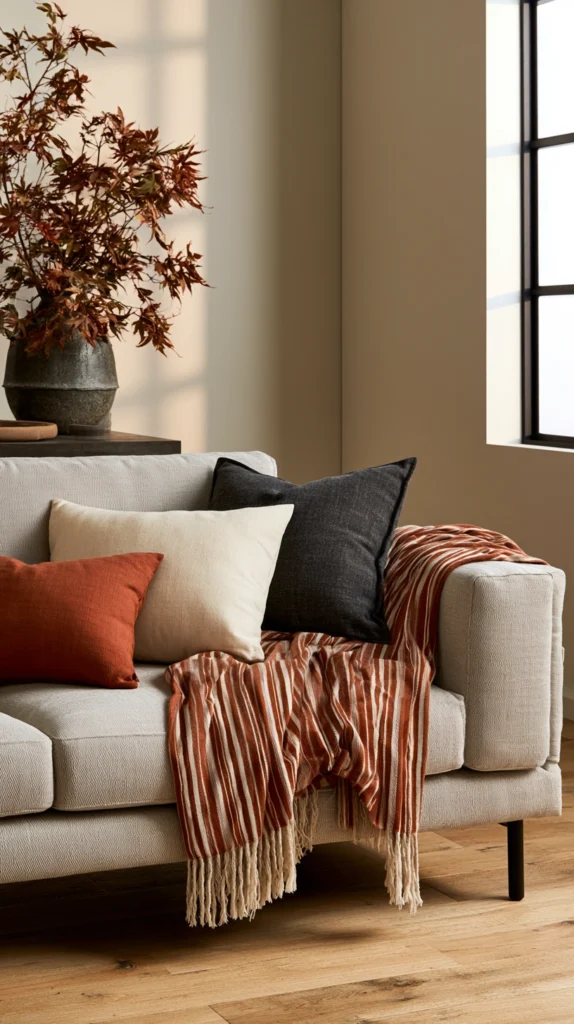
Striped throw blanket with solid color-blocked pillows — the contemporary alternative to plaid.
My move away from florals:
Why I switched:
- Floral pillows felt too soft for the modern furniture
- Wanted fall warmth without anything too traditional
- Discovered stripes provide pattern without fussiness
- Cleaner and more architectural feeling
Why stripes read as modern fall:
The graphic quality:
- Clean lines (unlike organic florals or plaid)
- Reads as considered and current
- Works in minimalist and contemporary rooms
- Pattern without complexity
Stripe styles for fall:
Wide horizontal stripe:
- Bold and graphic
- Works as the throw’s main pattern
- Two or three colors maximum
- Most contemporary stripe option
Pinstripe or narrow stripe:
- More subtle and refined
- Reads almost as texture from a distance
- Sophisticated and quiet
- Good for rooms with other busy elements
Color-blocked stripe:
- Bold sections of solid color (not traditional thin stripes)
- Most graphic and modern interpretation
- Statement piece on its own
Fall stripe color combinations:
Rust and cream:
- Warm and graphic
- Most fall-appropriate stripe colors
- Works with any solid pillow palette
Charcoal and mustard:
- Bold and contemporary
- High contrast, modern feeling
- Pairs with the mustard and charcoal room palette
Olive and oat:
- Subtle and sophisticated
- Quiet stripe, easy to live with
- Works year-round, not just fall
Building the solid pillows around the stripe:
Color-pull method:
- Identify the stripe’s two colors
- One solid pillow in each color (large size)
- One neutral pillow (medium, breathing room)
- One textured lumbar (ties everything together)
Throw display:
Folded versus draped for stripes:
- Stripes look great either folded (showing the pattern in a block) or draped (showing it in motion)
- Folded over the arm (clean, graphic display)
- Draped open across the back (more casual, shows full pattern)
- Both methods work; choose based on desired formality
Cost:
- Striped throw blanket: $30-55
- Four solid pillow covers: $50-90
- Total: $80-145
My stripe and solid result: Most modern-feeling fall combination I have tried, works beautifully in my contemporary living room where plaid felt wrong, the graphic clarity of stripes photographs and feels more current.
Stripe and Solid Tips
Stripe direction matters:
Horizontal vs vertical:
- Horizontal stripe throw (draped, the stripes run across, feels relaxed)
- Vertical stripe throw (draped, stripes run down, feels more formal)
- Consider how the throw will actually hang before choosing
- Horizontal is generally easier to style casually
Avoiding nautical confusion:
- Navy and white stripe (reads nautical, not fall)
- Rust, mustard, olive, or charcoal stripe combinations (reads fall specifically)
- Color choice prevents the wrong seasonal association
6. Sherpa and Boucle Combination (Cloud-Like Comfort)
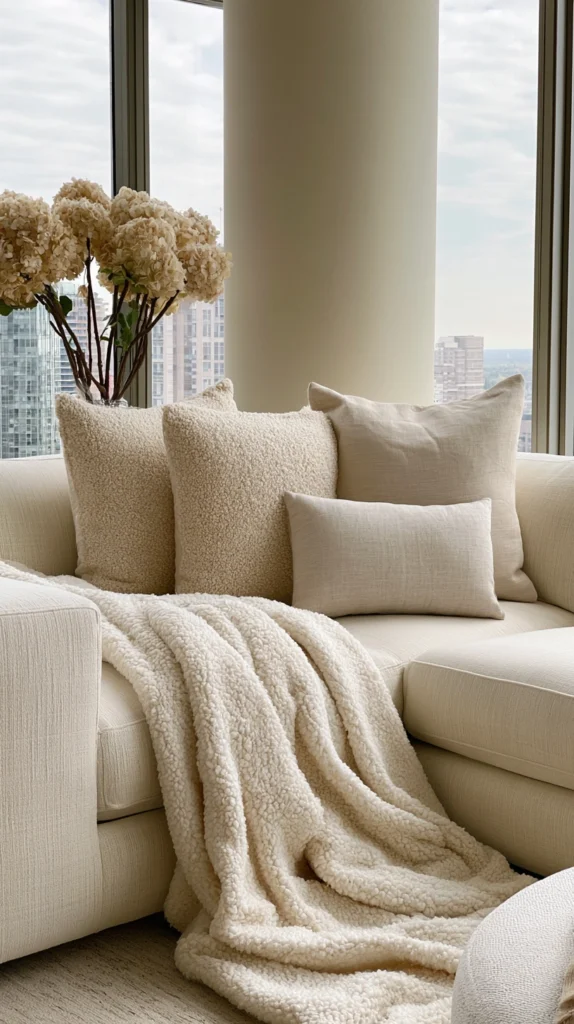
Two different soft, fluffy textures paired together — maximum tactile comfort without visual clash.
My coldest room solution:
The problem room:
- North-facing living room (always slightly cold)
- Needed maximum physical warmth
- Wanted softness without looking babyish
- Sherpa and boucle together solved it completely
Why these two textures pair well:
Different but related:
- Sherpa (looped pile, very plush, blanket-like)
- Boucle (looped yarn, more structured, pillow-appropriate)
- Both soft and tactile but different enough to layer
- Neither competes; both contribute to overall softness
The sherpa throw:
Best application:
- Reversible sherpa-fleece throw (fleece one side, sherpa the other)
- Cream, oat, or warm gray color
- Folded in thirds and draped, or fully open across the sofa back
- The warmest textile on this entire list
The boucle pillows:
Best application:
- Two or three boucle pillow covers
- Cream or warm white (lets the texture be the focus, not color)
- Medium size (18 inch), positioned among the arrangement
- The looped texture catches light beautifully
Building the full combination:
The all-soft formula:
- Two large linen pillows (provides some structure and contrast)
- Two medium boucle pillows (the soft texture layer)
- One lumbar in a third soft texture (chunky knit or velvet)
- Sherpa throw draped over the entire arrangement
Why include the linen pillows:
Avoiding the marshmallow effect:
- All soft textures with nothing structured (loses definition)
- Linen provides a flatter, more grounded base
- Contrast between structured and soft makes the soft pieces feel more luxurious
- Total softness without any contrast looks shapeless
Color approach:
Tonal cream and warm white:
- Most successful color story for this combination
- Lets texture be the entire visual interest
- Sophisticated rather than overly cute
- Adding one warm accent color (rust pillow) elevates further
Cost:
- Sherpa-fleece reversible throw: $25-50
- Three boucle pillow covers: $45-75
- Total: $70-125
My sherpa and boucle result: This combination made the coldest room in the house the warmest-feeling room, guests specifically request sitting in this spot, the tonal cream approach keeps it sophisticated rather than overly soft and juvenile.
Sherpa and Boucle Tips
Avoiding the all-white trap:
The risk:
- All cream and white textures (beautiful but can look flat without lighting)
- Warm lamp light is essential for this combination
- Daylight: looks soft and inviting
- Without warm lighting: can look slightly cold despite the soft textures
Washing schedule:
- Sherpa and boucle show oils and use faster than smooth fabrics
- Wash throw every two to three weeks during heavy use
- Spot clean pillow covers as needed
- Keep a backup set if budget allows (rotate while one set washes)
7. Velvet and Linen Mix (Sophisticated Contrast)
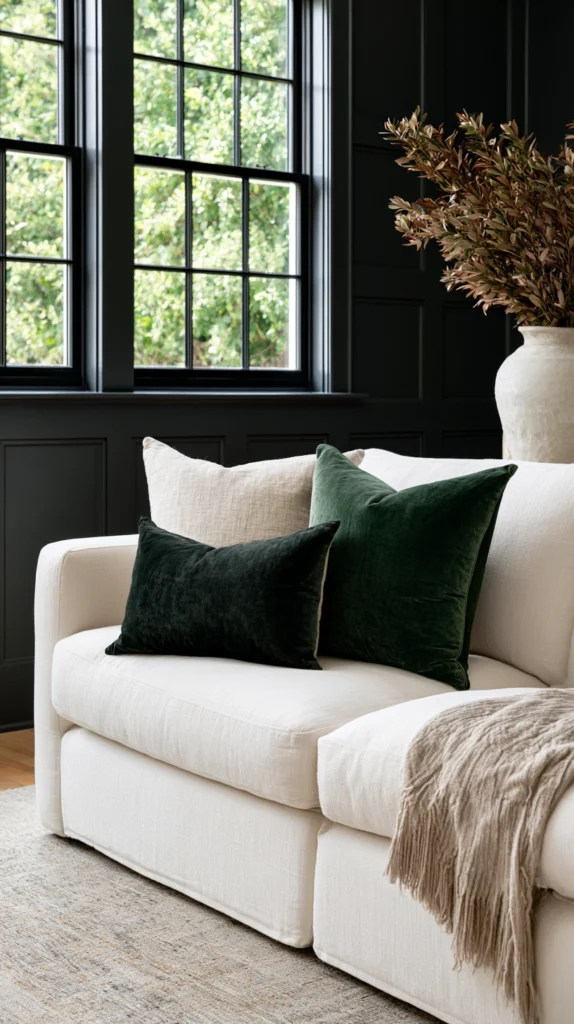
Smooth velvet pillows against natural linen throw — the most elegant fall combination.
My move toward sophistication:
What prompted the change:
- Wanted fall coziness without anything too casual
- Living room leans more formal
- Velvet and linen together struck the right balance
- Most complimented combination I have styled
The elegance of this pairing:
Why velvet and linen specifically:
- Velvet (formal, rich, light-catching)
- Linen (casual, natural, matte)
- Together: formal meets relaxed (sophisticated tension)
- Neither pure formality nor pure casualness
The velvet pillows:
Best application:
- Two or three velvet pillow covers
- Deep fall colors (rust, burgundy, forest green, or mustard)
- Medium to large size (18-20 inch)
- Velvet catches and holds lamp light beautifully
The linen throw:
Best application:
- Natural or warm white linen throw blanket
- Lighter weight, drapes elegantly rather than bunching
- Folded in a loose triangle over the sofa arm
- Lets the velvet pillows be the color story; linen stays quiet
Color combinations:
Burgundy velvet with natural linen:
- Rich and romantic
- Most elegant evening-appropriate option
Forest green velvet with warm white linen:
- Sophisticated and unexpected
- Works beautifully in any season transition
Rust velvet with oat linen:
- Most classically fall
- Warm and accessible
Building the full arrangement:
The complete formula:
- Two large linen pillows (matching the throw, the neutral base)
- Two medium velvet pillows (the color and texture statement)
- One lumbar in a complementary pattern or solid (optional fifth piece)
- Linen throw draped to complete the look
Why this reads as sophisticated:
The material hierarchy:
- Velvet historically associated with luxury and formality
- Linen historically associated with ease and natural living
- Combining them suggests a considered, curated home
- Neither overly formal nor overly casual; balanced
Cost:
- Three velvet pillow covers: $45-90
- Two linen pillow covers: $30-55
- Linen throw: $35-65
- Total: $110-210
My velvet and linen result: The combination that finally made my living room feel as elegant as I wanted, the velvet catches every bit of lamp light in the evening, this is now my permanent fall formula.
Velvet and Linen Tips
Velvet direction and light:
The nap consideration:
- Velvet has a directional nap (looks different from different angles)
- Brush gently in one direction for consistency
- Position pillows so the nap catches the room’s main light source
- Small detail that significantly affects how rich the velvet appears
Linen wrinkle acceptance:
- Linen throws wrinkle naturally with use and washing
- This is the correct, intended look for this fabric
- Do not iron (removes the casual elegance that makes the contrast work)
- Lived-in linen beside crisp velvet is the entire point
8. Tonal Monochrome Layering (Same Color, Different Textures)
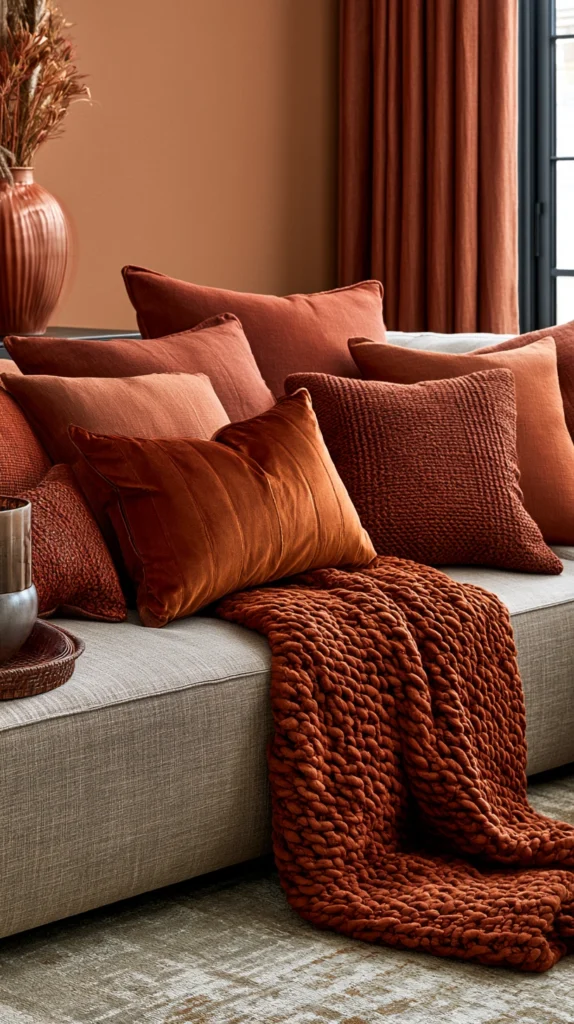
Every pillow and throw in one color family, varied only by texture — the most sophisticated and hardest combination to get wrong.
My tonal discovery:
Why I tried it:
- Worried about combining too many colors
- Wanted something foolproof
- Discovered that one color, many textures, never fails
- Now my most-used styling technique for any season
The principle:
Why monochrome works so well:
- No color decisions to second-guess
- Texture becomes the entire visual interest
- Reads as extremely intentional and high-end
- Nearly impossible to get wrong once the color is chosen
Choosing the one fall color:
Best colors for tonal layering:
All rust and terracotta:
- Light terracotta linen, medium rust velvet, dark rust knit
- Three depths of the same warm color
- Richest and most fall-specific tonal option
All camel and cognac:
- Light camel linen, medium camel boucle, dark cognac leather accent
- Most sophisticated and year-round wearable
- Works beautifully with leather furniture
All olive and sage:
- Light sage linen, medium olive velvet, dark olive knit
- Most unexpected tonal choice
- Reads as fresh and current
Building the tonal arrangement:
Three depths formula:
- Lightest shade: large pillows (the base, most visible mass)
- Medium shade: medium pillows (the middle layer)
- Darkest shade: throw blanket or lumbar pillow (the depth and grounding)
Texture variation within the tone:
This is where interest comes from:
- Linen in the lightest shade
- Velvet in the medium shade
- Chunky knit in the darkest shade
- Three different fabrics, one consistent color story
Example execution:
All-rust tonal combination:
- Two large pillows: pale rust or terracotta linen
- Two medium pillows: medium rust velvet
- One lumbar: deep rust or rust-brown chunky knit texture
- Throw blanket: deepest rust-brown, draped over the arm
Why this looks expensive:
The design principle:
- Designers use tonal layering specifically because it photographs and feels luxurious
- Eliminates the risk of clashing colors entirely
- Texture does all the work that color combinations usually do
- Reads as deliberate rather than accumulated
Cost:
- Five pillow covers in tonal shades: $65-130
- One throw blanket in deepest tone: $35-70
- Total: $100-200
My tonal rust combination: The most complimented sofa styling I have ever done, people cannot quite identify why it looks so put-together, the answer is always the same color in different textures.
Tonal Layering Tips
Finding true tonal matches:
The undertone challenge:
- Not all “rust” is the same rust
- Some lean more orange, some more brown, some more red
- Hold fabric swatches together in natural light before buying
- True tonal matching requires this extra verification step
Adding one outlier:
The advanced move:
- Once comfortable with tonal layering, add one small contrasting piece
- A single small pillow in cream or contrasting color
- Breaks the monotony just slightly
- Optional, and only after mastering the pure tonal version first
9. Pattern Mixing Formula (Three Patterns That Work Together)
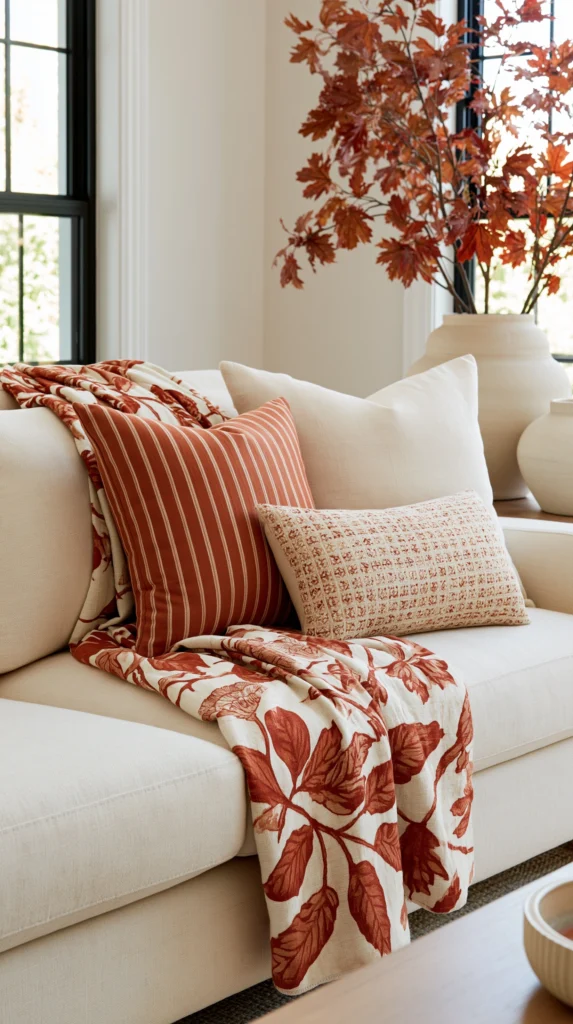
A specific system for combining multiple patterns without chaos — for those ready to move beyond solids.
My pattern fear:
Why I avoided this for years:
- Worried patterns would clash
- Stuck to solids exclusively
- Finally learned the three-pattern formula
- Now confidently mix patterns every season
The three-pattern rule:
The formula:
- One large-scale pattern (the statement)
- One medium-scale pattern (the support)
- One small-scale pattern or texture (the connector)
- Never more than three patterns in one arrangement
Pattern scale defined:
Large scale:
- Big, bold prints (large florals, large plaid, oversized geometric)
- Used sparingly (one pillow or the throw)
- The pattern everyone notices first
Medium scale:
- Stripes, medium check, mid-size geometric
- Supports the large pattern without competing
- Often the second-most visible piece
Small scale:
- Tiny print, fine texture, pinstripe
- Reads almost as solid from a distance
- The connector that ties the other two together
The unifying color rule:
Critical requirement:
- All three patterns must share at least one common color
- This shared color is what prevents visual chaos
- Without a shared color, even well-scaled patterns clash
- This is the single most important rule in pattern mixing
Example execution:
Fall pattern combination:
- Large pattern: bold rust and cream botanical print (throw blanket)
- Medium pattern: rust and cream stripe (one pillow)
- Small pattern: tiny cream and rust dot or fine check (lumbar pillow)
- Shared colors: rust and cream throughout all three
Supporting solid pillows:
Grounding the patterns:
- Two solid pillows (in one of the shared colors, usually the lighter one)
- These provide visual rest between the patterns
- Prevent the arrangement from feeling overwhelming
- Essential breathing room within a pattern-heavy combination
Placement strategy:
Where each pattern goes:
- Large pattern: throw blanket (most forgiving placement, can be draped to show partial pattern)
- Medium pattern: one of the larger pillows (substantial presence)
- Small pattern: the lumbar pillow (smallest piece, most detailed pattern)
- Solids: remaining pillows (the rest periods between patterns)
Cost:
- Patterned throw blanket: $35-65
- Two patterned pillow covers (medium and small scale): $35-65
- Two solid pillow covers: $30-55
- Total: $100-185
My pattern mixing result: Finally confident combining patterns after years of solids only, the shared-color rule made it foolproof, this arrangement gets the most specific compliments about “how did you do that.”
Pattern Mixing Tips
Start with two, not three:
Building confidence:
- First attempt: one pattern plus solids only
- Second attempt: two patterns sharing a color
- Third attempt: the full three-pattern formula
- Skipping ahead to three patterns without practice often fails
The fabric store test:
Before buying anything:
- Lay fabric swatches or pillow covers together on the floor
- Step back ten feet and assess
- If one pattern disappears or one pattern screams, adjust scale
- This test prevents expensive mistakes
10. Color-Blocked Solid Combination (Bold and Confident)
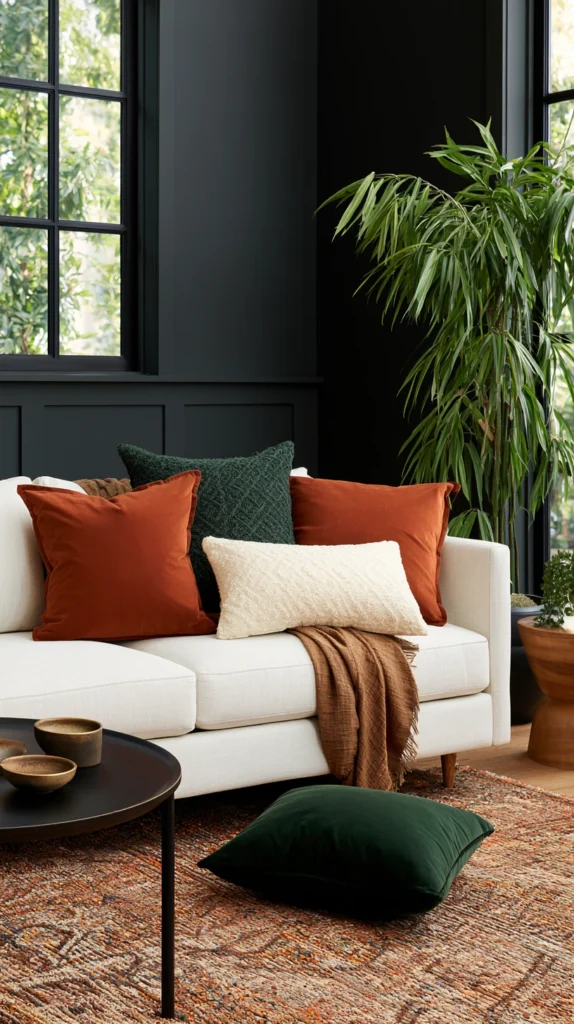
Large blocks of two or three solid fall colors, no patterns at all — graphic confidence through color alone.
My pattern fatigue solution:
Why I tried this:
- Tired of pattern decisions
- Wanted boldness without busyness
- Color blocking delivers drama through color alone
- Simpler to execute than pattern mixing, equally striking
The color-blocking principle:
What makes it different:
- No patterns whatsoever (every piece solid)
- Boldness comes entirely from color contrast
- Clean and graphic rather than textured or detailed
- Modern interpretation of fall coziness
Choosing the color block palette:
Two-color combinations:
Rust and forest green:
- High contrast, both deeply fall
- Bold and confident pairing
- Works in modern and traditional rooms alike
Mustard and charcoal:
- Most graphic and contemporary
- Strong contrast, sophisticated impact
- Best in minimal or modern spaces
Burgundy and camel:
- Rich and warm
- Less contrast than the others, more harmonious
- Elegant rather than bold
Three-color combinations:
Rust, cream, and forest green:
- The cream provides breathing room between two bold colors
- Most balanced three-color fall combination
- Works in almost any room style
Building the arrangement:
The block formula:
- Two large pillows: Color A (solid, no texture variation needed)
- Two medium pillows: Color B (solid, different fabric texture optional)
- One lumbar: Color C if using three colors, or Color A again for cohesion
- Throw blanket: Color B or C, whichever needs more visual weight
Texture still matters:
Avoiding flatness:
- Even without pattern, vary the fabric texture
- Velvet for one color, linen for another
- This prevents the arrangement from looking like flat color swatches
- Texture provides dimension that pattern would otherwise provide
Proportion guidance:
The 60-40 or 50-30-20 split:
- Two colors: roughly 60% one color, 40% the other
- Three colors: 50% dominant, 30% secondary, 20% accent
- Uneven proportions read as more intentional than perfectly equal splits
Cost:
- Five pillow covers in solid block colors: $65-120
- One throw blanket in a block color: $35-65
- Total: $100-185
My color-blocked result: The boldest combination on this entire list and somehow the simplest to execute, no pattern-matching anxiety, pure color confidence reads as extremely modern.
Color Blocking Tips
Saturation consistency:
Matching intensity:
- All colors should be similarly saturated (all muted, or all rich)
- Mixing a muted color with a highly saturated color looks accidental
- Rust (rich) paired with pale dusty sage (muted) clashes in intensity
- Match the saturation level across all chosen colors
The texture safety net:
If color blocking feels too bold:
- Add texture variation as the bridge
- A chunky knit in Color A beside a smooth velvet in Color B
- Texture difference softens the boldness of pure color blocks
- Makes the combination feel curated rather than stark
11. Layered Throws Without Pillow Changes (Quick Seasonal Switch)
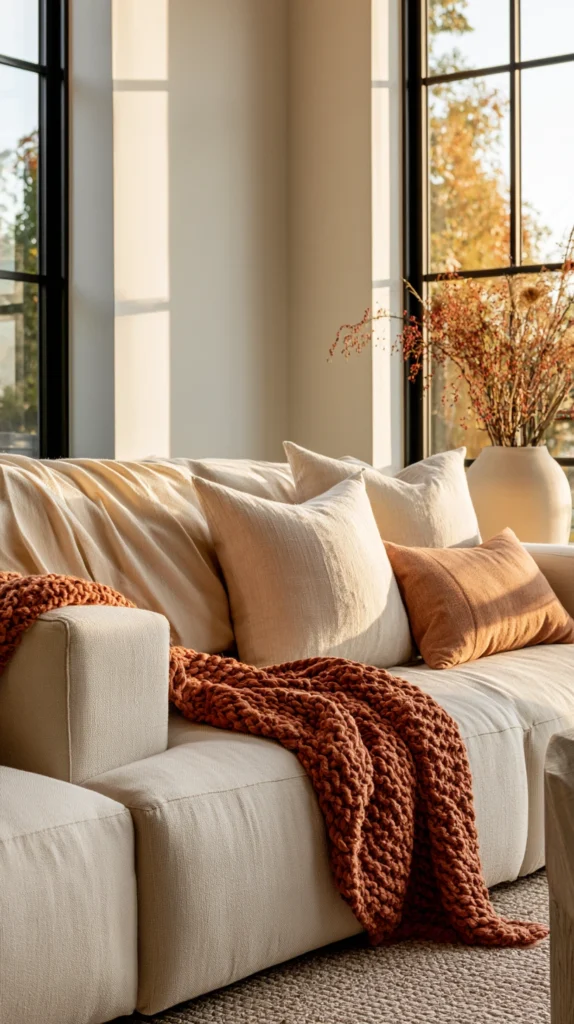
Adding fall throws over an existing year-round pillow arrangement — the fastest and least committal seasonal update.
My low-effort fall solution:
The situation:
- Already had pillows I liked year-round
- Did not want to buy new covers every season
- Wanted fall warmth without full pillow replacement
- Layered throws solved everything in one trip
Why throws alone can transform a sofa:
The visual weight of textiles:
- Throws cover more visible surface area than pillows
- A draped throw changes the entire sofa silhouette
- Faster seasonal impact than swapping pillow covers
- The lowest-effort, highest-impact seasonal change available
The layered throw technique:
Two throws, not one:
- One thinner throw as the base layer
- One thicker, more textured throw layered on top
- Creates depth without touching the pillows at all
- More visually rich than a single throw alone
Base throw:
Choosing the foundation:
- Lighter weight (linen or lightweight knit)
- Neutral or year-round color
- Draped fully across the back of the sofa
- Provides the canvas for the second throw
Top throw:
Choosing the fall layer:
- Heavier and more textured (chunky knit, sherpa, or faux fur trim)
- Fall-specific color (rust, olive, burgundy, mustard)
- Folded and draped over one arm or corner
- The seasonal statement piece
Draping technique:
Creating the layered look:
- Drape the base throw evenly across the sofa back
- Fold the seasonal throw in thirds lengthwise
- Place it diagonally across one arm or corner
- Let it cascade naturally, slightly overlapping the base throw
- Adjust until the two throws show distinct but complementary textures
Why no pillow changes needed:
The strategic decision:
- Existing pillows in neutral or year-round tones already work
- The throws introduce the fall color and texture story entirely on their own
- Saves money and storage space (no seasonal pillow rotation needed)
- Particularly good for renters or anyone who dislikes frequent redecorating
Color pairing without pillow coordination:
Making it work:
- Choose throws in colors that complement (not necessarily match) existing pillows
- A neutral pillow arrangement pairs with almost any throw color
- This is the most flexible combination on the entire list
Cost:
- Base throw (if not already owned): $25-50
- Seasonal top throw: $35-65
- Total: $35-115 (often less, since base throw is frequently already owned)
My layered throw-only result: The fastest fall update I have ever done, fifteen minutes from start to finish, proved that throws alone can carry an entire seasonal transformation without touching a single pillow.
Layered Throw Tips
The cascade matters more than the throw:
Styling over shopping:
- A budget throw, well-draped, outperforms an expensive throw, poorly placed
- Practice the cascade fold a few times before guests arrive
- Asymmetry (one side longer, slightly bunched) looks more natural than perfectly even draping
- The technique matters as much as the material
Two throws, one storage solution:
Practical management:
- Store both throws together as a designated “fall pair”
- Keeps the combination consistent each time you redecorate
- No need to re-decide the pairing every single fall
- Note which throw goes on top for future reference
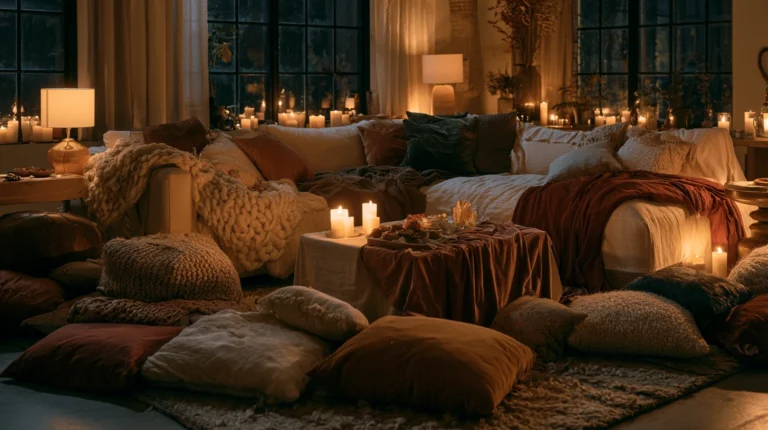
12. Floor Cushion and Sofa Pillow Coordination (Extending the Story Downward)
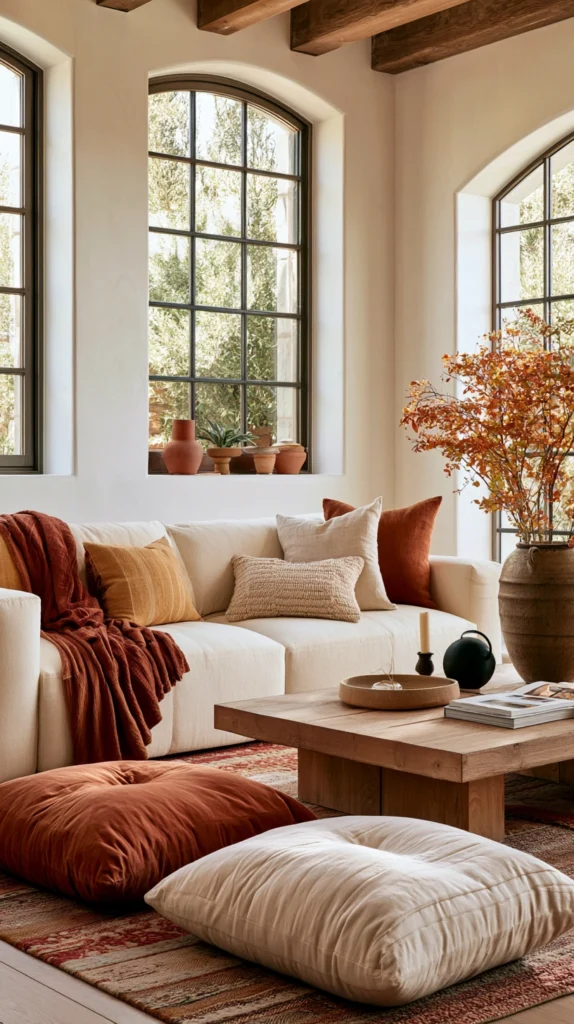
Matching or complementary textiles on floor cushions and the sofa above — creating cohesion across the entire seating area.
My disconnected seating realization:
What was wrong before:
- Sofa beautifully styled
- Floor cushions in completely unrelated colors and textures
- Two separate styling stories in one room
- Looked like furniture from two different households
The coordination principle:
Why floor and sofa should relate:
- The eye reads the whole seating area as one zone
- Disconnected textiles break that visual unity
- Coordination does not mean matching exactly
- Related tones and textures create cohesion without monotony
The coordination methods:
Method one — Shared color, different textures:
- Sofa pillows in velvet rust
- Floor cushions in linen rust (same color family, different fabric)
- Creates connection without exact repetition
Method two — Shared texture, different colors:
- Sofa pillows in chunky knit cream
- Floor cushions in chunky knit olive
- Same tactile quality, color variation keeps it interesting
Method three — Shared pattern, different scale:
- Sofa throw in large-scale plaid
- Floor cushions in smaller-scale version of the same plaid family
- Visual rhyme across different surfaces
Building the coordinated arrangement:
Sofa level:
- Standard five-pillow formula (from idea 1) in chosen fall palette
- One throw blanket in coordinating texture
Floor level:
- Two to three large floor cushions
- Same color family as sofa pillows, one shade lighter or darker
- Different texture from the sofa pillows (creates the textural conversation)
The visual flow:
Why this technique works:
- Eye travels naturally from floor to sofa and back
- Room feels designed as one cohesive seating zone
- Floor seating no longer looks like an afterthought
- Particularly effective for movie nights and gatherings (referenced in floor seating ideas)
Practical placement:
Where floor cushions go:
- In front of the coffee table, facing the sofa
- Beside the sofa arm, at the same visual height consideration
- Scattered casually rather than in a rigid row
Cost:
- Two to three floor cushion covers: $50-90
- (Sofa pillows from existing formula, idea 1)
- Total additional cost: $50-90
My coordinated seating result: The entire seating area now reads as one considered space rather than separate pieces, guests move freely between floor and sofa because both feel equally intentional, this connection is what elevated the whole room.
Floor and Sofa Coordination Tips
Avoid exact matching:
The subtle difference:
- Identical fabric on floor and sofa (looks like a matched set, slightly sterile)
- Related but distinct fabric (looks curated and considered)
- Aim for “clearly related” not “clearly identical”
- This distinction separates professional styling from a furniture showroom
Washing and durability for floor pieces:
Practical consideration:
- Floor cushions experience more wear than sofa pillows
- Choose more durable, washable fabric for floor pieces specifically
- Cotton canvas or treated linen handles floor use better than delicate velvet
- Reserve the most precious fabrics for the sofa level
13. The Minimalist Two-Texture Approach (For Modern and Restrained Spaces)
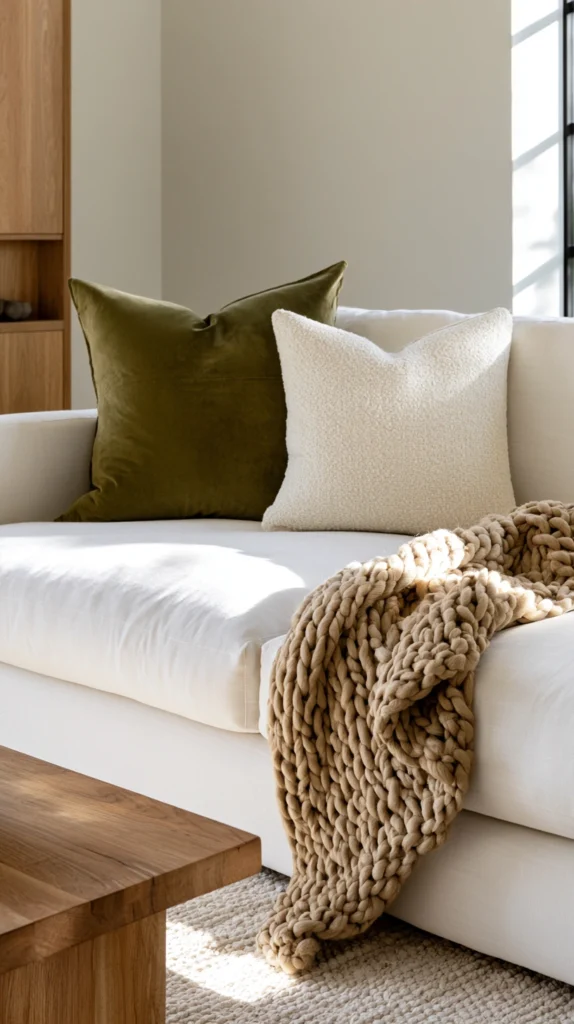
Just two pillows and one throw, in two coordinating textures — proof that fall coziness does not require abundance.
My restraint experiment:
Why I tried less:
- My modern living room felt overwhelmed by the five-pillow formula
- Wanted fall warmth without visual clutter
- Discovered that two excellent pieces outperform five mediocre ones
- Became my go-to for the most minimal rooms in the house
The minimalist principle:
Quality over quantity:
- Two pillows, chosen with extreme care
- One throw, in the best possible texture and color
- Every piece must be exceptional since there is nowhere to hide
- This approach demands higher quality per piece than the five-pillow formula
Choosing the two pillows:
The pairing:
- One large pillow (20-22 inch) in a rich solid fall color
- One medium pillow (18 inch) in a contrasting texture, same or complementary color
- Both pillows positioned with intention, generous space between them
- No lumbar, no additional small pieces
Choosing the one throw:
The single statement:
- The best quality throw the budget allows
- A genuinely beautiful texture (substantial chunky knit, real or excellent faux fur, fine wool)
- Since it is the only throw, it must do all the textural work alone
- Draped with extra care since it carries more visual weight than in a layered arrangement
Color and texture approach:
Example execution:
Modern minimal fall combination:
- One large pillow: deep olive velvet
- One medium pillow: cream boucle
- One throw: camel chunky knit, draped generously
Why this restraint reads as sophisticated:
The design principle:
- Minimal arrangements signal confidence
- Every piece is visible and considered, nothing crowded or competing
- Works specifically well in modern, Scandinavian, or minimalist interiors
- The opposite approach from maximalist layering, equally valid
Negative space matters:
The unstyled sofa surface:
- Leave generous bare sofa space around the two pillows
- This breathing room is part of the design, not an oversight
- Resist the urge to add a third pillow “to fill space”
- The emptiness is intentional and part of the minimalist appeal
Cost:
- Two pillow covers (invest in quality): $50-90
- One quality throw blanket: $45-85
- Total: $95-175
My minimalist result: This combination finally made fall styling feel right in my modern living room, less truly was more, the few pieces I chose get noticed precisely because there is nothing competing with them.
Minimalist Tips
Spend more per piece:
Budget reallocation:
- Five-pillow formula: moderate budget spread across many pieces
- Two-pillow formula: same total budget, concentrated into fewer, better pieces
- This redistribution often results in higher-quality individual pieces
- Worth the splurge since each piece carries more visual responsibility
Resisting the urge to add more:
The discipline required:
- After living with two pillows, the instinct to add a third is common
- Sit with the minimal arrangement for at least a week before deciding
- Often the urge passes once the eye adjusts to the restraint
- If still feeling sparse after a week, add one small textural element only
14. The Seasonal Transition Combination (From Late Summer Into Deep Fall)
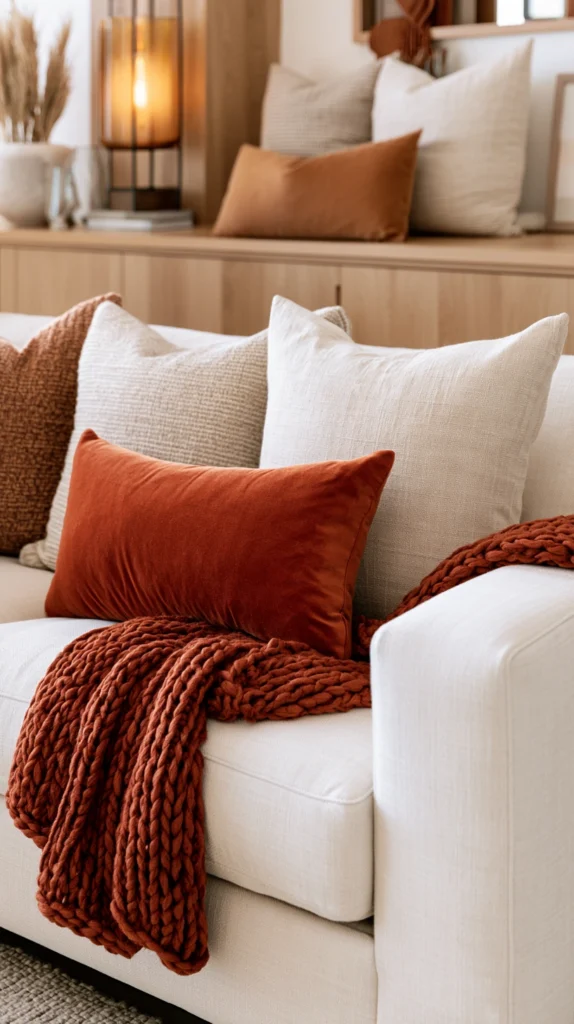
A combination designed to evolve gradually as the season progresses — one system, three stages.
My gradual transition discovery:
The problem with sudden seasonal swaps:
- Going from full summer to full fall overnight felt jarring
- Wanted the room to evolve the way the actual season does
- Designed a three-stage system that shifts gradually
- Each stage uses pieces from the stage before, adding rather than replacing
The three-stage system:
Stage one — Early fall (September):
Light transition:
- Keep summer’s lightweight linen pillows in place
- Add one fall-colored lumbar pillow (the first hint)
- Add one lightweight throw in a fall color (still warm-weather-appropriate weight)
- The room barely changes but the season has begun
Stage two — Mid fall (October):
Full fall arrival:
- Swap two of the summer linen pillows for fall velvet or knit pillows
- Layer in the chunky knit throw over the lighter stage-one throw
- Add the faux fur or boucle accent piece
- Now the full fall combination (from any of ideas 1 through 13) is in place
Stage three — Late fall (November):
Deepening into winter-adjacent warmth:
- Add a heavier, darker throw layer (deep burgundy or chocolate brown)
- Swap any remaining lighter pillows for the deepest, richest tones
- Increase texture overall (more chunky knit, more faux fur)
- Prepares the room for the eventual shift towhich winter without an abrupt change
Why gradual transition works better:
The psychological benefit:
- Mirrors how the actual season changes (gradually, not overnight)
- Each small addition feels intentional rather than overwhelming
- Spreads the cost across three months instead of one large purchase
- The room never feels “suddenly redecorated,” just naturally evolved
Storage and planning:
The practical system:
- Buy or set aside pieces for all three stages at the start of the season
- Store stages two and three pieces until their time arrives
- Calendar reminder to add the next stage’s pieces
- Removes decision fatigue once the plan is set
What stays constant throughout:
The anchor pieces:
- One or two pillows remain in place through all three stages (the formula’s foundation)
- This consistency prevents the room from feeling chaotic during transitions
- Usually the large, neutral pillows from the original five-pillow formula
Cost across the full transition:
Spread investment:
- Stage one: $40-70 (one pillow, one light throw)
- Stage two: $80-150 (pillow swaps, chunky throw, fur or boucle accent)
- Stage three: $50-90 (deeper throw layer, darkest pillow swaps)
- Total across three months: $170-310
My gradual transition result: The most natural-feeling seasonal change I have ever achieved, guests who visit in September and again in November see two different but related rooms, the cost spread across months made each stage feel affordable rather than one large expense.
Seasonal Transition Tips
Mark the calendar:
Staying on schedule:
- Set actual calendar reminders for each stage’s start
- Without reminders, stage two or three additions get forgotten
- The system only works if each stage actually happens on time
- Five minutes of planning at the season’s start saves the whole system
Photographing each stage:
Building a personal reference:
- Take a photo of the sofa at each stage
- Creates a personal lookbook for next year
- Removes guesswork in future seasons
- Compare year to year and refine the system further
Choosing Your Combination
By effort level:
Lowest effort (one trip, one afternoon):
- Layered throws without pillow changes (idea 11)
- Tonal monochrome layering if pillows already neutral (idea 8)
Medium effort (planned shopping, one weekend):
- Classic five-pillow formula (idea 1)
- Chunky knit and velvet (idea 2)
- Plaid and solid (idea 4)
- Velvet and linen mix (idea 7)
Higher effort (curated over time):
- Pattern mixing formula (idea 9)
- Seasonal transition combination (idea 14)
- Floor and sofa coordination (idea 12)
By room style:
Traditional and classic:
- Plaid and solid pairing
- Velvet and linen mix
- Chunky knit and velvet
Modern and minimal:
- Minimalist two-texture approach
- Color-blocked solid combination
- Stripe and solid layering
Maximalist and eclectic:
- Pattern mixing formula
- Faux fur accent with linen base
- Floor and sofa coordination
Cozy and relaxed:
- Sherpa and boucle combination
- Layered throws without pillow changes
- Tonal monochrome layering
By budget:
Under $100:
- Layered throws without pillow changes
- Stripe and solid (covers only, reuse inserts)
$100-200:
- Most combinations on this list
- Classic five-pillow formula
- Tonal monochrome layering
- Velvet and linen mix
$200+:
- Seasonal transition combination (full three stages)
- Floor and sofa coordination (full room)
- Quality faux fur and premium velvet combinations
Maintenance Reality
Keeping combinations looking right:
Weekly (5 minutes):
- Fluff and re-angle pillows
- Re-drape throws that have flattened or slipped
- Shake out faux fur or sherpa pieces
Monthly:
- Wash removable throw covers
- Spot clean pillow covers as needed
- Reassess the arrangement (anything flattened permanently, replace)
End of season:
- Wash everything before storing
- Store by combination (keep paired pieces together)
- Label storage bins by combination name for easy reassembly next year
My Complete Combination Journey
What I tried across three falls:
Fall one ($140):
- Classic five-pillow formula
- Learned the foundation everything else builds on
- Sofa transformed from flat to dimensional
Fall two ($180):
- Chunky knit and velvet, then layered in faux fur accent
- Texture contrast became my primary styling tool
- Most-touched pillow arrangement to date
Fall three ($220):
- Full seasonal transition system (three stages)
- Floor and sofa coordination added
- Most sophisticated and longest-lasting combination
Total investment: $540 across three falls Pillows and throws owned now: Enough to mix and match endlessly Main lesson: The formula matters more than the specific items; once understood, any budget can execute it
Getting Started This Weekend
Start with the foundation, not the fanciest combination.
This weekend:
Step 1 — Master the five-pillow formula first:
- Two large, two medium, one lumbar
- Even in solid colors, even in budget fabric
- This teaches the proportions everything else relies on
Step 2 — Add one textural contrast:
- One chunky knit throw against the smoother pillows
- This single addition teaches the contrast principle
Step 3 — Live with it one week:
- Notice what feels right and what feels off
- Adjust before buying anything additional
- The best combinations come from observation, not guessing
My recommendation:
Begin with idea 1, then layer idea 2 on top:
- Five-pillow formula as the foundation
- Chunky knit throw as the textural addition
- Total cost under $150
- This combination alone outperforms most random pillow shopping
See how it feels for a week, then choose your next combination based on what the room still seems to need.
Now go give your sofa the layered, cozy formula it has been missing all season.
Quick Summary
The 14 combinations:
Foundational:
- Classic five-pillow formula (idea 1): the formula everything else builds from
Texture-focused:
- Chunky knit plus velvet lumbar (idea 2): contrast done simply
- Faux fur with linen base (idea 3): one dramatic piece, restrained surroundings
- Sherpa and boucle (idea 6): maximum physical softness
Pattern-focused:
- Plaid and solid pairing (idea 4): classic fall, one pattern only
- Stripe and solid layering (idea 5): modern alternative to plaid
- Pattern mixing formula (idea 9): three patterns, one shared color
Color-focused:
- Tonal monochrome layering (idea 8): one color, many textures
- Color-blocked solid combination (idea 10): bold color, no pattern
Sophistication-focused:
- Velvet and linen mix (idea 7): formal meets casual
Effort-scaled:
- Layered throws without pillow changes (idea 11): fastest possible update
- Minimalist two-texture approach (idea 13): fewer, better pieces
Whole-room focused:
- Floor cushion and sofa coordination (idea 12): unifying the seating area
- Seasonal transition combination (idea 14): evolving gradually over months
The non-negotiable rules:
Always:
- Odd number of pillows (five is the classic, three works for smaller sofas)
- Vary texture even within one color story
- Size insert up from cover (plump never flat)
- Drape throws, never fold them flat and precise
Never:
- Buy a matching pillow set and call it done (no texture variation)
- Use more than three patterns in one arrangement
- Mix cool-toned and warm-toned colors in the same combination
- Skip the throw entirely (textiles need both pillows and throws to feel complete)
Common mistakes:
- Too few pillows (looks unfinished) or too many (overwhelming, no room to sit)
- All one texture, even in different colors (still reads as flat)
- Throws folded too neatly (looks untouched and unused)
- Pattern and color decisions made separately instead of together
- Forgetting the floor seating when styling the sofa
- Buying everything in one trip without living with a smaller version first
Remember: The five-pillow formula is the foundation for every other combination on this list, texture contrast is the single most powerful styling tool available, one shared color makes pattern mixing foolproof, draping technique matters as much as the throw itself, restraint (two pieces, well-chosen) can outperform abundance (five pieces, randomly assembled), the floor and the sofa should tell one coordinated story not two separate ones, and the best combination is the one that gets touched, used, and rearranged by the people who actually sit there every evening.