13 Fall Color Palettes That Transform Your Living Room
My living room looked the same in October as it did in April. Same gray sofa, same white walls, same silver accessories. Seasonless and flat.
Tried adding one orange pumpkin. Looked like a Halloween prop, not a fall room. Removed it after three days.
Then I stopped adding seasonal objects and started thinking in palettes. Coordinated color stories across walls, textiles, and accents. The room transformed into something that genuinely felt like fall.
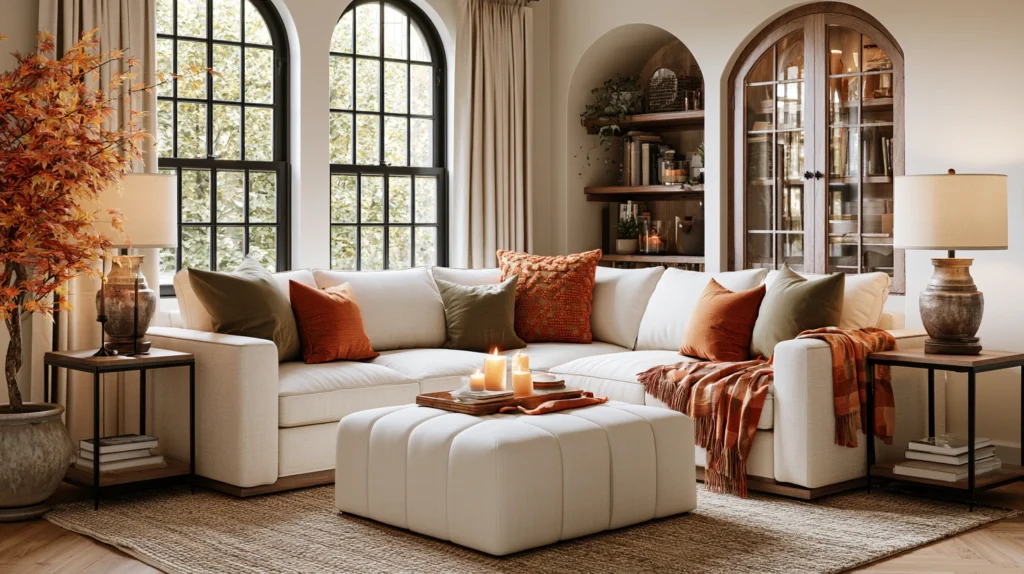
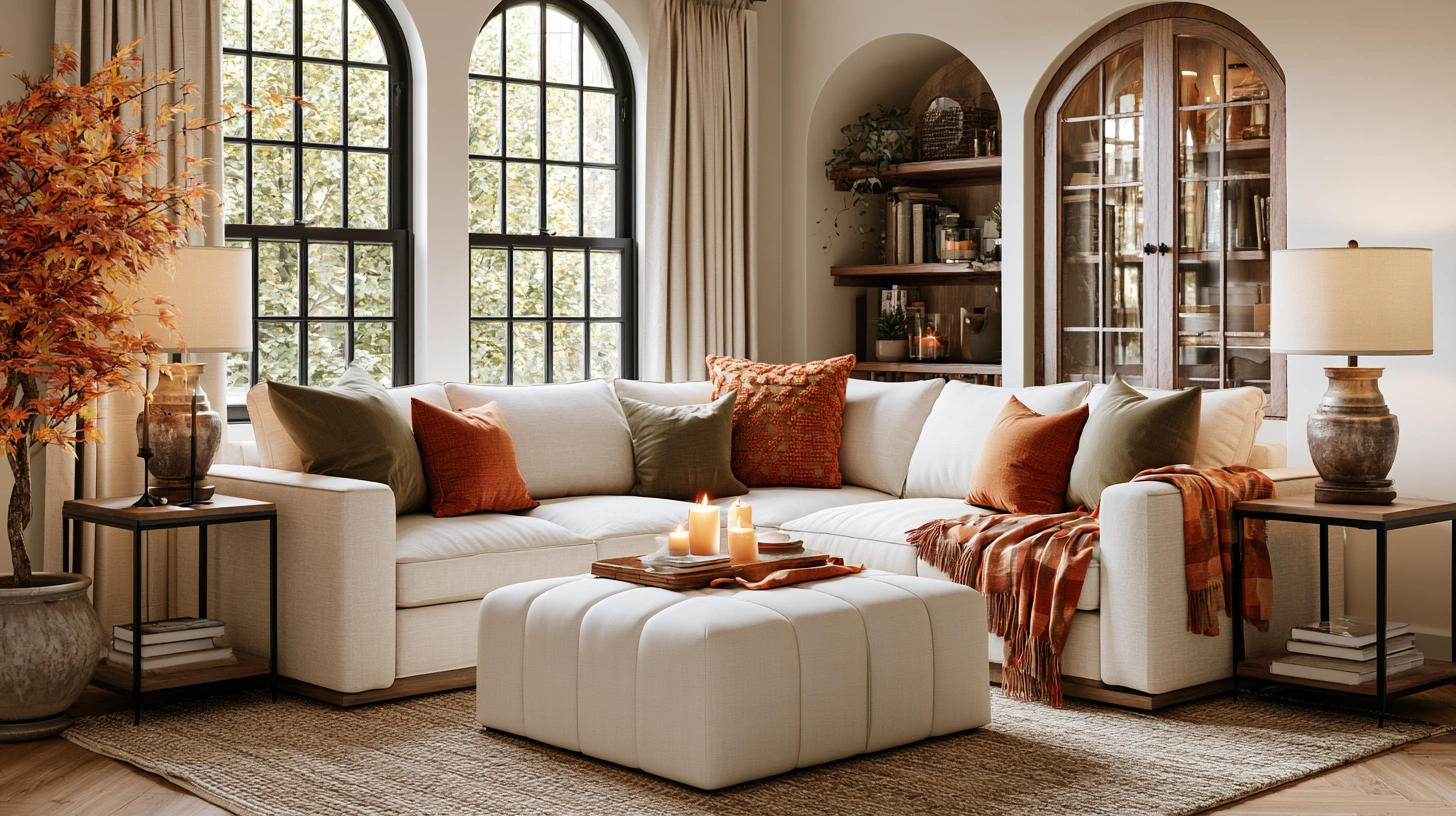
Now guests walk in during October and say the room feels different. Not decorated for fall. Just feels like fall. That distinction is everything.
Let me show you 13 color palettes that shift your living room into fall without making it look like a seasonal display.
Why One Orange Pumpkin Never Works
The single-object mistake:
What goes wrong:
- One seasonal object on an unrelated background
- Orange pumpkin on gray sofa (clashing not complementing)
- Object looks placed not considered
- Rest of room fights the seasonal piece
The color story problem:
- No palette connecting the pieces
- Fall object in non-fall room
- Eye sees the contrast (wrong kind)
- Looks decorated not designed
What a palette does differently:
- Colors relate across multiple surfaces
- Wall, textile, and accent work together
- Fall feeling comes from the room not the objects
- Cohesion reads as intention
The shift required:
- Stop thinking in objects (pumpkin, leaves)
- Start thinking in colors (rust, cream, olive)
- Apply palette across textiles first
- Let objects support the palette
My revelation: Fall color palettes are not about adding fall things — they are about shifting the room’s entire temperature toward warmth. The season is felt not spotted.
1. Burnt Orange and Cream (The Classic Fall Palette)
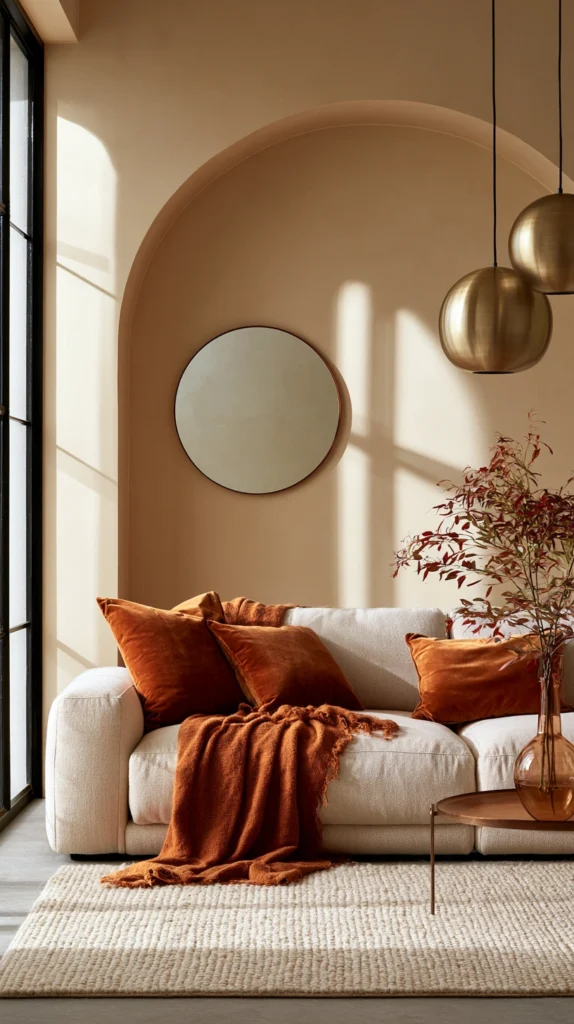
Deep orange-brown with warm ivory — the most recognizable fall combination executed with sophistication.
Why this palette works:
The tension:
- Orange alone (Halloween, too costume)
- Burnt orange with cream (warm and considered)
- The cream pulls orange toward sophistication
- Together they read as fall not festivity
Understanding burnt orange:
Burnt orange vs bright orange:
- Bright orange (pumpkin, Halloween, costume)
- Burnt orange (rust-meets-amber, sophisticated)
- The brown undertone is everything
- Brown undertone = fall, red undertone = Halloween
Finding true burnt orange:
- Sherwin-Williams Copper Mountain (SW 6882)
- Benjamin Moore Pumpkin Cream (2169-20)
- Farrow and Ball Fox Red (No. 48)
- Behr Burnished Amber
- All have brown-amber not red undertone
Where burnt orange appears in the room:
High impact:
- Accent wall (one wall, full commitment)
- Large sofa or loveseat (bravest choice)
- Area rug (grounds the whole room)
Medium impact:
- Throw pillows (3-4 on neutral sofa)
- Curtains (floor-to-ceiling presence)
- Upholstered accent chair
Low impact (supporting role):
- Candles
- Ceramic vases
- Small ceramic bowls
- Books with orange spines grouped
Cream placement:
Cream as the room’s base:
- Walls in warm cream (Sherwin-Williams Antique White)
- Sofa in natural linen or cream boucle
- Main rug in cream and natural fiber
- Orange sits against cream (relationship defined)
Cream qualities for this palette:
- Warm cream (yellow undertone, not blue)
- Never bright white (too stark against orange)
- Ivory or antique white preferred
- The warmth in the cream matches the warmth in the orange
Texture pairings:
Best textures for this palette:
- Velvet (burnt orange velvet pillow on cream sofa)
- Chunky knit (cream throw on orange chair)
- Linen (cream linen curtains)
- Woven jute (rug, natural base)
- Ceramic (orange glazed vessels)
Accent colors that support:
Third colors to add:
- Warm brown or cognac (wood tones, leather)
- Deep cream or tan (widening the cream family)
- Touches of gold or brass (metal accents)
- Avoid: red (too Christmas), bright yellow (too summer)
Paint approach:
For this palette:
- Walls: Sherwin-Williams Antique White or Benjamin Moore White Dove
- Accent wall if desired: Sherwin-Williams Copper Mountain
- Ceiling: Match walls (enveloping warmth)
- Trim: Crisp warm white (slight contrast)
Cost to implement:
- Pillow swap (4 pillows): $60-120
- One throw blanket: $30-60
- Two accent candles: $20-40
- Total for textile approach: $110-220
- If painting accent wall: add $50-80
My burnt orange and cream room: Stopped using pumpkins entirely, burnt orange velvet pillows on cream linen sofa replaced everything, room felt more fall than any decoration ever achieved.
Burnt Orange and Cream Tips
Test the undertone:
Before buying:
- Hold orange piece against cream piece
- Warm orange (amber undertone) plus warm cream: harmony
- Cool orange (red undertone) plus cream: clash
- This test takes thirty seconds and saves everything
The 70-20-10 split:
- 70% cream and neutral (walls, sofa, rug)
- 20% burnt orange (pillows, chair, one curtain)
- 10% accent (brass, brown wood, small objects)
- Too much orange overwhelms, too little disappears
2. Deep Rust and Warm White (Modern Sophistication)
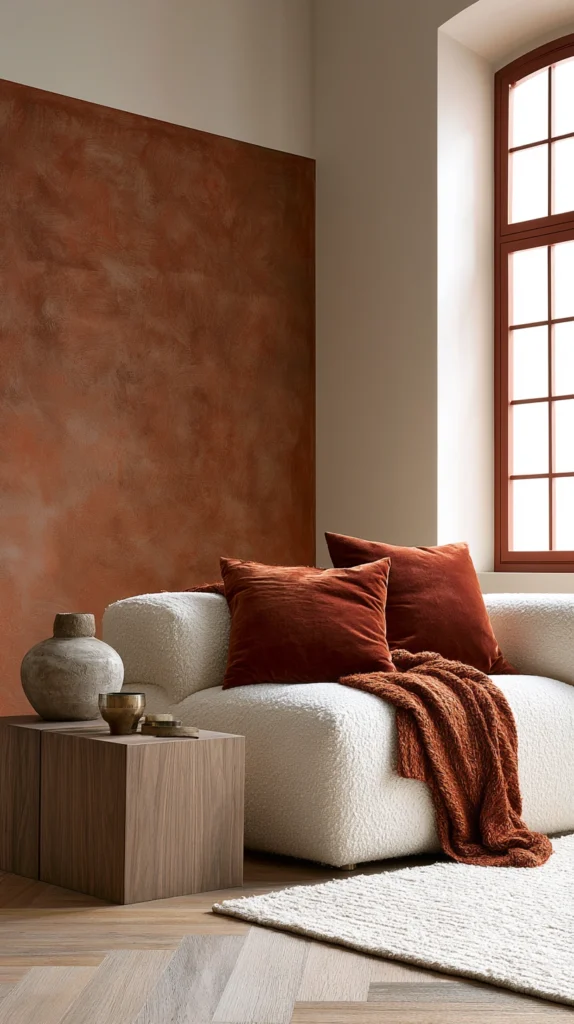
Darker and more muted than burnt orange — the fall palette for people who want warmth without brightness.
Understanding rust:
Rust vs burnt orange:
- Burnt orange (brighter, more amber)
- Rust (darker, more brown-red)
- Rust is where orange meets dried red clay
- More sophisticated, less obviously seasonal
The appeal of rust:
- Reads as both fall and year-round
- Pairs with everything (wood, brass, green, cream)
- Darkest comfortable warm accent
- Aged and organic feeling
Rust paint options:
On walls:
- Sherwin-Williams Cavern Clay (SW 7701) — most popular rust paint available
- Benjamin Moore Earthen Jug (2164-20)
- Farrow and Ball Red Earth (No. 64)
- Behr Moroccan Spice
- Portola Paints Sagebrush (slightly muted)
Rust on one wall:
- Fireplace wall (most natural placement)
- Wall behind sofa (seen across room)
- Entryway into living room (first impression)
- Commitment that rewards immediately
Warm white pairing:
Warm white here vs palette 1:
- Palette 1: cream (slightly darker)
- This palette: warm white (slightly brighter)
- Rust is darker, needs lighter counterpart
- Sherwin-Williams Alabaster or Benjamin Moore White Dove
Where rust lives in the room:
Dominant rust:
- Rust limewash accent wall (most beautiful use)
- Rust velvet sofa (boldest choice, most dramatic)
- Rust linen curtains (vertical presence)
Supporting rust:
- Chunky knit rust throw (draped on white sofa)
- Rust velvet pillows (4 on a linen sofa)
- Rust ceramic vase or vessel (shelf or table)
- Rust-toned candles
The limewash rust wall:
Why limewash specifically:
- Flat rust paint (can look like painted wall)
- Limewash rust (looks like ancient plaster, organic)
- Aged and natural quality
- Most sophisticated rust application
How to limewash:
- Apply with natural bristle brush
- Work in sections
- Wipe back while wet (mottled effect)
- Three coats maximum
- Portola Paints Roman Clay in Jasper or Sagebrush
Supporting palette elements:
What supports rust and warm white:
- Walnut and warm wood (always)
- Brass accents (golden warmth)
- Olive or sage green (natural third color)
- Cream and natural linen (bridge between rust and white)
Cost to implement:
- Rust throw pillows (4): $60-120
- Rust velvet throw: $35-65
- Rust ceramic accent: $20-50
- Limewash wall paint (optional): $60-120
- Total: $115-355
My rust and warm white room: Cavern Clay limewash on the fireplace wall changed the entire room temperature, warm white walls on the other three sides kept it feeling open, most complimented change in two years.
Rust and Warm White Tips
Limewash dries lighter:
Testing limewash:
- Apply test section and let dry completely (24 hours)
- Color looks darker wet (always)
- Dried color is the real color
- Add second coat if too light after drying
Rust and green:
- Rust and olive green are the perfect fall pair
- Add one olive element to rust and white room
- Keeps it from feeling too warm-monochromatic
- Small throw, one plant pot, one pillow
3. Terracotta and Cream Linen (Mediterranean Fall)
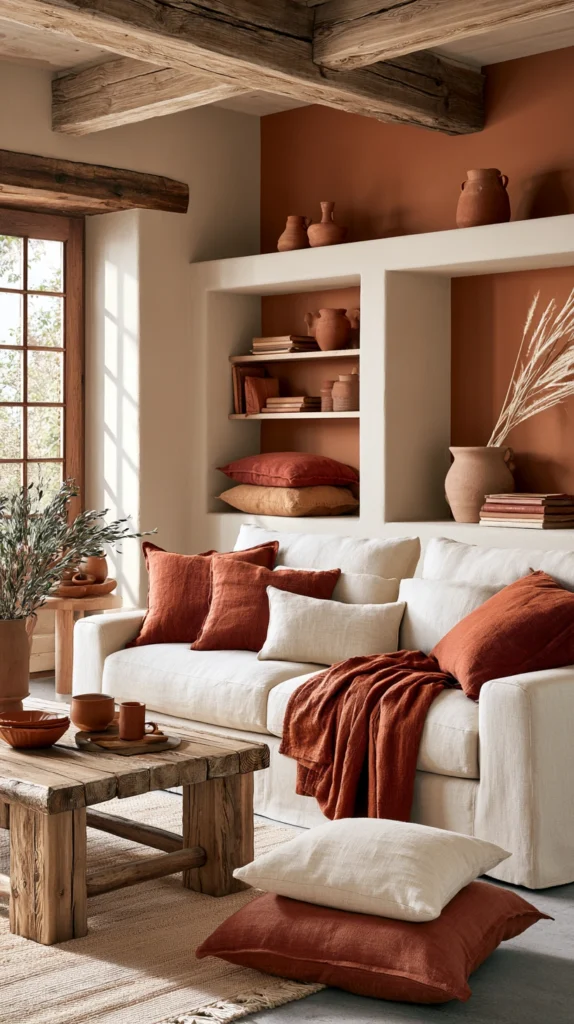
Clay-pot orange with natural linen — fall that feels like Tuscany in October.
Understanding terracotta:
Terracotta vs rust vs burnt orange:
- Burnt orange (brightest, most amber)
- Terracotta (between orange and clay brown)
- Rust (darkest, most brown-red)
- Terracotta sits in the middle, most earthen
Why terracotta reads as Mediterranean:
- Literal terra cotta means baked earth
- Southern Europe aesthetic (warm climates in fall)
- Pairs with cream linen (summer linens in cooling weather)
- Warm but not hot, earthy not rusty
Terracotta paint options:
Most loved terracotta paints:
- Sherwin-Williams Cavern Clay (slightly darker, doubles as terracotta)
- Benjamin Moore Moroccan Spice (2171-30)
- Farrow and Ball Dead Salmon (No. 28) — more muted, very sophisticated
- Behr Canyon Dusk
- Clare Paint Paloma (beautiful muted terracotta)
The linen element:
Natural linen in this palette:
- Sofa in oat or natural linen
- Linen curtains (unlined, lets light through warmly)
- Linen throw (natural, undyed)
- Linen pillow covers (textural interest)
Why linen specifically:
- Natural fiber (authentic material)
- Wrinkles slightly (casual and lived-in)
- Warm tone (oat and sand)
- Texture contrasts with smooth terracotta ceramics
Ceramic accent strategy:
Terracotta ceramics:
- Actual terracotta pots as vases
- Handmade ceramic bowls (imperfect glazes)
- Stoneware in earthy tones
- Clustered on coffee table or shelf
Why actual terracotta vessels:
- Material matches the palette name
- Authentic and organic
- Unglazed terracotta (textural, porous)
- Most genuine version of this palette
Plant integration:
Best plants for terracotta and linen:
- Olive tree (literal Mediterranean reference)
- Potted herbs (rosemary, lavender)
- Snake plant in terracotta pot
- Any plant in an unglazed terracotta pot
The pot unifies:
- Any plant in terracotta pot becomes part of palette
- Consistent pot material (terracotta throughout)
- Different plants, same container color
- Cohesion through repetition
Third colors:
Supporting the palette:
- Warm white walls (always)
- Warm wood (acacia, olive wood, teak)
- Dusty sage green (herb garden reference)
- Aged brass or copper (patinated warmth)
Cost to implement:
- Linen throw pillow covers (4): $40-80
- Natural linen throw: $30-55
- Terracotta pots (various sizes): $15-40
- Terracotta ceramic vessel: $20-45
- Total: $105-220
My terracotta and linen room: Most relaxed fall palette I have used, room felt like it was from a travel magazine, terracotta pots with plants inside are the most fall thing that also works year-round.
Terracotta and Linen Tips
Wrinkled linen is correct:
Do not iron linen:
- Wrinkles are part of the aesthetic
- Casual and lived-in (intentional)
- Ironed linen (stiff, formal, wrong for this palette)
- Natural fiber behavior is the feature not a flaw
Aging terracotta:
- Unglazed terracotta develops white mineral marks (beautiful)
- Shows character of use
- Do not seal (let it breathe and mark)
- Patina improves the look
4. Warm Camel and Cognac (Rich and Tonal)
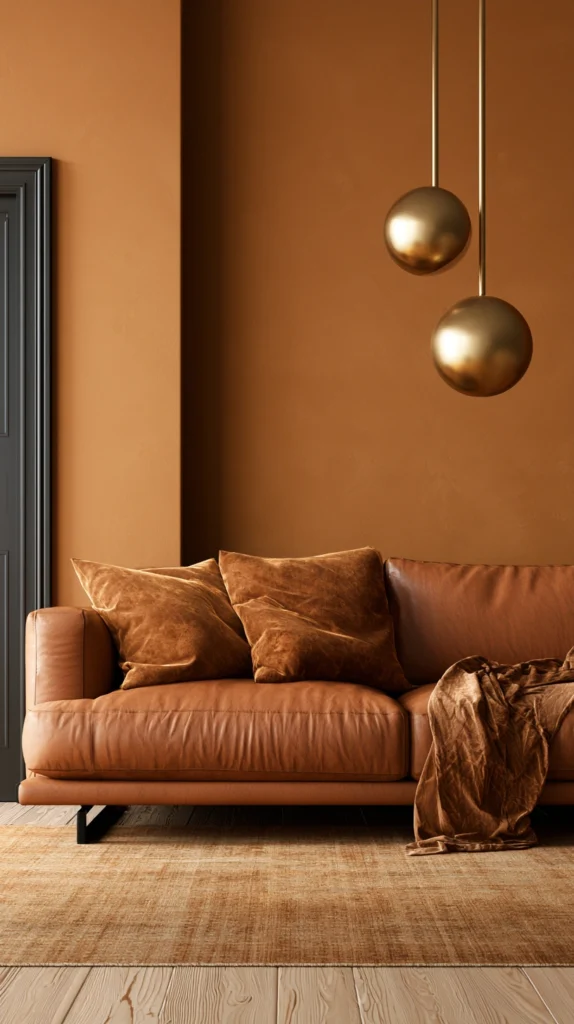
Two warm browns from the same family — the most sophisticated and wearable fall palette.
Why tonal palettes are powerful:
What tonal means:
- Colors from same family (all warm browns)
- Varied depth within one color story
- Light version and dark version of same hue
- Room feels unified and purposeful
Camel and cognac defined:
Camel:
- Light warm brown (sand to honey)
- Named after the animal color
- Versatile neutral that leans warm
- Most universal fall neutral
Cognac:
- Deeper warm brown (amber to dark honey)
- Named after the French spirit (accurate color)
- Rich and sophisticated
- Deepens any palette it enters
Together:
- Two layers of the same warmth
- Light version grounds (walls, large pieces)
- Dark version accents (pillows, accessories)
- Feels expensive without trying
Camel in the room:
Where camel lives:
- Walls in warm camel (Sherwin-Williams Antelope or Accessible Beige)
- Sofa in camel velvet or caramel leather
- Large area rug (natural camel tone jute or wool)
- Curtains in camel linen
Cognac in the room:
Where cognac lives:
- Leather accent chair (cognac leather)
- Throw pillows (cognac velvet)
- Leather tray or accessories
- Cognac glass vessels (catches light)
The leather element:
Why leather belongs in this palette:
- Cognac leather is the material version of cognac color
- Natural and authentic
- Ages and darkens beautifully
- Ottoman, chair, or accessories
Warm metal support:
Brass and gold:
- Camel and cognac beg for warm metal
- Brass lamp base (golden warmth)
- Gold-toned picture frames
- Aged bronze candle holders
- Every metal in room should be warm
No cool metal rule:
- Chrome (cold silver, wrong family)
- Brushed nickel (too cool)
- Black metal (graphic, not organic)
- Warm palette needs warm metal throughout
Third color option:
What to add:
- Cream or ivory (lightest version of palette)
- Warm white walls if not going camel
- Deep chocolate brown (darkest version)
- Forest green (contrast that still works)
Cost to implement:
- Camel velvet throw pillows (3): $45-90
- Cognac leather tray: $30-60
- Brass accent lamp or candleholders: $40-80
- Camel knit throw: $35-65
- Total: $150-295
My camel and cognac room: Most year-round usable fall palette, never needed to swap back to neutral for winter (it just became a winter palette too), leather ottoman was the best single purchase.
Camel and Cognac Tips
Leather care in fall:
Conditioning schedule:
- Condition leather twice yearly (fall and spring)
- Leather conditioner ($10-15)
- Prevents cracking and drying
- Deepens and enriches the color
Camel wall paint testing:
- Camel paints read very differently in different lights
- Morning light (cool, looks beige)
- Evening light (warm, looks golden)
- Test at both times before committing
5. Olive Green and Warm Cream (Forest Floor Fall)
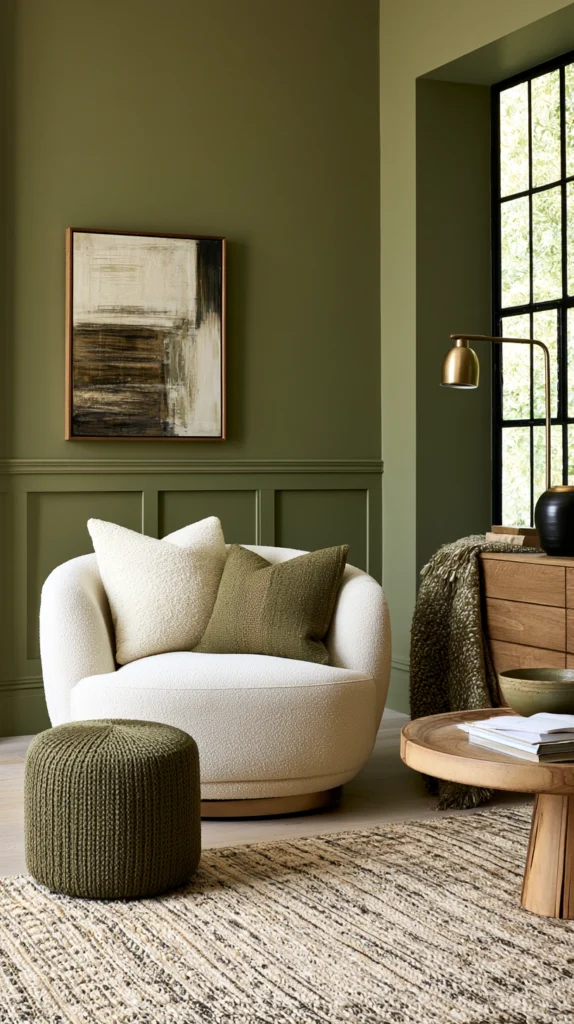
Muted yellow-green with ivory — fall that references the changing forest canopy not the pumpkin patch.
Why olive green is the best fall color nobody talks about:
Olive green truths:
- Every deciduous tree turns through olive on the way to gold
- Natural fall color nobody manufactured
- Sophisticated where orange is obvious
- Pairs with everything in the fall family
Understanding olive:
Olive vs sage vs forest:
- Sage (lighter, more gray-green, romantic)
- Olive (medium, more yellow-green, earthy)
- Forest green (darker, more blue-green, lush)
- Olive sits between sage and forest, most fall-specific
Finding true olive green:
Paint options:
- Sherwin-Williams Oakmoss (SW 6180)
- Benjamin Moore Dried Thyme (HC-183)
- Farrow and Ball Mole’s Breath (more gray-green, olive adjacent)
- Behr Back to Nature
- Clare Paint Wanderer (perfect olive)
Olive as wall color:
Impact:
- Olive accent wall (behind sofa or fireplace)
- All walls olive (bold, enveloping, beautiful)
- Wainscoting in olive below cream above (two-tone)
- Ceiling in olive (most unexpected, most dramatic)
Olive as textile:
Throughout the room:
- Olive velvet sofa (most impactful)
- Olive linen curtains (floor-to-ceiling presence)
- Olive chunky knit throw (most popular use)
- Olive velvet pillow covers (easiest entry point)
Warm cream as counterpart:
Why warm cream (not white):
- White beside olive (cool clash)
- Warm cream beside olive (natural harmony)
- Like limestone beside moss
- Natural pairing from the outdoor world
What cream to use:
- Benjamin Moore Pale Oak (most versatile)
- Sherwin-Williams Antique White
- Farrow and Ball Clunch (soft and warm)
- All have yellow-warm undertone (matches olive’s yellow-green)
Natural elements in olive and cream:
What to add:
- Dried botanicals (olive and cream tones)
- Wood in warm blonde tones (white oak)
- Moss and preserved fern accents
- Acorns and pinecones (fall naturals)
- Olive tree in terracotta pot (perfect plant for this palette)
Third accent colors:
What supports olive and cream:
- Rust or terracotta (warm accent)
- Gold and brass metal (warmth)
- Deep brown wood (grounding)
- Camel and tan (extension of cream family)
Cost to implement:
- Olive velvet throw pillows (4): $60-100
- Olive chunky knit throw: $35-65
- Dried botanical stems (olive and cream): $20-40
- Olive candle (two): $20-35
- Total: $135-240
My olive and cream room: Most unusual fall palette that gets the most questions, nobody realizes it is a fall palette immediately then suddenly sees it, most sophisticated take on fall color.
Olive and Cream Tips
Olive and orange together:
The combination:
- Olive plus one burnt orange accent (small)
- Ties olive into broader fall story
- One rust pillow among four olive pillows
- Feels like the forest floor in October
Olive ceiling experiment:
- Paint ceiling olive before committing to walls
- Less commitment than all four walls
- Enormous impact from above
- Changes room temperature dramatically from one surface
6. Deep Burgundy and Blush (Romantic Fall)
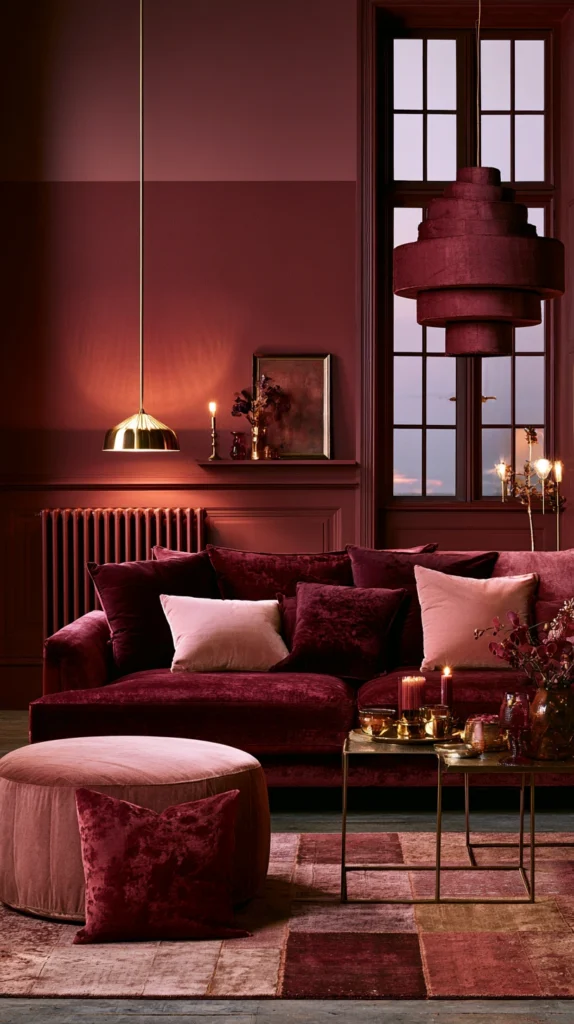
Wine-dark red with dusty pink — the fall palette for evenings by candlelight.
Why burgundy is fall:
Burgundy in nature:
- Dying maple leaves (dark red stage)
- Wine and grape harvest (October)
- Autumn berry clusters
- Forest mushrooms and bark
Burgundy vs red:
- Red (Christmas, too bright, too bold)
- Burgundy (red plus brown plus purple undertone)
- The darkness and brown-purple undertone makes it fall
- Never red, always burgundy or wine
Best burgundy paints:
On walls:
- Sherwin-Williams Merlot (SW 6307)
- Benjamin Moore Burgundy (2083-20)
- Farrow and Ball Preference Red (No. 297) — more muted
- Behr Vintage Wine
- Benjamin Moore Dark Burgundy (2258-10) — deepest option
The blush counterpoint:
Why blush (not white):
- White beside burgundy (stark, formal)
- Blush beside burgundy (romantic, warmed)
- Blush shares burgundy’s pink family
- Softens the darkness without losing warmth
Blush in this palette:
- Blush linen sofa (warm and soft)
- Blush throw pillows on burgundy chair
- Blush linen curtains (let them filter light pinkly)
- Blush ceramic vessels
Room application:
Burgundy dominates:
- Accent wall in burgundy (one wall, powerful)
- Burgundy velvet sofa (commitment, beautiful)
- Burgundy curtains (darkens and enriches room)
- Burgundy layered rug
Burgundy supports:
- Four burgundy velvet throw pillows
- Burgundy throw blanket draped on blush sofa
- Burgundy candles grouped
- Burgundy ceramic objects
The evening room quality:
Why this palette loves evening:
- Candlelight on burgundy (glows warmly)
- Blush reflects warm light (softens further)
- Room feels different at 8pm than 8am
- Designed for evening use and atmosphere
Candles in this palette:
- Deep burgundy or plum pillar candles
- Blush taper candles in brass holders
- Mixed together in one display
- Candle light on these colors is extraordinary
Third colors:
Supporting burgundy and blush:
- Deep plum (darker version of burgundy)
- Rose gold or copper metal (warmer than brass)
- Warm cream (neutral between the two)
- Forest green (unexpected, works beautifully)
Cost to implement:
- Burgundy velvet pillows (4): $60-120
- Blush throw blanket: $30-65
- Burgundy candles (set): $20-40
- Rose gold or copper accent: $20-45
- Total: $130-270
My burgundy and blush room: Most atmospheric fall palette for evenings, completely different feeling at 8am and 8pm, candlelight on burgundy velvet is extraordinary.
Burgundy and Blush Tips
The blush must be warm:
Warm vs cool blush:
- Cool blush (pink with blue undertone, looks cold)
- Warm blush (pink with peach undertone, looks right)
- Hold blush piece beside burgundy
- Warm blush harmonizes, cool blush clashes
Burgundy wall test:
- Deepest colors change most between wet and dry
- Burgundy dries lighter than wet paint
- Apply large test section, dry 24 hours
- Second coat brings depth back
7. Mustard Yellow and Charcoal (Bold and Modern Fall)
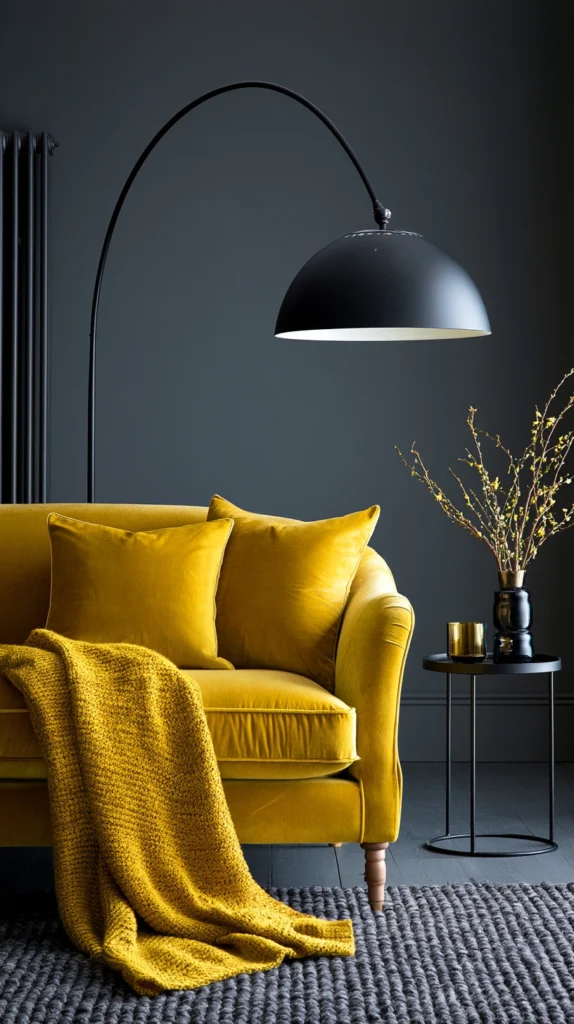
Warm yellow-gold with deep gray — the most graphic and contemporary fall palette.
Why mustard is fall:
Mustard in nature:
- Ginkgo trees (pure mustard yellow in October)
- Goldenrod wildflower fields
- Prairie grass going golden
- The field color of late fall
Mustard vs yellow:
- Bright yellow (summer, too light, too cheerful)
- Mustard (yellow plus brown undertone)
- The brown brings it into fall territory
- Warm and slightly darkened yellow
Finding true mustard:
Paint options:
- Benjamin Moore Hawthorne Yellow (HC-4)
- Sherwin-Williams Harvest Gold (SW 6369)
- Farrow and Ball Babouche (No. 223) — perfect mustard
- Behr Antique Gold
- Clare Paint Dapper (warm mustard)
Charcoal as counterpart:
Why charcoal (not black):
- Black beside mustard (too harsh, graphic)
- Charcoal beside mustard (softer, more room for warmth)
- Charcoal has brown or warm gray undertone
- Creates drama without eliminating warmth
Charcoal in this palette:
- Charcoal sofa (most popular starting point)
- Charcoal accent wall (wall behind mustard elements)
- Charcoal rug (grounds the brightness)
- Charcoal curtains (dramatic framing)
Mustard placement:
Mustard as accent:
- 4 mustard throw pillows on charcoal sofa
- Mustard throw draped over charcoal chair
- Mustard curtain panels alternating with charcoal
- Mustard velvet accent chair
Mustard as dominant:
- Mustard velvet sofa (bravest choice)
- Charcoal walls behind (reversal of typical)
- Most graphic and modern version
- Requires confidence, rewards with impact
The graphic quality:
Why this palette reads modern:
- High contrast (dark charcoal, bright mustard)
- Graphic not romantic
- Architectural rather than organic
- Best in modern and contemporary spaces
Third colors:
Supporting mustard and charcoal:
- Warm cream or ivory (softens the contrast)
- Rust accent (ties into broader fall)
- Warm wood (walnut, adds warmth)
- Brass metal (bridges mustard and charcoal)
Who this palette suits:
Best for:
- Modern and minimal living rooms
- Industrial or loft spaces
- Anyone who finds other fall palettes too soft
- Rooms that already have charcoal or dark gray bones
Cost to implement:
- Mustard velvet pillows (4): $60-100
- Mustard throw blanket: $35-65
- Mustard ceramic accent: $20-40
- Warm brass lamp or object: $30-70
- Total: $145-275
My mustard and charcoal room: Most modern fall palette, completely unexpected, guests say it feels like fall without knowing why (the mustard does the work invisibly).
Mustard and Charcoal Tips
Mustard quantity control:
The restraint rule:
- Mustard is powerful (small amount goes far)
- 10-15% of room in mustard (enough)
- More than 20% (overwhelming, starts feeling like a school bus)
- Charcoal carries the room, mustard accents it
Undertone testing:
- Mustard and charcoal must share undertone family
- Warm charcoal (brown-gray) plus warm mustard: harmony
- Cool charcoal (blue-gray) plus mustard: clash
- Hold fabrics together in natural light before buying
8. Forest Green and Amber (Deep Woods Fall)
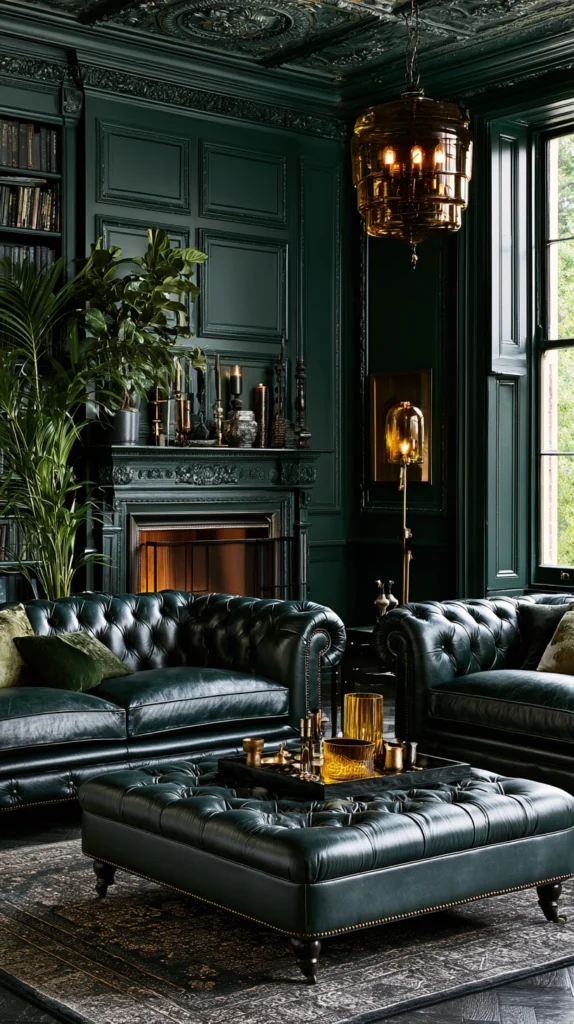
Dark and complex green with golden amber — the fall palette that references the forest at dusk.
Why forest green is fall:
Green in autumn:
- Evergreen trees (pine, cedar, fir) stay constant
- Their deep green becomes more visible as deciduous trees lose leaves
- Late fall is dominated by evergreen
- Forest green is the quiet backdrop of the season
Forest green vs other greens:
The spectrum:
- Sage (lightest, most gray-green)
- Olive (medium, most yellow-green)
- Forest (dark, most blue-green)
- Hunter (darkest, most saturated)
Forest green is:
- Darkest usable green
- Deep and enveloping
- Blue-green undertone (cooler than olive)
- Needs amber to warm it
Forest green paint options:
The best:
- Sherwin-Williams Rookwood Dark Green (SW 2809)
- Benjamin Moore Forest Green (2047-10)
- Farrow and Ball Calke Green (No. 80) — one of the most beautiful
- Farrow and Ball Mizzle (No. 266)
- Behr Botanical Garden
- Clare Paint Easy Tiger (deep and rich)
Amber as counterpart:
What amber does:
- Warms the cool blue-green of forest
- Brings in golden light quality (falling leaves)
- Bridges forest green to fall story
- Glows beside green (complementary relationship)
Amber in the room:
- Amber glass vessels (catches and holds light)
- Amber candles (lit, extraordinary beside green)
- Amber woven textile (throw or rug)
- Warm honey wood tones
The amber glass strategy:
Glass vessels in amber:
- Multiple sizes (vase, bottle, bowl)
- Grouped on shelf or coffee table
- Backlighting or candle beside (they glow)
- Most effective use of amber in this palette
Where forest green lives:
Dominant:
- All four walls (most dramatic, enveloping)
- Forest green sofa (velvet or linen)
- Forest green curtains (dark and rich)
- Forest green accent wall
Supporting:
- Forest green throw pillows
- Forest green chunky knit throw
- Forest green ceramic vessels
- Green plants in green room (layered)
The all-green room:
Why all green walls work:
- Forest green envelops without closing in
- Candlelight and lamp light warm the green beautifully
- Room feels like a forest library
- Most dramatic fall transformation available
Third colors:
Supporting forest and amber:
- Cream and warm white (essential lightening)
- Deep cognac or brown (grounding)
- Brass metal (gold ties to amber)
- Terracotta (unexpected, works beautifully)
Cost to implement:
- Forest green velvet pillows (4): $60-110
- Forest green throw: $35-70
- Amber glass vessels (set): $20-50
- Brass candle holders: $25-55
- Total: $140-285
My forest green and amber room: All four walls in Farrow and Ball Calke Green changed the room more than any furniture change ever did, amber glass vessels glow beside candles, most requested palette from everyone who sees it.
Forest Green and Amber Tips
All green walls need good lighting:
The compensation rule:
- Dark walls absorb light
- More lamps required (not optional)
- Warm bulbs only (2700K)
- Candlelight especially beautiful on dark green
- Budget for lighting upgrade alongside paint
Amber glass sourcing:
- Thrift stores (amber glass is common)
- $1-5 per piece if patient
- Grouping inexpensive pieces (powerful collective effect)
- Apothecary bottles, old olive oil bottles, vintage glass
9. Chocolate Brown and Ivory (Warmest Neutral Fall)
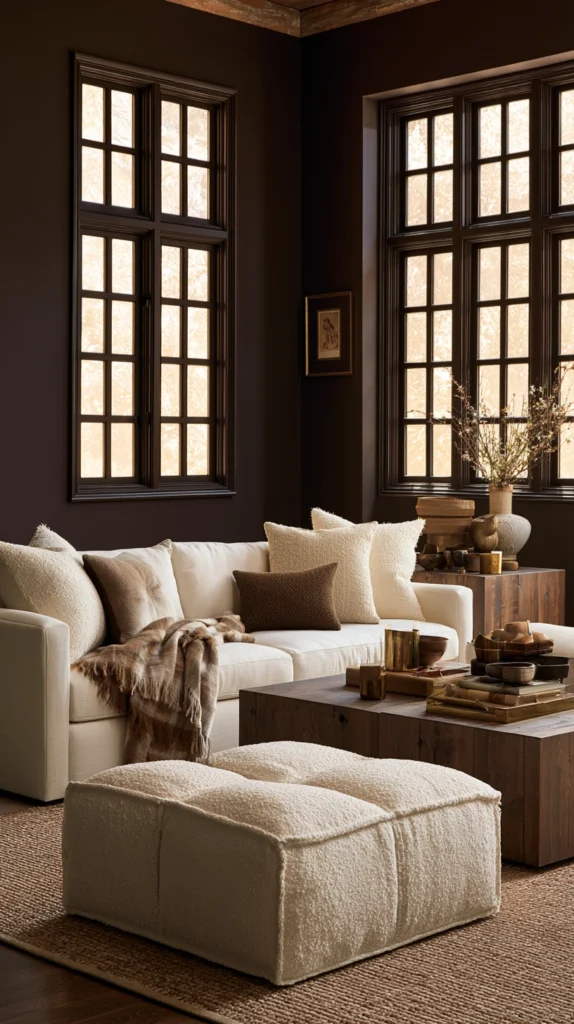
Deep warm brown with clean ivory — the fall palette that feels like cashmere and hot chocolate.
Why chocolate brown is underused:
The hesitation:
- Brown (people fear it looks dated)
- 1970s brown and orange (understandable fear)
- Chocolate brown in 2020s (completely different)
- Paired with ivory instead of orange: entirely modern
Chocolate brown defined:
Not all brown is the same:
- Cool brown (gray undertone, wrong)
- Warm brown (red or amber undertone, right)
- Chocolate (the darkest warm brown)
- Rich and indulgent, like the name suggests
Paint options:
Chocolate brown walls:
- Benjamin Moore Smoky Taupe (983) — dark and warm
- Sherwin-Williams Kona (SW 9108) — truest chocolate
- Farrow and Ball Mahogany (No. 36)
- Benjamin Moore Dark Chocolate (2107-10) — deepest option
- Behr Espresso Beans — affordable richness
Ivory as counterpart:
Ivory vs cream vs white:
- White (too stark against deep brown)
- Cream (works but gets buried)
- Ivory (right depth, holds its own against dark brown)
- Ivory has yellow undertone (warm, flatters brown)
Best ivory paint:
- Benjamin Moore Ivory White (925)
- Sherwin-Williams Creamy (SW 7012)
- Farrow and Ball Clunch (No. 2009)
- Benjamin Moore White Chocolate (OC-127)
The cashmere quality:
Why this palette feels luxurious:
- Deep brown recalls cashmere, dark wood, aged leather
- Ivory recalls fine linen and wool
- Both materials feel expensive even when they are not
- Palette evokes quality through color association
Chocolate brown in textiles:
Best applications:
- Chocolate brown velvet sofa (richest option)
- Brown leather ottoman or chair
- Brown faux fur throw (luxurious)
- Chocolate woven blanket
Ivory placement:
Against the brown:
- Ivory linen curtains (light against dark)
- Ivory boucle throw pillows
- Ivory chunky knit throw
- Ivory ceramic vessels
Natural elements:
Supports this palette:
- Dark walnut wood (same family as chocolate)
- Dried botanical stems in ivory or cream
- Pinecones and dark wood objects
- White or cream candles against brown surfaces
Third colors:
Small additions:
- Camel or tan (extension of brown family)
- Warm gold (brass accents)
- Cream (between ivory and white)
- Deep plum (unexpected, luxurious addition)
Cost to implement:
- Chocolate velvet pillows (4): $60-110
- Ivory boucle throw: $40-75
- Walnut tray or object: $25-50
- White ivory candles: $15-30
- Total: $140-265
My chocolate and ivory room: Quietest fall palette with the most year-round versatility, never once looked dated, felt more expensive than any other palette I have tried.
Chocolate and Ivory Tips
Brown wall test:
Undertone critical:
- Cool brown on walls (gray, industrial, wrong)
- Warm brown on walls (red or amber, right)
- Test the undertone before committing
- Kona by Sherwin-Williams is the safest warm chocolate
Texture saves from heaviness:
- Deep brown without texture (dark and flat)
- Deep brown with varied textures (rich and dimensional)
- Boucle, velvet, faux fur, chunky knit (all correct)
- Texture is what separates cozy from dark
10. Warm Gray and Pumpkin Spice (Transitional Fall)
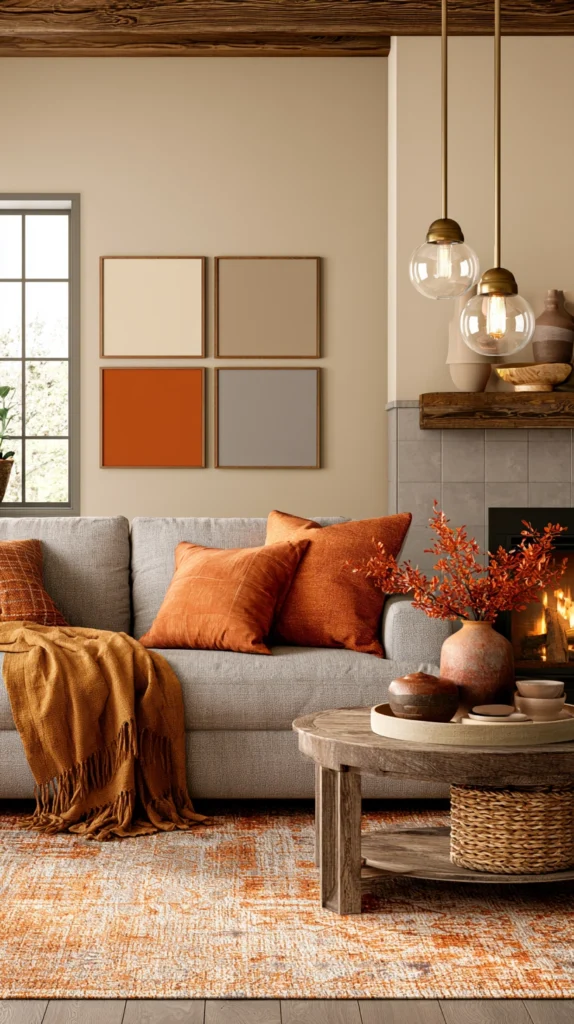
Existing gray updated with warm amber accents — the fall palette for anyone who already owns a gray sofa.
The gray sofa problem:
What most people have:
- Gray sofa (bought during gray trend)
- Cannot afford to replace it
- Gray fighting fall
- Every fall object looks out of place against it
The transitional solution:
Not replacing the gray:
- Warm the gray with specific accents
- Choose gray-adjacent warm accents (not pure warm)
- Use warm accessories to shift the temperature
- Gray becomes the neutral not the problem
Understanding gray undertones:
Gray and fall can coexist:
- Cool gray (blue undertone, hardest to warm)
- Warm gray (brown undertone, much easier)
- Greige (gray-beige, easiest to fall-transition)
- The undertone of your gray determines which accents work
Warming a cool gray room:
Shift the temperature:
- Warm cream wall paint (crucial first move)
- Cool gray and white walls fight fall accents
- Change wall to warm white or cream immediately
- Instant difference before buying anything
Pumpkin spice defined:
More than a coffee order:
- Warm amber-orange (softer than pure pumpkin)
- Cinnamon and nutmeg tones (darker orange-brown)
- The fall spice palette in color form
- Warm without being bright
Where pumpkin spice accents go:
Against gray sofa:
- 2-3 pumpkin spice velvet pillows (not 4, too much)
- Warm amber throw blanket draped over arm
- Warm amber ceramic vase on side table
- Cinnamon-toned candles
Layering in warm neutrals:
Building warmth around gray:
- Jute or sisal rug (warm neutral underfoot)
- Cream or ivory additional pillows (warming the white)
- Warm wood coffee table (walnut not black)
- Brass lamp (warm metal, shifts temperature)
What still does not work:
Gray remains challenging with:
- Bright orange (too much contrast)
- Dark burgundy (cool gray fights it)
- Bright mustard (clashes with cool gray)
- Olive (can work but needs greige not cool gray)
The smartest gray fall palette:
Specific combination:
- Warm gray or greige sofa
- Warm cream walls (freshly painted)
- Jute rug
- Three pumpkin spice pillows, two cream
- Walnut or warm wood coffee table
- Brass lamp
- Amber glass vessel grouping
- Two fall candles
This combination works:
- Every element warm
- Gray sofa neutralized by warm surroundings
- Looks intentionally transitional
- Can be achieved in one afternoon
Cost to implement:
- Warm white paint (if walls need it): $50-80
- Three pumpkin spice pillows: $45-90
- Warm amber throw: $30-60
- Amber glass accent: $15-30
- Jute rug (if not owned): $60-150
- Total: $140-410
My gray sofa transition: Painted walls warm white first (biggest impact), added three amber pillows and a jute rug, gray sofa disappeared into the palette instead of fighting it.
Gray Transition Tips
Warm the walls first:
Order of operations:
- Paint before buying any fall accents
- Wrong wall color fights every accessory
- Warm wall color makes everything else easier
- This is the one step that should not be skipped
The greige test:
- If gray sofa has brown undertone (greige)
- Fall transition much easier
- Test: hold a brown pillow against it
- If the brown looks related: greige
- If the brown clashes: cool gray (harder, but still workable with warm surroundings)
11. Navy and Gold (Moody Fall Elegance)
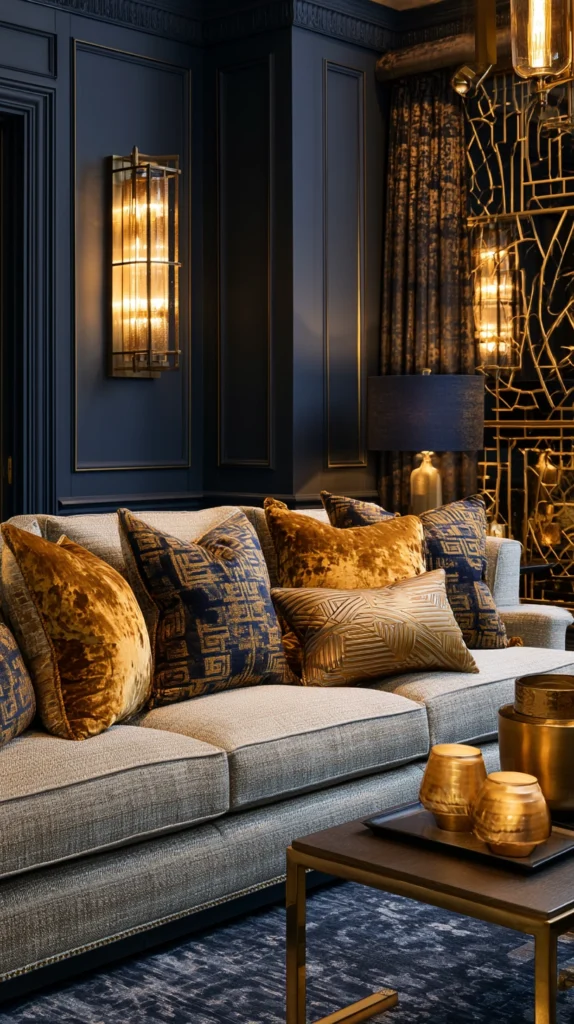
Deep blue with warm gold — the fall palette that reads as sophisticated and collected.
Why navy is fall:
Navy in autumn:
- Clear fall skies (that specific saturated blue)
- Evening coming earlier (darker blue hours)
- Night arriving at 5pm (navy is the color of early dark)
- Pairs with gold as richly as the night sky with stars
Navy as fall vs other seasons:
- Spring navy (too nautical)
- Summer navy (beach and stripes)
- Fall navy (pairs with gold and amber, warm accents)
- Winter navy (shifts to midnight, Christmas adjacent)
- The gold is what makes navy fall specifically
Navy paint options:
On walls:
- Benjamin Moore Hale Navy (HC-154) — most popular navy
- Sherwin-Williams Naval (SW 6244) — slightly darker
- Farrow and Ball Hague Blue (No. 30) — most complex
- Behr Yacht Club
- Clare Paint Good Jeans (rich and true)
The gold counterpoint:
Gold in fall:
- Autumn leaves in gold phase (most beautiful stage)
- Late afternoon October light (golden hour extended)
- Harvest gold of fields and fields
- Pairs with navy as if they were made for each other
Gold in the room:
Warm gold accents:
- Brass and unlacquered gold fixtures
- Gold-toned glass vessels
- Gold-framed artwork
- Warm gold candle holders
Gold textiles:
- Gold or ochre throw pillows (not bright yellow gold, aged gold)
- Warm honey-gold woven blanket
- Mustard as the textile version of gold
Navy room applications:
All navy walls:
- Most dramatic version
- Jewel box quality
- Gold accents glow against navy
- Needs excellent lighting (compensate for darkness)
Navy accent wall:
- One wall (behind sofa or fireplace)
- Three cream walls supporting
- Gold accents throughout
- More accessible starting point
Navy furniture:
- Navy velvet sofa (statement piece)
- Gold accents around navy sofa
- Cream walls (lighter surroundings)
The evening quality:
Navy and gold at night:
- Candlelight on navy walls (extraordinary)
- Gold reflects the warm light
- Room looks like a painting
- Specifically beautiful from October through January
Third colors:
Supporting navy and gold:
- Warm cream and ivory (essential lightening)
- Warm wood (walnut, grounding)
- Cognac leather (warmth against cool navy)
- Soft camel (bridges gold and cream)
Cost to implement:
- Navy velvet pillows (4): $60-110
- Gold and ochre throw: $35-70
- Brass candleholders or lamp: $30-70
- Gold-toned glass vessel: $20-40
- Total: $145-290
My navy and gold room: Hale Navy on all four walls with gold accents, most dramatic room transformation I have ever done, specifically beautiful when lit only by candles and lamps.
Navy and Gold Tips
Navy needs warmth compensation:
Lighting requirement:
- Dark walls absorb light (same as forest green)
- More lamps mandatory (not optional)
- Warm gold bulbs specifically (2200-2700K)
- Candlelight on navy is the best possible outcome
The aged gold not bright gold:
- Bright gold (looks like costume)
- Aged brass and unlacquered gold (beautiful)
- The patina and age of brass is the correct gold
- Shiny gold accents undermine navy’s sophistication
12. Warm Plum and Copper (The Most Unexpected Fall Palette)
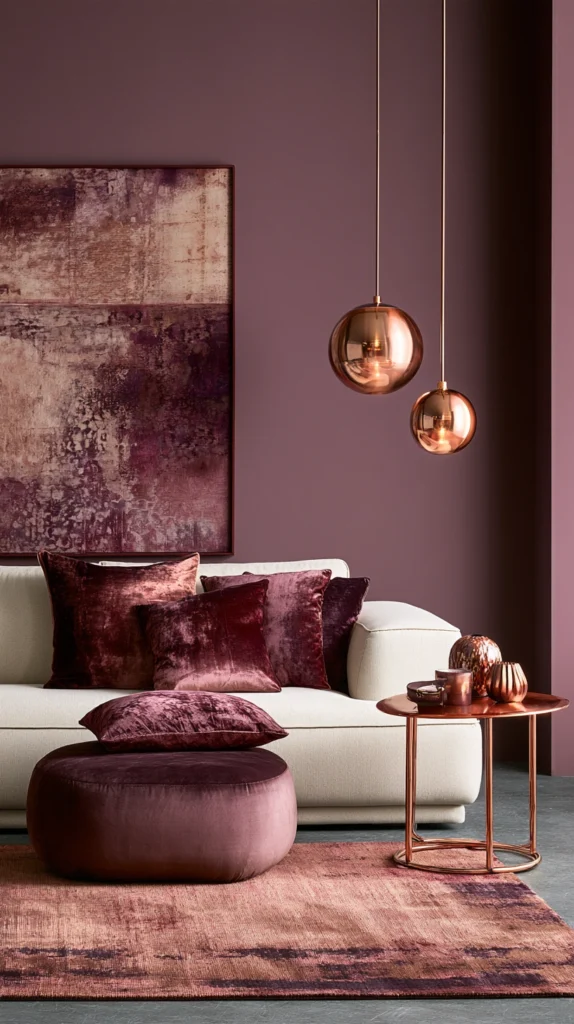
Deep purple-red with warm metallic copper — the fall palette nobody sees coming.
Why plum is fall:
Plum in autumn:
- Late-ripening plums and figs (September-October)
- Elderberries and late blackberries
- Dark purple kale and cabbage (fall garden)
- Night arriving purple before going full dark
Plum in interior design:
The underused color:
- Considered risky (unfairly)
- Actually pairs beautifully with warm fall tones
- Deeper than burgundy, less red
- The most unexpected fall wall color
Plum paint options:
Best plum paints:
- Benjamin Moore Twilight (2070-30) — true plum
- Sherwin-Williams Passionate Purple (SW 6285) — adjust to muted with right pairing
- Farrow and Ball Brassica (No. 271) — most sophisticated muted plum
- Behr Elderberry (perfect name, perfect color)
- Clare Paint Eggplant (deeper, richest option)
Copper as counterpart:
Why copper (not gold, not brass):
- Gold (warm but conventional)
- Brass (beautiful but expected)
- Copper (warm, reddish metallic, unusual)
- Copper shares plum’s red undertone (perfect match)
Copper in the room:
- Copper light fixtures
- Copper vessels and bowls
- Copper candle holders
- Copper-toned throw pillows (rust, terracotta)
Finding copper accents:
- Actual copper (patinas over time, beautiful)
- Copper-toned ceramic (glaze color not metal)
- Rust and terracotta as textile versions of copper
- IKEA copper-toned accessories (affordable)
Plum room applications:
Plum accent wall:
- Single wall (easiest commitment)
- Behind sofa or fireplace
- Other three walls warm cream
- Copper and natural accents throughout
All plum walls:
- Most dramatic (this palette rewards full commitment)
- Copper accents and warm lighting
- Cream textiles (essential lightening)
- Incredible in a smaller room
Plum textiles:
Using plum in textiles:
- Plum velvet throw pillows (on cream sofa)
- Deep eggplant throw blanket
- Plum cushion cover (chair or floor)
- Plum taper candles in copper holders
Third colors:
Supporting plum and copper:
- Warm cream and ivory (always)
- Deep forest green (unexpected, works)
- Gold (second warm metal)
- Burgundy (related family, richer)
Who this palette suits:
Best for:
- Confident maximalists
- Rooms that want to be memorable
- Evening-focused living rooms
- Anyone tired of the same fall palettes
Cost to implement:
- Plum velvet pillows (4): $60-110
- Copper-toned ceramic vessel: $20-45
- Plum throw blanket: $35-70
- Copper candle holders: $25-50
- Total: $140-275
My plum and copper room: The palette nobody recommends and everyone should try, guests had never seen this combination in a living room before, completely distinctive.
Plum and Copper Tips
Muted plum only:
The tone matters:
- Bright purple (too vibrant, child’s room)
- Muted dusty plum (sophisticated adult)
- Farrow and Ball Brassica is the reference standard
- Muted and dusty, never bright and saturated
Copper care:
- Real copper tarnishes (beautiful patina)
- Or polish to keep bright (either choice valid)
- Lacquered copper (stays bright, no maintenance)
- Raw copper (patinates, more interesting over time)
13. Neutral Fall Palette (Warm Whites, Taupes, and Natural Textures)
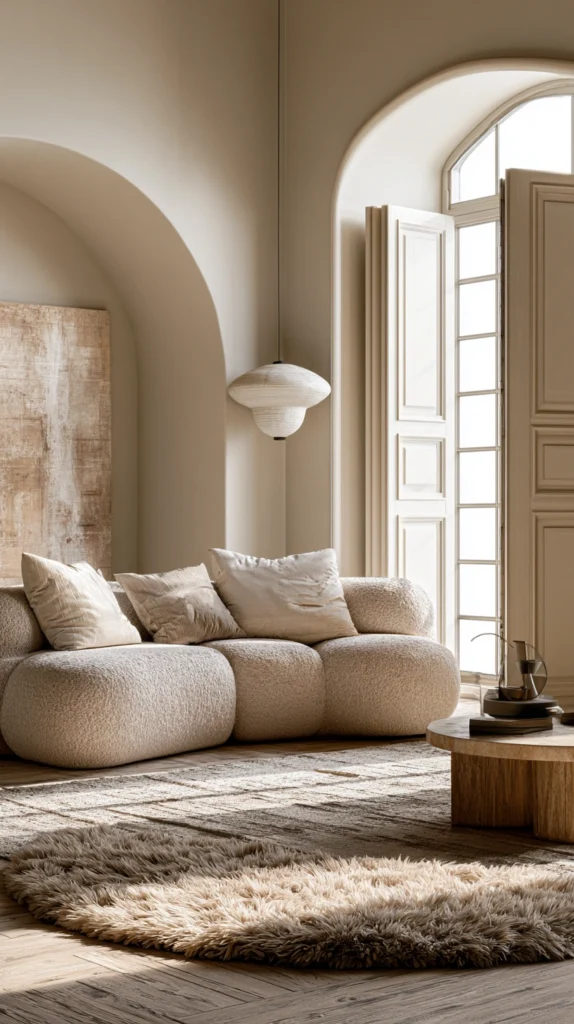
No true color — only texture and warmth — the fall palette for anyone who finds color commitment impossible.
Who this palette is for:
The neutral fall lover:
- Color makes them anxious
- Already have neutral room
- Want fall feeling without fall colors
- Believe in restraint as design
Why neutral can be fall:
Fall without orange or rust:
- Heavy texture (fall quality without color)
- Natural materials (seasonal without seasonal color)
- Warm light alone (changes room temperature)
- Abundance of textiles (cozy without colorful)
The neutral fall palette defined:
What neutral fall includes:
- Warm white (walls, primary surface)
- Warm cream (secondary surface)
- Taupe (warm gray-brown, third layer)
- Natural linen (fourth layer)
- Oat and sand (fifth layer)
What it excludes:
- Any cool tone (gray with blue undertone)
- Bright white (too clean, not warm)
- Beige with pink undertone (wrong family)
- Every tone must lean warm not cool
Building the neutral fall room:
Layer one — Walls:
- Warm white or soft cream
- Sherwin-Williams Creamy (SW 7012) — warmest white
- Benjamin Moore White Dove (OC-17) — universal warm white
- Not Chantilly Lace (too cool and bright)
Layer two — Large textiles:
- Cream or oat linen sofa
- Natural jute or sisal area rug
- Warm cream boucle or chunky knit throws
- Taupe or warm gray curtains
Layer three — Texture:
- Chunky knit throw (most texture possible)
- Boucle chair (textural contrast to linen sofa)
- Woven jute rug (tactile foundation)
- Rattan or woven accessories
Layer four — Natural materials:
- Walnut wood (warmest wood tone)
- Linen and cotton (natural fiber everywhere)
- Dried botanicals (pampas, wheat, lunaria)
- Unglazed terracotta (vessel only)
- Wicker and rattan
Layer five — Warm light:
- Every bulb 2700K warm white
- Multiple lamps (no overhead)
- Candles (cream or ivory, unscented if palette is the focus)
- Fireplace or candle alternative
What makes this feel like fall:
The texture abundance:
- More textiles than spring or summer
- Heavier and more layered
- Tactile warmth replaces visual warmth
- Touch is as important as sight
The natural abundance:
- More natural materials appear in fall
- Dried botanicals replace fresh flowers
- Gourds and pumpkins in cream or white
- Pinecones and acorns in wooden bowls
The light shift:
- Fewer hours of natural light (fall reality)
- More lamp light filling the room
- Candles used more (darker evenings)
- The room lit differently than summer
Styling the neutral fall room:
Coffee table:
- Wooden tray (warm wood)
- Stack of books (neutral or warm spines)
- Cream candle
- One dried botanical stem
- Small gourd or white pumpkin
Shelf or console:
- Dried pampas grass in warm ceramic
- Stack of warm-toned books
- Woven basket
- One natural object (pinecone, driftwood)
- Warm candle
What to buy:
Specific additions:
- Chunky knit throw in oat or cream (most impactful): $35-65
- Dried pampas grass stems (3-5): $15-35
- Cream or white mini pumpkins: $10-20
- Beeswax or cream candles: $15-30
- Wooden bowl for naturals: $20-35 (if not owned)
Cost to implement:
- Chunky knit throw: $35-65
- Dried botanicals: $15-40
- White pumpkins and gourds: $10-25
- Cream candles: $15-30
- Warm wood accent (tray or bowl): $20-35
- Total: $95-195
My neutral fall room: Most year-round usable palette, never needs to be swapped out for winter, guests feel the fall without seeing obvious fall color, texture does all the work that color does in other palettes.
Neutral Fall Tips
Texture must compensate for color:
The abundance rule:
- Fewer colors (more texture required)
- Neutral palette without texture (looks bland)
- Chunky knit, boucle, jute, linen, rattan all together
- Texture is the visual interest that color provides elsewhere
The warm light requirement:
Non-negotiable for neutral fall:
- Cool white bulbs destroy neutral fall palette
- Everything looks gray and cold
- 2700K warm white bulbs (mandatory)
- Without warm light, neutral palette is just beige
Choosing Your Fall Palette
Every room has a starting point:
By existing sofa color:
Cream or linen sofa:
- Any palette works (most versatile base)
- Burnt orange and cream (easiest)
- Burgundy accents (most dramatic)
- Olive green (most sophisticated)
Gray sofa:
- Palette 10 (warm gray and pumpkin spice)
- Navy with gold accents (if warm gray)
- Mustard accents (greige sofa only)
- Neutral palette (always works)
Charcoal or dark sofa:
- Mustard and charcoal (leans into it)
- Camel and cognac accents
- Amber glass and brass (warms it)
- Cream and ivory textiles only
Brown or cognac sofa:
- Camel and cognac palette (tonal, beautiful)
- Cream and ivory around it
- Forest green accents (unexpected)
- Any warm palette (already warm base)
By room light:
Bright room (south or west facing):
- Dark palettes work (forest green, navy, plum)
- All thirteen palettes available
- Can go as dark as desired
- Good natural light manages dark walls
Medium light:
- Mid-range palettes (terracotta, olive, burgundy)
- Avoid darkest options without lighting upgrade
- Warm white walls essential
- Lamps supplement beautifully
Dark room (north facing or few windows):
- Lighter palettes (neutral, camel, burnt orange)
- Warm white walls mandatory
- More lamps always
- Avoid dark green, navy, plum, chocolate on walls
By commitment level:
Zero commitment (textiles only):
- Buy pillows and throw blankets
- No painting, no furniture
- Any palette achievable this way
- Cost: $100-250
Low commitment (textiles plus accents):
- Pillows, throws, candles, accessories
- No painting, no furniture
- More complete palette story
- Cost: $150-350
Medium commitment (one accent wall):
- Paint one wall
- Full textile swap
- Dramatic result
- Cost: $200-500
High commitment (full room):
- Paint all walls
- Full textile refresh
- New accent furniture or rug
- Most complete transformation
- Cost: $400-1,500
By personality:
Classic and safe:
- Burnt orange and cream (palette 1)
- Camel and cognac (palette 4)
- Neutral fall (palette 13)
Modern and bold:
- Mustard and charcoal (palette 7)
- Navy and gold (palette 11)
- Forest green and amber (palette 8)
Romantic and atmospheric:
- Burgundy and blush (palette 6)
- Warm plum and copper (palette 12)
- Deep rust and warm white (palette 2)
Natural and organic:
- Terracotta and linen (palette 3)
- Olive and warm cream (palette 5)
- Neutral fall (palette 13)
Maintenance and Seasonal Transition
Keeping the palette all fall:
Month by month:
September:
- Begin palette shift (still warm outside)
- Textile additions (pillows, throws)
- Scent and candles
- Light adjustment (warmer bulbs if not already)
October:
- Full palette in place
- Natural elements added (pumpkins, dried botanicals)
- Heavier curtains if swapping
- Peak of fall palette season
November:
- Palette stays (still fully fall)
- Begin removing Halloween-adjacent pieces
- Natural elements refreshed
- Transitioning toward winter at month’s end
December transition:
- Remove most seasonal naturals
- Keep warm textiles (they become winter)
- Add holiday-specific accents if desired
- Or shift to winter palette of same color family
Storing fall pieces:
End of season:
- Wash all textile additions before storing
- Label bins by palette (burnt orange bin, olive bin)
- Cedar blocks inside (moths)
- Store in cool dry place
- Ready for next September immediately
My Complete Palette Journey
Four falls, four palettes:
Fall One:
- Burnt orange and cream (safest start)
- Four pillows and a throw ($120)
- Guests noticed immediately
- Understood palette power
Fall Two:
- Olive and warm cream (more adventurous)
- Added accent wall (Sherwin-Williams Oakmoss, $65)
- Full textile swap
- Total: $280
- Most-commented room I had ever had
Fall Three:
- Forest green all four walls ($120 paint)
- Amber glass vessels from thrift store ($18)
- Brass candleholders ($35)
- Total: $220
- Guests said it was the best room they had seen in a home
Fall Four:
- Navy and gold (most dramatic)
- Hale Navy all walls ($130)
- Gold and cognac accents ($180)
- Total: $310
- Completely different room from fall one despite same furniture
Total investment: $930 over four falls Lesson learned: Paint is the most powerful palette tool by far Most impactful single change in all four falls: Warm white bulbs everywhere ($20)
Getting Started This Weekend
Pick the palette before buying anything.
This weekend:
Step 1 — Identify your starting point:
- What color is your sofa
- What color are your walls
- How much natural light does the room get
- Use the guide above to narrow choices
Step 2 — Order paint samples:
- Two or three wall colors from your chosen palette
- $5-8 per sample pot
- Tape large swatches on your actual walls
- Live with them three days (morning, afternoon, evening)
Step 3 — Start with textiles before paint:
- Buy two throw pillows in the palette
- Buy one throw blanket
- Live in the palette for one week (fabric only)
- Confirm the palette before painting anything
My recommendation:
First fall palette:
- Burnt orange and cream if you want warmth
- Olive and cream if you want sophistication
- Neutral fall if you want no commitment
- All three work on the first attempt
The warm white bulb reminder:
- Replace every bulb this weekend
- $20 total
- Every palette looks better under warm light
- Do this before buying a single pillow
Now go choose a palette and let the room become what fall always meant it to be.
Quick Summary
The 13 fall palettes:
Classic and warm:
- Burnt orange and cream (palette 1): most recognizable, safest, most fall
- Deep rust and warm white (palette 2): more sophisticated, limewash opportunity
- Terracotta and linen (palette 3): Mediterranean, most organic
Neutral and tonal:
- Warm camel and cognac (palette 4): most year-round, wearable always
- Neutral fall in texture (palette 13): no color, all texture, quietest
Green family:
- Olive and warm cream (palette 5): most sophisticated, forest floor reference
- Forest green and amber (palette 8): darkest, most dramatic, most requested
Jewel and moody:
- Deep burgundy and blush (palette 6): most romantic, candlelight dependent
- Navy and gold (palette 11): most elegant, most dramatic at night
- Warm plum and copper (palette 12): most unexpected, most memorable
Graphic and modern:
- Mustard and charcoal (palette 7): most contemporary, most graphic
- Warm gray and pumpkin spice (palette 10): gray sofa solution
Unexpected:
- Chocolate brown and ivory (palette 9): most underused, most luxurious
By first move:
Change textiles only: Start with any palette using throw pillows and one blanket Change one wall: Burnt orange, rust, olive, forest green, navy (all reward accent wall) Change all walls: Forest green, navy, plum, chocolate (all become room-defining) Change the light first: Warm bulbs make every palette work better immediately
Budget by approach:
Under $150: Textile swap only (any palette achievable) $150-350: Full textile plus accents (complete palette story) $350-600: Accent wall plus full textile (most complete transformation) $600+: Full room paint plus furniture accent plus all textiles
The non-negotiables:
- Warm white bulbs (2700K) before any other change
- Warm wall color before buying fall accents
- Warm wood tones in every palette (always)
- Brass or warm metal in every palette (always)
- Odd numbers in every grouping (always)
- All tones warm within chosen palette (no cool anything)
Common mistakes:
- Bright orange instead of burnt orange (Halloween not fall)
- Cool gray walls fighting warm fall accents
- Chrome and silver metal in warm fall palettes
- Too many fall colors at once (no palette story)
- Small pattern repeat textiles (too busy, loses palette)
- One fall object in a non-fall room (spotted not felt)
- Cool white light bulbs destroying every warm palette
- Not testing paint samples on actual walls in actual light
Remember: The palette is a color story not a collection of fall objects, warm light bulbs do more for fall atmosphere than any purchase you can make ($20, do it immediately), paint is the highest-leverage palette tool available (one wall changes everything), the sofa color is your starting constraint not your limitation, textiles carry the palette when paint feels too permanent, every palette needs warm metal (brass not chrome), wood tones ground every fall palette without exception, test paint samples on your actual walls for three days before committing, the room should feel like fall not look decorated for it — that distinction is the entire goal.