14 Halloween Porch Decor Ideas That Aren’t Cheesy
Halloween decor has a reputation problem. Walk down most residential streets in October and you’ll see the same inflatable ghosts, the same orange string lights stapled in a straight line, the same plastic skeleton propped against the railing in a pose that’s more awkward than eerie. None of it is wrong, exactly — but it rarely looks intentional, and it almost never looks good in daylight.
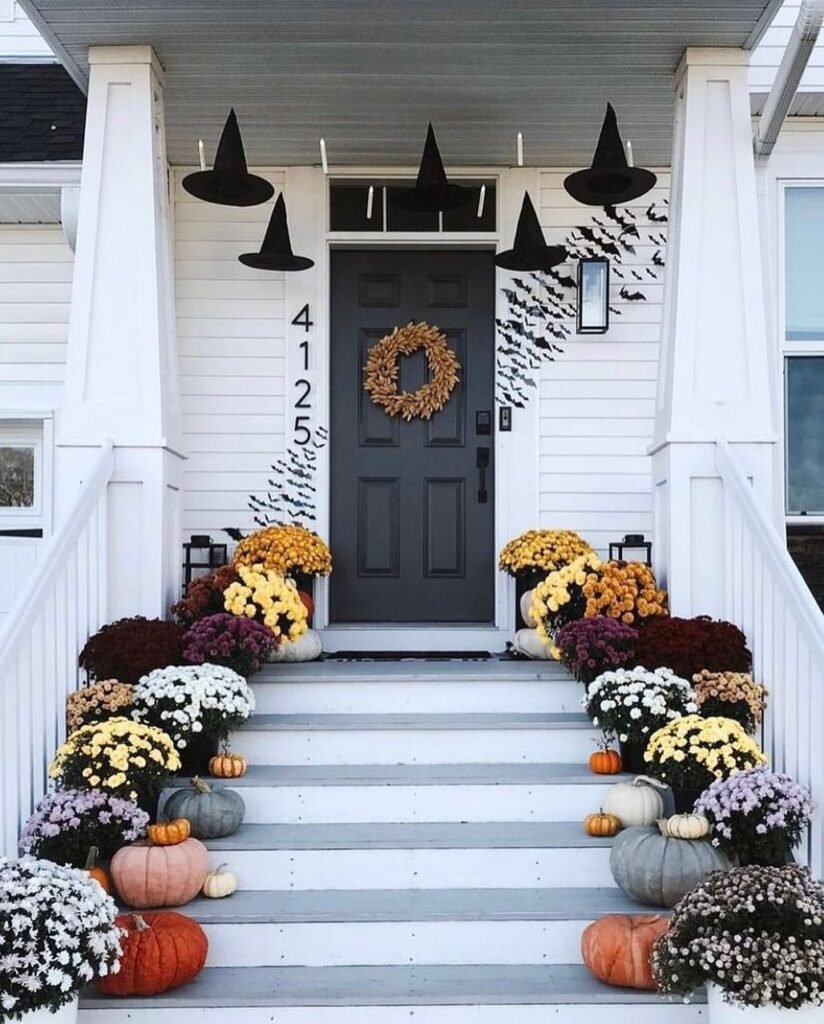
A porch that actually impresses treats Halloween the way it would treat any other seasonal decorating moment: with a real color palette, real texture, and restraint. The scariest, most stylish porches on the block aren’t the ones with the most decorations. They’re the ones where every piece earns its spot.
Why Most Porches Feel Cheesy Instead of Chic
The problem usually isn’t the decorations themselves — it’s the mix. A porch with a dollar-store spiderweb, a mass-produced foam tombstone, a string of blinking purple lights, and a plastic pumpkin bucket has four different “eras” of Halloween decor fighting each other, and none of them read as cohesive.
Compare that to a porch styled with a stacked pyramid of real and faux pumpkins in a tonal palette, a single oversized wreath with dried botanicals, and amber lantern light instead of novelty string lights. Same holiday, same basic budget — but one looks like a magazine spread and the other looks like a clearance aisle. The difference is almost always palette discipline and material quality, not how many items are on display.
A few of the most common culprits behind a cluttered, costume-store porch:
- Mixing more than three colors, especially neon or glitter tones alongside natural ones
- Combining plastic novelty props with real or natural materials in the same vignette
- Relying on blinking or colored string lights instead of warm, steady light
- Scattering many small items evenly instead of building one focal point
- Keeping pieces out of nostalgia or habit even when they no longer fit the palette
Five Principles for Porch Decor That Actually Works
Before getting into individual ideas, it helps to have a short framework to filter every purchase and every placement decision against. These five principles show up again and again in the porches that actually photograph well and hold up in daylight.
- Pick a palette and stop at three colors. Deep black, warm orange, and bone white read as elevated. Adding neon green, purple, and glitter orange all at once reads as costume-party clutter.
- Mix real and faux, but keep textures natural. Real pumpkins, dried corn stalks, and natural fiber ribbon ground even the spookiest elements.
- Light matters more than volume. Warm string lights, flickering lanterns, or uplighting on a single feature does more than a dozen scattered props.
- Scale one thing up. One oversized item — a giant pumpkin, a tall wreath, a tree-height spiderweb — reads as a statement. Ten small items read as clutter.
- Edit ruthlessly. If a piece doesn’t fit the palette or the mood, it doesn’t go on the porch this year, even if it’s already in the garage.
Keep this list nearby while shopping. It’s easy to get pulled toward a fun impulse buy at a garden center in October — the filter above is what keeps a porch cohesive instead of accumulated.
1. Tonal Pumpkin Pyramid
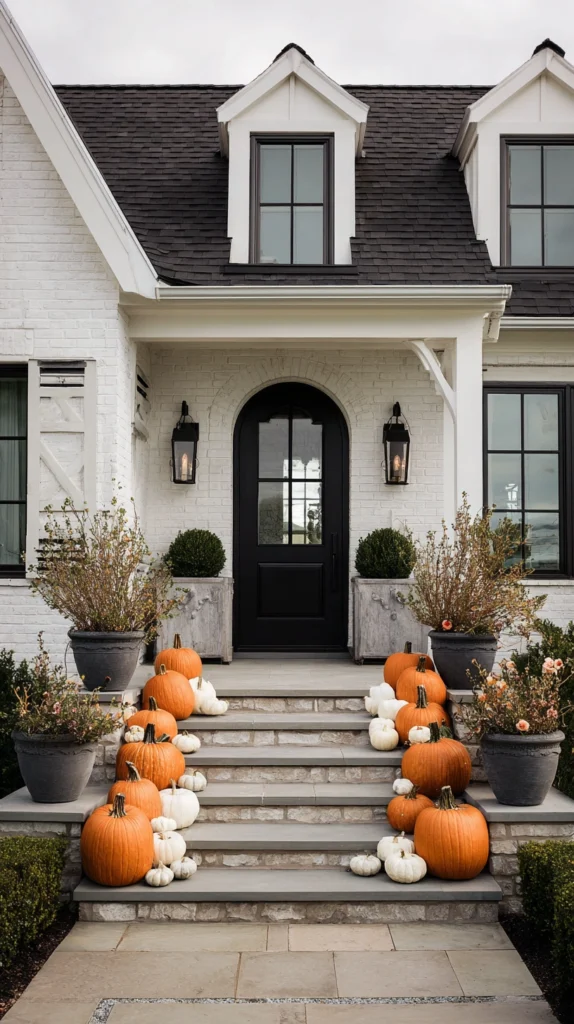
Skip the mixed-color pumpkin pile and stack pumpkins in a single tonal range — all white, all black, or a graduated orange-to-cream gradient. A pyramid of 12–15 pumpkins in mixed sizes typically costs $60–$120 depending on real versus faux and size mix, with faux pumpkins costing more upfront but reusable for several seasons.
What goes into building a pyramid that holds its shape and reads as intentional:
- Stack the largest pumpkins at the base, tapering upward in size, both for physical stability and for a silhouette that photographs well from the street
- Choose one tonal range and stay within it, since even a single mismatched bright orange pumpkin in an all-white pyramid breaks the effect
- Use a mix of shapes — tall Cinderella-style pumpkins, squat classic rounds, and small ribbed varieties — rather than uniform pumpkins, which keeps the pile visually interesting despite the single color story
- Real pumpkins in a stacked pyramid typically last 4–6 weeks outdoors before softening, so plan the build for roughly three to four weeks before the display needs to come down
Styling detail: Add two or three unpainted mini gourds tucked into the gaps for texture without breaking the palette.
2. Oversized Dried Botanical Wreath
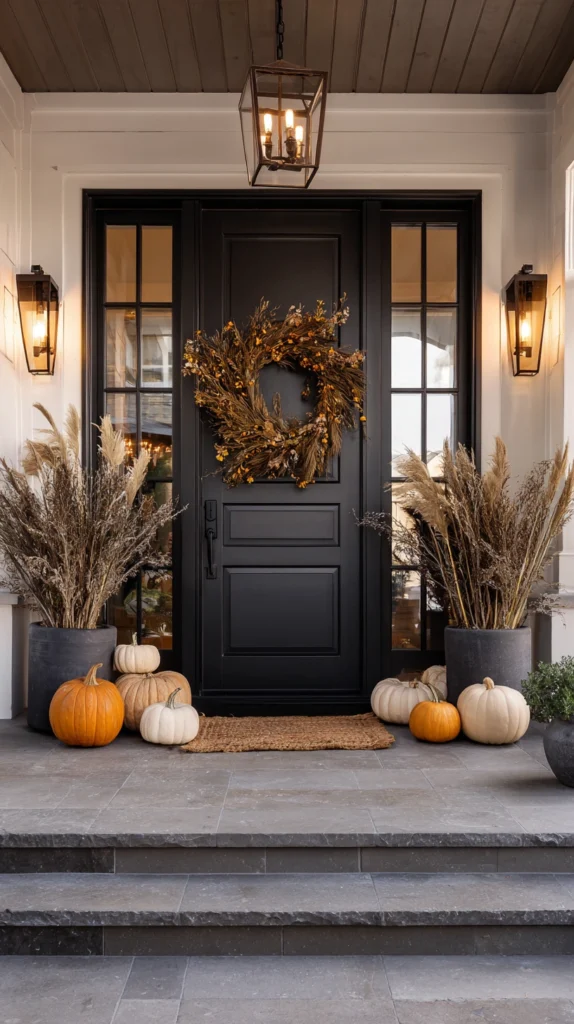
A wreath built from dried wheat, pampas grass, and preserved eucalyptus in warm neutral tones feels more like fall design than costume-store Halloween. Dried botanical wreaths in the 24–30 inch range run $70–$150, or can be built at home for about $30–$50 in dried stems and a grapevine base.
Considerations that separate a wreath that reads as designer from one that reads as a craft-store impulse buy:
- Size relative to the door matters more than material cost — an undersized wreath on a full-size door reads as an afterthought no matter how nice the materials are
- Layer at least two or three textures within the wreath — a coarse material like wheat, a soft material like pampas plumes, and a structural element like eucalyptus stems — for depth
- A grapevine base holds up outdoors far better than a foam base, which can degrade with humidity and rain over a multi-week display
- Preserved (rather than fresh-dried) botanicals hold their color longer in direct sun, which matters for a south- or west-facing door that gets afternoon light
Placement tip: Size it to cover at least a third of the door’s height — an undersized wreath disappears against a full-size entry.
3. Amber Lantern Pathway
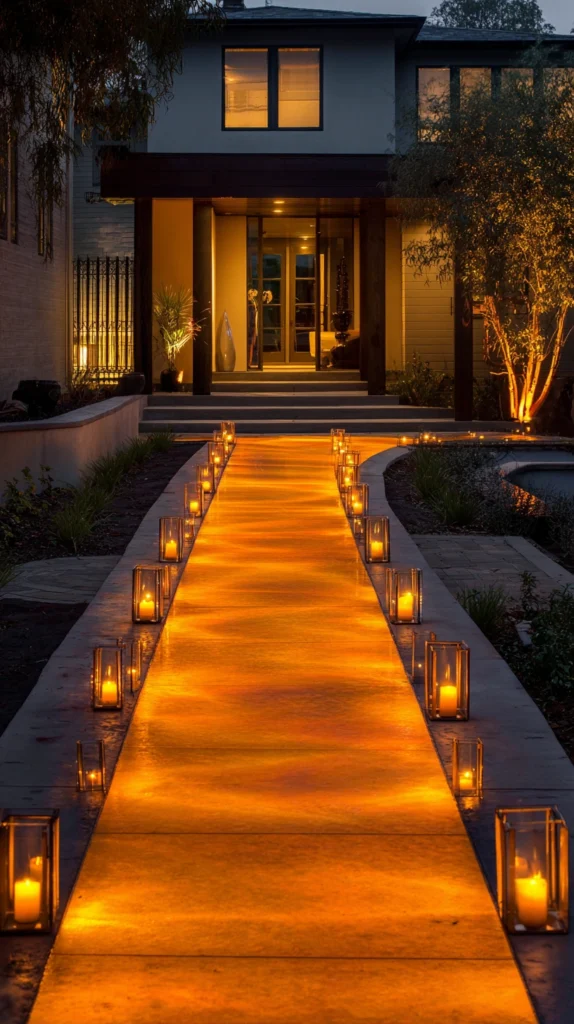
Replace string lights with a row of flame-effect lanterns lining the front walk. Battery-powered amber LED lanterns run $15–$25 each, and five to seven placed at even intervals create a warm, flickering approach that reads as elegant rather than novelty.
Why lanterns outperform string lights on most porches, and how to get the placement right:
- Warm amber tones read as cozy rather than novelty, especially compared to the cool white or multicolor LEDs used in most mass-market string lights
- Flame-effect flicker adds movement without needing motion props elsewhere on the porch, which helps keep the rest of the display calm and uncluttered
- Even spacing along a walkway draws the eye toward the door rather than sideways across the yard, reinforcing the entry as the visual destination
- Battery-powered lanterns typically run 6–8 hours per charge on flicker mode, so plan to either recharge them during the day or use rechargeable batteries on a rotation for multi-week displays
Upgrade option: Swap in real pillar candles inside glass hurricane lanterns for outdoor-safe open flame, at roughly $10–$18 per lantern set.
4. Black and White Ghost Silhouettes
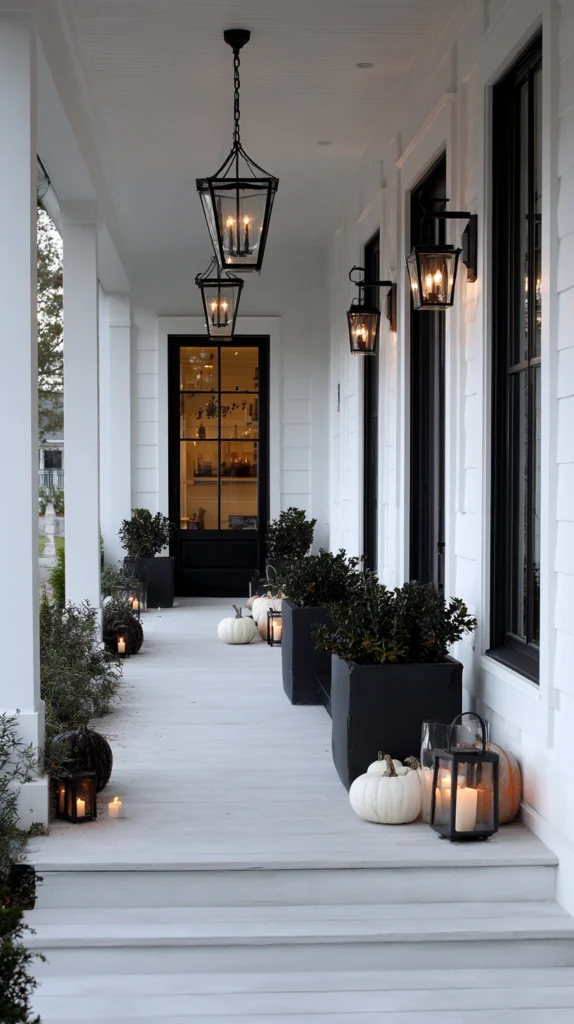
Instead of inflatable ghosts, cut simple ghost or bat silhouettes from black cardstock or thin plywood and mount them flat against a white porch wall or window. Plywood silhouette kits run $15–$30 each, or a DIY cardstock version costs under $10 for a full set. The flat, graphic shape reads as modern rather than kitschy.
Details that make the flat-silhouette approach look designed rather than makeshift:
- A high-contrast surface is essential — black silhouettes against a white or light-colored wall read as graphic art, while the same shapes against a busy or dark background disappear
- Plywood holds up far better than cardstock in rain or humidity, so cardstock versions are best reserved for covered porches or short-term displays closer to Halloween itself
- Keep the shapes simple and geometric rather than overly detailed — a rounded ghost silhouette or a simple triangular bat wing reads more intentional than an intricate cutout
- Mount with removable adhesive strips rather than nails or screws where possible, to avoid damaging painted siding or window trim
Placement tip: Cluster silhouettes at varying heights on one wall rather than spacing them evenly across the whole porch.
5. Dried Corn Stalk Bundles
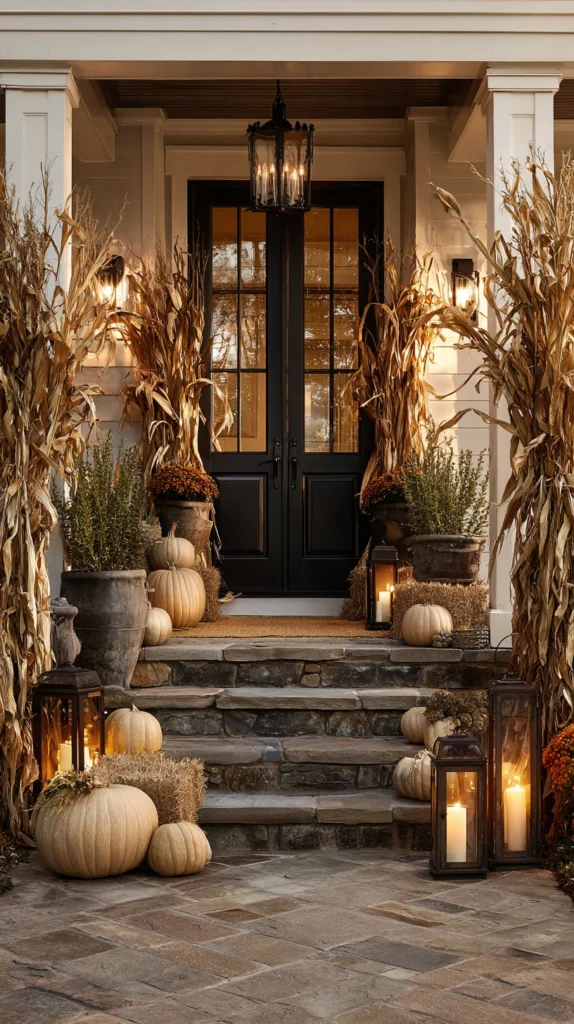
Bundles of dried corn stalks flanking the front door bring height and vertical texture without leaning costume-y, and they’re one of the more budget-friendly ways to add real scale to a porch. A bundle of 5–6 stalks tied with natural jute twine costs $15–$25 per bundle at most garden centers or farm stands in October, and larger 8–10 stalk bundles for a fuller look run closer to $25–$35.
What to know before buying and placing corn stalk bundles:
- Height matters more than fullness for visual impact — a taller, slightly thinner bundle usually reads better flanking a door than a short, wide one
- Secure bundles to a stake or porch railing with twine or zip ties, since dried stalks are lightweight and prone to toppling in wind without support
- Pair two matching bundles on either side of the door for symmetry, or use a single larger bundle off to one side for a more asymmetrical, farmhouse-leaning look
- Dried stalks typically hold their look through the full fall season without much upkeep, making them one of the lower-maintenance options on this list, though they should be kept away from open flame sources like nearby candles or lanterns
Styling detail: Tuck a few dried wheat stems or bittersweet vine into the bundle for extra texture at almost no added cost.
6. Minimalist Black Pumpkin Display
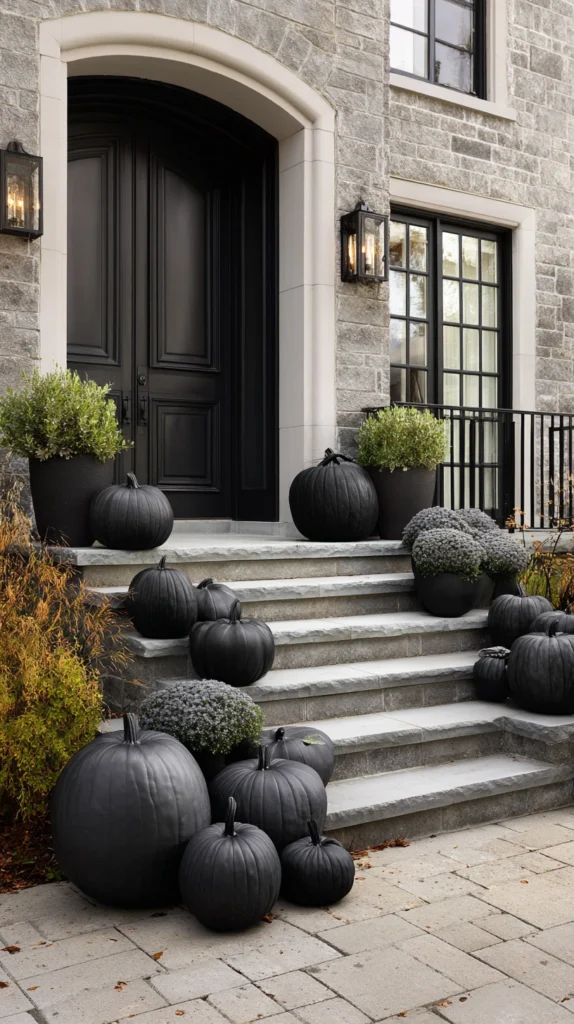
A cluster of matte black pumpkins — real, painted, or faux — set directly on the porch steps creates a striking, gallery-like moment. Faux matte black pumpkins run $12–$25 each depending on size; real pumpkins can be painted with matte black spray paint for about $8–$10 per can, covering 4–5 pumpkins.
A few ways to keep a monochrome display from looking flat or repetitive:
- Vary the pumpkin shapes — tall, squat, ridged — rather than using uniform sizes, since the shape variation is what keeps a single-color display visually interesting
- Group in odd numbers, typically three, five, or seven, rather than even numbers, which tends to read as more visually balanced in asymmetrical groupings
- Set a few directly on the steps at different levels rather than lining them all up on one surface, to build some height variation into the display
- If painting real pumpkins, apply two thin coats rather than one thick one for an even matte finish, and let each coat dry fully to avoid drips pooling in the pumpkin’s ridges
Pro tip: Vary the pumpkin shapes rather than using uniform sizes — the variation is what keeps a monochrome display visually interesting.
7. Vintage-Style Iron Lantern Stakes
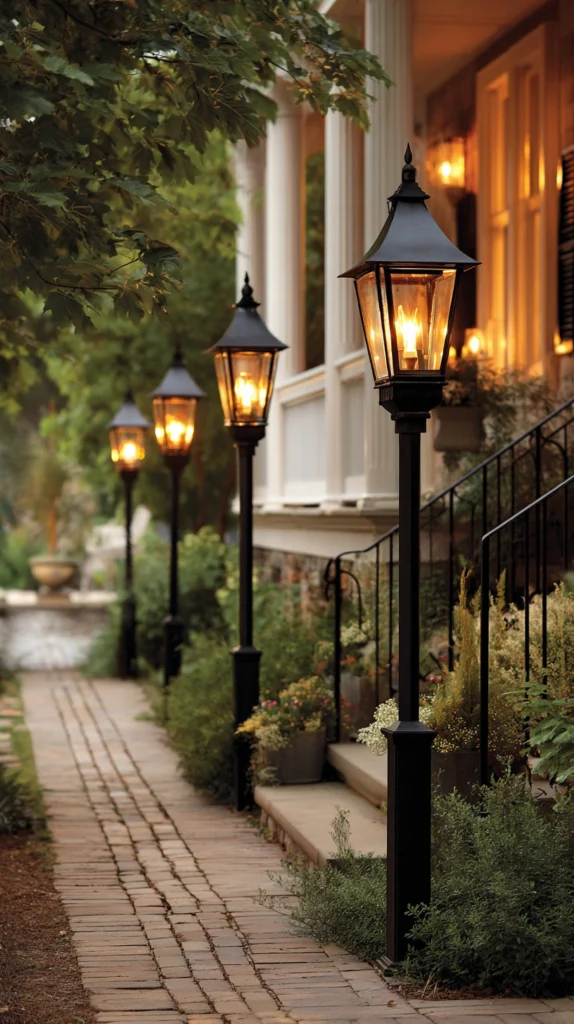
Tall iron lantern stakes pushed into flower beds or planters along the porch add height and a slightly gothic, old-world feel. A set of two to three stakes with flame-effect bulbs runs $40–$70 total and can be reused as general fall or winter decor after Halloween.
What makes iron stakes worth the slightly higher upfront cost compared to other lighting options:
- Height variation between stakes, rather than a perfectly uniform row, mimics the look of an aged, collected-over-time garden rather than a matching decor set
- Iron or iron-finish stakes hold up outdoors far longer than plastic alternatives, which matters if the goal is decor that carries into winter and future fall seasons
- Push stakes into soil rather than mulch or gravel where possible, since loose mulch doesn’t anchor them as securely in wind
- Flame-effect bulbs typically use significantly less power than traditional string lights, making them a reasonable option to leave on for extended evening hours through the season
Placement tip: Stagger heights slightly rather than lining them up perfectly — a small variance looks more organic against greenery.
8. Draped Cheesecloth “Cobweb” Alternative
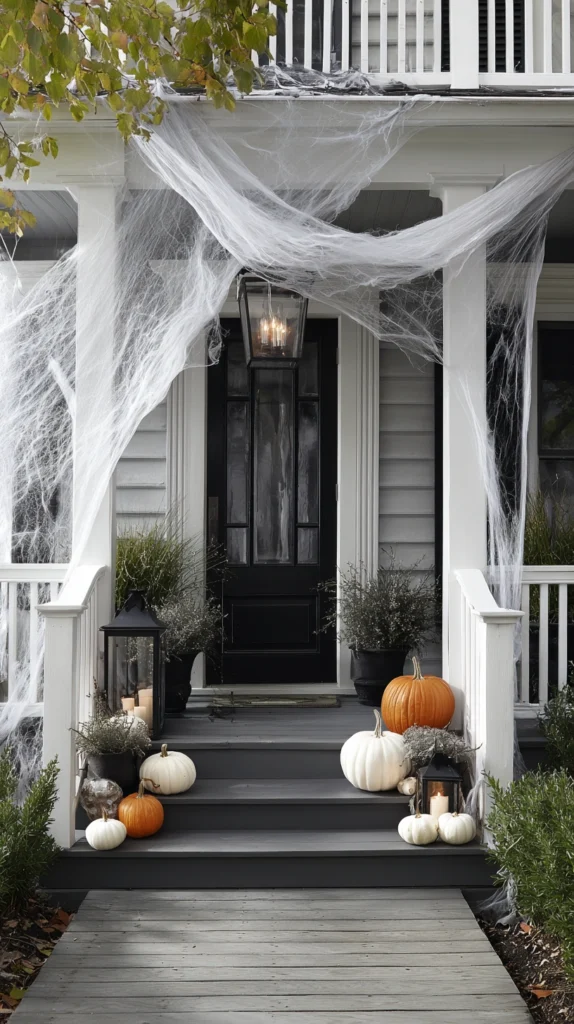
Traditional stretchy spiderweb material almost always looks synthetic. Loosely draped cheesecloth, torn and layered over a railing or doorway, creates a similar cobweb texture with a more natural, aged look. A few yards of cheesecloth costs $8–$15 total and can be dyed grey or beige for extra realism.
How to get a genuinely convincing “aged cobweb” look rather than a draped sheet:
- Tear the edges by hand rather than cutting with scissors, since a clean-cut edge reads as fabric while a torn, frayed edge reads as decayed material
- Layer two or three overlapping pieces at varying lengths rather than one single large piece, to build depth and avoid a flat, blanket-like appearance
- A light mist of diluted grey fabric spray paint, applied unevenly rather than uniformly, mimics the look of dust and age far better than pure white cheesecloth
- Drape loosely rather than pulling taut — the sagging, uneven quality is what sells the aged look, since a tight drape reads as a deliberately hung fabric rather than natural decay
Texture tip: Lightly fray the edges by hand and mist with diluted grey fabric spray paint for a cobweb that reads as weathered rather than fake.
9. Carved Pumpkin Message Display
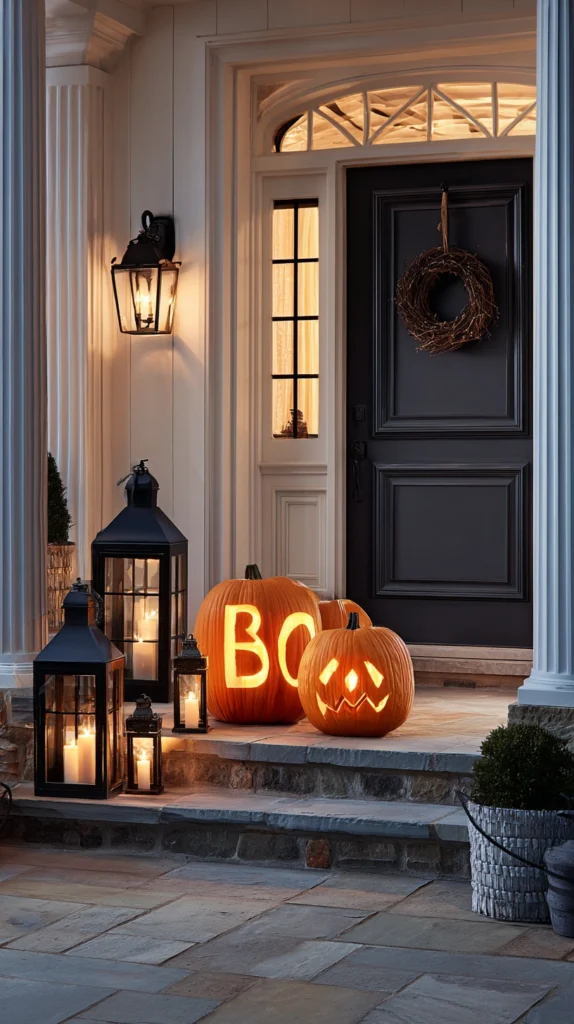
Instead of a scary face, carve or paint a single word or short phrase across two or three pumpkins lined up on the steps — “BOO,” “HOWL,” or a family name. Carving tools and stencils run $10–$15, and the display uses pumpkins already on hand for the pyramid or cluster displays elsewhere on the porch.
Notes on getting a clean, legible message rather than a messy one:
- Choose pumpkins with flat, unribbed fronts where possible, since heavily ridged pumpkins distort lettering and make a word harder to read from the street
- Keep the phrase short — a single word across two or three pumpkins, or a short two-word phrase across three to four, reads more clearly than a longer sentence spread across many pumpkins
- Painted lettering lasts longer than carved lettering, which begins to shrink and warp within a few days as the pumpkin dries out from the cut surface
- If carving, cut on a cooler day and keep the finished pumpkins out of direct sun, since heat significantly accelerates the shrinking and collapsing of carved pumpkins
Styling detail: Uplighting each pumpkin from behind with a small LED tea light ($1–$2 each) makes the carved message glow after dark.
10. Woven Willow or Twig Ghosts
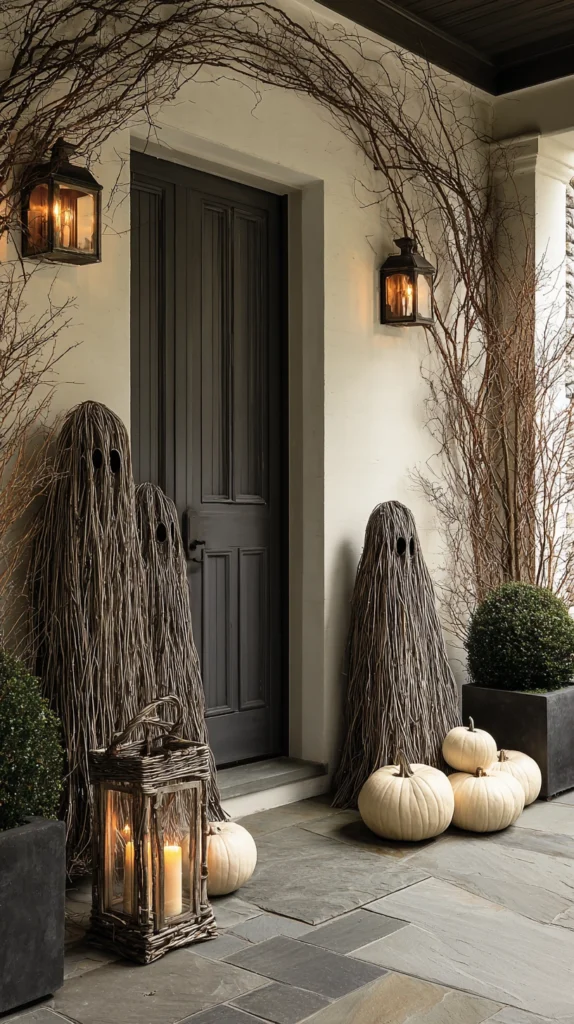
Skip plastic ghosts entirely and use woven willow branch forms or twig sculptures in loose ghost or spirit shapes. These sell at farm stands and craft markets for $20–$45 depending on size, and their natural material keeps them from reading as a costume-store prop even when displayed in daylight.
What makes this piece work as a quiet, unexpected detail rather than a centerpiece:
- Willow ghosts read best in small doses — one or two figures tucked among other decor, rather than several spread across the porch, keeps them feeling like a discovery rather than the main event
- Natural, undyed willow holds up well outdoors through a full season, while any painted or dyed versions may fade faster in direct sun
- Placing a figure partially behind or among pumpkins or greenery, rather than fully exposed, adds to the subtle, half-hidden quality that makes this piece feel intentional
- These pieces typically store well and can be reused for several Halloween seasons if kept dry between uses
Placement tip: Group two or three at different heights near the door rather than spacing them across the full porch width.
11. Layered Neutral Fabric Runner
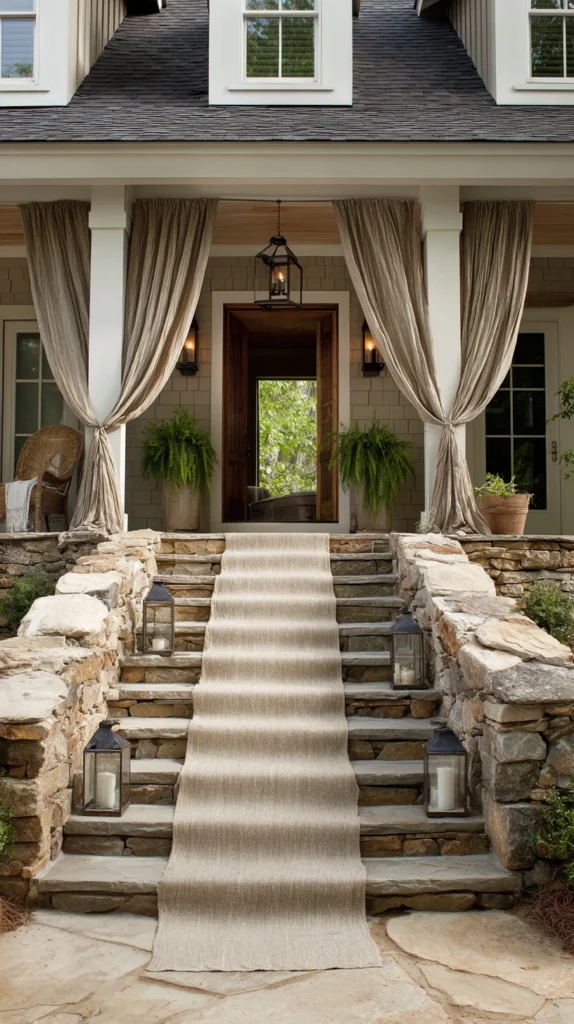
Drape a length of burlap, cheesecloth, or muslin down the porch steps as a runner, anchored with small pumpkins or stones at the edges. Fabric runs $6–$10 per yard, and a typical porch staircase needs 4–6 yards.
Getting the runner to look draped rather than simply laid down:
- Choose a slightly wrinkled, unpressed fabric, since a too-crisp runner undercuts the intentionally rustic, lived-in look this idea is going for
- Anchor the edges loosely with small pumpkins, stones, or lanterns rather than pinning it flat, allowing the fabric to ripple naturally along the step edges
- Burlap holds up best in wet weather, while muslin and cheesecloth are better suited to covered porches or shorter-term displays
- A single continuous runner down the center of the steps reads cleaner than fabric draped across the full width, which can look more like a covering than a styled accent
Styling detail: Choose a slightly wrinkled, unpressed fabric — a too-crisp runner undercuts the intentionally rustic look.
12. Black Ribbon and Raffia Door Accent
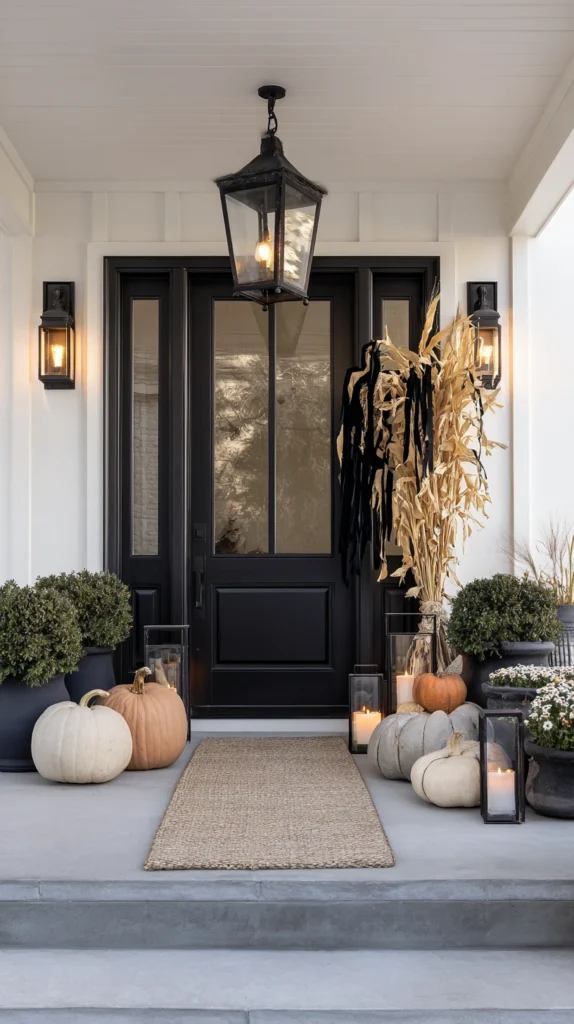
Instead of a full wreath, tie a cascading arrangement of black velvet ribbon and natural raffia to the top of the door frame, letting it hang loosely down one side. Velvet ribbon runs $8–$12 per yard and raffia bundles cost $5–$8, making this one of the least expensive statement pieces on the list.
How to build the cascade so it reads as styled rather than simply tied on:
- Layer two ribbon widths — a wide velvet and a thin satin or grosgrain — for visual depth without introducing a second color
- Let the ends fall to varying lengths rather than trimming them even, which gives the cascade a looser, more organic movement
- Raffia adds texture contrast against the smooth velvet, and works best mixed in rather than as a separate bundle
- This accent works well paired with a smaller wreath or left as the sole door decoration for a more minimal porch overall
Pro tip: Layer two ribbon widths (a wide velvet and a thin satin) for visual depth without adding more colors.
13. Antique Mirror or Frame Accent
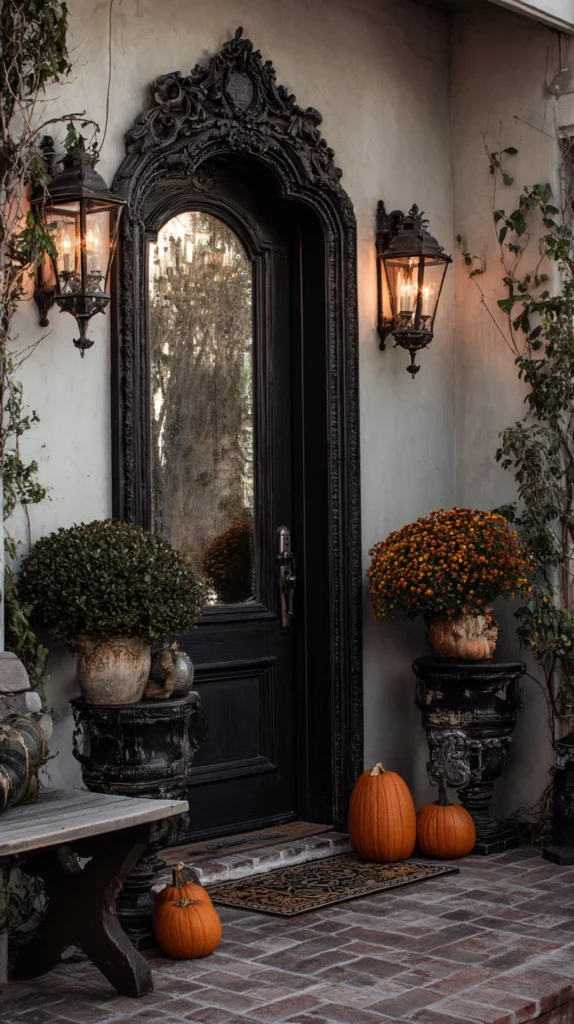
Lean a large, ornate vintage-style mirror or empty picture frame against the porch wall near the door, styled with a few dried florals or a pumpkin at its base. Thrifted frames run $15–$40, while new faux-antique options cost $40–$80.
What makes this piece feel eerie and intentional rather than simply decorative:
- A slightly foggy, distressed, or antiqued mirror finish does more of the visual work than an ornate frame alone, since the imperfect reflective surface is what reads as unsettling
- Lean rather than hang, angled slightly back against the wall, which creates a more natural shadow and depth than a perfectly flush mount
- Style the base with a small grouping — a few dried stems, a single pumpkin, or a short candle — rather than leaving the frame’s base empty, which can look unfinished
- This piece works especially well positioned to catch the amber glow from nearby lanterns, since the reflected light adds to the eerie effect after dark
Styling detail: A slightly foggy or antiqued mirror finish adds to the eerie effect without needing any additional props.
14. The Complete Porch: Gothic Harvest Entry
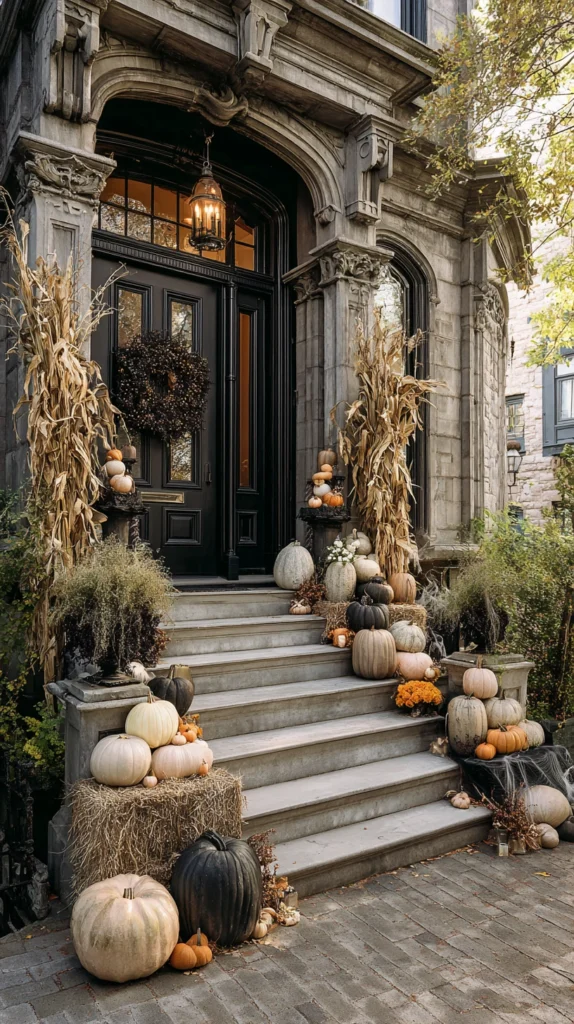
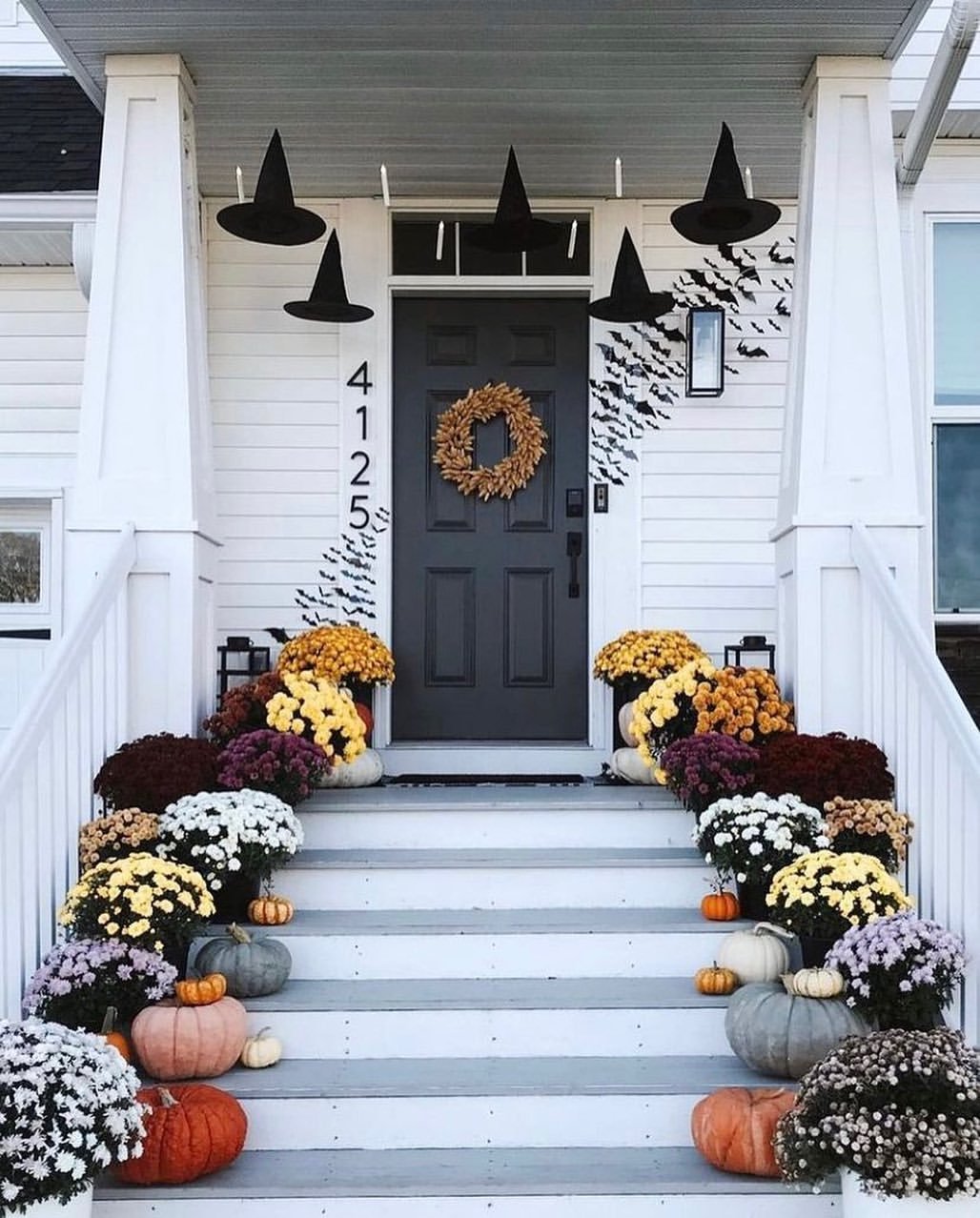
If only one full setup makes the cut, this is the one to build the whole porch around. Start with a tonal pumpkin pyramid in black, cream, and deep orange stacked on one side of the steps, and balance it with a bundle of dried corn stalks and dried wheat on the other side for symmetry. Hang an oversized dried botanical wreath on the door, sized to cover roughly a third of its height, and drape a loose cheesecloth “cobweb” across the top corner of the doorway for texture.
Line the walkway with five to seven amber flame-effect lanterns at even intervals, and add a woven willow ghost figure tucked among the pumpkins for a quiet, unexpected detail. Skip any string lights in favor of the lantern glow, and finish with a black velvet ribbon accent at the top of the door frame, left to cascade loosely down one side.
The full setup, broken down by piece:
- Tonal pumpkin pyramid (one side of steps): $60–$120
- Dried corn stalk and wheat bundle (opposite side): $15–$25
- Oversized dried botanical wreath (door): $70–$150
- Cheesecloth cobweb drape (doorway corner): $8–$15
- Amber lantern pathway, 5–7 lanterns: $75–$175
- Woven willow ghost figure (tucked among pumpkins): $20–$45
- Black velvet ribbon accent (door frame): $8–$12
Full cost range: This complete setup typically runs $250–$450 depending on how much is bought new versus sourced from existing fall decor, and most pieces — the wreath, lanterns, and iron stakes — carry over into general autumn styling once Halloween passes.
Budgeting by Porch Size
Not every porch needs the full setup above. A quick way to right-size the budget:
- Small stoop or apartment landing: One statement piece (wreath or pumpkin pyramid) plus a few lanterns. Budget $100–$180.
- Standard suburban porch: Two statement pieces plus a lantern pathway. Budget $200–$320.
- Wraparound or large farmhouse porch: The full Gothic Harvest Entry setup, possibly duplicated on both sides of the steps. Budget $400–$600.
A Question Before You Decorate
Before buying anything new, ask: does this piece still look good in daylight, with no lighting effects or fog machine to hide behind? The porches that hold up as genuinely stylish are the ones built to look intentional at 2 p.m. on a Tuesday, not just after dark on October 31st.
A quick daylight test to run on any piece already in the garage:
- Does it fit within the three-color palette chosen for this year?
- Is the material natural or natural-looking, rather than shiny plastic?
- Would it still look intentional with all string lights turned off?
If a piece fails more than one of these, it’s a candidate to skip this year, even if it’s technically still usable.
Getting Started This Weekend
Start by choosing a three-color palette and pulling everything already on hand that fits it — pumpkins, ribbon, dried florals from other seasons. Make a short list of the two or three statement pieces still needed (a wreath, a lantern set, a pumpkin pyramid) and source those first, since they set the tone for everything smaller added afterward.
A simple weekend plan:
- Saturday morning: Walk the porch and decide on the three-color palette
- Saturday afternoon: Sort existing decor into “keeps” and “skips” using the daylight test above
- Sunday: Shop for the one or two statement pieces still missing, and do a full dry-run placement before committing to final spots