14 Entryway Wall Decor Ideas That Make a Statement
The entryway wall is the first surface a visitor sees and the last one you look at on the way out of the door. It sets the tone for everything behind it — communicating the character of the home, the taste of the people who live there, and the care that has gone into the space before a single room has been entered. A well-considered entryway wall does this work quietly and immediately, without explanation or effort. A bare or neglected one leaves the home without an introduction, which is a missed opportunity of the most visible kind.
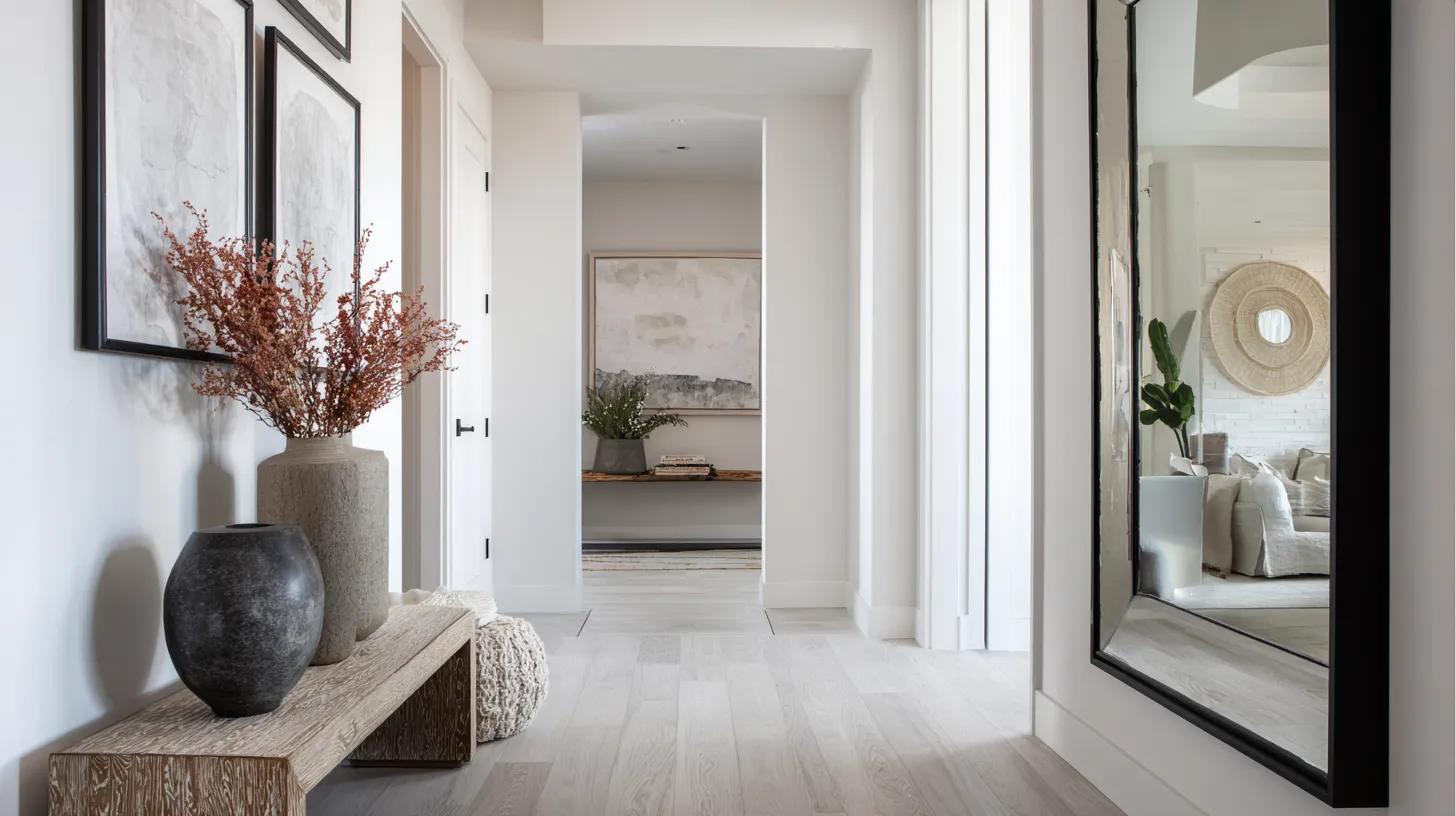
The challenge of the entryway is its constraints. Most are narrow, receive limited natural light, and have to accommodate the practical demands of coats, keys, and shoes alongside any decorative ambition. The ideas below treat those constraints as design parameters rather than problems, each one finding a way to make the entryway wall work as hard decoratively as it does practically — and in many cases making the two things inseparable.
1. The Floor-to-Ceiling Gallery Wall
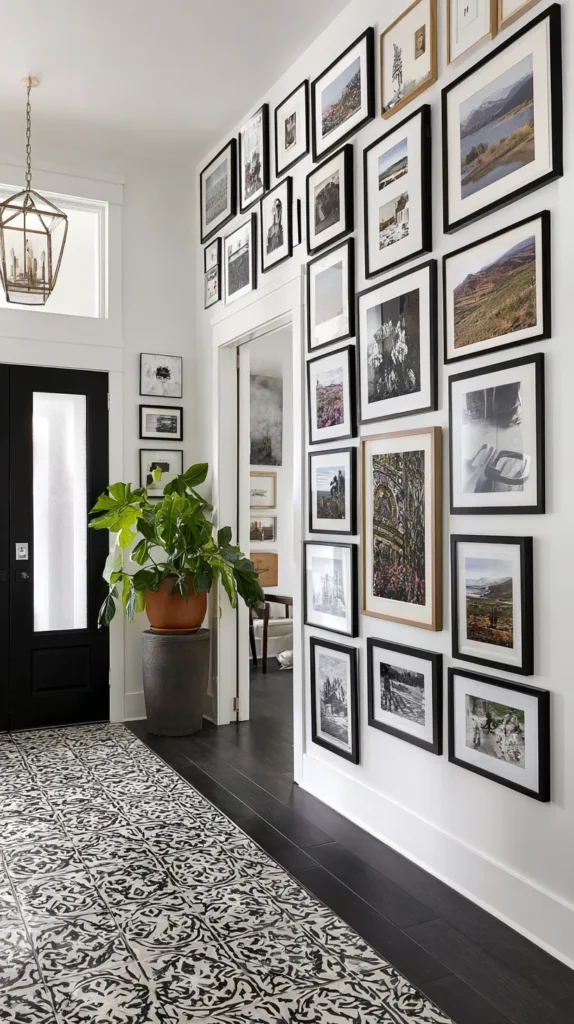
Budget: $80 – $500
A gallery wall that runs from the skirting board to the ceiling cornice — filling the entire vertical height of the entryway wall with framed prints, photographs, and artworks — creates an immediate, immersive statement that announces the character of the home before any other room has been seen. The full-height treatment is particularly effective in a narrow hallway where wall width is limited — working the full vertical height compensates for the restricted horizontal space and creates a display of genuine scale and ambition.
Use a consistent frame style throughout — all black, all white, all natural timber, or all antique gold — to unify images of very different subjects, sizes, and styles into a coherent gallery. The frame consistency is what transforms a collection of different pictures into a considered installation rather than an accumulation of separately hung pieces. Mix image scales deliberately — large prints near the centre of the arrangement, medium and small toward the edges — for a composition with visual hierarchy.
Styling tip: Start the gallery arrangement by placing the largest piece first at approximately eye level, then build outward and upward from that anchor. Attempting to design the full floor-to-ceiling arrangement from the top down or from a corner outward almost always produces an unbalanced composition. The largest piece at eye level is the visual centre of gravity from which everything else finds its position naturally.
2. The Statement Mirror
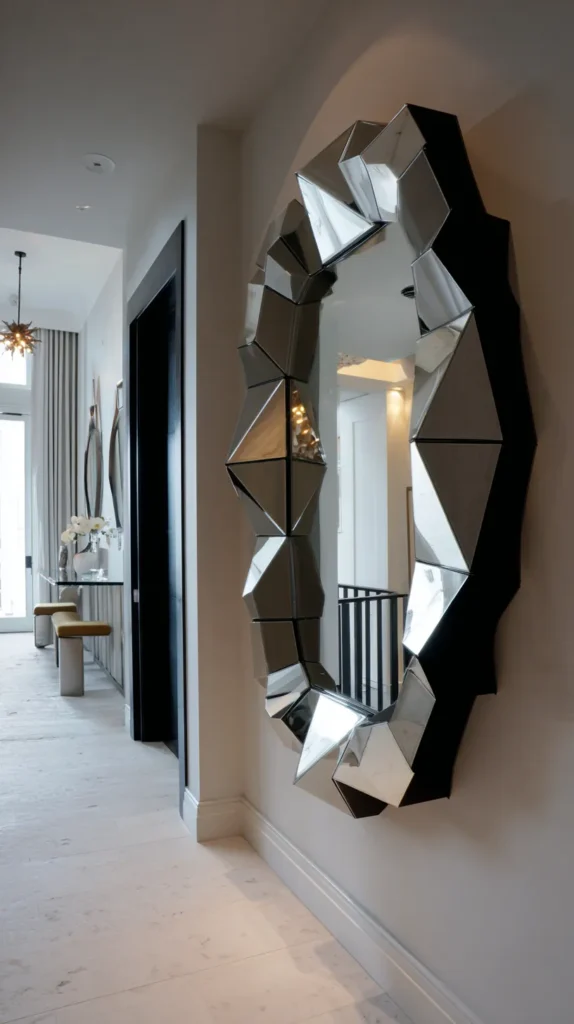
Budget: $60 – $400
A large, architecturally significant mirror — oversized arch, sunburst, ornate baroque frame, wide flat contemporary profile — hung as the single dominant element on the entryway wall creates maximum impact with minimum complexity. The mirror reflects available light into what is often the darkest space in a home, doubles the visual depth of the narrow hallway, and provides the practical function of a last-look check on the way out of the door. No other single decorative object does as much useful work in as little space.
The frame is the statement — the mirror glass itself is a constant, but the frame determines whether the piece reads as contemporary, traditional, maximalist, or restrained. An ornate plaster frame painted in the same colour as the wall creates a tonal, textural effect. A raw brass sunburst against a dark wall creates bold graphic contrast. A simple wide white frame on a white wall creates a clean, architectural effect. The frame choice communicates the home’s character more directly than almost any other single decorating decision.
Styling tip: Hang the mirror so its centre sits at approximately 150 centimetres from the floor — slightly higher than standard picture-hanging height. At this height the mirror reflects the mid-section of the hallway and the faces of people moving through it rather than the floor or the ceiling, which maximises both its practical usefulness and its decorative impact simultaneously.
3. The Wallpaper Feature Wall
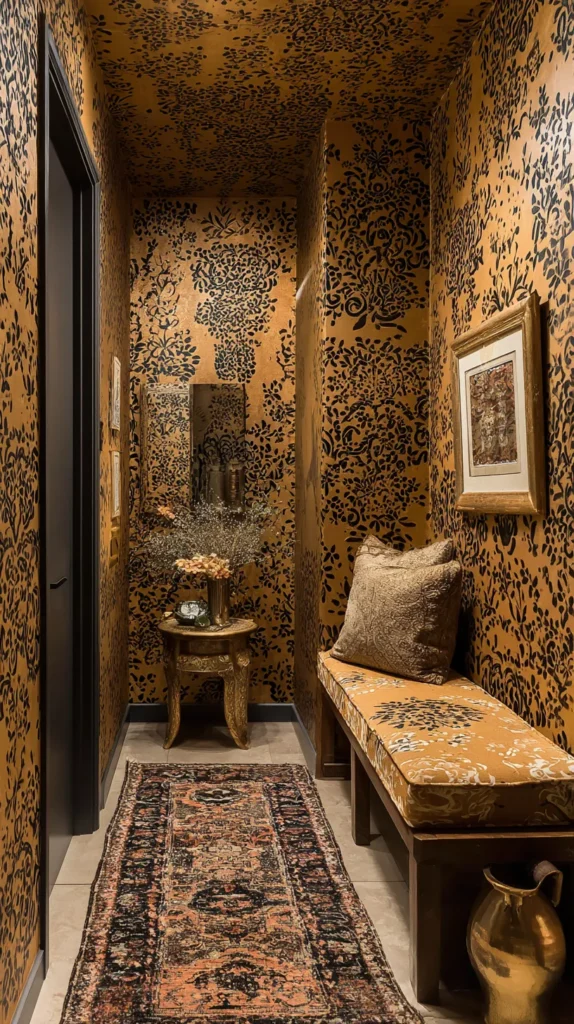
Budget: $80 – $600
A single wall of bold wallpaper in an entryway — a large-scale botanical print, a geometric repeat, a maximalist floral, a graphic stripe, or a textured grasscloth — creates the most complete and immersive statement a single wall surface can make. Wallpaper in an entryway works particularly well because the narrow space means the pattern is viewed at close range, which rewards detailed, complex designs that would be lost in a larger room viewed from a distance.
The entryway is the ideal space to use a wallpaper that might feel too bold, too pattern-dense, or too expensive per roll for a larger room — the limited area means fewer rolls are needed, the close viewing distance rewards the detail in a premium pattern, and the visual impact of a strong pattern in a small space is disproportionately powerful relative to the cost and effort of installation.
Styling tip: Paint the ceiling of a wallpapered entryway in a colour drawn from one of the less dominant tones in the wallpaper pattern rather than white. A ceiling that connects tonally to the wallpaper creates a fully enveloped, immersive quality that a plain white ceiling cannot provide — the colour connection makes the space feel designed as a whole rather than as a wall with decoration applied to it.
4. The Console Table and Art Combination
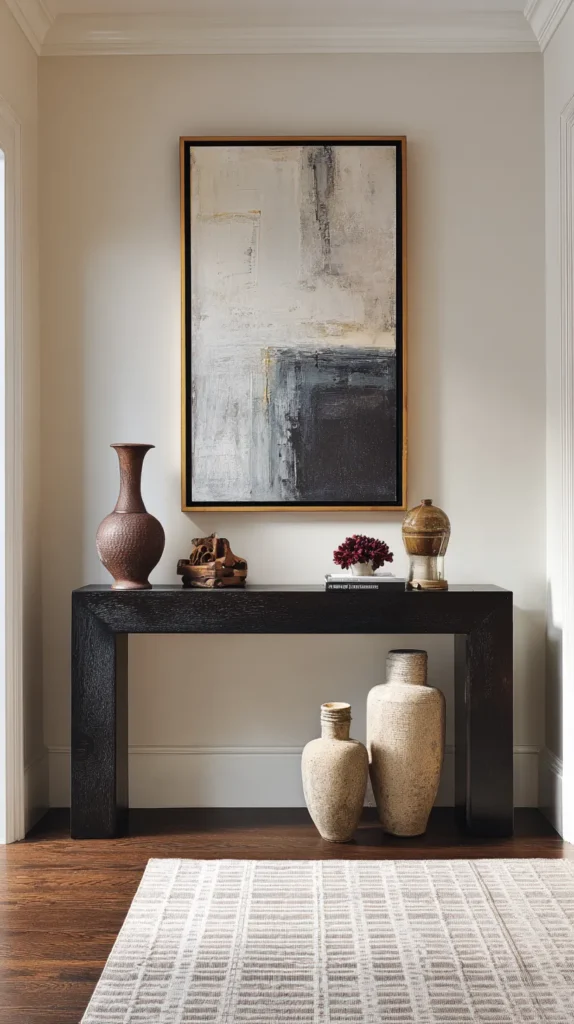
Budget: $150 – $800
A narrow console table positioned against the entryway wall with one significant piece of art hung directly above it — sized so the art fills the wall space between the console surface and the ceiling with appropriate breathing room on each side — creates the most considered and the most formally composed entryway arrangement available. The art and the table work together as a single composed vignette, and the surface of the console provides a changing display of seasonal objects, practical items, and decorative pieces that keeps the arrangement alive and personal.
The proportional relationship between the console table and the art above it is critical. The art should be approximately two thirds the width of the console table — wider looks overwhelming, narrower looks unrelated. The bottom edge of the art should sit 15–20 centimetres above the console surface — close enough to read as connected, high enough to allow objects on the table surface without crowding the frame.
Styling tip: Keep the console table surface edited to a maximum of five objects — a lamp, a small plant or vase, a tray for keys and essentials, one decorative object, and one personal item. A console surface with more than five elements looks cluttered in the narrow entryway context where every object is immediately visible at close range. Five well-chosen pieces look curated and intentional; seven or eight look like the table has collected rather than been arranged.
5. The Maximalist Print Collection
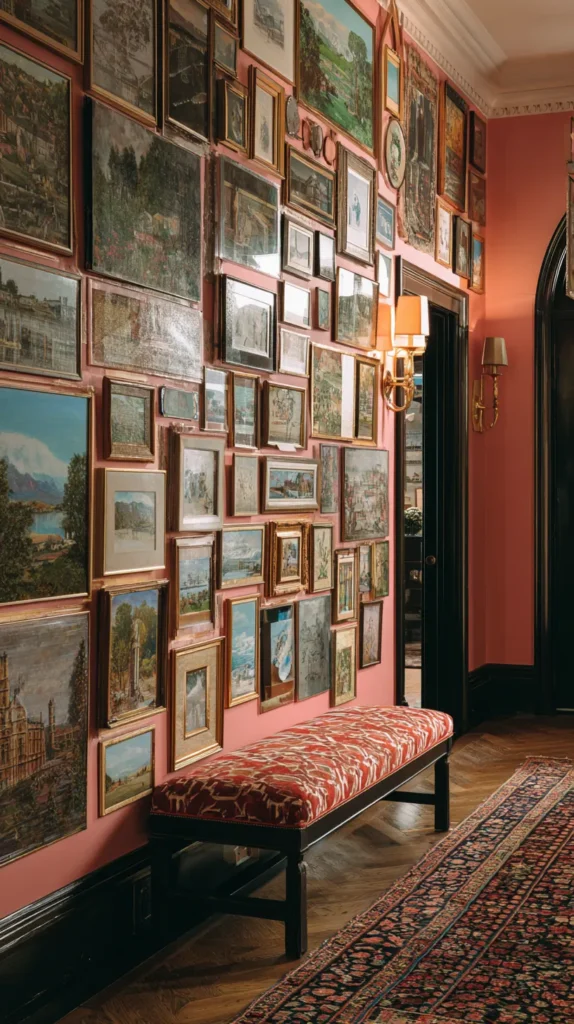
Budget: $50 – $300
A densely packed wall of prints — vintage posters, botanical engravings, travel photographs, typographic prints, map reproductions, postcard-sized artworks — covering every available inch of the entryway wall from dado rail to ceiling creates an entry experience that functions simultaneously as autobiography and entertainment. Every visit to the home begins with a moment of discovery — a print not previously noticed, a detail newly visible, a connection between two images suddenly apparent — that no sparsely decorated wall can provide.
The success of a maximalist print collection depends entirely on the consistency of the frame — a wall of thirty prints in thirty different frame styles looks chaotic and accidental. The same thirty prints in one consistent frame type — all simple black flat profiles, all identical white-painted timber frames, or all unframed prints pinned with visible brass pins — reads as a genuine collection rather than an accumulation. Frame consistency is the order that makes the abundance readable.
Styling tip: Include at least three or four genuinely personal items in a maximalist print collection — a childhood photograph, a hand-drawn map of a significant place, a ticket stub framed behind glass, a postcard from somewhere meaningful. The personal items are what transform a collection of beautiful prints into a wall that communicates the character of the people who live behind it, which is the true purpose of any entryway decoration.
6. The Painted Mural
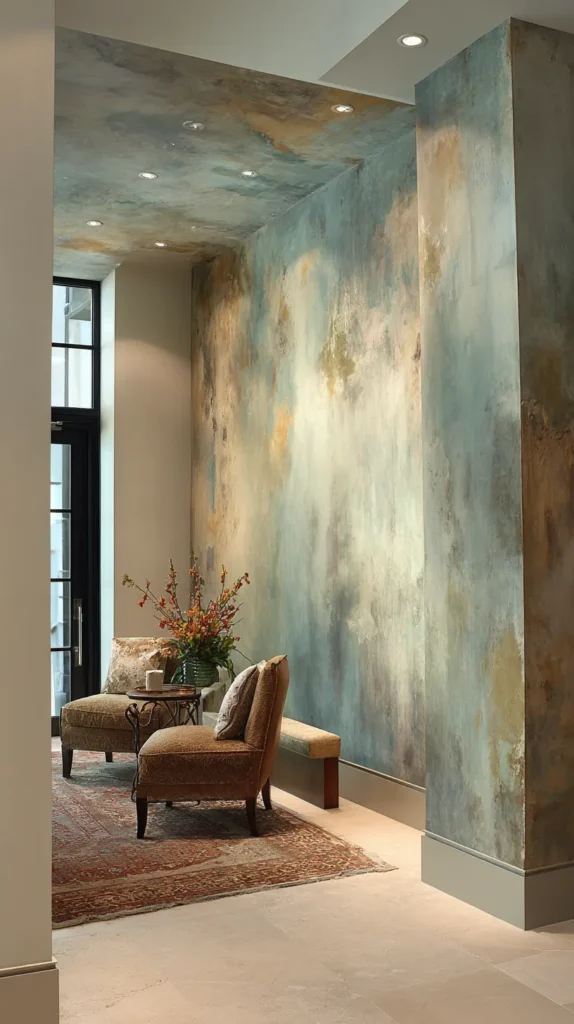
Budget: $100 – $2,000
A hand-painted mural on the entryway wall — commissioned from a local artist or painted by the homeowner — creates the most unique and most personal entryway statement possible. A botanical scene, a landscape, an abstract colour wash, a geometric pattern, a trompe l’oeil architectural feature — the subject can be anything that suits the home’s character and the resident’s confidence — and the result is a piece of art that belongs specifically and exclusively to that space.
Commission a local muralist through Instagram or local art school connections for $300–$1,500 depending on scale and complexity — significantly less expensive than most people expect for a piece of original art. A homeowner with basic painting confidence can execute an abstract colour-wash mural, a simple geometric pattern, or a loose botanical scene for the cost of the paint alone — the entryway wall, being small and enclosed, is a manageable scale for a first mural attempt.
Styling tip: Extend the mural onto the ceiling if the design allows — even 20–30 centimetres of the mural continuing across the ceiling plane dramatically increases the immersive quality of the piece and makes the entryway feel like a designed space rather than a decorated one. A mural that stays strictly within the wall plane is beautiful; one that bleeds onto the ceiling is transformative.
7. The Floating Shelf Display Wall
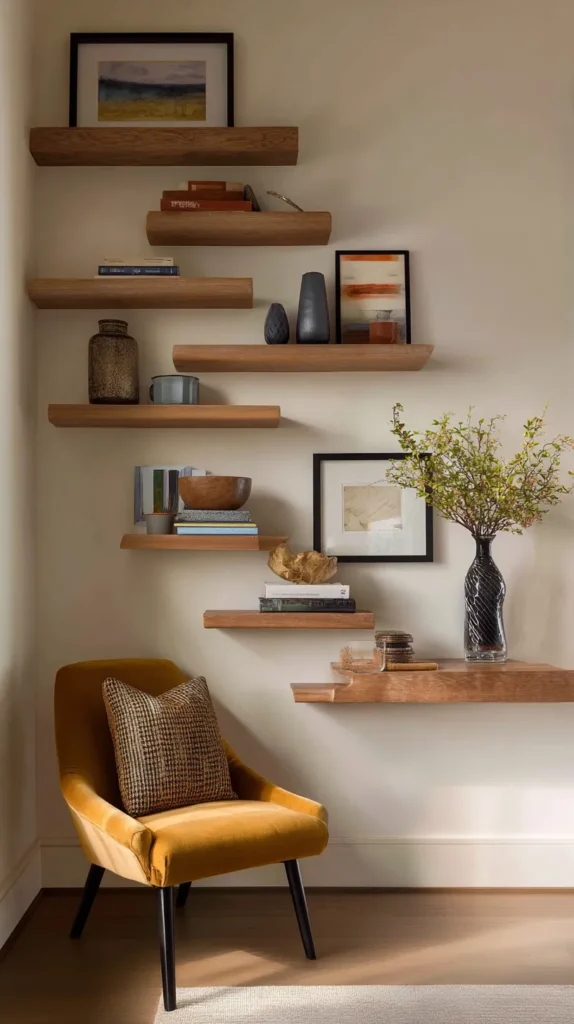
Budget: $60 – $300
A series of floating shelves on the entryway wall — installed at varying heights and depths, styled with a curated mix of books, plants, ceramics, framed photos, and practical objects — creates a display that is simultaneously decorative and functional, personal and considered. The shelves organise the entryway wall vertically, create multiple display levels at different heights, and allow the arrangement to be changed easily as seasons, objects, and preferences evolve.
Install shelves in an asymmetric arrangement — varying the horizontal position and the vertical spacing between shelves rather than creating a uniform grid — for a display that looks designed rather than standardised. A perfectly regular grid of shelves looks like retail shelving; an irregular arrangement with deliberate spacing variations looks like a considered architectural feature.
Styling tip: Style each shelf as an individual composition rather than filling it evenly from end to end. A shelf with one large ceramic piece, one small plant, and two books standing upright at one end looks curated and considered. The same shelf filled evenly with evenly spaced objects of similar size looks like a shop display. Empty space on a shelf is as important as the objects it contains — it gives the eye somewhere to rest between items and makes each piece more visible and more significant.
8. The Architectural Panelling Wall
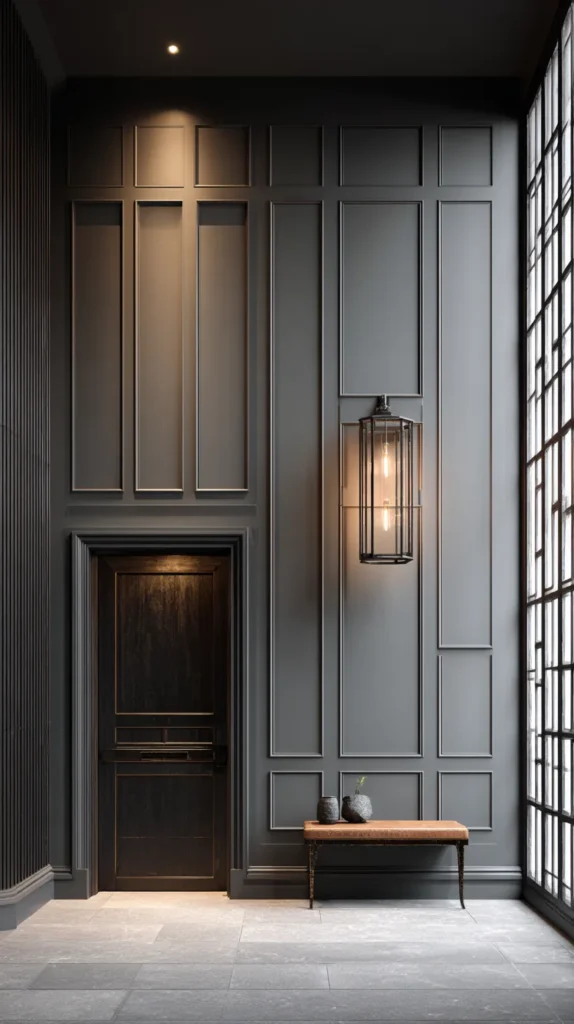
Budget: $150 – $1,500
Architectural wall panelling — dado rail and fielded panels, vertical shiplap boards, horizontal tongue-and-groove cladding, geometric MDF panel mouldings — applied to the entryway wall creates a surface of depth, shadow, and craft quality that flat painted plaster can never achieve. The panel geometry catches raking light and creates a constantly shifting play of shadow across the wall surface that makes it interesting to look at throughout the day without any additional decoration.
Panel the lower two thirds of the wall in a colour — deep green, navy, charcoal, warm white — and paint the upper third and ceiling in a lighter tone of the same colour for a layered, colour-drenched effect. Or paint the panelling in the same colour as the wall above for a tone-on-tone effect that reads as architectural relief rather than colour contrast. Both approaches produce a result significantly more sophisticated than unpanelled walls in any colour.
Styling tip: Hang a single large mirror or one significant art piece above the panelling rather than filling the panelled wall with multiple decorative elements. Architectural panelling is already providing considerable visual interest through its geometry and shadow — adding too many decorative pieces on top of it creates visual competition. One large statement piece above the panel line allows the architecture of the wall to read clearly while giving the eye a focal point above it.
9. The Antler and Natural Material Wall
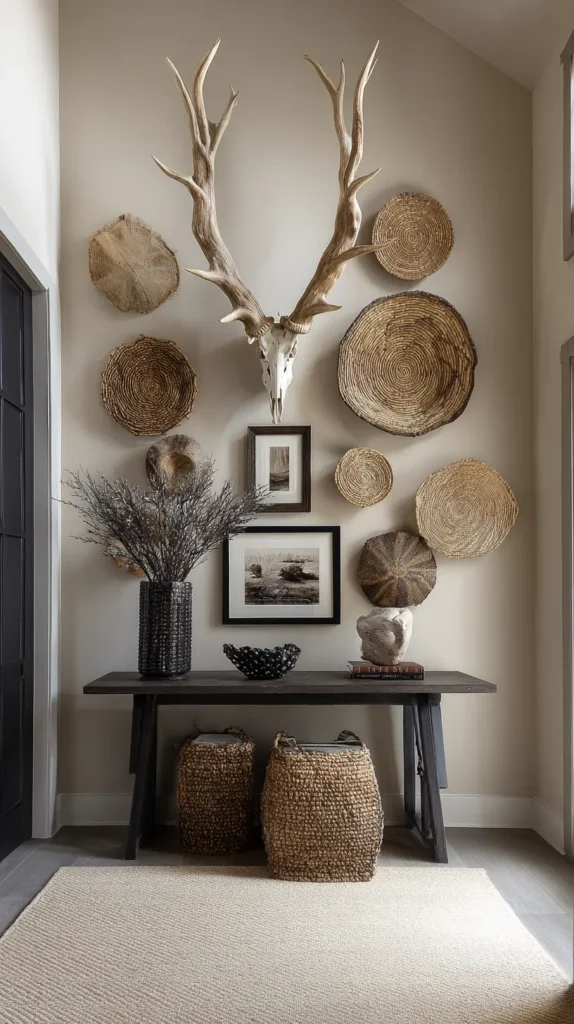
Budget: $60 – $300
A wall arranged with natural material objects — antlers, dried botanical wreaths, woven grass wall hangings, driftwood sculptures, pressed fern panels, stone and mineral specimens in frames — creates an entryway with an organic, earthy character that suits rural, cottage, and naturalistic home styles. The natural materials bring texture, dimension, and a connection to the outside world into the first space of the home in a way that printed or painted decoration cannot replicate.
Faux antlers in resin or recycled materials cost $20–$60 and are ethically uncomplicated. Dried botanical wreaths in pampas grass, eucalyptus, and dried flowers cost $15–$40 each or can be made for less from garden-harvested material. Framed pressed ferns and leaves cost $3–$8 in materials per frame. The collection of natural objects does not need to be large — three to five carefully chosen pieces arranged with deliberate spacing creates more impact than a wall covered in many smaller pieces.
Styling tip: Vary the dimensionality of a natural material wall arrangement — some pieces flat to the wall, some projecting 10–15 centimetres, some hanging three-dimensionally on wire. The depth variation creates a genuinely three-dimensional wall surface with shadow and movement that flat hung pieces alone cannot achieve and makes the arrangement feel more like a sculpture installation than a conventional wall display.
10. The Oversized Single Art Print
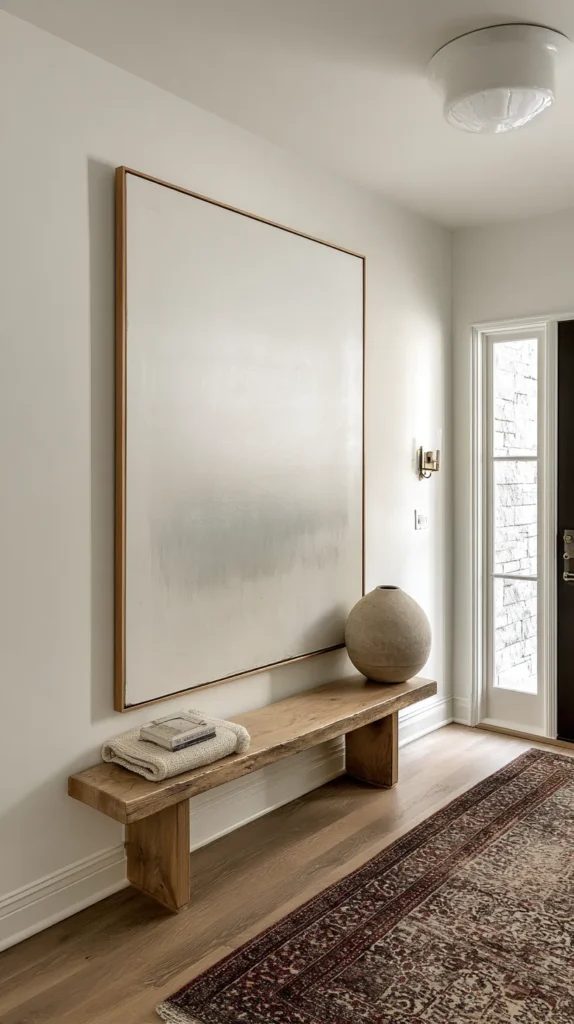
Budget: $40 – $300
One print or artwork sized to fill the majority of the available wall space — with a generous margin of wall visible on all four sides — makes a statement of confident simplicity that no gallery wall or complex arrangement can replicate. The oversized single piece says that the art is the thing — that nothing else is needed, that the image is enough — and the space around it amplifies rather than diminishes its presence. In a narrow entryway where wall space is limited, a single large piece is often more powerful than multiple smaller ones.
An oversized print can be produced affordably by printing a high-resolution image at a large format print shop — A0 size ($15–$30), 100×140 centimetres ($20–$40), or custom panoramic dimensions at $30–$60. Frame simply or leave unframed and clip-mounted with aluminium hanging rails at the top and bottom edges for a contemporary, gallery-like presentation that costs significantly less than a frame of equivalent size.
Styling tip: Choose an image for an oversized entryway print that works at close range as well as at a distance — texture, detail, and depth that reward inspection matter more in the entryway than in any other room because the space is experienced at close range rather than viewed across a distance. An image that is beautiful as a thumbnail but empty up close loses its impact in the space where it is most closely and most frequently seen.
11. The Typographic and Text Wall
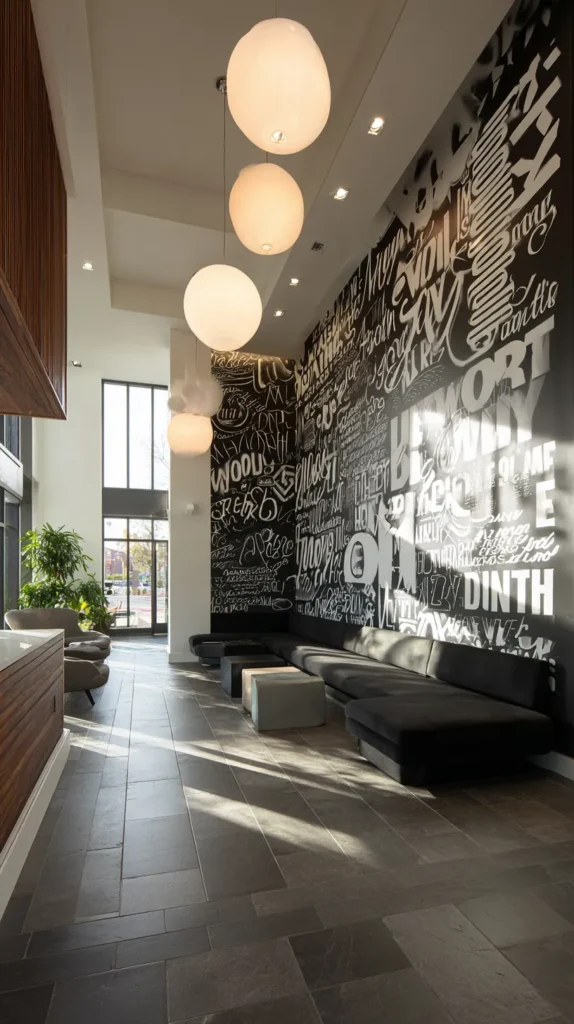
Budget: $30 – $200
A wall arranged with typographic elements — a large-format text print of a meaningful quote, a neon or LED sign in script lettering, individual letter prints in a grid arrangement, a hand-lettered canvas, or a combination of different typographic scales and styles — creates an entryway that communicates directly and personally with everyone who enters. Text in an entryway has the quality of a greeting — it says something specific and human in a way that purely visual decoration cannot.
Choose text with personal significance rather than generic motivational content — a line from a favourite poem, a family motto, a date, a place name, a word that means something specific to the people who live in the home. Generic quotes and familiar typographic clichés communicate nothing about the home’s character. Specific, personal text communicates everything about it.
Styling tip: Scale the text to fill the available wall space generously — a typographic print or sign that is too small for its wall looks tentative and decorative rather than bold and architectural. Typography that fills its space — that uses the wall as a page — has genuine visual authority that small or modest-sized text never achieves, regardless of how meaningful the words themselves might be.
12. The Dark and Moody Entryway Wall
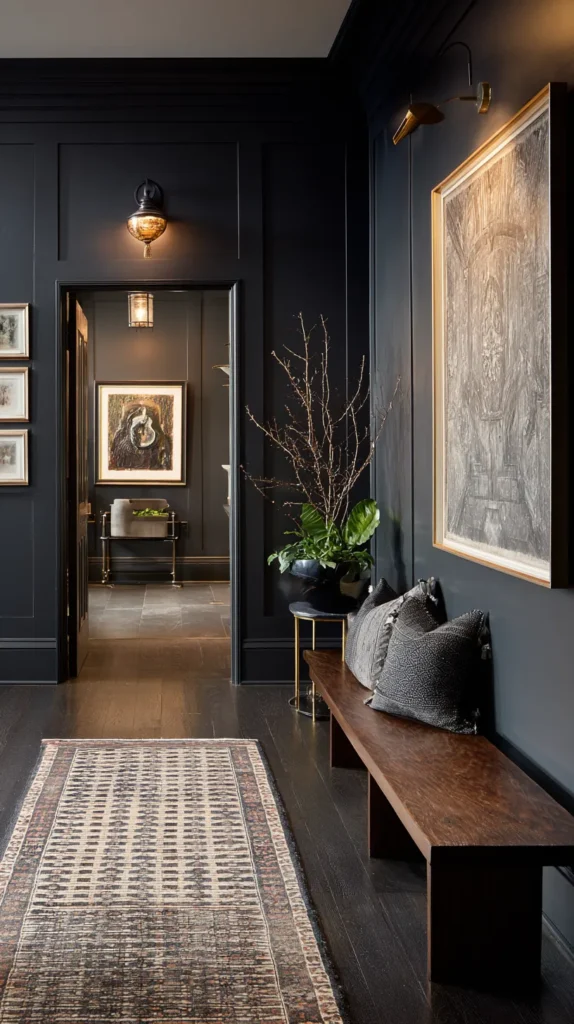
Budget: $50 – $400
A deep, dark entryway wall — charcoal, forest green, navy, aubergine, or near-black — painted in a rich, flat finish and decorated with carefully chosen objects creates an entry experience of extraordinary atmosphere and drama. The counterintuitive logic of making the smallest, darkest space in the home even darker works because it leans into the enclosed quality of the entryway rather than fighting it — making the space feel intimate, jewel-box-like, and deliberately moody rather than accidentally dim.
Hang objects on a dark wall in materials that stand out against the depth of the colour — brass and gold frames, pale ceramic pieces, white or cream prints, mirrors that reflect light back from the dark surface, plants with pale or variegated foliage. The contrast between the dark wall and the objects mounted on it creates the kind of dramatic visual depth that pale walls cannot produce regardless of what is placed on them.
Styling tip: Paint the entryway ceiling in the same dark colour as the walls — or in a tone only slightly lighter — for maximum drama and immersion. A dark-walled entryway with a standard white ceiling looks like a room where the painting stopped at the picture rail. The same entryway with a dark or darkened ceiling reads as a completely designed space where the colour is the architecture — intimate, complete, and entirely intentional.
13. The Hanging Textile and Tapestry Wall
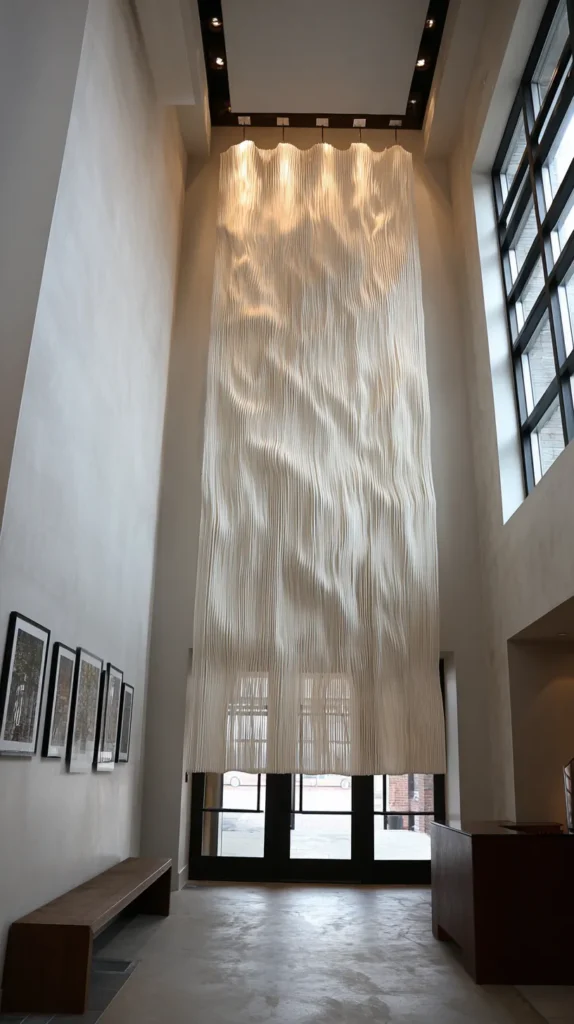
Budget: $40 – $300
A large woven textile — a kilim, a macramé wall hanging, a printed or embroidered tapestry, a woven wool panel, a vintage suzani — hung as the primary wall element in the entryway creates a surface of extraordinary warmth, texture, and colour that no framed print or painted surface can replicate. Textiles bring a tactile quality to a wall that changes the acoustic character of the space, absorbs sound rather than reflecting it, and creates an immediate sense of warmth that hard surfaces lack.
Hang a large textile from a timber or metal rod mounted just below the ceiling with the fabric falling to within 10–20 centimetres of the floor for the maximum sense of scale and presence. A textile hung this way functions as a soft wall within the entryway — it is as much architecture as decoration, and it occupies the wall with an authority that a framed piece of equivalent size rarely achieves.
Styling tip: Choose a textile for an entryway wall whose colours connect to the decoration of the first room visible beyond the entry — the living room, the kitchen, or the staircase. A textile that introduces the colour palette of the interior spaces makes the entryway feel like the beginning of the home rather than a separate space — a deliberate visual bridge between the street and the private interior that gives the whole house a sense of compositional coherence.
14. The Living Plant Wall
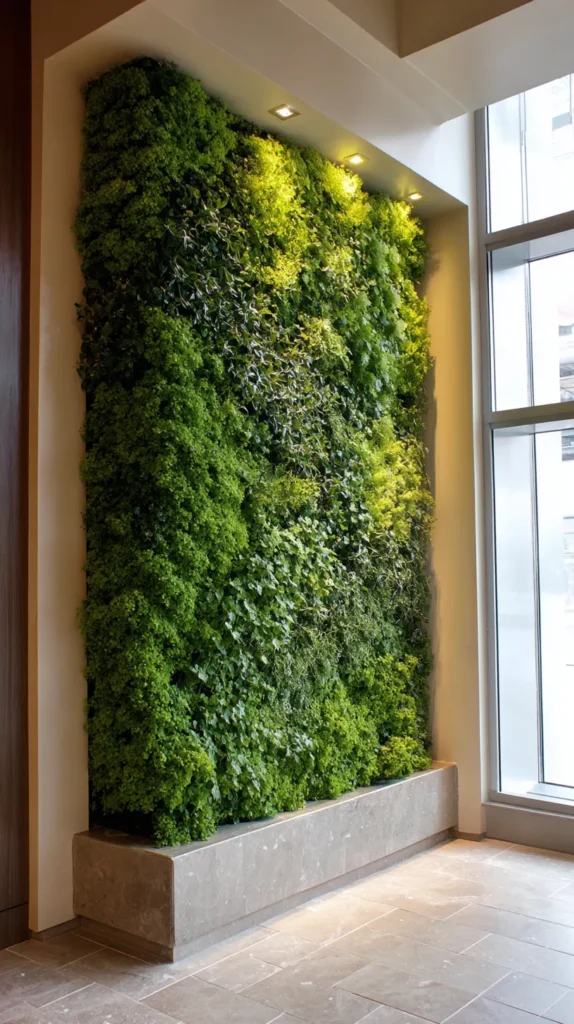
Budget: $100 – $600
A living plant wall — a modular planting system or a series of wall-mounted planters creating a dense, green vertical garden on the entryway wall — brings the most dramatic and the most biologically alive statement available in any interior. The sight of a lush, planted wall on entering a home creates an immediate and powerful impression of care, generosity, and a connection to nature that no other single decorating element can replicate with the same sensory completeness.
Pothos, philodendrons, ferns, spider plants, peperomias, and tradescantia all thrive in the lower light conditions of most entryways and provide a range of leaf shapes, textures, and tones that create visual complexity within an entirely green palette. A self-watering modular wall planting system costs $150–$400 for a one-square-metre installation and reduces the maintenance commitment to a manageable weekly check rather than daily watering.
Styling tip: Frame the living wall with a simple painted border — a rectangle of paint in a deep, complementary colour applied directly to the plaster wall around the planted area — to define the living wall as a deliberate feature within the entryway space. An unframed living wall that simply occupies part of a white wall looks installed; the same living wall within a painted frame looks designed, intentional, and considered as part of the overall decorative scheme of the space.
The entryway wall is the home’s opening sentence — the first thing said, the first impression made, the first indication of what follows. Like any good opening sentence, it should be considered, confident, and specific enough to be genuinely interesting rather than generic. Choose the idea that suits the character of the home and the people who live in it, execute it with care, and let the first wall do what first impressions always do — make everything that follows feel more worth discovering.