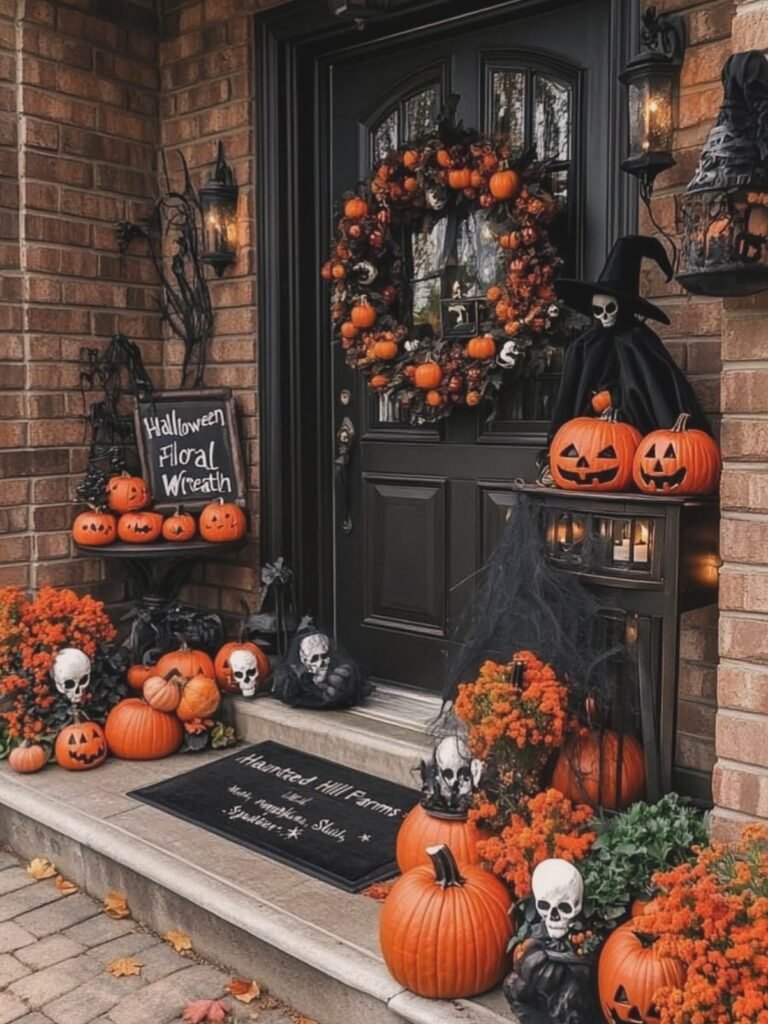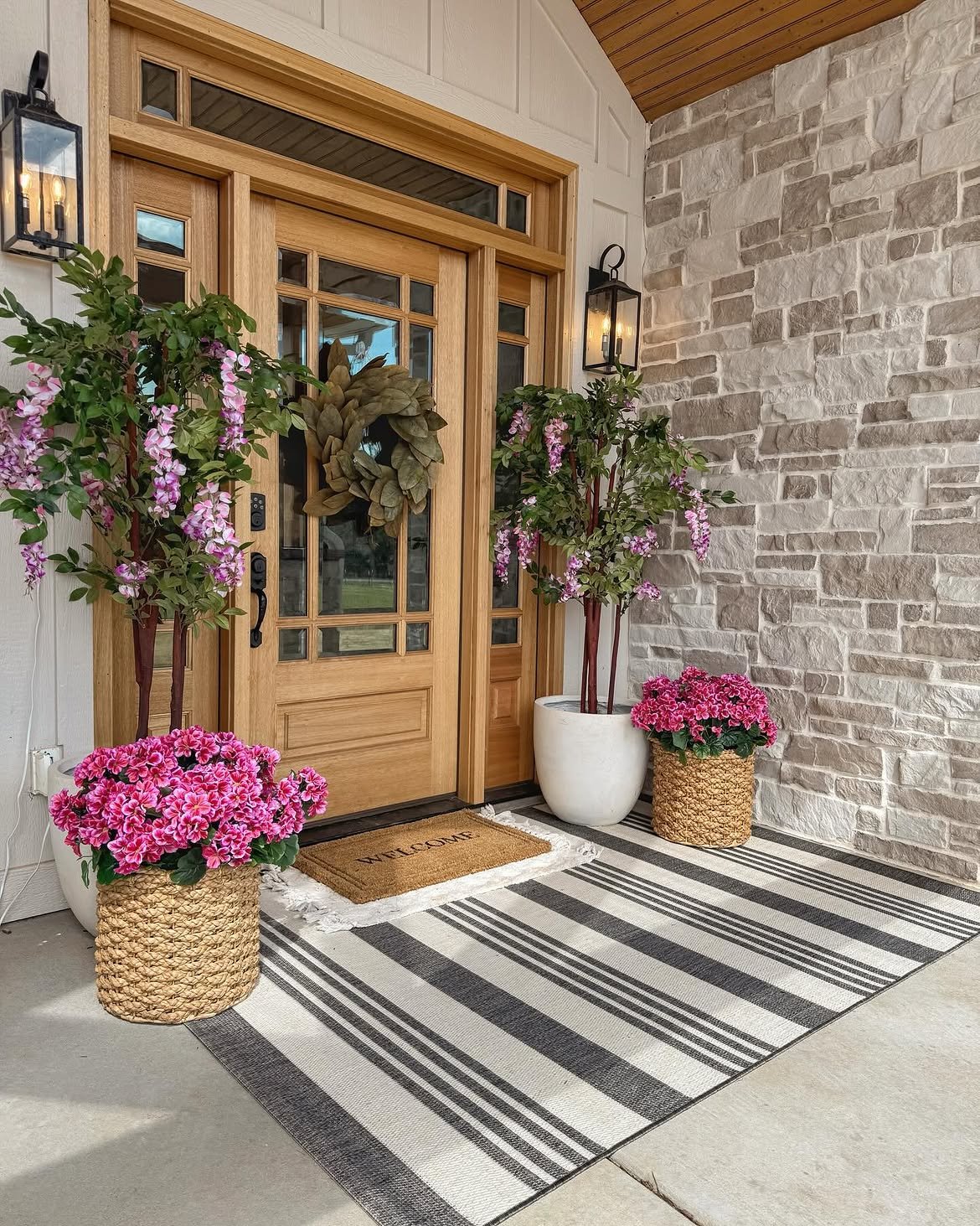
13 Fall Front Porch Decor Ideas That Wow Guests
Most front porches get decorated the same way every October — a single pumpkin by the door, maybe a wreath if there’s time, and whatever was already growing in the planters left to fade on its own. It’s enough to acknowledge the season, but it rarely makes anyone stop and look twice.
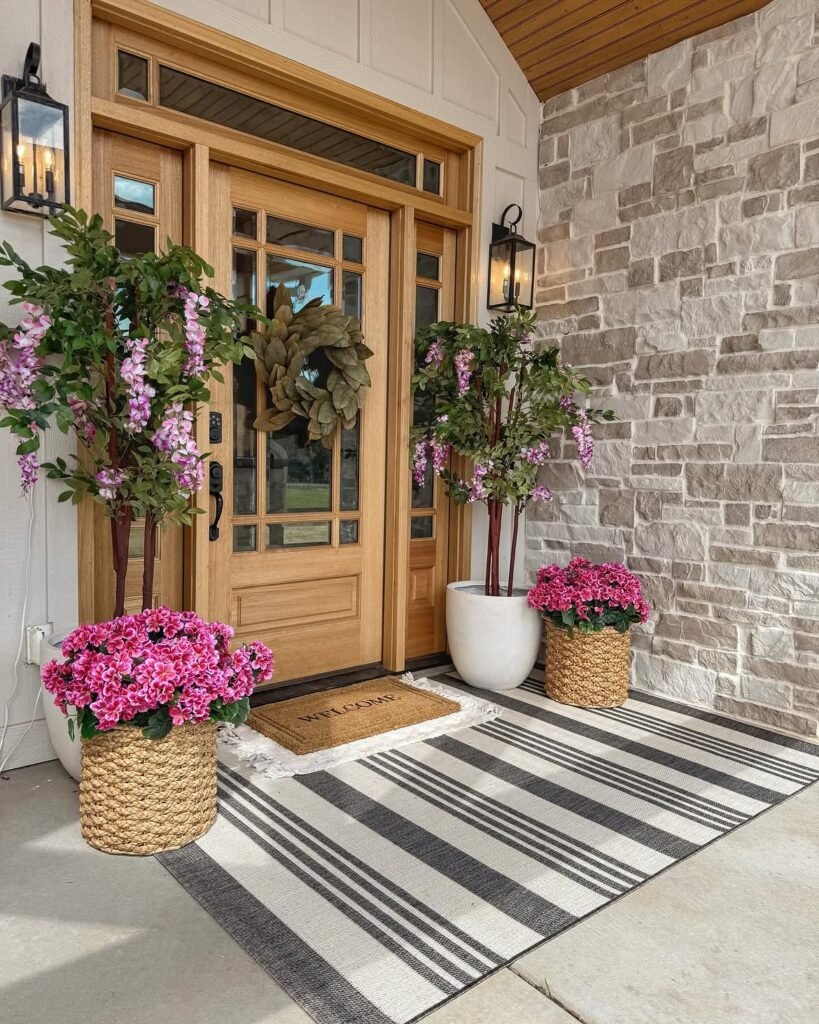
That approach undersells the one part of the house every single guest sees before they see anything else. A front porch isn’t a backdrop to walk past on the way to the door — for the entire stretch of fall, from the first cool evening through Halloween and into Thanksgiving, it’s the highest-traffic, highest-visibility square footage on the property.
A porch that actually wows isn’t the result of more decorations crammed into the same space. It’s the result of understanding what reads from the street versus what only matters up close, and building the display in layers that work in both daylight and the early dark fall brings. Get that right, and a porch becomes the thing neighbors slow down to look at, not just the thing guests step past.
Here are 13 ideas for decorating a fall porch built to actually be noticed.
Why Fall Porch Decor Plays by Different Rules Than Summer
The rules are not the same for every season on the porch:
Summer Porch Advantages:
- Long daylight, so the porch is rarely seen in the dark
- A few potted plants or a simple wreath feel sufficient, since the season does much of the visual work on its own
- High daytime visitor traffic, with less reliance on the porch making an impression after sunset
The summer porch comparison: light decor for a season that doesn’t need much help
Fall Porch Advantages and Realities:
- The porch becomes the entry point during the year’s highest-traffic stretch, between trick-or-treaters and holiday guests
- Earlier darkness means porch lighting plays a far bigger role than it does in July
- A porch is the very first thing every guest sees, before they’ve reached the door, let alone the foyer
The key insight:
- Summer porch decor rewards minimal, simple touches
- Fall porch decor rewards layering and a deliberate sense of occasion, since holiday visitors actually stop and look
- These are different design problems, not the same porch with a pumpkin added
The Approach Reality
The most important distance in fall porch decor:
The street view:
- Most porches are seen first from 20–50 feet away, at the sidewalk or street, before anyone reaches the steps
- Decor that looks great up close can disappear entirely from that distance
- Know this — it governs every choice about scale
The “scale up, not just add” calculation:
- A single small pumpkin reads as almost nothing from the street; a cluster of varied sizes reads as a display
- Working backward from the street view: oversized, layered elements register from a distance, while small single accents only work right at the door
- Most porches need fewer, larger gestures rather than many small scattered ones
Most porch decor builds in two registers, not one:
- The street-view layer — big, bold elements that register from the sidewalk, like mums, pumpkins, and a wreath
- The doorstep layer — close-up details that reward a guest who’s actually arrived, like a doormat or a small vignette
- The two registers are different jobs, not the same display simply made bigger or smaller
1. The Graduated Pumpkin Display (The Porch’s Foundation Piece)
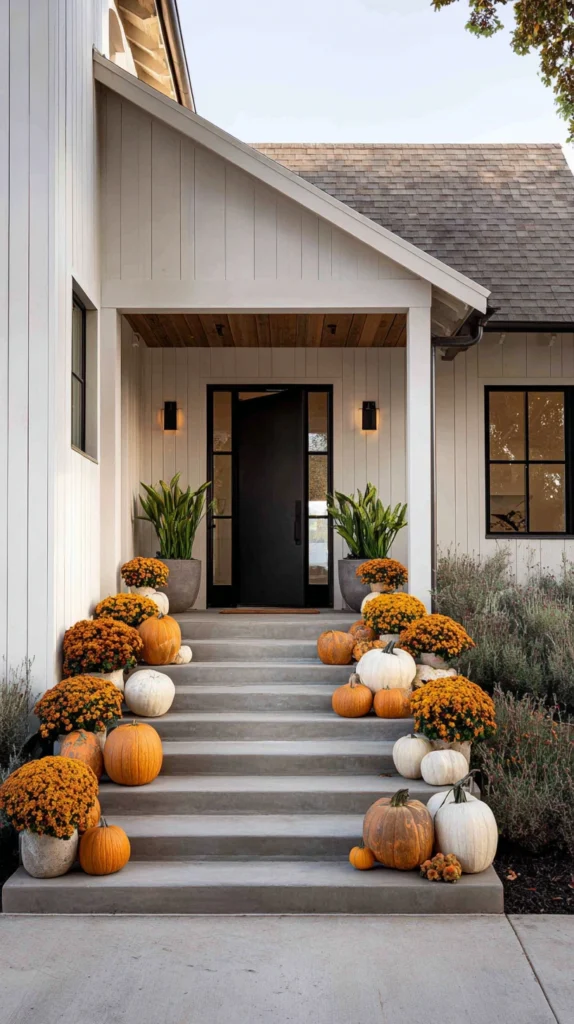
A cluster of pumpkins in varied sizes, arranged on the steps or beside the door — the single display most responsible for announcing the season before a guest has registered anything else about the porch.
Why this display anchors everything else
- The anchor point: every other fall decoration on the porch tends to get arranged in relation to this display, whether or not it’s the literal centerpiece
- The street-visibility factor: a graduated cluster of pumpkins reads clearly from the sidewalk in a way a single small pumpkin simply doesn’t
- The flexible scale: this idea works at almost any budget, from a few dollar-store minis to a real investment in heirloom varieties
The options
- Classic orange pumpkins, in three or four graduated sizes, the most traditional and recognizable option
- Heirloom or specialty varieties — Cinderella, Fairytale, blue-gray Jarrahdale — for a more curated, less generic look
- A mix of pumpkins and gourds, adding shape variety alongside the size variety
- Painted or whitewashed pumpkins, for a softer palette than standard orange
The practical execution
- Group in odd numbers (three, five, seven) for a more natural-looking cluster than an even, symmetrical pile
- Place the largest pumpkin lowest and most forward, with smaller ones receding behind and above it on a step
- Replace any pumpkin that begins to soften or collapse — one rotting pumpkin undermines the whole display faster than its size would suggest
Cost breakdown
- Classic pumpkins, a cluster of 5–7 mixed sizes: $25–60
- Heirloom or specialty varieties: $40–100
- Total: $25–100
The pumpkin cluster on the steps: the one display every other idea on this list ends up arranged around, whether intentionally or not.
2. The Mum and Ornamental Cabbage Planters (Color That Does the Work From the Street)
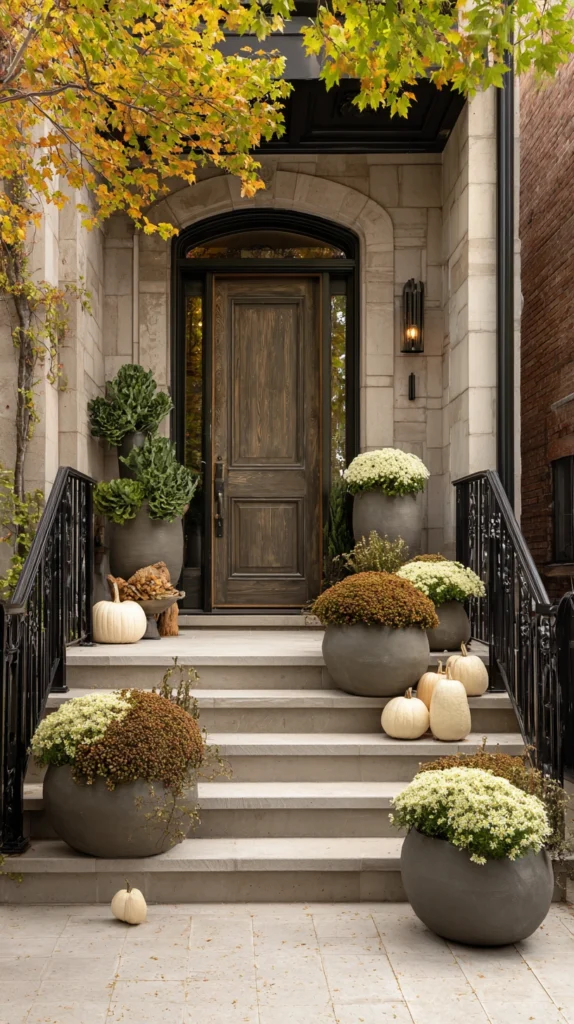
Potted chrysanthemums and ornamental cabbage or kale, arranged in groupings along the steps or porch edge — the color source that does more to register a porch as decorated from a distance than almost any single object could.
Why color carries more weight here than shape or texture
- The distance problem most decor doesn’t solve: small objects disappear from 30 feet away, but a mass of deep purple, rust, or gold mums reads clearly from the street
- The living-color advantage: unlike fabric or plastic decor, mums and ornamental cabbage actually change and fill in over the weeks they’re displayed
- The cold-tolerance bonus: both plants handle a light frost well, extending their usefulness later into the season than most flowering plants
The options
- Mums in deep autumn tones — rust, burgundy, gold — grouped by color rather than mixed randomly
- Ornamental cabbage or kale, with a rosette shape and color that reads as almost floral despite being a vegetable
- A mix of mums and cabbage in the same containers, layering bloom and texture together
- White or cream mums, for a porch that wants a more neutral, less saturated fall palette
The practical execution
- Group several pots together rather than spacing them individually — a cluster reads as a single mass of color from the street, where individual pots disappear
- Water consistently, since potted mums dry out faster than the same plant in the ground
- Deadhead spent blooms regularly to keep the display looking full rather than tired
Cost breakdown
- Mum, single pot: $8–18
- Ornamental cabbage or kale, single pot: $5–12
- A full grouping (8–10 plants): $60–150
- Total: $60–150
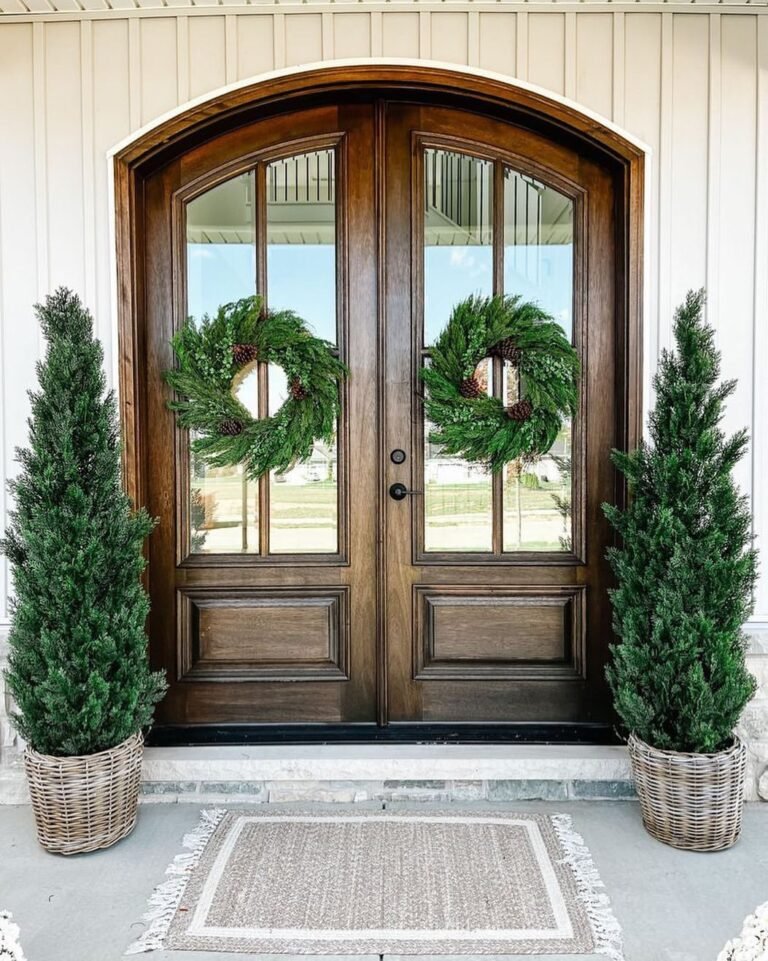
3. The Fall Wreath (The Door’s Single Most Important Decision)
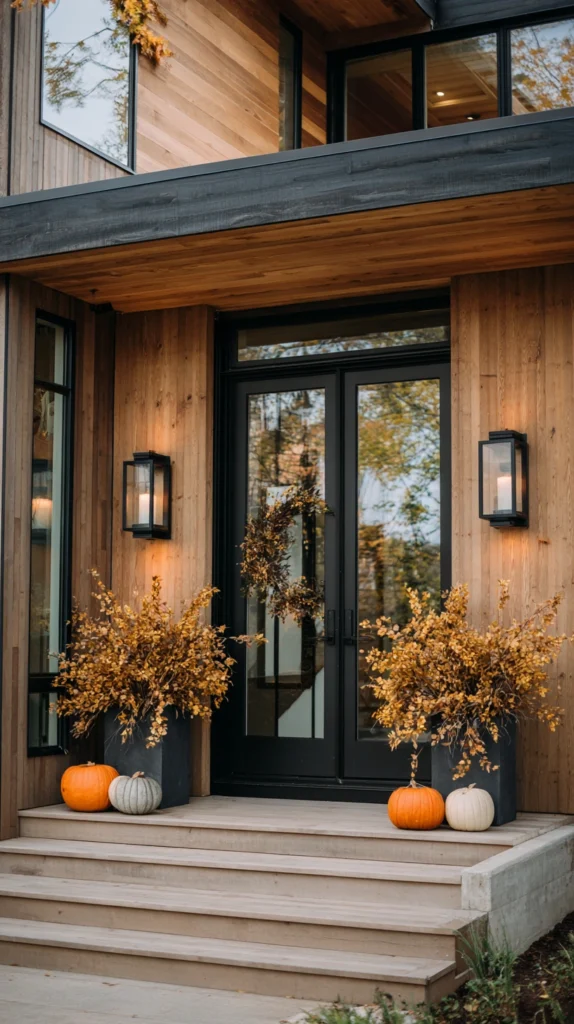
A wreath hung on the front door — the one decoration nearly every visitor looks directly at, since it sits exactly where their eyes land while waiting for the door to open.
Why the wreath gets more attention than anything else on the porch
- The forced-attention factor: unlike almost any other porch decoration, a guest standing at the door has no choice but to look directly at the wreath while waiting
- The single-focal-point efficiency: one well-chosen wreath can carry as much seasonal character as several smaller scattered decorations
- The weather exposure it has to survive: a door-mounted wreath takes more direct sun and rain than almost anything else on the porch, which changes what materials actually hold up
The options
- A faux foliage wreath, mixing fall leaves, berries, and pinecones, built to last the full season without wilting
- A fresh or dried foliage wreath, with real branches and grasses, shorter-lived but more textured and fragrant
- A grapevine base wreath, left partially bare for a more rustic, less dense look
- A wreath built around a focal element — a bow, a small sign, a cluster of faux pumpkins — rather than foliage alone
The practical execution
- Size the wreath to roughly one-third to one-half the width of the door for proportion, rather than defaulting to whatever size happens to be on the shelf
- Hang with a wreath hanger or hook designed not to damage the door’s finish, rather than a nail driven directly into it
- Check the wreath periodically for fading or wear on south- or west-facing doors, which take the most direct sun
Cost breakdown
- Budget faux wreath: $20–40
- Mid-range faux or dried wreath: $50–100
- Custom or designer wreath: $100–250
- Total: $20–250
4. The Hay Bale and Cornstalk Bundle (Structure and Height Without a Single Plant)
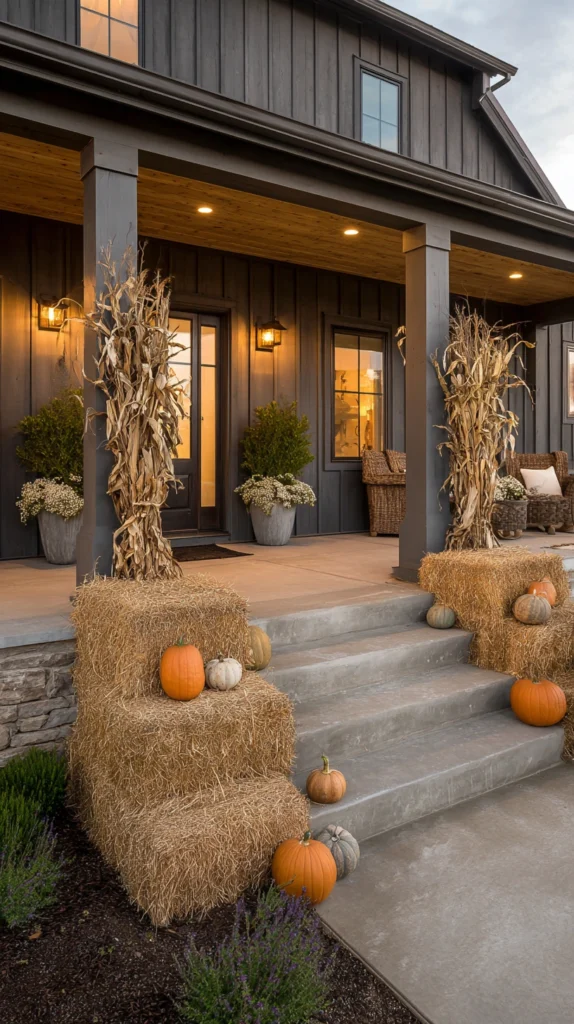
A small hay bale paired with bundled cornstalks, set beside the door or steps — the structural element that adds real height and texture to a porch display without relying on a single additional plant.
Why height matters as much as color
- The height problem most porch decor doesn’t solve: pumpkins and planters are almost all low to the ground, and a porch display with no vertical element can look flat from the street
- The texture contrast: the rough, golden texture of hay and cornstalks plays against the smoother surfaces of pumpkins, planters, and the porch itself
- The no-watering, no-wilting advantage: unlike mums or fresh foliage, this combination needs essentially no maintenance through the entire season
The options
- A single hay bale, used as a base or platform for a smaller pumpkin display set on top
- Bundled cornstalks, tied and leaned against a railing or column for vertical height
- A double hay bale stack, for a more substantial structural anchor on a larger porch
- Cornstalks alone, without a hay bale, for a narrower porch with less floor space to spare
The practical execution
- Position the hay bale where it won’t block the path to the door or any railing needed for support going up the steps
- Secure cornstalk bundles with sturdy twine or wire, since wind can topple a loosely tied bundle over a season outdoors
- Expect some shedding and breakdown by late in the season — this combination looks best in the first half of its display life and can be refreshed or removed as it wears
Cost breakdown
- Small hay bale: $8–15
- Cornstalk bundle: $10–20
- Total: $18–35
5. The Layered Doormat (The Detail Every Guest Steps on First)
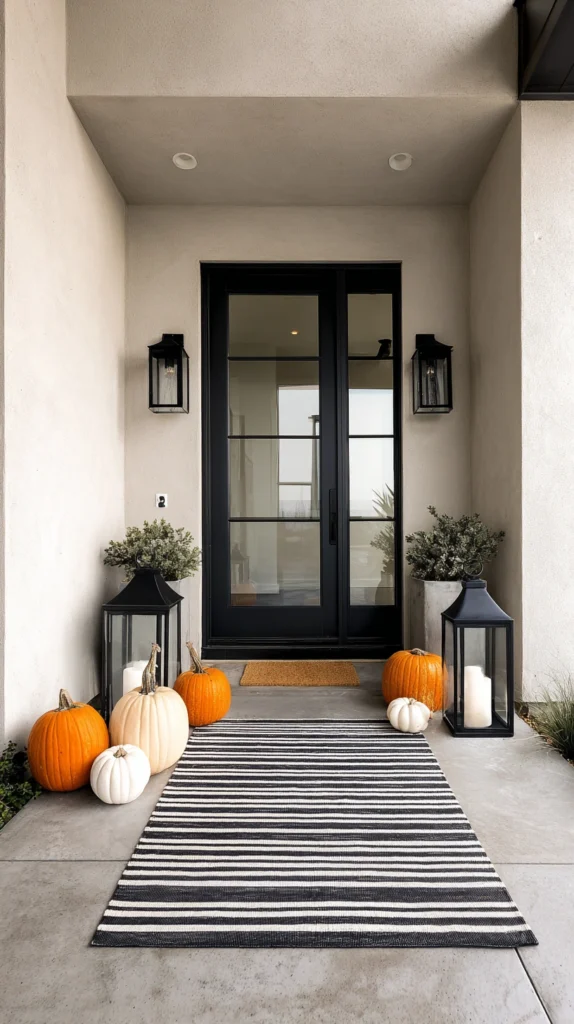
A doormat with a fall-specific pattern or message, often layered over a plainer all-weather mat underneath — the detail every single guest interacts with directly, whether or not they consciously notice it.
Why this small detail earns real attention
- The guaranteed interaction: unlike a wreath someone might glance at or a pumpkin cluster they might walk past, every visitor steps directly on the doormat
- The function-meets-decoration overlap: a doormat scrapes dirt and debris off shoes while also being one of the easiest, cheapest seasonal swaps on the whole porch
- The layering opportunity: a seasonal mat over a more durable, neutral base mat gets the personality of a fall design without sacrificing the actual function a heavier-duty mat provides
The options
- A coir doormat with a fall phrase or pattern, the most traditional choice, durable and scrapes shoes effectively
- A rubber-backed mat with a seasonal print, more weather-resistant than coir in wet climates
- A layered pair — a plain, heavy-duty base mat with a smaller seasonal accent mat on top
- A monogrammed or personalized fall mat, for a porch that wants a more custom touch
The practical execution
- Size the mat to the full width of the doorway, not narrower — an undersized mat looks like an afterthought
- Choose a coir or rubber-backed mat for genuine scraping function, reserving anything decorative-only for layering on top
- Shake out or sweep the mat regularly through the season, since fall foot traffic brings in more debris than a typical summer week
Cost breakdown
- Seasonal accent doormat: $20–40
- Heavy-duty base mat: $25–50
- Total: $20–90, depending on whether one mat or a layered pair is used
6. The Lantern and String Light Layer (Lighting for a Porch That’s Dark by Six)
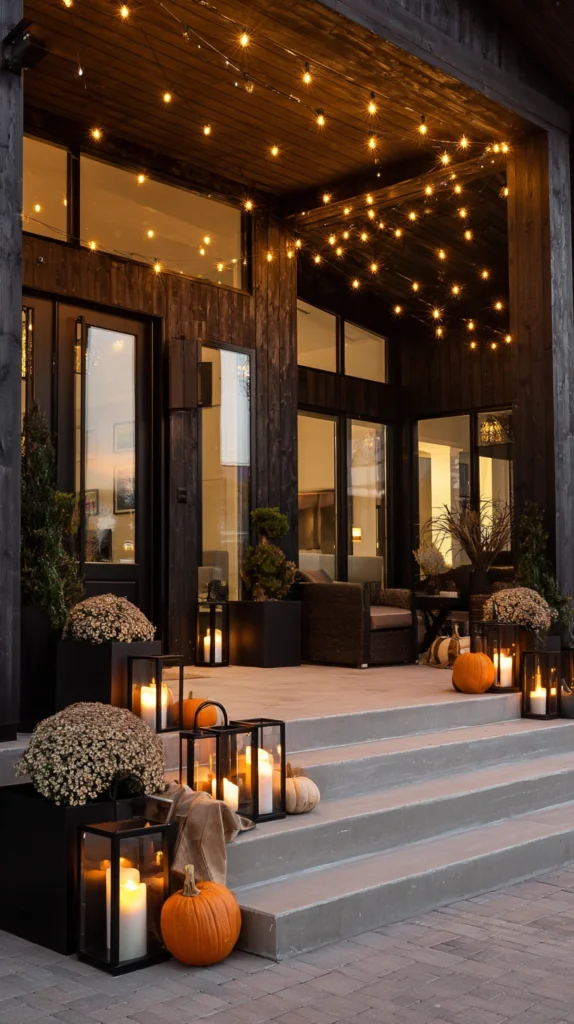
Lanterns, string lights, or both, added to the porch’s existing fixtures — the layer that keeps the whole display visible and welcoming once fall’s early sunset arrives.
Why this layer matters more in fall than in any other season
- The early-darkness case: a porch decorated entirely for daylight viewing loses most of its impact the moment the sun sets by six o’clock, which is most of a fall evening
- The warmth-of-light effect: warm lantern and string light glow does for a porch in the evening what mums and pumpkins do for it in daylight
- The trick-or-treat and holiday-traffic factor: fall brings some of the year’s highest evening foot traffic to a front porch, making this lighting layer disproportionately valuable
The options
- Battery or solar-powered lanterns, set among the pumpkin display or along the steps
- Warm white string lights, wrapped along a railing or strung across a porch overhang
- Flameless candles in glass jars or holders, for a softer, more contained glow near the door
- Uplighting at the base of the porch’s columns or planters, for a more architectural lighting effect
The practical execution
- Use warm-toned (2700–3000K) bulbs throughout, matching the cozy feel the rest of the fall decor is going for
- Position lanterns and lights where they illuminate the display itself, not just the porch ceiling or empty space
- Check battery levels and solar exposure periodically, since shorter, cloudier fall days reduce solar charging compared to summer
Cost breakdown
- Battery-powered lanterns, a set of 2–3: $20–45
- Warm white string lights: $15–35
- Total: $35–80
7. The Flanking Urn or Planter Pair (Symmetry That Frames the Door)
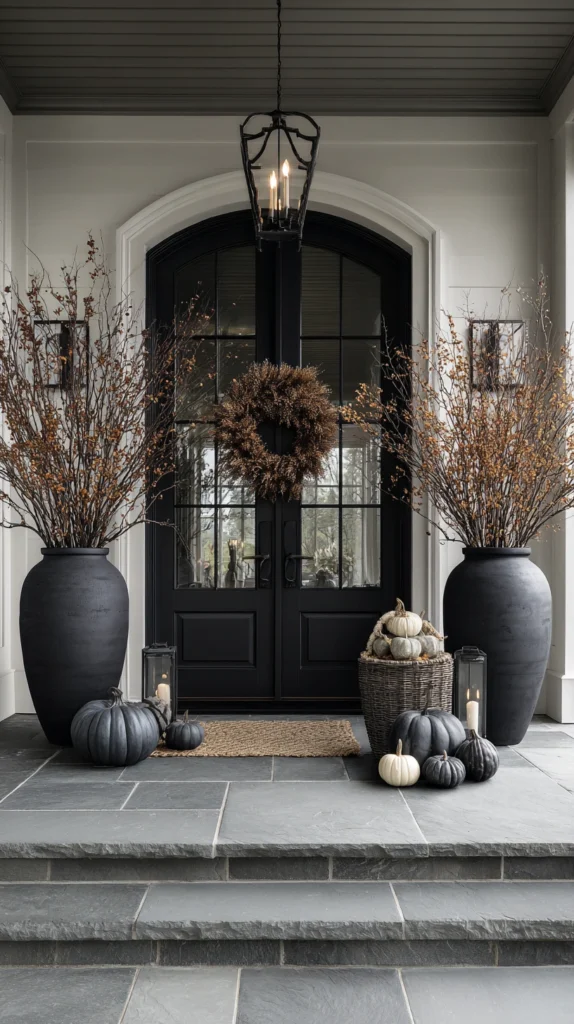
A matching pair of planters or urns, one on each side of the front door, filled with seasonal foliage or flowers — the symmetry that frames the entrance the way a mirror frames a console table indoors.
Why a matched pair does more than two separate planters
- The architectural framing effect: a matched pair on either side of the door creates an immediate sense of intention and balance, the same way flanking sconces or matching lamps work indoors
- The focal-point reinforcement: symmetry naturally draws the eye toward the center, meaning a matched pair of urns actually helps direct attention to the door and wreath rather than competing with them
- The seasonal flexibility: the same pair of urns can be re-planted or re-filled for spring, summer, and winter, making this one of the more durable investments on the list
The options
- Matched ceramic or resin urns, planted with mums, kale, and seasonal foliage
- Wood or galvanized metal planters, for a more rustic material pairing with hay bales or cornstalks elsewhere on the porch
- Tall, narrow urns, better suited to a porch with limited floor width on either side of the door
- Wide, low planters, for a porch with more horizontal space to fill
The practical execution
- Confirm the pair is genuinely identical in size and material — near-matches read as mismatched rather than intentional
- Plant or fill both urns with the same combination of foliage, rather than varying the contents between the two sides
- Position both urns at an equal distance from the door, even if the porch itself isn’t perfectly symmetrical
Cost breakdown
- Matched urn or planter pair, budget: $40–80 total
- Mid-range matched pair: $100–250 total
- Seasonal plants to fill both: $30–70
- Total: $70–320
8. The Styled Porch Seating Vignette (A Chair Worth Sitting In, Not Just Looking At)
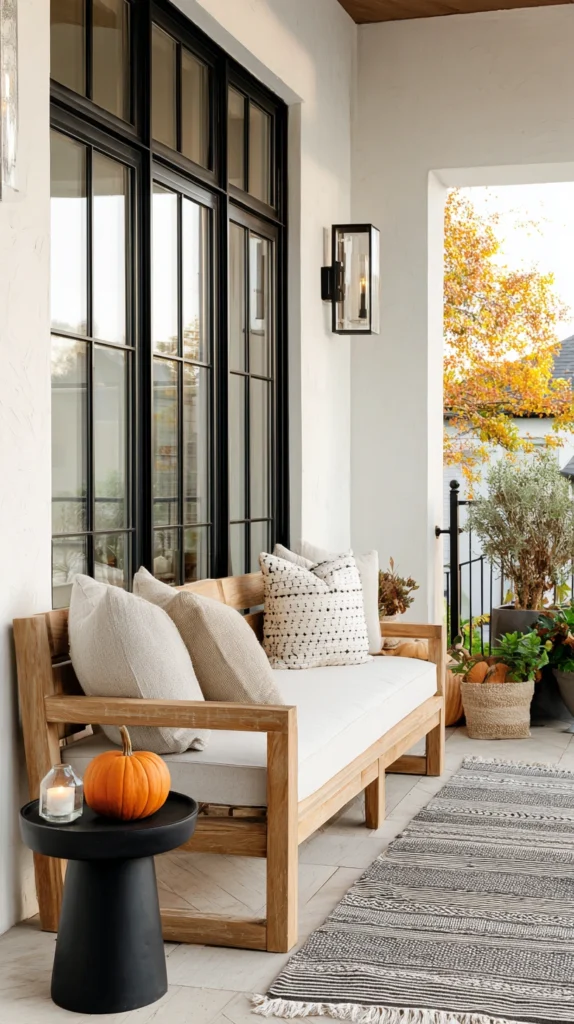
A bench, rocking chair, or pair of chairs arranged with a small side table and seasonal styling — the vignette that turns a porch from a pass-through into a place someone might actually want to sit.
Why seating changes how the whole porch is experienced
- The function-and-decor overlap: seating gives the porch an actual use beyond display, which changes how the whole space gets experienced rather than just viewed
- The lived-in signal: a porch with somewhere to sit, styled with a throw and a small pumpkin or two, reads as cared for and used, not staged for show alone
- The photo-moment value: a styled seating vignette is consistently one of the most photographed corners of a decorated fall porch, for guests and for the household alike
The options
- A wooden rocking chair, the classic porch seat, paired with a small side table
- A two-seat bench, for a slightly more substantial anchor on a larger porch
- A pair of matching chairs, flanking a small table rather than a single chair alone
- A porch swing, where the structure allows, for a more distinctive seating option
The practical execution
- Choose weather-resistant materials and finishes, since porch furniture stays exposed to sun, rain, and temperature swings far more than indoor seating
- Add a seasonal throw and a cushion or two in a fall color palette, echoing the textile layering used indoors
- Keep a small side table within reach for a drink or a book, reinforcing that this is a spot meant to be used, not just looked at
Cost breakdown
- Wooden rocking chair: $80–200
- Small side table: $30–80
- Outdoor throw and cushion: $30–60
- Total: $140–340
9. The Railing Garland (Decorating the Frame Around the View)
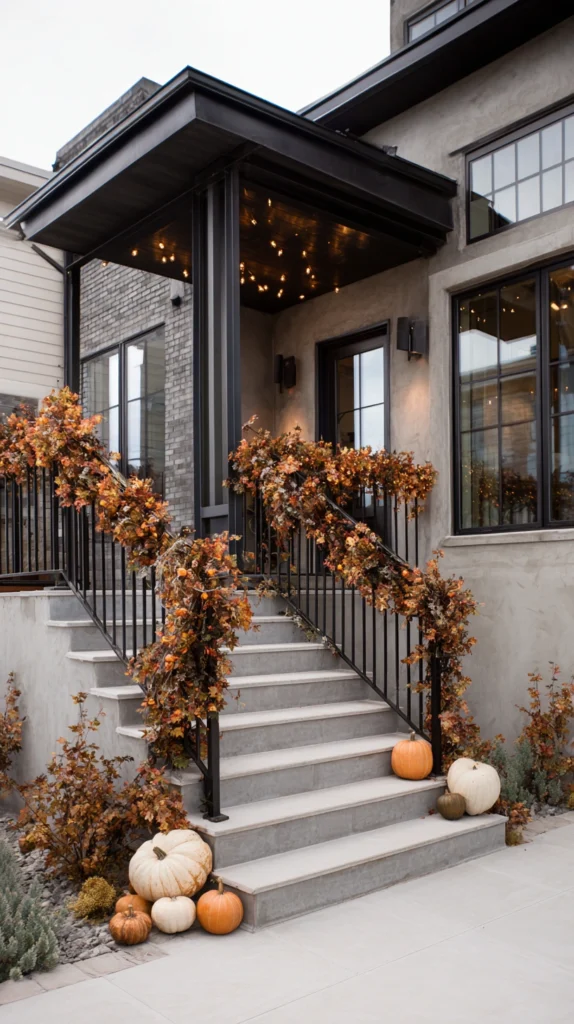
A garland of faux foliage, berries, or fall leaves wrapped along the porch railing — the detail that decorates the frame around the porch’s main view rather than adding a separate standalone object.
Why the railing deserves its own decoration
- The frame-not-feature logic: unlike a wreath or a pumpkin display, a railing garland decorates something already structurally part of the porch, extending the seasonal feel along its entire length rather than concentrating it in one spot
- The proportion-filling function: railings are often the longest unbroken stretch of surface on a porch, and an undecorated railing can make the rest of a fall display look sparse by comparison
- The low-maintenance durability: faux garland in particular holds up through an entire season of sun and rain with little upkeep required
The options
- A faux fall leaf garland, in mixed autumn tones, wound loosely along the railing’s length
- A garland incorporating small faux pumpkins or berries, for added texture and color variation
- A fresh or dried garland, using real branches and foliage for a more textured, fragrant option
- String lights woven into the garland itself, combining Idea #6’s lighting layer directly into the railing decoration
The practical execution
- Secure the garland at intervals with zip ties or floral wire, rather than relying on its own weight to stay in place through wind
- Leave the garland loose rather than pulled taut, so it drapes naturally rather than looking stretched
- Trim or adjust sections that begin to fade or fray partway through the season, rather than waiting until the whole length looks worn
Cost breakdown
- Faux fall garland, per 6-foot section: $10–20
- A full railing’s worth, depending on porch size: $30–80
- Total: $30–80
10. The Painted or Decorated Pumpkin Accent (The Personal Touch Among the Purchased Ones)
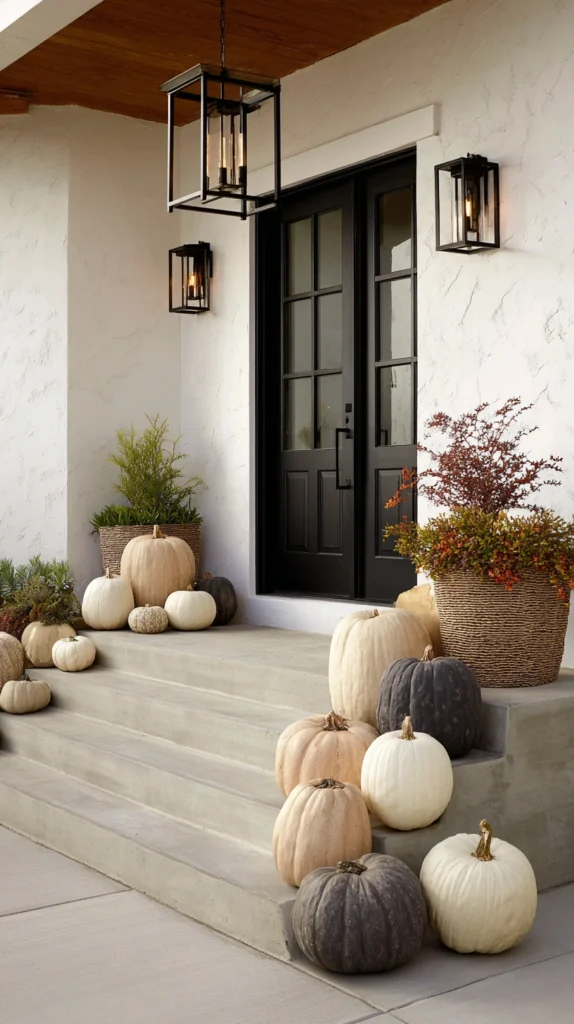
One or two pumpkins, painted, stenciled, or otherwise customized, mixed in among the purchased display from Idea #1 — the small personal touch that breaks up a porch that might otherwise look entirely store-bought.
Why one handmade piece changes the feel of the whole display
- The handmade contrast: a single painted or decorated pumpkin stands out precisely because everything else nearby was purchased as-is, giving the whole display a sense of having been made, not just assembled
- The low cost of a high-personality addition: this is one of the least expensive ways to make a fall porch feel specific to the household rather than generic
- The activity built into the idea: painting or decorating a pumpkin is itself a small seasonal activity, not just a finished product to set out
The options
- A painted pumpkin, in a single solid color or a simple pattern, using outdoor-rated craft paint
- A stenciled pumpkin, with a word, monogram, or simple shape applied over the natural surface
- A pumpkin wrapped or covered in fabric or twine, for a no-paint, no-mess option
- A pumpkin decorated by kids, embracing imperfection as part of the charm rather than aiming for a polished result
The practical execution
- Use a real pumpkin with a flat, stable base, or a faux pumpkin for genuine multi-season reuse
- Seal painted pumpkins with a clear outdoor sealant if they’ll be displayed for more than a couple of weeks, to protect against fading and moisture
- Position the personalized pumpkin somewhere it won’t be overshadowed by the larger graduated display, such as closer to the door itself
Cost breakdown
- Real pumpkin for decorating: $5–15
- Faux pumpkin, reusable: $10–25
- Craft paint and supplies, if not already on hand: $10–20
- Total: $5–40
11. The Harvest Sign or Door Hanger (A Small Detail With an Outsized Welcome)
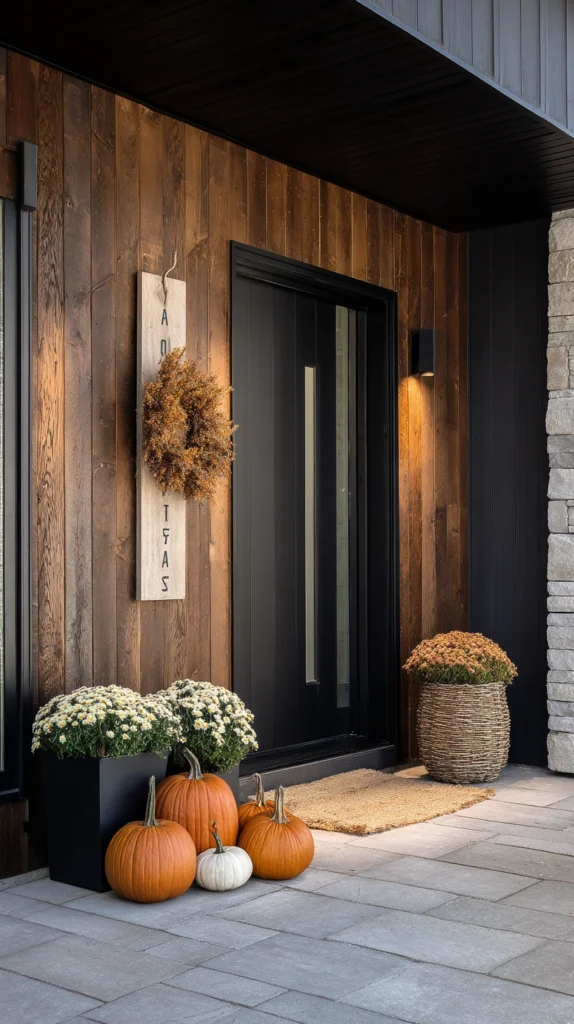
A small wooden or metal sign, or a fabric door hanger, with a simple seasonal word or phrase — the detail that adds a personal, welcoming note without requiring a single additional plant or pumpkin.
Why a small sign earns its place among bigger decorations
- The low-footprint personality: a sign takes up almost no physical space on the porch but adds a clear point of view to the whole display
- The complement-not-competitor role: unlike a wreath, which often anchors the door visually on its own, a small sign can sit alongside other elements without overwhelming them
- The flexible placement: a sign can hang on the door, lean against a planter, or sit propped on a step, adapting to whatever space is actually available
The options
- A wooden harvest sign, with a simple carved or painted phrase
- A metal sign, more durable through weather than wood or fabric
- A fabric door hanger, softer and lower-cost, layered alongside or instead of a full wreath
- A chalkboard-style sign, allowing the message to change through the season
The practical execution
- Keep the message short — a single word or short phrase reads clearly at a glance, where a longer one gets lost
- Choose a material rated for the porch’s actual exposure, since a south-facing porch fades materials faster than a shaded one
- Position the sign where it doesn’t compete directly with the wreath for the same visual space, rather than stacking both in the exact center of the door
Cost breakdown
- Fabric door hanger: $15–30
- Wooden or metal sign: $20–50
- Total: $15–50
12. The Gourd and Foliage Scatter (The Filler That Finishes Every Gap)
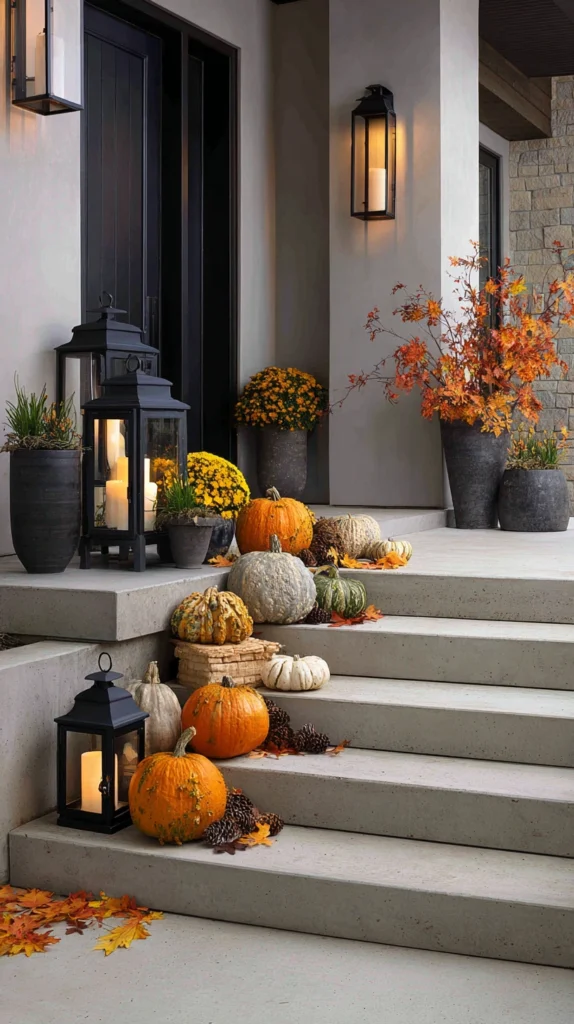
Small gourds, faux leaves, and bits of foliage scattered across steps, window boxes, or empty corners — the lowest-cost, most flexible filler layer that finishes whatever gaps remain after the larger decorations are in place.
Why the smallest, cheapest layer still matters
- The gap-filling function: even a well-planned porch display tends to have a few small empty spots between the larger pieces, and this layer fills them without requiring another major purchase
- The cohesion it adds: small gourds and leaves scattered consistently across multiple surfaces — steps, a window box, the edge of a planter — tie those separate areas together into a single unified display
- The lowest-cost idea on the list: this is essentially the finishing dust of fall porch decor, costing very little relative to the visual completeness it adds
The options
- Small decorative gourds, in mixed shapes and colors, tucked between larger pumpkins or along step edges
- Faux fall leaves, scattered loosely for a “just fallen” look rather than arranged too precisely
- Acorns or small pinecones, mixed in for additional texture in small gaps
- A few sprigs of faux wheat or dried grass, tucked into planters or laid across a step
The practical execution
- Add this layer last, after every other idea on the list is in place, since its entire purpose is filling whatever gaps remain
- Avoid over-scattering — a few well-placed pieces read as intentional, while too many start to look like debris rather than decor
- Refresh real foliage and gourds as they fade or rot through the season, since this layer is the most likely to show wear first
Cost breakdown
- Small decorative gourds, a bag: $8–15
- Faux fall leaves, a bag: $5–12
- Total: $13–27
13. The Pathway and Step Styling (Decorating the Approach, Not Just the Door)
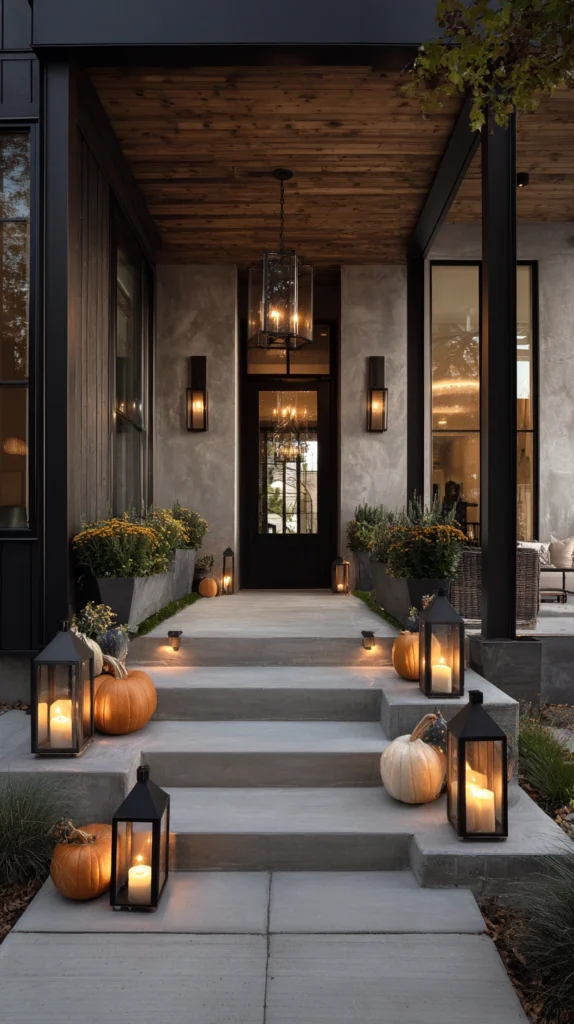
Small pumpkins, lanterns, or potted mums placed along the walkway or each step leading to the porch — the idea that extends the fall display backward, so the approach itself becomes part of the welcome rather than just the door at the end of it.
Why the path deserves the same attention as the porch itself
- The full-journey logic: most porch decor focuses entirely on the door and the immediate porch area, leaving the walkway leading up to it completely undecorated
- The anticipation it builds: a guest who sees fall decor building gradually along the path arrives at the door already in the mood the rest of the display is going for
- The visual-rhythm benefit: repeated small elements — a pumpkin on each step, a lantern at each turn in the path — create a sense of rhythm and intention that a single concentrated display at the door alone can’t replicate
The options
- A single small pumpkin on each step, repeating up the staircase to the porch
- Lanterns placed at intervals along the walkway, doubling as both decor and the lighting layer from Idea #6
- Potted mums lining the path, smaller versions of the planters used directly at the door
- A simple garland or ribbon along a handrail leading up the steps, connecting the path visually to the railing garland at the top
The practical execution
- Keep each step or path placement small enough not to create a tripping hazard or block the walking surface itself
- Repeat the same one or two elements consistently along the whole path, rather than varying the decor at every step
- Check path elements after wind or rain, since this is the most exposed and least protected area of the entire display
Cost breakdown
- Small pumpkins for steps, one per step: $3–8 each
- Lanterns for the path, a set of 3–4: $30–70
- Total: $30–100, depending on path length and number of elements
The path that’s just as decorated as the door: the difference between a porch that wows and a porch a guest simply walks past on the way to it.
The Fall Porch Decorating Roadmap
The work, sequenced:
Phase One (the structural display):
- The graduated pumpkin display (#1)
- The mum and ornamental cabbage planters (#2)
- The fall wreath (#3)
- The flanking urn or planter pair (#7)
Phase Two (the bigger statement pieces):
- The hay bale and cornstalk bundle (#4)
- The styled porch seating vignette (#8)
- The railing garland (#9)
Phase Three (the function layers):
- The layered doormat (#5)
- The lantern and string light layer (#6)
Phase Four (the finishing touches):
- The painted or decorated pumpkin accent (#10)
- The harvest sign or door hanger (#11)
- The gourd and foliage scatter (#12)
- The pathway and step styling (#13)
Getting Started This Weekend
The immediate-impact porch refresh:
One afternoon, three changes:
- Build a graduated pumpkin cluster on the steps (Idea #1)
- Swap in a new fall doormat (Idea #5)
- Hang a fall wreath on the door (Idea #3)
Total cost: $65–190. Time: about an hour. The porch will read as fully seasonal from the street by the time the work is done.
The structural investment (the next big project):
The flanking urn or planter pair (Idea #7) and the styled seating vignette (Idea #8) are the two biggest single investments on this list, and both pay off across every season, not just fall. Once either is in place, the wreath, the lighting, and every smaller layer on this list have something more substantial to arrange themselves around.
What a fully decorated fall porch provides that a bare one can’t:
The impression that arrives before a single knock on the door:
- A pumpkin cluster and a mass of mums that register clearly from the sidewalk
- A wreath that gives a waiting guest something considered to look at
- Symmetry from a matched urn pair that signals intention before anyone reaches the steps
The welcome that works in daylight and after dark:
- A lantern and string light layer that keeps the display visible once the sun sets by six
- A path lit and decorated, so the approach feels like part of the occasion, not just the way there
- A railing garland that holds its character whether it’s seen at noon or at dusk
The detail that rewards a guest who actually stops to look:
- A doormat that’s been chosen, not just left over from the builder
- A painted pumpkin or small sign that adds a point of view, not just more decor
- A scatter of gourds and leaves filling in every gap the bigger pieces left behind
A fall porch that wows isn’t the one with the most decorations crammed onto it. It’s the one built in layers that actually work together — big enough to register from the street, detailed enough to reward someone who’s arrived, and lit well enough to do both jobs after dark too. The pumpkin cluster that gets noticed in October is the same one that needs replacing before it collapses in November. The wreath hung carefully at the start of the season is still doing its job on the coldest night it’s asked to.