15 Timeless Neutral Living Room Ideas That Always Look Expensive
Neutral does not mean safe. The most beautiful neutral living rooms are not rooms where every decision was made to avoid risk — they are rooms where every decision was made with extraordinary precision within a restrained palette. The difference between a neutral room that looks expensive and one that simply looks beige is the difference between intentional restraint and accidental blandness. One has been edited and considered. The other has simply not been finished.
The fifteen ideas below show every way of creating a neutral living room that reads as genuinely high-end — through texture, proportion, material quality, lighting, and the specific restraint that allows each individual element to be clearly seen. Each includes a cost guide and a practical tip to help you apply it in the home you actually have.
1. Build the Entire Room From Warm Whites and Creams
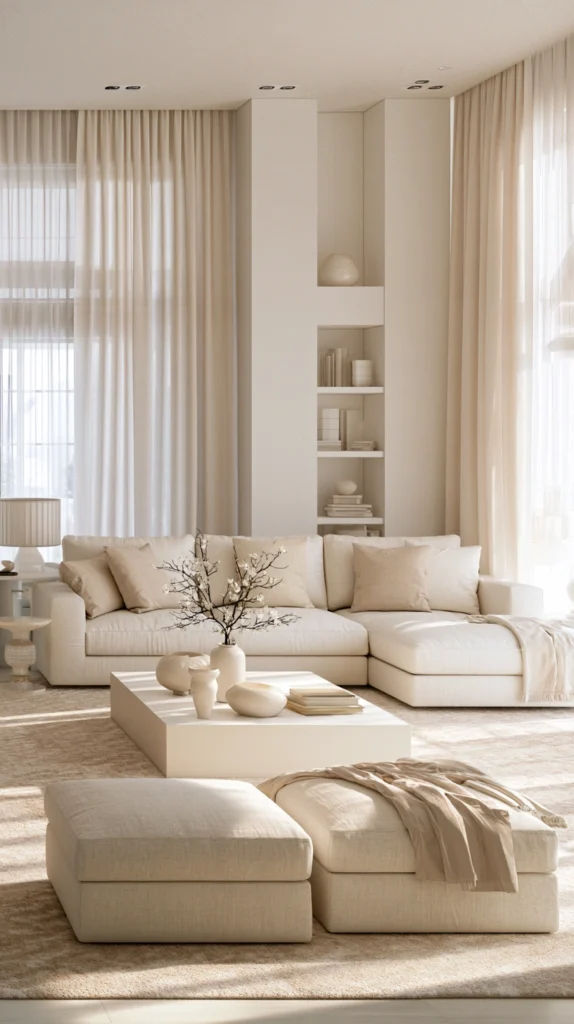
Budget: $50 – $400 for paint and soft furnishings
A room decorated entirely within the warm white and cream family — walls, textiles, and accessories all in the same three to four tones — is the most specifically expensive-looking neutral approach available when executed with precision. The tonal variation between a warm white wall, a cream linen sofa, an oatmeal boucle cushion, and an ivory throw creates a monochromatic richness that a single flat neutral cannot produce. Each tone reads against the others and the composition builds without a single colour contrast anywhere in the room.
Warm white wall paint costs $25–$50 per 2.5 litre tin. Cream linen cushion covers cost $20–$45 each. A natural ivory throw runs $40–$100. The key to the warm white and cream room is that nothing in the palette can be cool — a single blue-white or grey-white element immediately reads as an intrusion and undermines the warm monochromatic quality that makes the whole approach work. Test every white and cream purchase beside each other in natural light before committing.
Style tip: Introduce variation within the warm white palette through sheen level rather than colour. Walls in a flat matt, sofa fabric in a slightly shiny weave, a ceramic lamp base in a gloss glaze, a polished brass tray — the same warm white-to-cream tone at different surface sheens creates layered visual interest that reads as material richness from across the room without introducing any colour contrast that would compromise the palette’s monochromatic quality.
2. Choose a Stone or Travertine Coffee Table
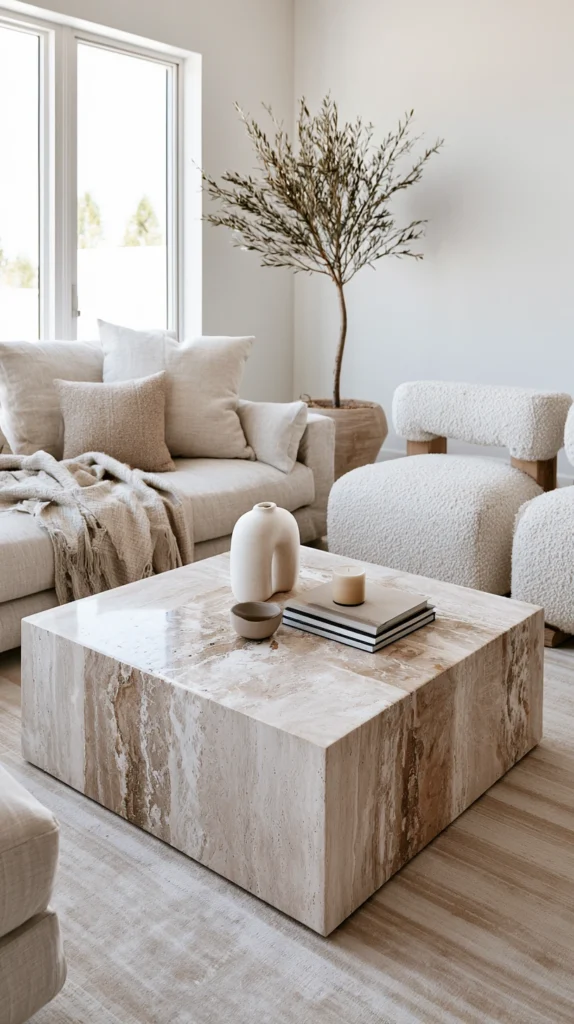
Budget: $200 – $1,200
A stone coffee table — travertine, marble, or concrete — at the centre of a neutral living room creates an anchor of genuine material substance that no timber or glass equivalent produces in the same position. Stone communicates permanence, weight, and quality in a way that is immediately felt as well as seen, and in a neutral room where colour is deliberately restrained, the material quality of the furniture is the primary design statement available.
A travertine coffee table in a simple rectangular or oval form costs $400–$800. A concrete equivalent runs $200–$500. A marble-top table on a brass frame costs $350–$900. In a neutral room of warm whites and creams the warm, veined surface of travertine is particularly effective — its natural patterning provides the only visual complexity in the room’s surface palette and its warm beige tones are perfectly compatible with every other warm neutral in the scheme.
Style tip: Style a stone coffee table with a maximum of three objects — one ceramic vessel, one stack of two books with a small object on top, and one candle. Three objects on a stone surface reads as deliberate. Six reads as cluttered. The stone deserves to be seen as a material in its own right and every additional object placed on it competes with the table for visual attention. Let the table win.
3. Layer Three Textures on Every Seating Surface
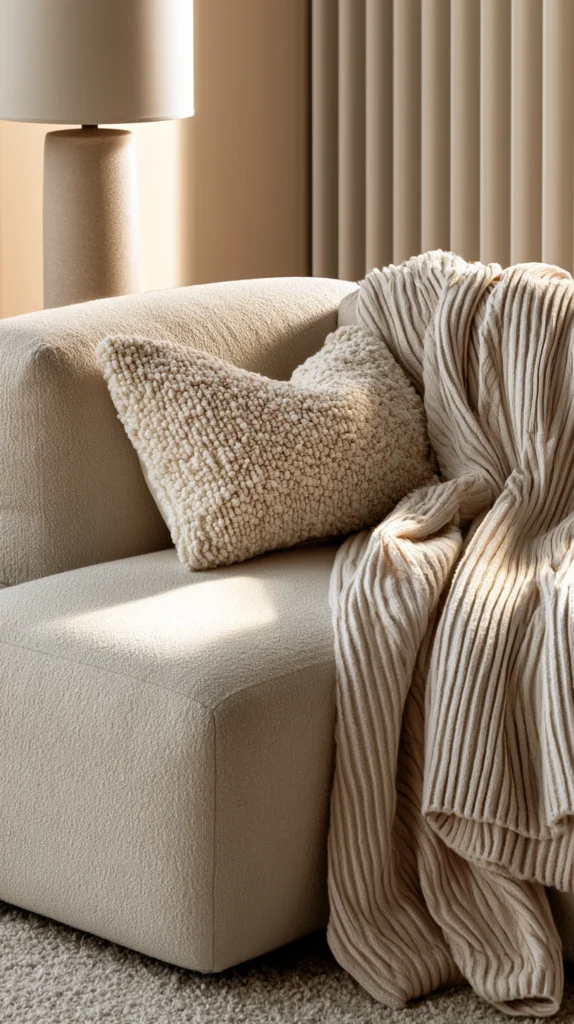
Budget: $80 – $300
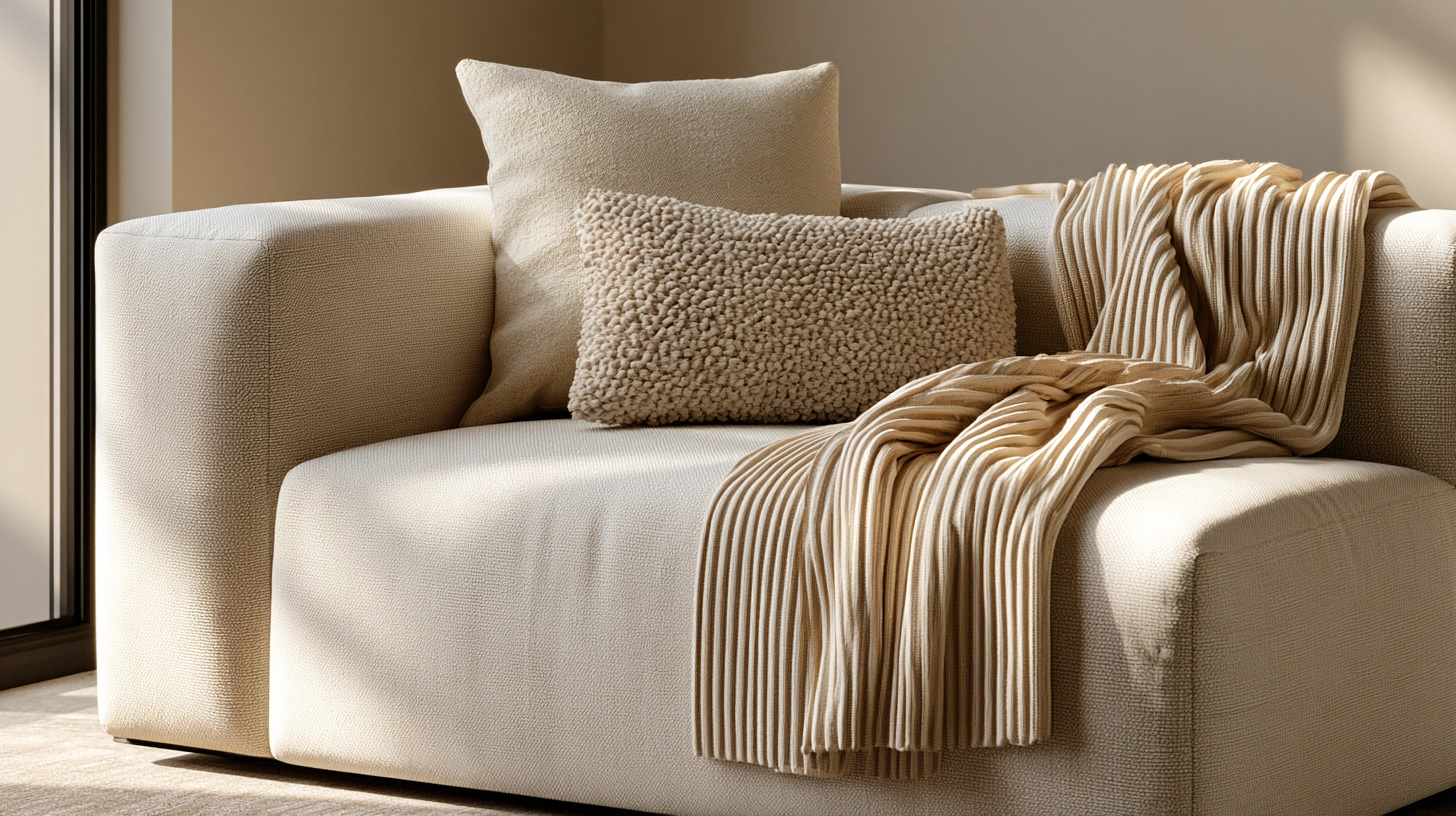
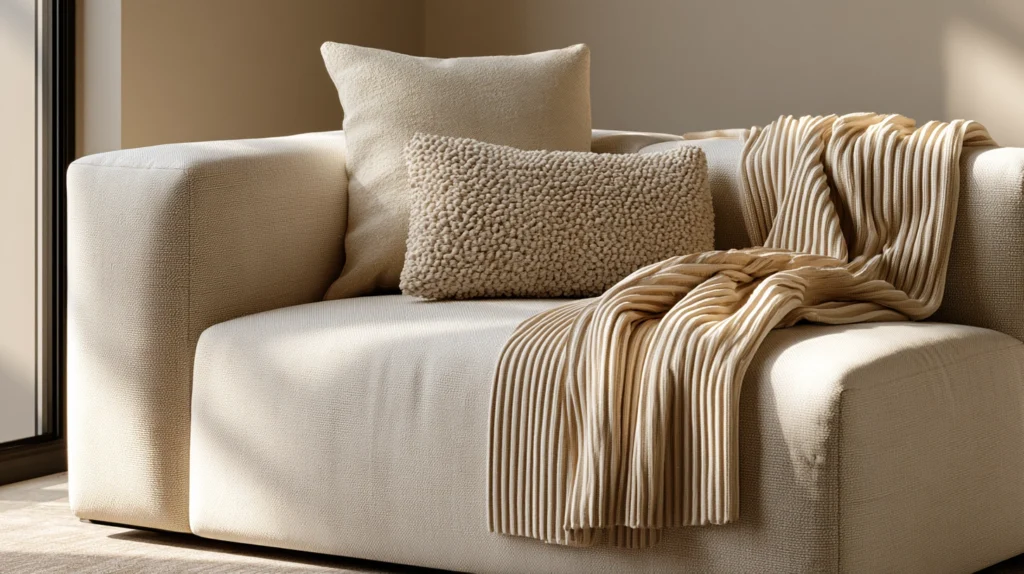
The neutral room that looks expensive is almost never the one with the most furniture or the most objects — it is the one with the most textural variation within a restrained colour palette. A sofa dressed with three different textures — a smooth linen cover, a boucle cushion, and a ribbed cotton throw — creates a sensory richness at the seating level that tells the eye the room has been thought about in detail. The three textures speak to each other in a way that a single material surface never can.
Choose three textures that relate to each other materially — all natural fibres, or all with a matte, non-reflective surface quality — rather than mixing synthetic and natural materials. A linen sofa cover, a boucle cushion ($35–$70), and a waffle weave cotton throw ($40–$90) create the complete three-texture seating surface for $75–$160 in textiles. The textures should all be in the same tonal range — the textural variation provides the visual interest and the tonal consistency provides the luxury quality that makes the room read as designed rather than assembled.
Style tip: Replace the sofa cushions every two to three seasons rather than leaving the same cushions in place indefinitely. Cushions are the most frequently touched and most visibly worn textiles in a living room — a flat, slightly greyed cushion on an otherwise well-maintained sofa undermines the whole room’s quality more visibly than any other single element of wear and age. New cushion covers at $20–$45 each are the lowest-cost, highest-impact refresh available for a neutral living room at any stage of its life.
4. Use Ceiling-Height Curtains in Undyed Linen
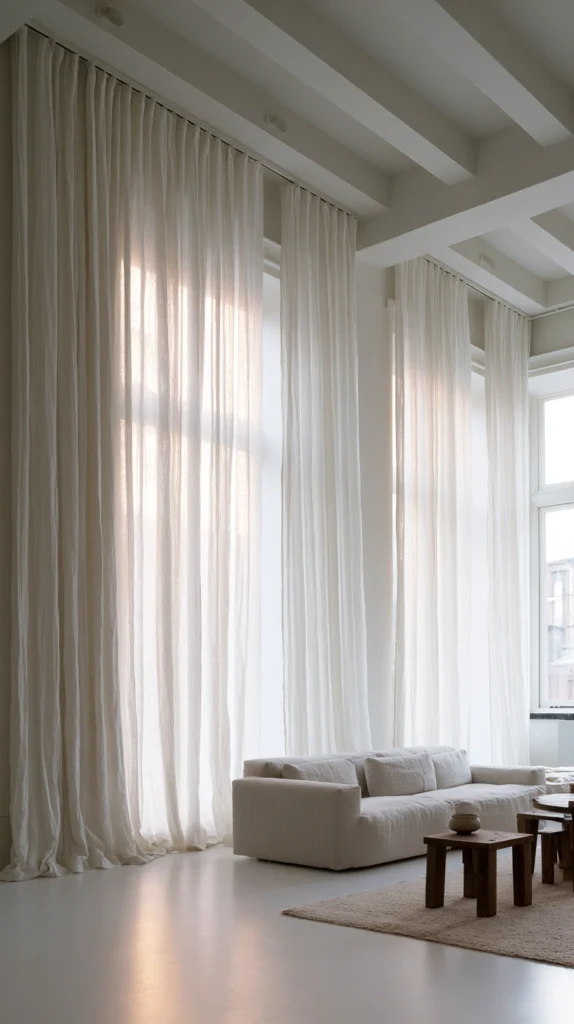
Budget: $120 – $500 per window
Undyed natural linen curtains hung from a track or pole fixed at ceiling height — rather than at window frame height — is the single most impactful window treatment upgrade available for a neutral living room. The full-height hang makes every ceiling appear higher and every window appear larger than it is, and the warm, undyed linen tone sits within every neutral palette with the ease of a material that has never been coloured because it was never required to be.
Undyed natural linen fabric costs $20–$45 per metre. A standard 120 cm window requires 3–4 metres per panel for generous fullness. A ceiling-fixed track costs $25–$60. Custom-made undyed linen curtains cost $150–$400 per panel from specialist curtain makers. The slight irregularity of the natural linen weave — the occasional slub, the variation in thread density — is a material quality that elevates the curtain from a window covering to a textile feature in its own right, and it reads as significantly more expensive than its actual material cost suggests.
Style tip: Do not line undyed natural linen curtains in a south-facing room. The light that passes through unlined natural linen at midday creates a warm, amber-toned diffusion that is one of the most beautiful natural light qualities available in any interior — it is actively destroyed by an opaque interlining. In rooms requiring privacy or light control, a separate blackout blind behind the linen provides function without compromising the linen’s material quality in natural light.
5. Invest in a Quality Neutral Rug Sized Correctly
Budget: $150 – $800
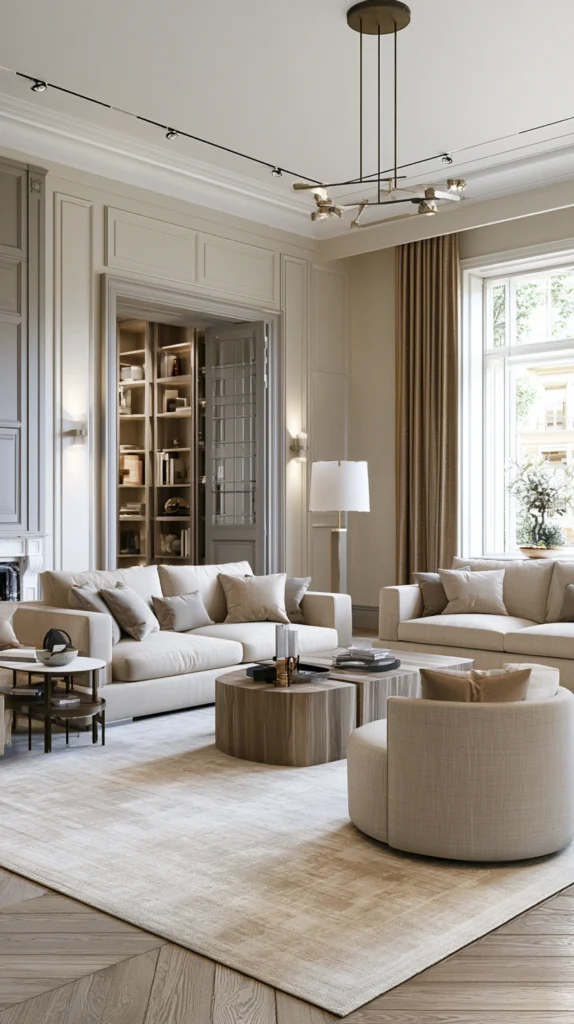
The neutral rug that makes a living room look expensive has two qualities: it is made from a genuine material — wool, jute, sisal, or a quality synthetic — and it is sized correctly for the room. An undersized rug is the most common and most immediately visible proportional error in living room decoration. The correct rug size for a standard living room seating arrangement has all four legs of every piece of furniture sitting on or touching the rug surface — anything smaller makes the furniture float and the room appear smaller than it is.
A quality wool rug of 200×300 cm costs $200–$600. A natural jute rug of the same size runs $120–$300. A sisal equivalent costs $150–$400. In a neutral room the rug pattern — if any — should be subtle: a tone-on-tone texture, a very low contrast geometric, or a simple stripe rather than a bold motif that competes with the room’s colour restraint. The rug’s primary role in a neutral living room is to define and anchor the seating zone rather than to introduce colour or pattern as independent design statements.
Style tip: Place a quality rug pad beneath any neutral area rug. A rug pad prevents the rug from sliding on hard floor surfaces, prevents the edges from curling, adds cushioning underfoot that significantly improves the feeling of quality, and extends the rug’s working life by protecting the base of the pile from direct abrasion against the hard floor surface below it. A good rug pad costs $40–$80 and is invisible — but its effect on how the rug feels underfoot is the difference between a rug that is placed in the room and one that is installed in it.
6. A Single Large Artwork on the Primary Wall
Budget: $100 – $800
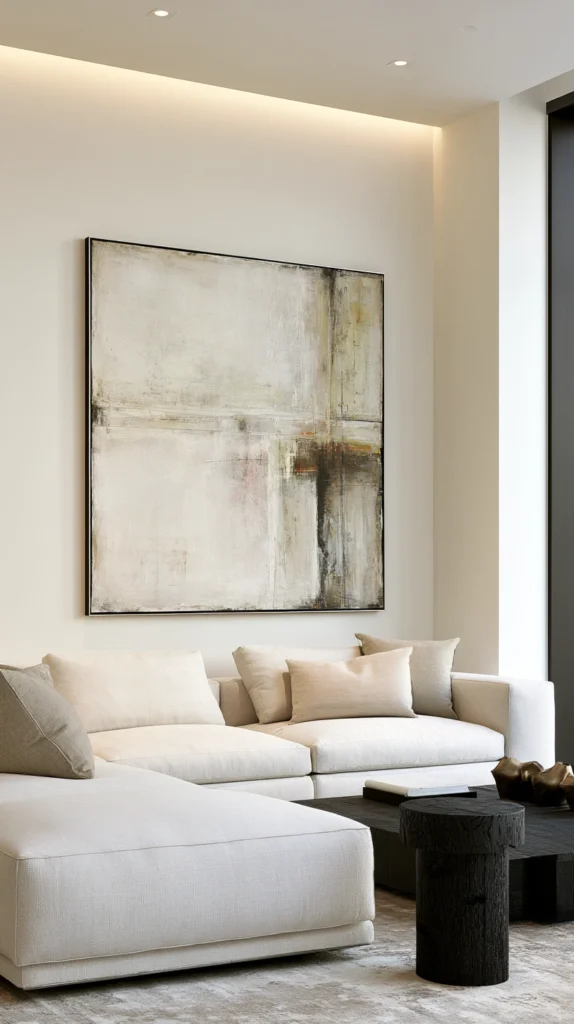
A neutral living room needs one moment of visual arrival — a point where the eye finds something genuinely interesting and is rewarded for looking. In most neutral rooms this moment is provided by a single large artwork on the wall behind the sofa or on the wall directly opposite the main entry point. The artwork should be large enough to read from across the room as a composition rather than as a framed object, which typically means at least 100 cm wide for a standard living room wall.
An original abstract painting from an independent artist costs $150–$600 for a large-format work. A large-scale fine art photograph in a simple frame costs $100–$400. A limited edition print from a specialist print publisher costs $80–$300. In a neutral room the artwork does not need to be neutral itself — a single painting with genuine colour in it provides the room’s only colour moment and earns it completely. The restraint everywhere else in the room makes this one colour statement more powerful than it would be in a multi-coloured scheme where it would simply be one note among many.
Style tip: Hang the artwork so its visual centre sits at 155–160 cm from the floor — the standard museum hanging height that places the centre of the work at the eye level of a standing adult. Artwork hung above this height on a wall requires the viewer to look up to see it, which creates a slightly uncomfortable viewing relationship that is particularly evident in lower-ceilinged rooms where the artwork is closer to the ceiling than to the furniture level it is intended to relate to.
7. Replace Standard Switches With Architectural Plates
Budget: $15 – $60 per switch plate
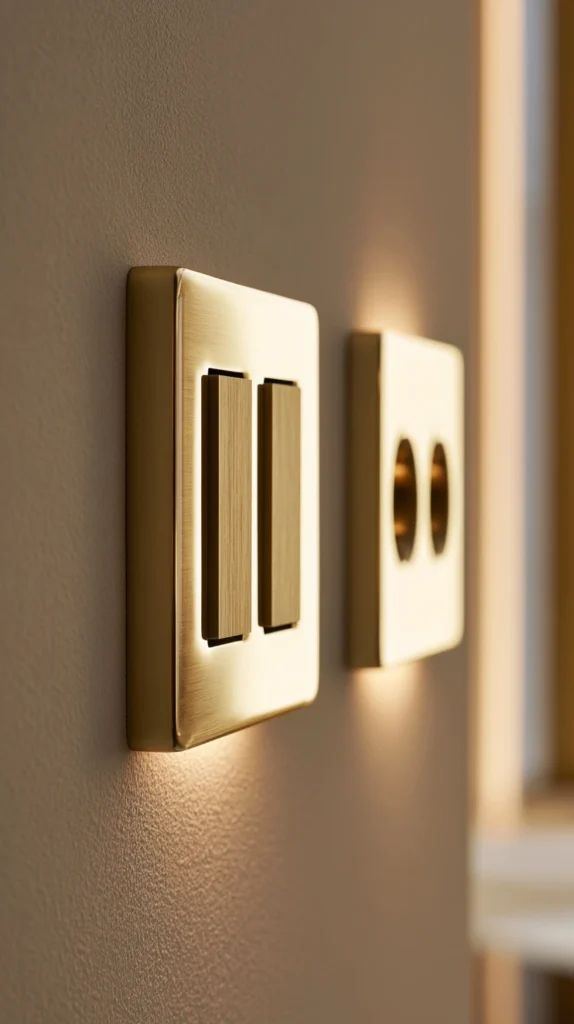
The detail that most immediately distinguishes a neutral room that has been finished from one that has simply been decorated is the quality of the hardware — light switches, socket covers, door handles, and hinges. Standard white plastic switch plates break the visual continuity of a carefully painted neutral wall in a way that quality architectural plates in brushed brass, polished nickel, or a warm black finish do not. They are small, they are entirely functional, and they communicate an attention to finishing detail that is specific to genuinely high-end interiors.
Brushed brass switch plates and socket covers cost $15–$40 each from specialist electrical accessory retailers. Polished nickel versions run $20–$50 each. The replacement requires no electrician — the existing mechanism is unchanged and only the decorative front plate is swapped. A standard living room has three to five visible switch plates and sockets. Replacing all of them costs $75–$200 and produces a finish quality across the room’s wall surfaces that no amount of paint quality or art investment creates as specifically and as affordably.
Style tip: Match the switch plate finish to the dominant metal tone in the room — the lamp bases, the hardware on furniture, and the picture hanging fixings. Brushed brass switch plates in a room with chrome lamp fixtures create an unresolved metal mix at the hardware level. A consistent metal throughout — all brass, all nickel, or all black — is the detail that makes the room’s hardware read as a considered finish rather than an afterthought applied plate by plate without reference to the wider material palette.
8. Add an Architectural Mirror With a Quality Frame
Budget: $80 – $600
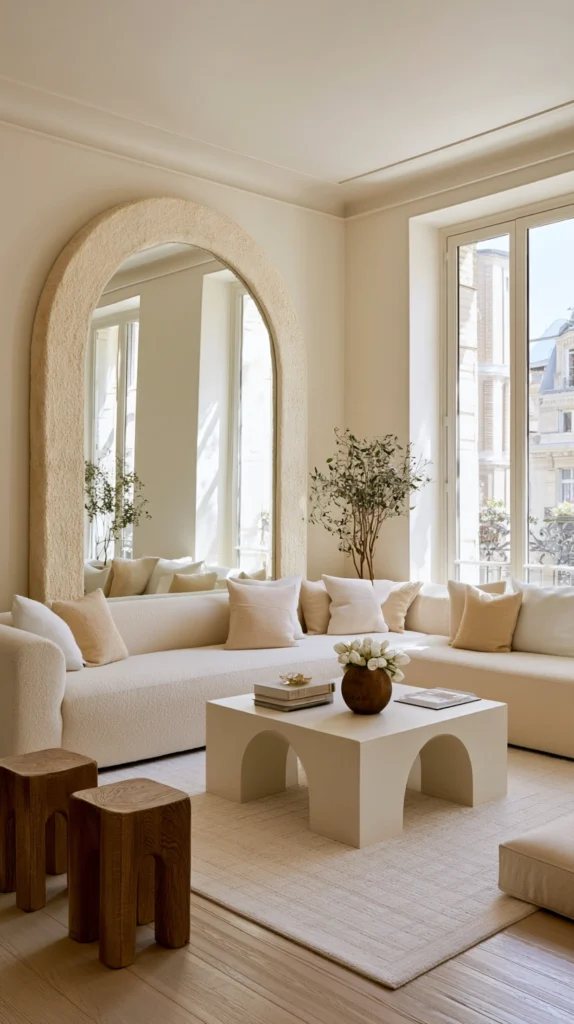
A large mirror with a frame of genuine material quality — carved plaster, aged gold leaf, solid timber, or cast iron — creates the dual function of reflecting light and adding visual depth while also functioning as a significant decorative object in its own right. In a neutral room where art is restrained and colour is edited, an exceptional mirror frame provides the room’s most complex decorative surface and earns more visual attention per pound spent than almost any alternative investment at comparable cost.
A large arched mirror in a plaster or gesso frame costs $200–$500. An antique gilt-framed mirror from a reclamation dealer runs $80–$400 depending on size and condition. A simple, oversized leaning mirror in a solid timber frame costs $150–$400. Position on the wall perpendicular to the main window — where it captures and reflects the room’s natural light and interesting interior rather than the window itself — at a height where the reflection includes the furniture at mid-height rather than primarily the ceiling.
Style tip: Clean the mirror with a solution of white vinegar and water rather than commercial glass cleaners. Ammonia-based commercial glass cleaners strip the silver backing from the edges of antique and reproduction mirrors over time, creating the dark edge deterioration that reduces the mirror’s decorative quality progressively. Vinegar and water cleans the glass surface effectively and is entirely safe for the silver backing and the frame’s surface finish regardless of the frame material or age.
9. Introduce Warm Metallics as the Room’s Only Accent
Budget: $50 – $300
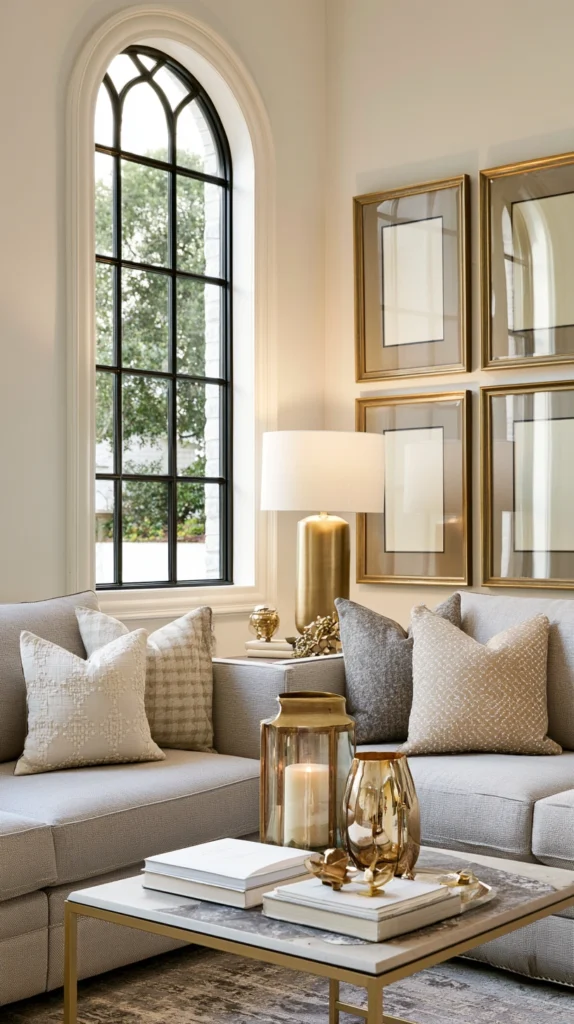
In a neutral living room where colour is deliberately absent, warm metallics — brass, antique gold, brushed bronze, and aged copper — provide the room’s only visual accent without breaking its tonal restraint. They catch the light in a way that creates movement and warmth without colour, and they communicate material quality and permanence through their weight and surface complexity in a way that no painted or printed surface can replicate.
A pair of brushed brass candlestick holders costs $30–$80. An antique gold picture frame runs $20–$60. A brass side table or lamp base costs $80–$250. A polished copper tray for the coffee table runs $30–$70. The metallic accents should appear at three different heights in the room — on the floor (a brass lamp base), at table height (a tray or candle holder), and at wall height (a frame or wall sconce) — to create the distributed warmth that makes warm metallics most effective as a neutral room accent rather than a collected concentration in one area.
Style tip: Mix two warm metallic tones rather than using a single finish throughout — brushed brass alongside antique bronze, or warm gold alongside aged copper. Two closely related warm metallics create a more sophisticated and more specifically collected quality than a single consistent metallic used exclusively. The slight tonal variation between the two finishes reads as curated over time rather than purchased simultaneously, which is always the more convincing luxury signal in an interior built on restraint and quality.
10. Choose One Exceptional Lighting Fixture
Budget: $200 – $1,000
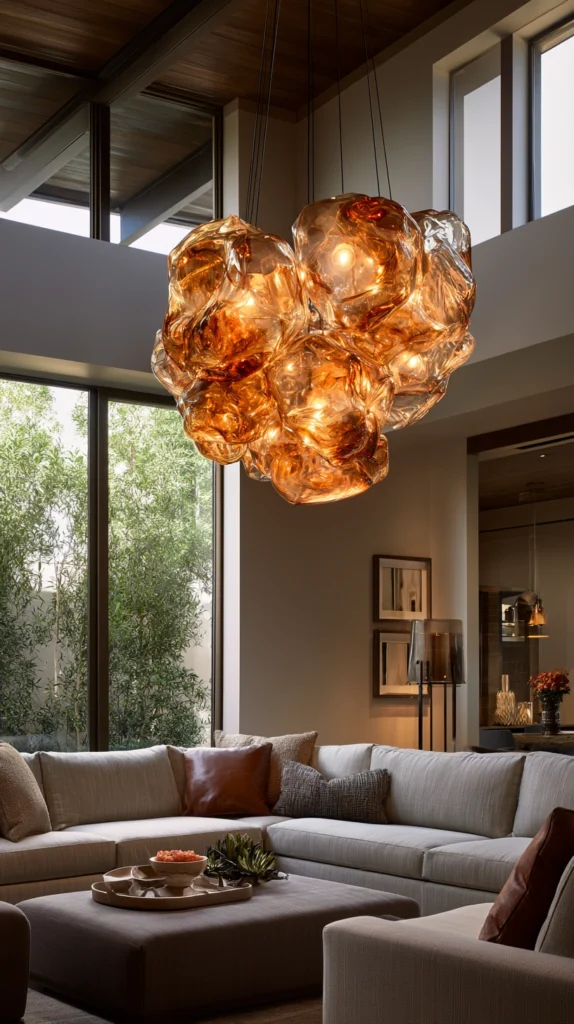
The lighting fixture in a neutral living room is the room’s only structural opportunity for a sculptural design statement — the pendant, the chandelier, or the statement floor lamp is visible at all hours, in all light conditions, and from every position in the room. In a room where every surface has been edited to reveal only what earns its place, an exceptional lighting fixture earns its place more completely than any other single object available at the same cost.
A handblown glass pendant in a warm amber or smoke tone costs $200–$600. A sculptural woven rattan or abaca pendant runs $150–$400. A cast plaster or ceramic ceiling light costs $200–$500. A statement floor lamp in a warm metal with a quality shade costs $180–$500. The fixture should be sized generously relative to the room — a pendant that appears too small for the ceiling height is a common and immediately visible proportional error. A pendant that appears slightly too large for the space communicates confidence and reads as the most significant object in the room rather than a fitting that was chosen to be inoffensive.
Style tip: Install the pendant light on a dimmer as a priority over any other electrical upgrade in the neutral living room. A dimmable pendant at 30–40 percent of full output in the evening creates the warm, atmospheric quality that makes a neutral room look genuinely beautiful after dark. The same pendant at full output creates a flat, functional light environment that reveals every surface imperfection and makes the room feel like a well-lit office rather than a thoughtfully designed home.
11. Use Dark Timber Flooring Throughout
Budget: $40 – $120 per square metre installed
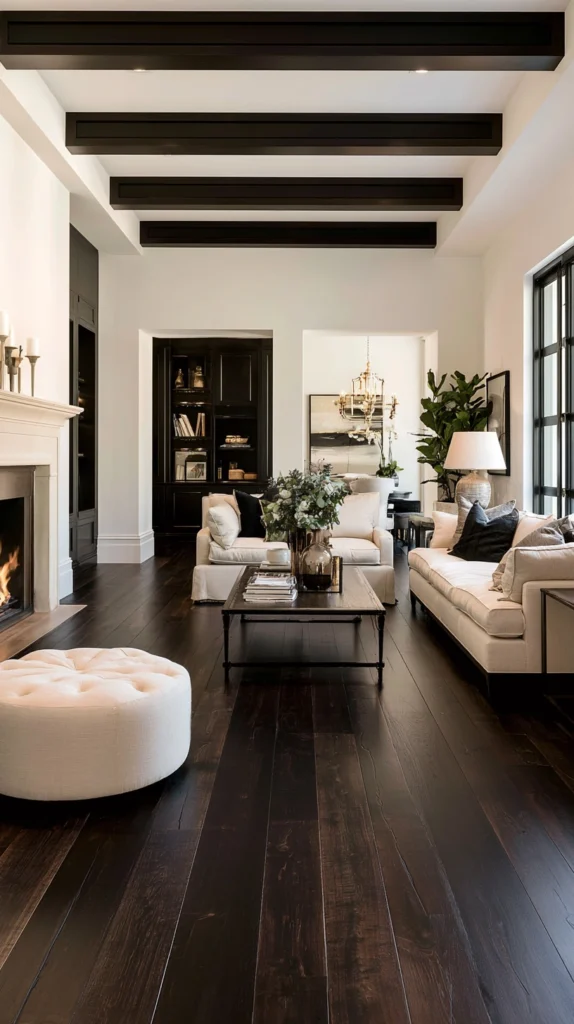
Dark timber flooring — a rich walnut, a deep oak with a warm stain, or a well-maintained original parquet — creates the grounding element that makes a neutral living room read as genuinely substantial rather than floating in an undifferentiated pale palette. The dark floor provides the visual weight that a room of warm whites and creams requires to feel anchored, and it creates a tonal relationship with the warm metallics and the dark wood furniture that gives the neutral palette its structural depth.
Engineered walnut flooring costs $50–$100 per square metre supplied and fitted. A warm oak with a deep stain runs $40–$80 per square metre. Reclaimed timber flooring in a dark stained finish costs $60–$120 per square metre. The flooring should run in the longest available direction of the room — boards oriented parallel to the longest dimension visually extend the room’s length in a way that boards running perpendicular to it do not. The direction of the flooring boards is a proportional decision that costs nothing to get right and is impossible to change after installation.
Style tip: Clean dark timber flooring with a barely damp microfibre mop rather than a wet mop or a steam cleaner. Excess moisture on any timber floor — including engineered varieties — causes the boards to swell, warp, and eventually separate at the joints over repeated wet cleaning cycles. A barely damp microfibre mop removes everyday dust and marks effectively while providing insufficient moisture to damage the board surface or penetrate the finish at the joint lines.
12. Display Books as Architecture
Budget: $0 – $100
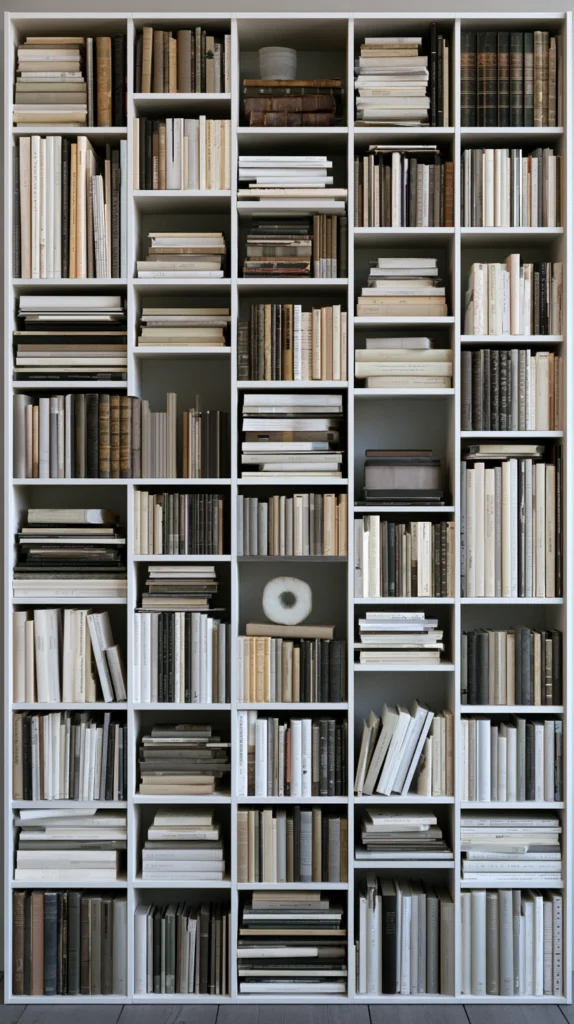
Books in a neutral living room are not simply functional objects — they are the most cost-effective way of adding colour, depth, and personality to a wall of shelving without introducing any element that competes with the room’s neutral palette. A well-organised bookshelf in a neutral room, where spines face inward on some shelves and outward on others, where horizontal stacks alternate with vertical rows, and where small objects and natural materials create breathing space between the book groups, is one of the most specifically beautiful and most personally characterful wall treatments available at zero additional cost.
Apply the following to the book arrangement: face all books with predominantly white or cream spines outward and keep darker spine colours for horizontal stacks where the spine is less prominent. Remove any book with a particularly strident spine colour from the main display and store it elsewhere if it disrupts the palette. Group books by spine tone rather than by subject or author — the colour organisation of a bookshelf is a legitimate and specifically effective visual choice that reads as more considered than alphabetical organisation from the main viewpoint of the room.
Style tip: Leave every third shelf section entirely empty — clear, dusted, and containing nothing. The empty shelf section is the visual rest that makes the occupied sections readable and that prevents the bookshelf from reading as a storage unit rather than a curated display. The proportion of empty to occupied shelf space in a genuinely well-styled living room bookshelf is always higher than instinct suggests — aim for 30–40 percent of total shelf area as deliberately empty negative space.
13. Position the Sofa Away From the Wall
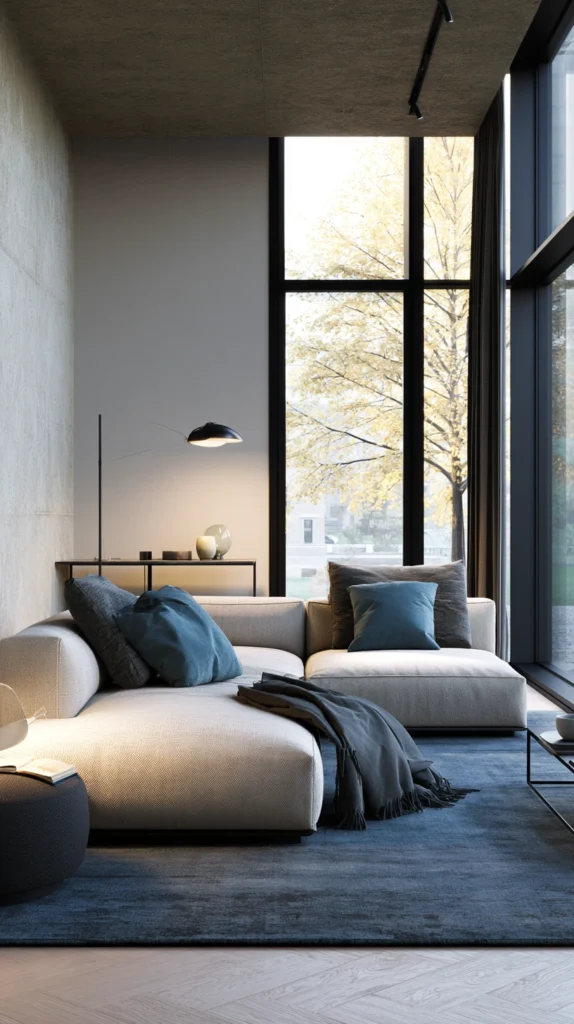
Budget: $0
Moving the main sofa away from the wall — even 30–45 cm into the room — creates one of the most immediately effective proportional improvements available for any neutral living room without a single purchase. A sofa pushed against a wall reads as furniture arranged for maximum floor clearance rather than for maximum conversational and visual quality. A sofa floating in the room reads as a furniture arrangement that was considered and placed with intention — which is precisely the quality the expensive neutral living room always communicates.
The space behind the floating sofa is not wasted: a narrow console table behind the sofa back provides a surface for lamps, books, and objects that a wall-pushed sofa cannot accommodate and that creates a visual layer between the sofa and the back wall. The console table visible behind the sofa from the room entrance creates a depth of arrangement that makes the room read as significantly larger and more generously furnished than the same furniture pushed against the wall without the console table behind it.
Style tip: Place a tall floor lamp at one end of the console table behind the floating sofa — positioned so the light it produces creates a warm pool above and behind the sofa back. The lamp behind the sofa provides the backlighting that makes the sofa appear more dimensional and more visually present in the room than a lamp positioned anywhere else in the seating zone. Back-lit furniture has a quality that front-lit furniture simply doesn’t, and a floor lamp behind the floating sofa is the most directly available way to create it.
14. Choose Plump Cushion Inserts Over Flat Ones
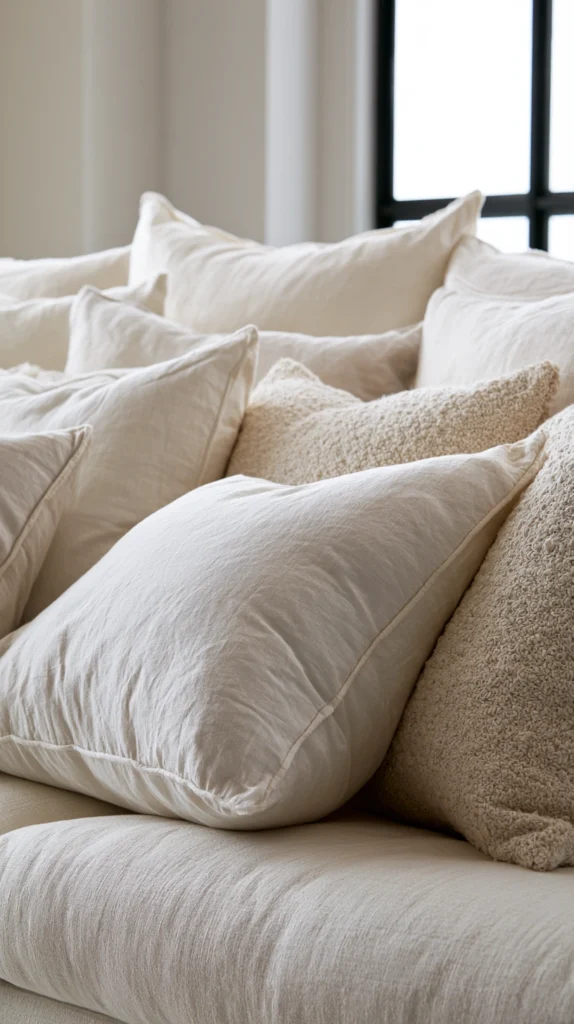
Budget: $8 – $25 per insert
The cushion insert is the hidden quality variable in any sofa cushion arrangement — a quality feather-and-down or high-density foam insert at the correct size makes a cushion look genuinely luxurious and feel immediately plump and full. A cheap polyester insert in the same cover looks flat, limp, and slightly deflated within weeks of first use. The cushion cover may be beautiful. Without the right insert behind it, the cover will always look compromised.
A quality duck feather and down cushion insert costs $12–$25 for a 45×45 cm size. A high-density foam insert wrapped in a fibrefill layer — which maintains its shape longer than a pure feather insert — costs $8–$20 per insert. Buy inserts that are 5 cm larger than the cushion cover in both dimensions — a 50×50 cm insert in a 45×45 cm cover fills the corners fully and produces the plump, overfilled quality of a hotel or showroom cushion rather than the slightly concave quality of a correctly sized or undersized insert in the same cover.
Style tip: Karate chop the top of a feather-filled cushion immediately after plumping — press the heel of the hand into the top edge of the upright cushion to create the distinctive indentation. The karate chop is the styling move that transforms a plumped cushion from a rounded ball into the relaxed, slightly indented rectangle that reads as naturally arranged rather than stiffly positioned. It costs nothing and takes three seconds and is the single most visible difference between cushions that look styled and cushions that simply look plumped.
15. Maintain the Room — Quality Is a Practice, Not a State
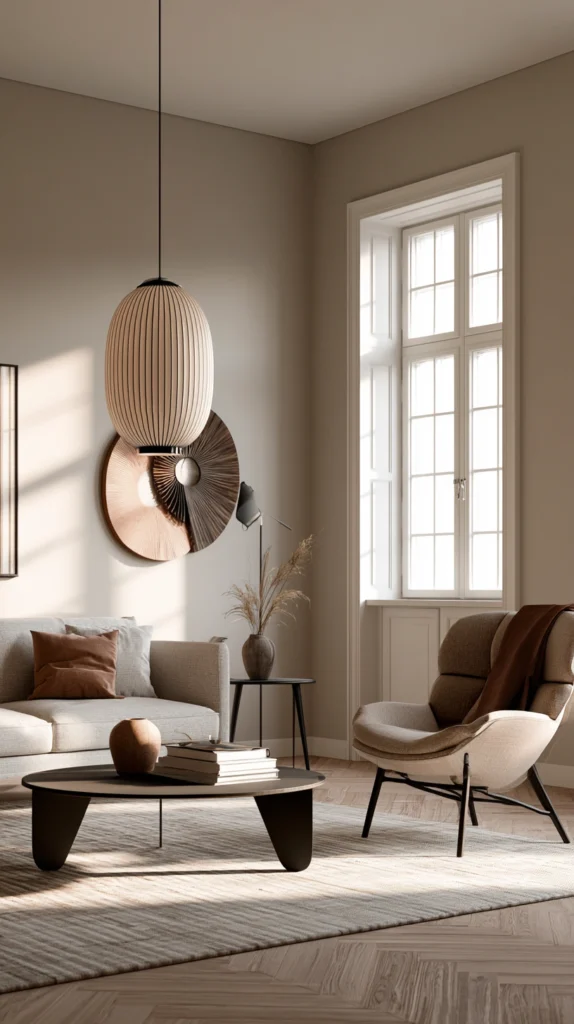
Budget: $0
The neutral living room that always looks expensive is not one that was decorated expensively and then maintained passively — it is one that is actively and consistently maintained at the level its design deserves. Every surface cleared after use, every cushion straightened, every throw refolded, every lamp cleaned, and every fresh flower replaced as it fades. These are five-minute daily acts rather than weekend projects, and they produce the consistent quality of appearance that distinguishes a genuinely well-kept room from one that was beautiful once and has since been allowed to drift.
A neutral room is the most demanding in terms of maintenance visibility — in a colourful or patterned room, dust, marks, and disorder are absorbed into the visual complexity of the palette. In a neutral room every speck, every crease, and every displaced object is immediately and precisely visible from across the room. The commitment to maintaining a neutral living room is therefore a commitment to a specific standard of daily domestic attention that is as much a design decision as any purchase or arrangement the room contains.
Style tip: Spend five minutes at the same time every day resetting the living room to its intended state — cushions straightened, throws folded, surfaces cleared, and one fresh or living element (a candle lit, a plant watered, a fresh flower stem added to the vase) refreshed. The daily reset is not a cleaning routine — it is a maintenance ritual that keeps the room looking as it was intended to look rather than as it looked after the most recent occupation. Rooms that are reset daily always look better on average than rooms that are reset only when they have visibly deteriorated.
The neutral living room that always looks expensive is always the result of the same underlying decision made consistently across every detail: quality over quantity, intention over accumulation, and the restraint to trust that less, done well, is the most reliable path to a room that impresses everyone who enters it and satisfies everyone who lives in it.
Begin with the edit — remove everything that does not belong before adding anything new. A neutral room that has been properly edited always looks better than one that has been decorated without first being cleared, because the clarity of the palette depends on the absence of everything that does not contribute to it. Edit first. Then add one excellent thing. Then wait to see what the room reveals it needs next.