13 Stylish Coffee Table Decor Ideas for Any Aesthetic
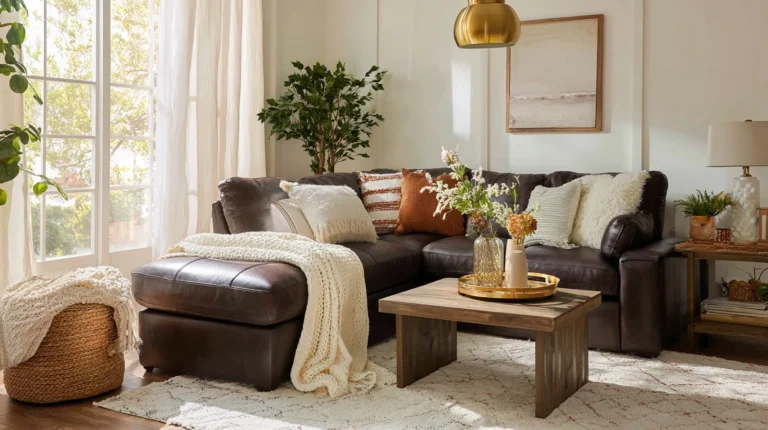
The coffee table is the most visible horizontal surface in the living room and the one that guests look at first. It is also the surface that most directly communicates whether the room has been thought about or simply furnished — a well-styled coffee table can elevate the most ordinary living room into one that feels considered and complete, while an unstyled one, or one covered in accumulated daily objects without any visual organisation, undermines the quality of everything around it regardless of how much was spent on the surrounding furniture and decoration.
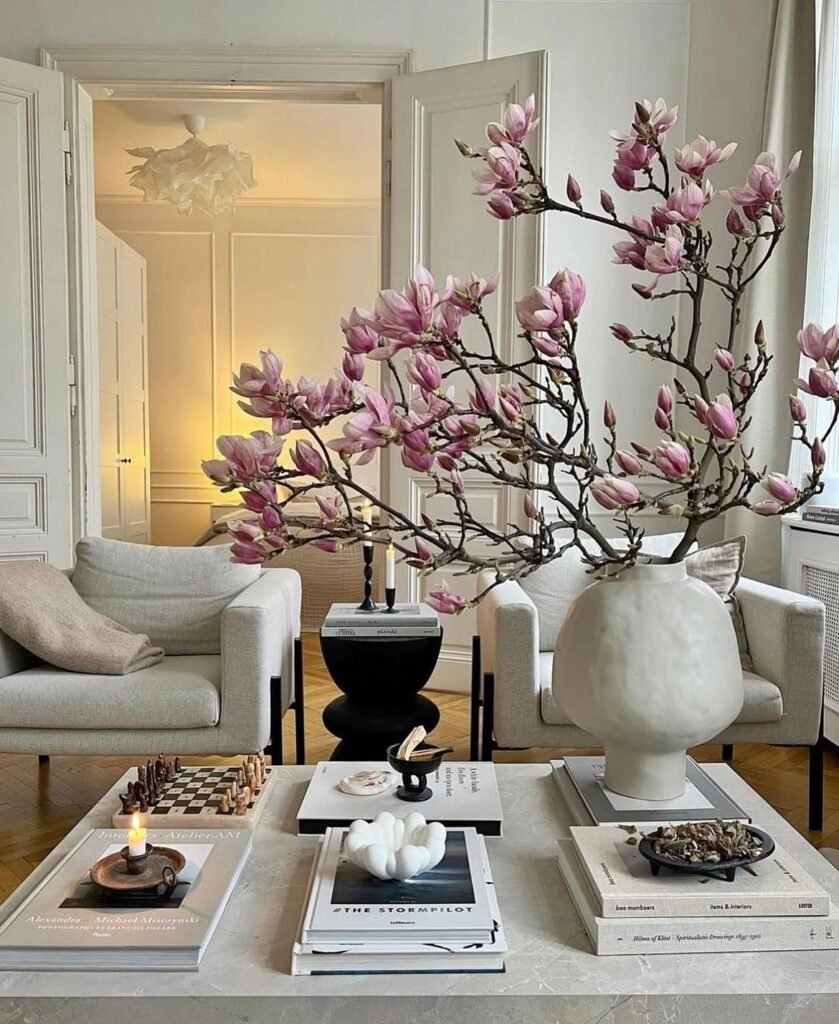
The thirteen ideas below cover every coffee table styling approach — from a single object on a minimal surface to a fully layered tray composition — for every room aesthetic from contemporary minimal to maximalist eclectic. Each includes a cost guide and a practical tip to help you apply the principle in the specific room you have.
1. The Tray as Anchor
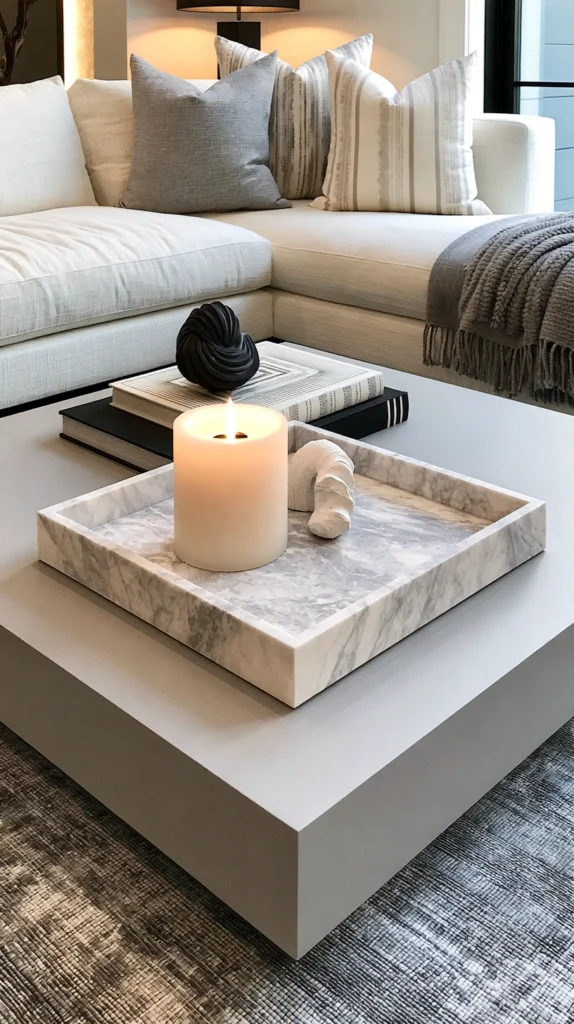
Budget: $20 – $100
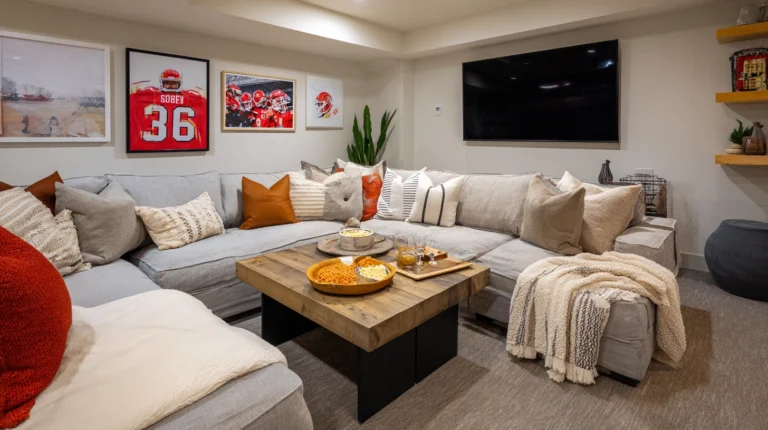
A tray on the coffee table surface does two things simultaneously — it defines the styled zone within the full table surface, allowing the remainder to function as a practical everyday surface, and it elevates the objects placed within it to the status of a curated arrangement rather than objects placed on a table. A tray with three or four carefully chosen objects inside it reads as designed. The same objects without the tray read as accumulated.
A round or rectangular tray in marble, lacquered timber, woven rattan, or hammered brass costs $20–$80. Choose a tray material that relates to the dominant materials elsewhere in the room — a marble tray in a room with stone surfaces, a brass tray where warm metals appear in the lamp bases and hardware, a rattan tray in a natural materials scheme.
The tray should be at least 35–40 cm in its largest dimension to accommodate three to four objects with comfortable spacing between them.
Style tip: Position the tray slightly off-centre on the coffee table surface rather than exactly centred. A perfectly centred tray on a symmetrical table creates a formal, static quality. The same tray placed one third of the way across the table surface from one end creates an asymmetric composition with positive and negative zones on either side — the positive zone (the tray and its objects) and the negative zone (the clear table surface) in balanced but not equal relationship, which is always the more visually interesting arrangement.
2. Three Objects, Three Heights
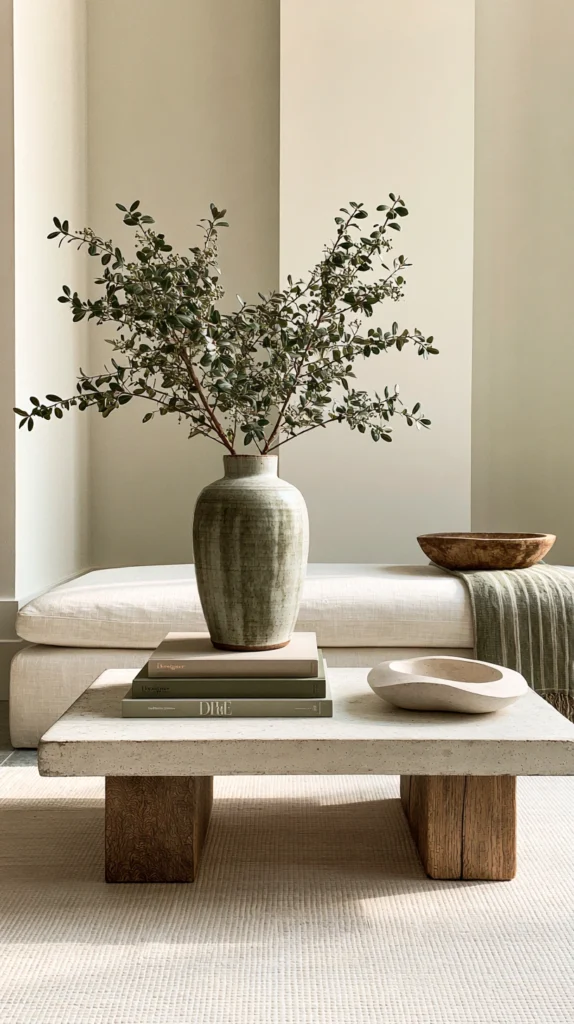
Budget: $30 – $150
The most consistently reliable coffee table styling principle — three objects at three distinctly different heights — creates visual rhythm, depth, and the skyline profile that makes any grouping of objects look specifically composed rather than randomly placed.
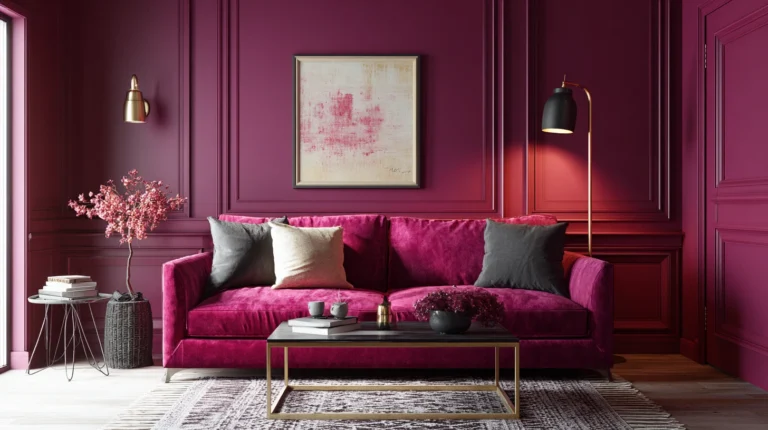
A tall object (a vase, a candlestick, a sculptural plant), a medium object (a stack of books, a bowl, a decorative object), and a low object (a small dish, a candle, a small stone) at the same position creates a composition that reads clearly from the sofa at eye level and from the doorway across the room simultaneously.
The tall object might be a ceramic vase at 25–35 cm height ($20–$60). The medium a stack of two coffee table books ($30–$80 combined). The low a small sculptural dish or candle at 5–8 cm ($10–$30). The total three-object composition costs $60–$170 and creates a coffee table arrangement that looks professionally styled from every viewpoint in the room. The three heights are the principle — the specific objects at each height can be changed seasonally or stylistically without losing the compositional quality that the height variation provides.
Style tip: The tall object should be at least twice the height of the low object for the height variation to read as intentional rather than incidental. A tall object at 30 cm, a medium at 20 cm, and a low at 8 cm creates a clear three-step height gradient. A tall object at 20 cm, a medium at 18 cm, and a low at 15 cm creates such similar heights that the variation reads as imprecision rather than composition. The height differences must be decisive enough to read as deliberate from the primary seated viewing position at the sofa.
3. A Statement Coffee Table Book Stack
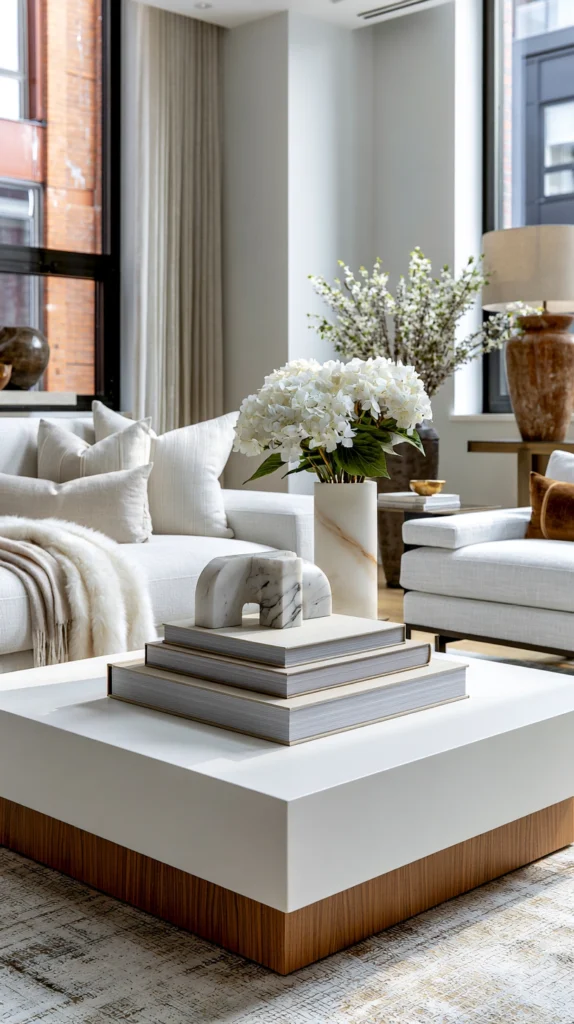
Budget: $30 – $100
Two or three coffee table books stacked horizontally — spines facing inward to show only the smooth book edges — with one small object placed on top creates one of the most accessible, most adjustable, and most universally stylish coffee table arrangements available. The books provide the visual mass and height. The object on top provides the finishing detail. The stack reads as a considered editorial choice rather than books placed on the table because there was nowhere else to put them.
Coffee table books in architecture, photography, interior design, nature, or art cost $20–$50 each new and $5–$20 each from secondhand bookshops and charity shops. A stack of three costs $15–$150 depending on source. Choose books whose spine-free edges — the three visible sides when the spine faces inward — are clean and light in colour rather than dark or heavily printed. A white-paged book with a pale cover edge reads as cleaner and more intentional when stacked spine-inward than a dark-paged equivalent in the same position.
Style tip: Place the largest book on the bottom of the stack and the smallest on top — the natural pyramid created by graduating sizes reads as architecturally stable. The reverse — smallest on the bottom — looks visually unstable regardless of whether the stack is physically secure. Add one small object on the very top: a small crystal, a pebble, a ceramic bird, or a pinecone. The object at the top of the stack is the punctuation mark that completes the composition and prevents the stack from reading as simply books stacked on a table rather than a deliberate arrangement with a centre of interest.
4. A Seasonal Botanical Element
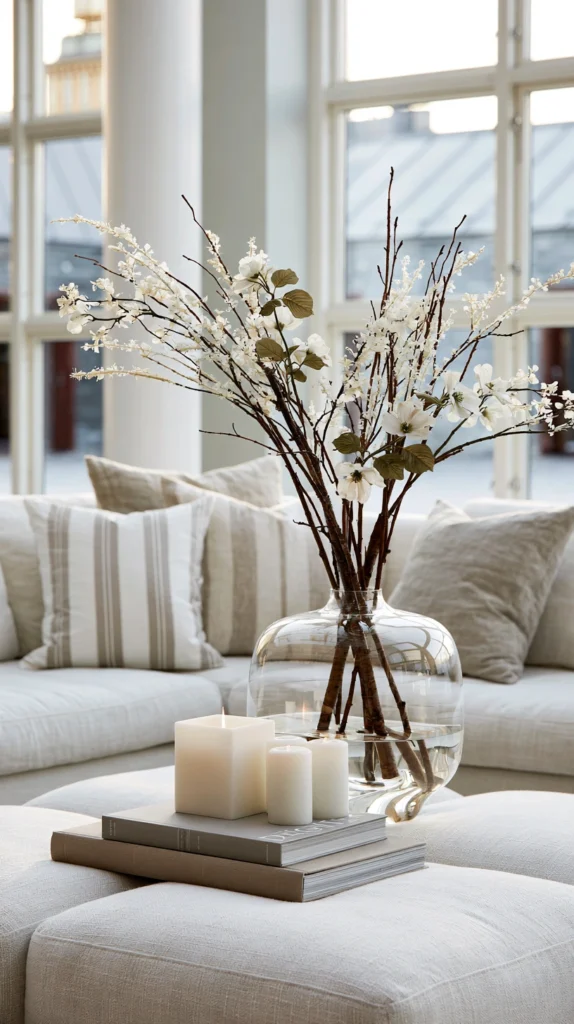
Budget: $0 – $30
A botanical element on the coffee table — fresh flowers, a single branch, a small potted plant, dried seed heads, or foraged natural material — connects the interior to the natural world outside and changes the quality of the room in a specific way that no manufactured decorative object replicates. The botanical element is also the element that changes most frequently — with the season, with what the garden is producing, with what is available at the florist — which makes the coffee table a surface that is noticed and responded to regularly rather than settled into invisibility through familiarity.
A small bunch of whatever is in season at the local florist costs $5–$15. A single stem in a simple bud vase costs $3–$8 for the stem plus $10–$25 for the vase. A small potted succulent costs $4–$12 and lasts several months without replacement. Foraged material — a branch of blossom, a few stems of autumn berries, a handful of seed heads — costs nothing. The botanical element is the most cost-effective and most seasonally responsive coffee table styling choice available and it is the element that guests most consistently notice and comment on.
Style tip: Use a single variety of flower in a single stem or a small bunch rather than a mixed arrangement for a coffee table display. One variety of flower — five stems of the same white tulip, three stems of the same pink peony, a single branch of cherry blossom — always reads more considered on a coffee table than a mixed arrangement of five different flower types and colours at the same location. The singularity of one variety communicates that the choice was specific and intentional rather than assembled from whatever was available.
5. A Candle Grouping for Evening Atmosphere
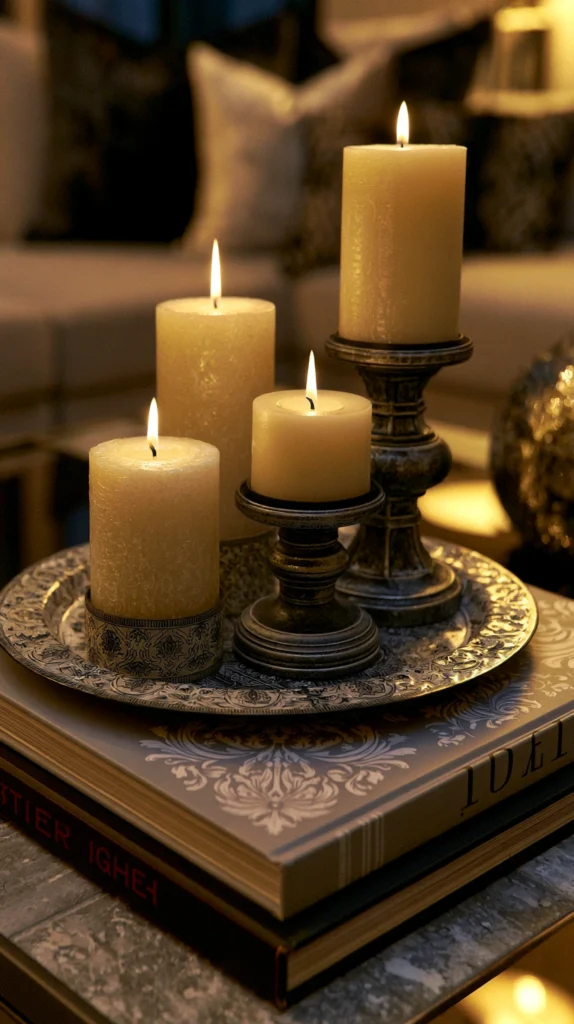
Budget: $20 – $80
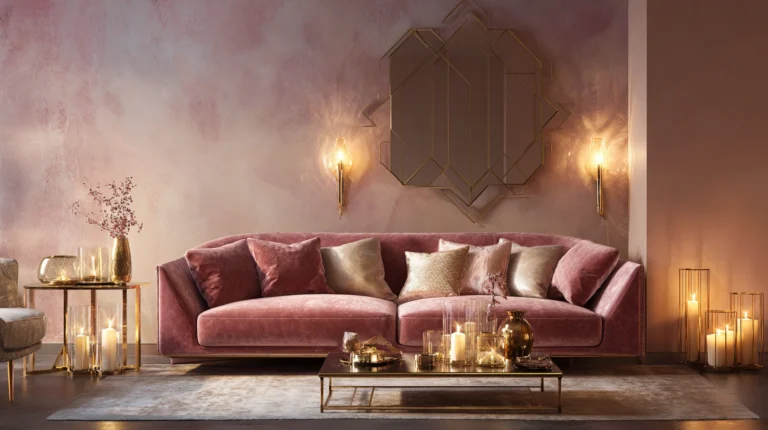
Three candles of different heights in coordinating holders — grouped at one end of the coffee table or within a tray — create an evening atmosphere on the coffee table surface that no other object provides at the same cost. The moving flame quality of real candles, or the high-quality LED equivalents, transforms the living room’s evening character in a way that is specifically associated with the coffee table rather than the overhead lighting, and the grouped arrangement of multiple candles at varying heights is consistently the most photographed and most frequently saved coffee table detail across every interior photography platform.
Pillar candles in graduated heights cost $8–$20 for a set of three. Taper candles in matching candlesticks run $15–$40 for the pair. Votives in small glass holders cost $5–$15 for a set of four. LED flame candles that flicker realistically cost $8–$25 each for the most convincing versions. Group all candle vessels in the same material — all glass, all ceramic, all brass — for the most coherent arrangement. Mixed candleholder materials create the scattered, assorted quality that the grouping principle is specifically designed to avoid.
Style tip: Position the tallest candle at the back of the grouping, the medium in the middle, and the lowest at the front — the same height gradient used in any flower or object arrangement. A candle grouping viewed from the sofa reads best when the height graduates from front to back, creating a visible layering at the group’s face that is clearest from the primary seated viewing angle. A random height arrangement within the same grouping looks accidental rather than composed from the seated position even when the same candles and the same holders are used.
6. A Sculptural Object as the Sole Display
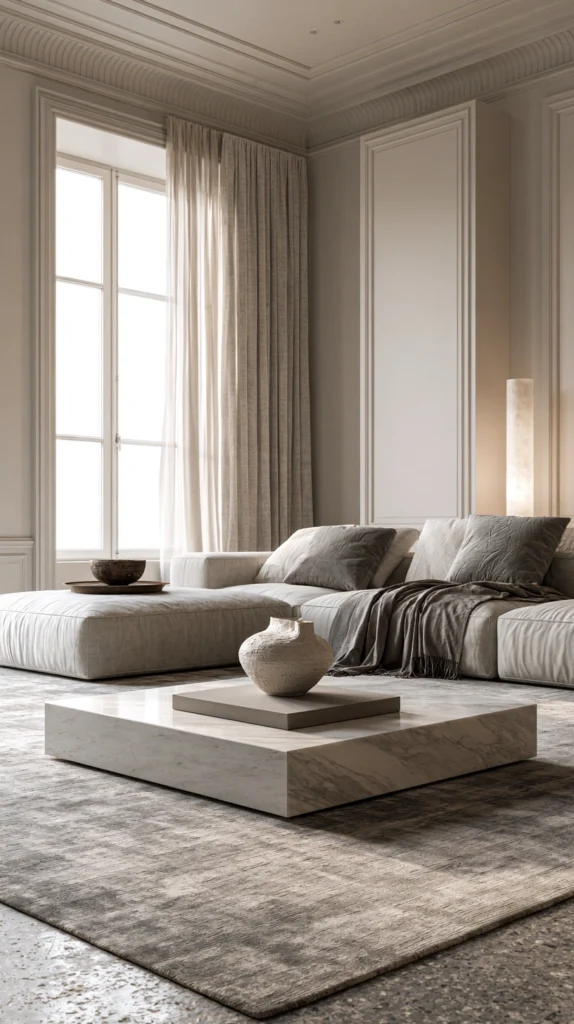
Budget: $20 – $200
One exceptional sculptural object — a smooth river stone, a ceramic form, a piece of driftwood, a carved sphere — on an otherwise completely clear coffee table surface is one of the most confident and most specifically luxurious coffee table arrangements available. The singular object communicates a level of design restraint that crowded coffee tables cannot achieve and the clear surface surrounding it gives the object exactly the space it needs to be seen as the exceptional thing it is rather than as one of many objects competing for attention on the same surface.
A handmade ceramic sculptural bowl costs $30–$80. A polished stone sphere costs $20–$60. A piece of quality driftwood from a coastal walk costs nothing. A cast concrete or plaster sculptural object costs $25–$80. The singular object approach works when the object is genuinely exceptional — interesting in form, interesting in material, interesting in its relationship to the surrounding room. An ordinary object on a clear table simply looks as though the table has not been styled yet. The singular approach requires an object worth the attention it demands.
Style tip: Place the singular object slightly off-centre on the coffee table surface rather than exactly centred. A sculptural object at the geometric centre of a table creates a formal symmetry that suits some interior styles and feels slightly rigid in others. The same object at one-third of the way across the table surface creates an asymmetric composition with more visual tension and more interest — the eye must travel further to find the object and the journey from the table edge to the object and the empty surface beyond it creates a spatial narrative that a centred arrangement does not.
7. A Rattan or Woven Tray With Natural Objects
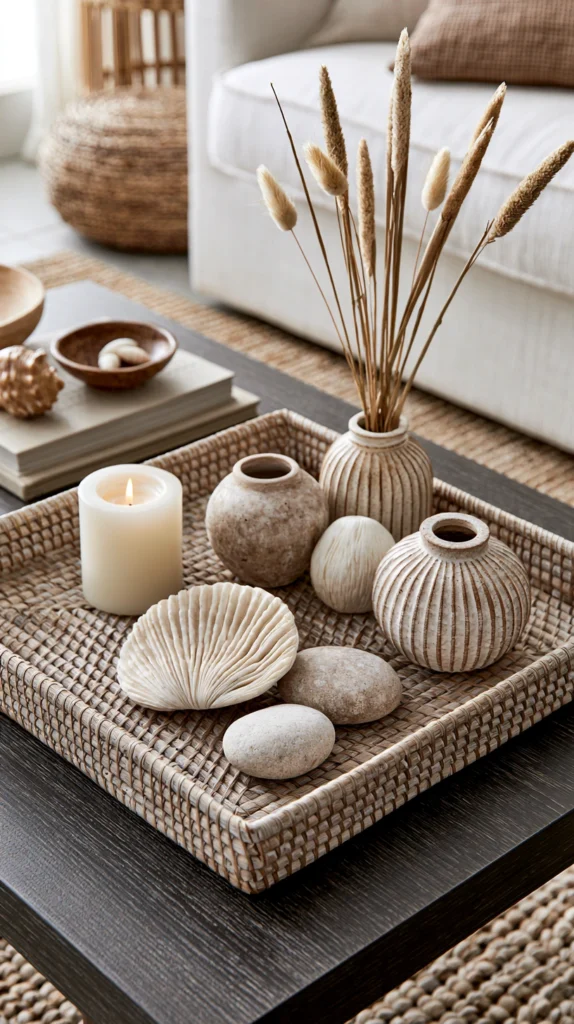
Budget: $25 – $100
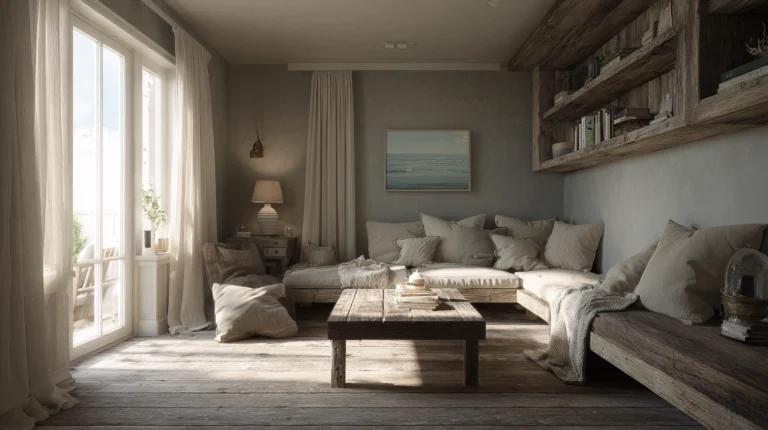
A woven rattan or seagrass tray on the coffee table — filled with a collection of natural objects: smooth pebbles, a small piece of coral, shells, dried botanicals, a small wooden bowl — creates one of the most cohesive, most relaxed, and most specifically coastal or Scandinavian coffee table arrangements available. The rattan tray and natural material objects share a material language that makes the arrangement read as a found collection rather than a purchased display — one of the most consistently admired qualities in any interior styling context.
A round rattan tray of 35–40 cm diameter costs $15–$35. Natural objects to fill it — a small selection of smooth stones from a beach, a piece of weathered driftwood, two or three shells — cost nothing if foraged and $5–$20 if purchased from homeware retailers. A small dried botanical arrangement or a dried grass stem in a simple vessel adds a living element to the collection at minimal cost. The complete rattan and natural material coffee table arrangement costs $20–$60 and produces a display that reads as simultaneously warm, personal, and considered.
Style tip: Add one object to the rattan tray that is slightly unexpected relative to the natural material theme — a small brass figurine, a coloured glass piece, or a handmade ceramic — as the single anomaly within the otherwise coherent collection. The single unexpected object is the detail that prevents a styled tray from reading as a themed display assembled from matching props and gives it the quality of a personal collection that has accumulated one individual object at a time rather than been purchased as a complete set.
8. A Marble Tray With Warm Metal Accents
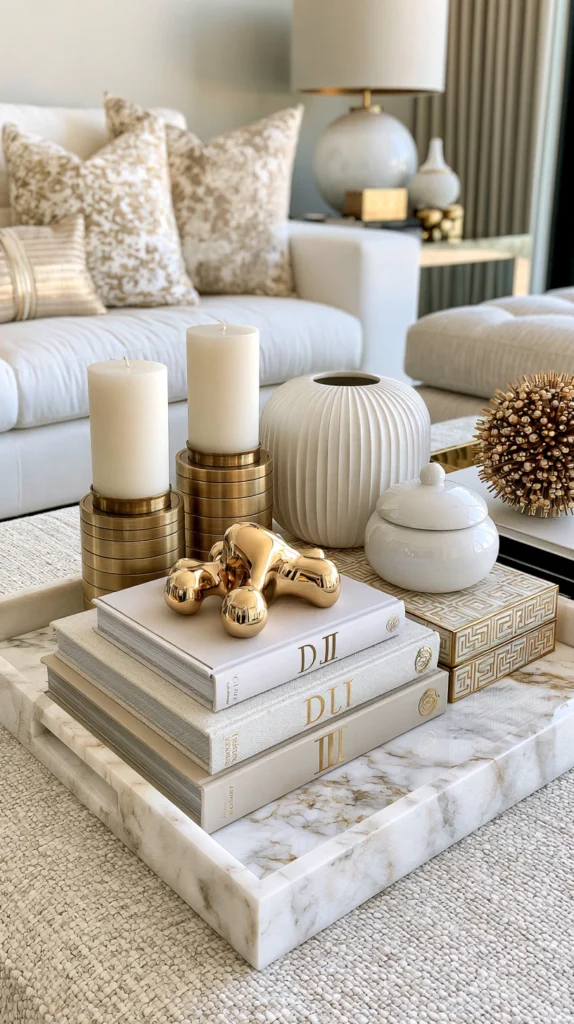
Budget: $40 – $150
A marble or marble-effect tray on the coffee table — holding a brass candle holder, a gold-toned paperweight, and one white ceramic vessel — creates one of the most specifically luxurious and most consistently photographed coffee table arrangements available for a neutral or contemporary living room. The marble provides the cool, veined surface quality. The warm metal accents provide the tonal warmth that prevents the marble from reading as cold. The white ceramic bridges the two materials in a tone that suits both equally.
A white marble serving tray of 35×25 cm costs $20–$50. A small brass candle holder costs $15–$35. A brass or gold-toned paperweight or small sculptural object costs $20–$50. A white ceramic bud vase costs $10–$25. The complete marble and warm metal coffee table arrangement costs $65–$160 and creates the specific combination of cool stone and warm metal that currently represents the most widely adopted contemporary luxury interior styling approach across every living room aesthetic from minimal to maximalist.
Style tip: Keep the marble tray surface visible — do not fill it so completely that the marble surface disappears beneath objects. At least 30–40 percent of the tray surface should remain clear and visible, because the marble surface itself is a design element rather than simply a background. The veining of the marble, the cool smoothness of its surface, and the quality of the stone are part of the display — not merely the platform on which the display sits. Obscuring the marble with too many objects defeats the purpose of having it visible on the table surface at all.
9. A Green Plant as the Centrepiece
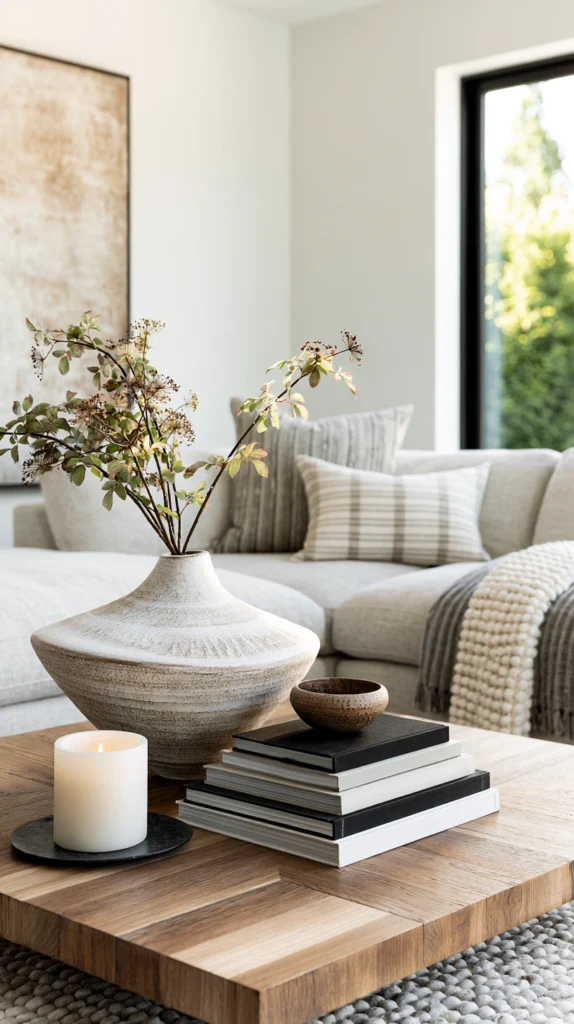
Budget: $10 – $50
A compact green plant — a small potted fern, a succulent in a ceramic pot, a pothos trailing over the edge of the table, or a small orchid — as the primary object on the coffee table surface creates the most biophilic and most specifically lived-in coffee table arrangement available. The plant brings the quality of growth, of living green, and of genuine natural material to the room’s central surface in a way that no manufactured decorative object replicates. A plant on the coffee table announces that the room is inhabited and cared for.
A small potted fern in a 9 cm nursery pot costs $4–$10 and can be transferred to a simple ceramic pot ($8–$20) for a finished display. A compact succulent in a 7 cm pot costs $4–$8. A small orchid in bloom costs $10–$30 and provides up to two months of display. Position the plant at one end of the coffee table surface rather than at the centre — an asymmetrically positioned plant creates a more dynamic and more interesting composition than a centred arrangement and leaves the remainder of the table surface clear for the other two or three objects that complete the coffee table arrangement.
Style tip: Choose a plant in a pot that suits the room’s material palette rather than the first pot the plant comes in. A succulent in a mismatched plastic nursery pot looks like a plant waiting to be repotted. The same succulent in a simple black ceramic pot, a small terracotta vessel, or a smooth concrete pot looks like a specifically chosen display element — which is the quality that transforms a plant from a houseplant on the table to a styled coffee table feature.
10. A Monochromatic Tone-on-Tone Display
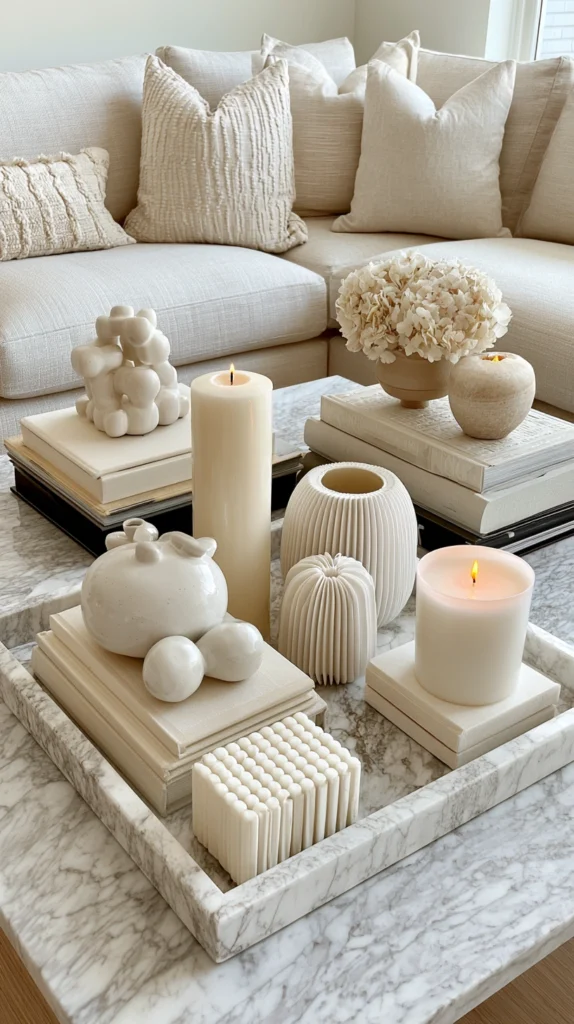
Budget: $40 – $150
A coffee table styled entirely within one colour family — all white, all terracotta, all warm neutral, or all deep charcoal — creates one of the most sophisticated and most specifically contemporary styling approaches available for any living room aesthetic. The colour unity of a tone-on-tone display communicates a level of design intention that multi-coloured arrangements rarely achieve, because it demonstrates that each object was chosen in relation to every other rather than independently for its individual appearance.
A white tone-on-tone display might combine a white marble tray ($20–$40), two white ceramic vessels of different heights ($15–$30 each), one white candle ($5–$12), and three white pebbles or a small white ceramic sculpture ($8–$25). The complete display costs $63–$137 and produces a coffee table arrangement that reads as more specifically designed — more obviously curated — than any mixed-colour arrangement of equivalent quality and comparable cost. The colour restraint is the design decision that creates the display’s entire impact.
Style tip: Introduce tonal variation within the monochromatic palette through texture rather than colour — a smooth white marble surface beside a rough-textured white ceramic vessel beside a matte white candle. The textural variation keeps a monochromatic display visually interesting from close range without introducing any colour that would break the palette’s unity. A monochromatic display with no textural variation risks reading as flat and undifferentiated from the primary seated viewing position — the texture differences are what make each object visible as an individual within the unified palette.
11. A Minimal Japandi Arrangement
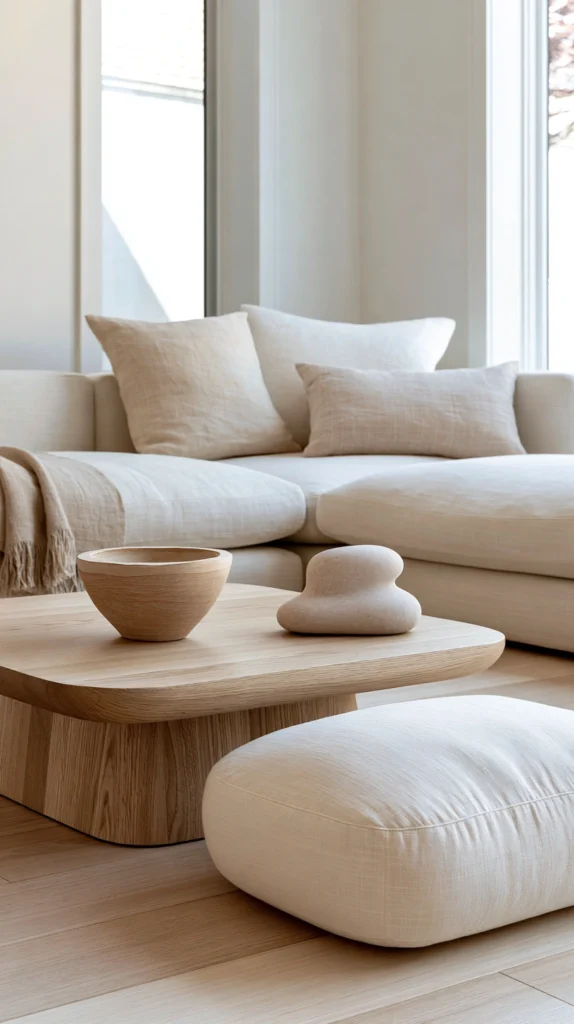
Budget: $30 – $120
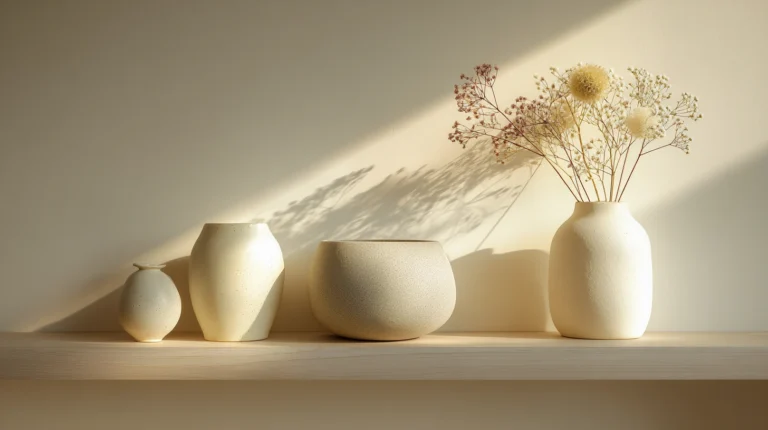
A Japandi coffee table arrangement — applying the Japanese-Scandinavian aesthetic of extreme restraint, natural materials, and deliberate negative space — uses the coffee table surface as a composition rather than a display. One object, thoughtfully positioned, with the remainder of the surface completely clear. Or two objects in a specific relationship to each other, with significant empty space on all sides. The display is organised around what is absent rather than what is present.
A Japandi coffee table arrangement might use a single hand-thrown ceramic bowl ($20–$60), positioned at one-third of the way across a 120 cm table with the surface otherwise completely clear. Or two objects: a smooth stone and a small bud vase with one branch — together costing $15–$40 — at opposite ends of the table with the centre completely empty. The negative space is not wasted — it is the most important element of the composition and the one that most communicates the philosophical restraint that defines the Japandi aesthetic.
Style tip: Resist the Japandi arrangement for at least two weeks before adding anything else to the coffee table surface. The instinct to fill the empty space — to add one more object, one more book, one small item that was recently on the table — is strongest in the first week of a minimal arrangement. The arrangement that survives two weeks of this instinct without additions is the one that the room genuinely needs rather than the more populated arrangement that instinct repeatedly suggests would complete it.
12. A Personalised Collected Display
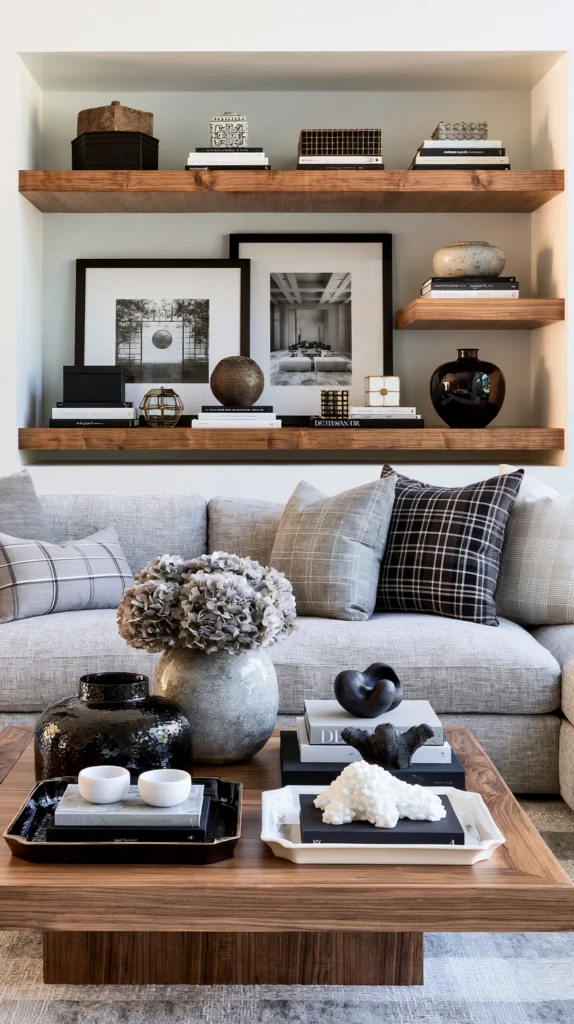
Budget: $0 – $50
A coffee table display assembled from personal objects — a small travel souvenir, a photograph in a simple frame, a book with particular significance, a found object from a meaningful location — creates the one quality that no styled or purchased display can replicate: specific personal meaning. The collected display communicates that these objects are here because of who this household is rather than because a styling principle suggested them, which is always the most compelling quality in any domestic interior regardless of the aesthetic it otherwise pursues.
Existing personal objects cost nothing. A simple frame for a small photograph costs $8–$20. A small shelf or tray to organise the collection costs $15–$40. The personalised collected display is not an absence of styling — it requires as much thought about arrangement, height variation, and negative space as any other approach on this list. The difference is that the objects are chosen for what they mean rather than for what they look like, and the styling decisions are made in the service of objects that already have a reason to be on the table.
Style tip: Edit a personalised collected display to the five or six objects with the most meaning rather than including everything that has sentimental significance. A coffee table covered with twenty meaningful objects reads as accumulated rather than curated — and the individual meaning of each object is lost when so many compete for attention simultaneously. Five objects with space around them, each visible and identifiable, communicate their individual significance far more clearly than twenty objects crowded together regardless of their collective meaning.
13. A Layered Multi-Texture Composition
Budget: $60 – $200
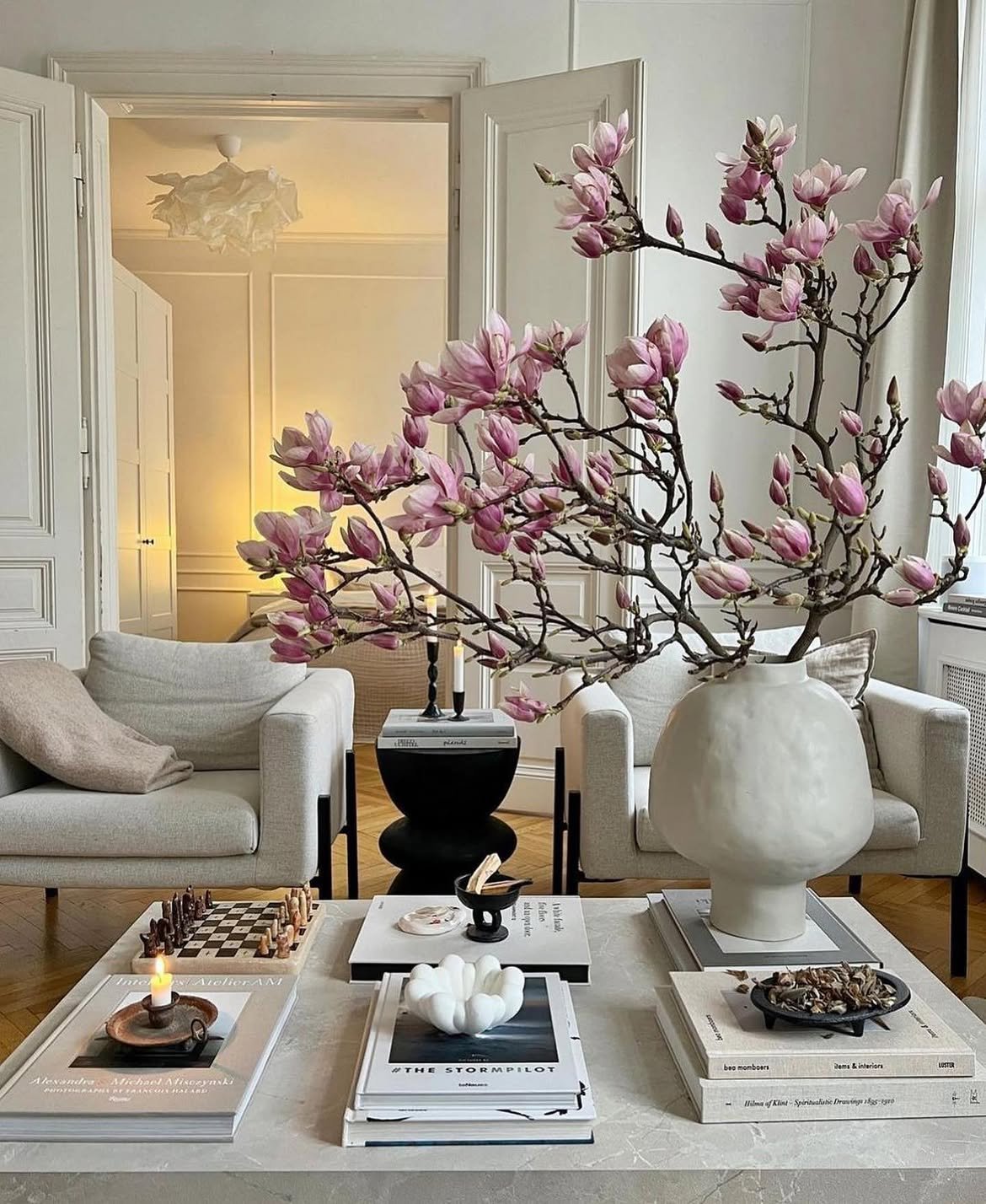
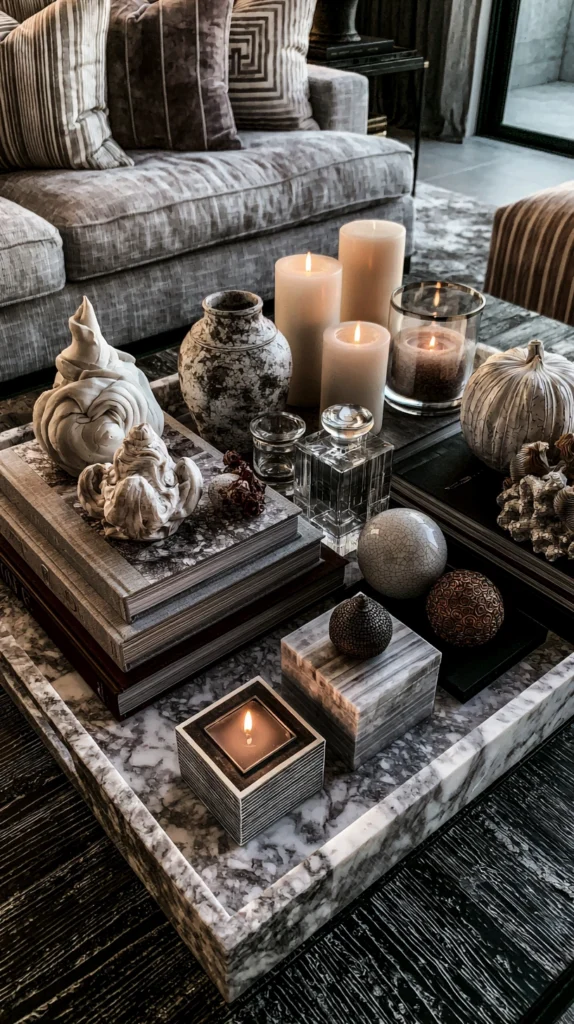
The most maximally styled coffee table approach — a layered composition of tray, books, vessels, botanicals, and candles at multiple heights — creates the most visually abundant and most specifically editorial coffee table arrangement available. It suits a maximalist, eclectic, or globally influenced interior where visual richness is the primary aesthetic goal and restraint would read as an incomplete rather than a resolved design intention.
A layered composition assembles: one tray ($15–$40), one book stack of two ($20–$60), one vessel at the tallest height ($20–$50), one botanical element ($5–$20), one candle at medium height ($8–$20), and one low textural object ($10–$25). Total cost: $78–$215 for a coffee table arrangement that reads as professionally styled from every viewpoint in the room. The composition requires three distinctly different object heights, no more than three distinct materials (keeping the palette coherent despite the multiple objects), and at least 20–30 percent visible table surface at one end where no object is placed.
Style tip: Arrange a layered multi-object composition by placing the largest or tallest object first and building outward from it rather than placing objects sequentially from left to right across the table surface. Starting from the primary object and adding supporting elements around it naturally creates a composition organised around a clear centre of visual gravity. Starting from left to right creates a sequential arrangement that reads as objects placed on a surface rather than a composition organised around a shared focal point.
The coffee table arrangement that consistently works is the one built on a clear underlying principle — a tray, three heights, one primary object, or one colour family — rather than the one assembled from whatever objects were available at the moment the table needed styling. The principle is more important than the specific objects, and any principle applied consistently produces a result that looks more considered than any random collection of attractive objects placed together without a shared organising logic.
Clear the coffee table completely. Remove everything from its surface and look at the empty table for five minutes before putting anything back. What returns first is the object you most want to see on the table. What returns second is the object that best supports the first.
What returns third completes the composition. Everything else can stay in the drawer or the cupboard. The coffee table that begins from an empty surface always arrives at a better arrangement than the one that begins from trying to improve an existing accumulated collection.