13 Tiny Balcony Decor Ideas That Feel Surprisingly Spacious
The tiny balcony — one square metre of concrete slab outside a flat door, or a narrow ledge of 80 cm depth along a city apartment — is not a compromise on outdoor space. It is one of the most usable and most frequently used outdoor spaces available when it has been thought about, because its very smallness makes every decision visible and every right decision impactful in a way that a larger outdoor space absorbs without the same immediate result.
The ten square metres that make a small balcony feel generous require not renovation but a clear idea of what the space is for and what it needs to be that thing well.
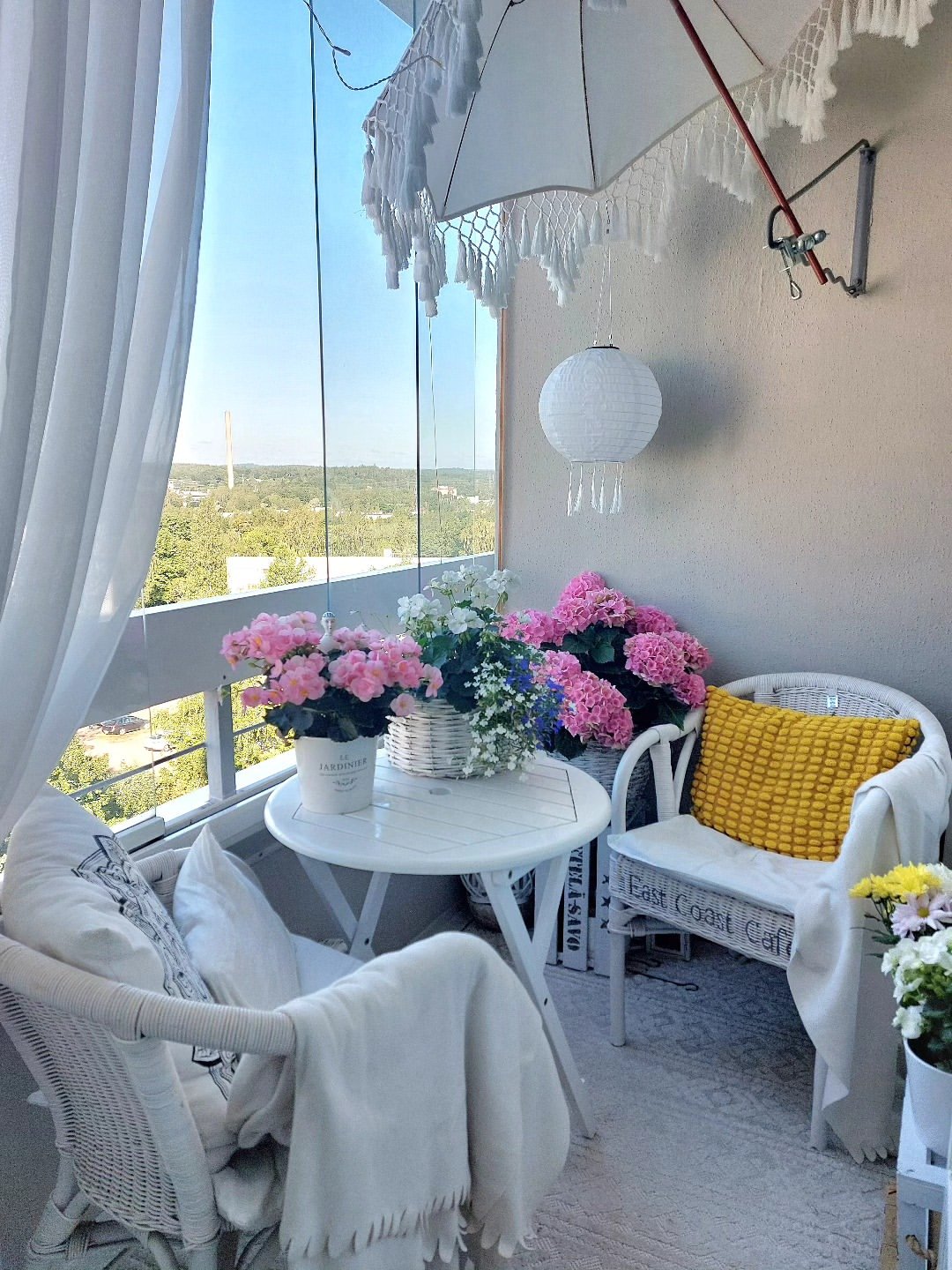
The thirteen ideas below are each chosen specifically for their effectiveness on a very small balcony — not ideas that happen to work at any scale but ones that work best precisely because the space is minimal and every element must earn its position through genuine contribution to the experience of being in it.
1. Lay Interlocking Timber Deck Tiles
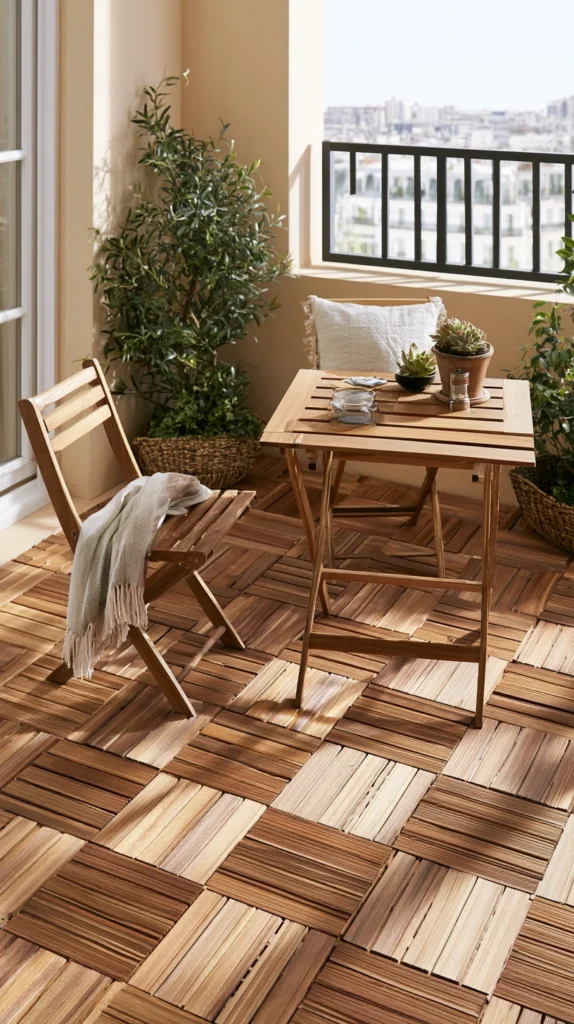
Budget: $30 – $120
Covering a concrete or tiled balcony floor with interlocking timber deck tiles is the single transformation that most completely changes the character of a tiny balcony from functional external ledge to a defined outdoor room. The warm natural surface of timber underfoot changes the physical experience of being on the balcony — it feels warmer, quieter, and less institutional — and it provides a visual consistency at floor level that makes the space read as designed rather than simply used.
Interlocking acacia or pine deck tiles cost $2–$5 each and click together without any tools or adhesive. A 1.5×2 metre balcony requires approximately fifteen tiles at $30–$75. Install directly over the existing floor surface without any groundwork or preparation beyond ensuring the drainage channel remains unobstructed at the balcony’s lowest point. Treat annually with an exterior timber oil ($10–$20 per tin) to maintain the warm colour and prevent the greying that untreated timber develops within one exposed season.
Balcony tip: Lay the deck tiles diagonally — at 45 degrees to the balcony walls — rather than parallel to them. The diagonal tile direction makes the floor appear larger by drawing the eye across the widest available dimension of the space rather than along the shortest. On a very small balcony the visual difference between a parallel and a diagonal tile orientation is proportionally more significant than on a larger surface — the right direction adds perhaps 20 percent to the apparent floor area at zero additional cost.
2. Use Folding or Wall-Mounted Furniture Only
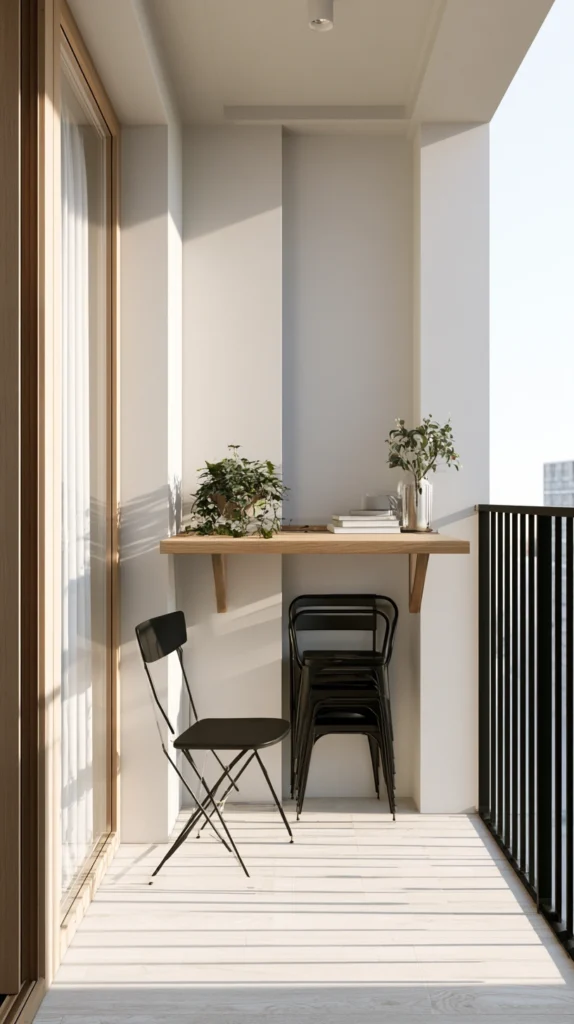
Budget: $40 – $200
A tiny balcony furnished with furniture that is always in the same position, occupying fixed floor space regardless of whether the balcony is being used, will always feel smaller than it is because the furniture defines the remaining usable space as whatever is left around it. Folding furniture — a bistro chair that folds flat against the wall, a fold-down table that drops to horizontal when not in use — occupies the same floor area when in use and almost none when stored, transforming the apparent size of the space between uses.
A wall-mounted fold-down timber table of 60×40 cm costs $40–$100. A pair of folding bistro chairs in powder-coated steel cost $30–$80 each and store flat against the wall or behind a panel. A folding stool that doubles as a side table costs $25–$60. The complete fold-down balcony furniture system costs $100–$240 and allows the entire balcony floor to be clear and spacious when no one is using it — which makes the first experience of stepping onto the balcony on any occasion feel like entering a space rather than navigating around furniture to reach the railing.
Balcony tip: Mount the fold-down table at a height that works both as a dining surface when standing (90 cm) and as a working surface when seated (75 cm) by choosing a height between the two — 80–82 cm — that is functional for both uses with appropriate chair or stool height. A fold-down table that serves both seated and standing use doubles its functional value in a space where every installed element must justify its presence through the maximum possible number of use scenarios.
3. Add a Privacy Screen That Doubles as a Planter
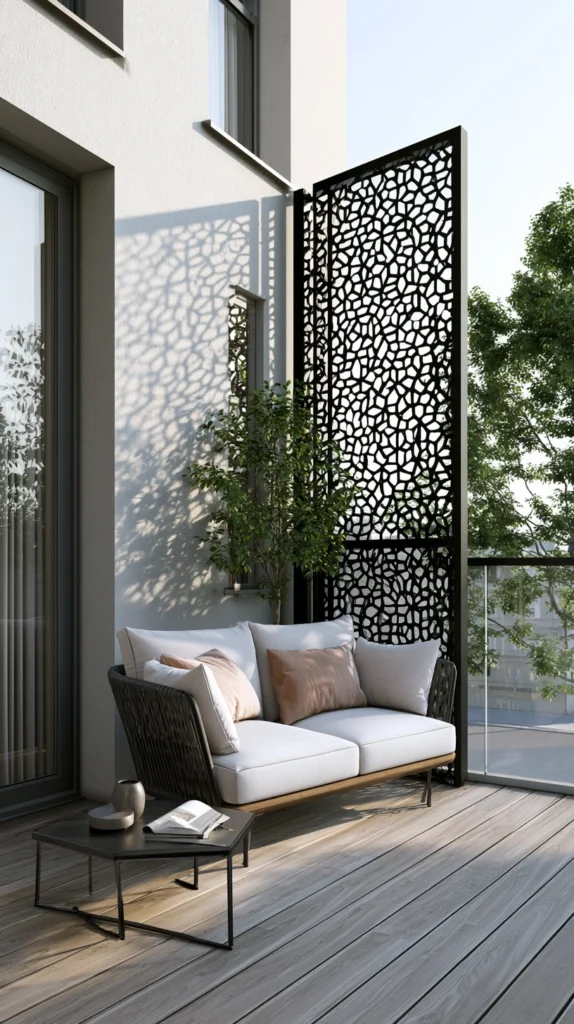
Budget: $50 – $200
A combined privacy screen and planter — a vertical structure that provides a physical boundary against an adjacent balcony while also supporting growing plants — solves the privacy problem that most small urban balconies face while simultaneously introducing greenery in a form that consumes no floor space beyond its own footprint. The screen-planter combination is the most space-efficient and most visually generous solution to the twin requirements of privacy and planting that any tiny balcony presents.
A freestanding trellis planter of 120×30×30 cm in powder-coated steel or timber costs $60–$150. A bamboo screen panel with an integrated planter base costs $50–$120. Plant with a fast-growing climber — climbing nasturtium, sweet peas, or a jasmine in a sheltered position — so coverage develops within the first growing season. Position the screen at the end of the balcony most exposed to the adjacent property rather than along the railing where it would reduce the view outward that gives the tiny balcony its primary quality of spatial connection to the wider outdoor environment.
Balcony tip: Choose a semi-transparent screen material — bamboo, willow hurdle, or an open-weave trellis — rather than a solid panel. A solid privacy screen on a small balcony creates a fully enclosed box that reduces the feeling of space more dramatically than the privacy it provides justifies. A semi-transparent screen reduces direct overlooking without eliminating the light, air movement, and sense of visual connection to the outside world that is the primary reason for using the balcony at all.
4. Hang String Lights at Railing Height
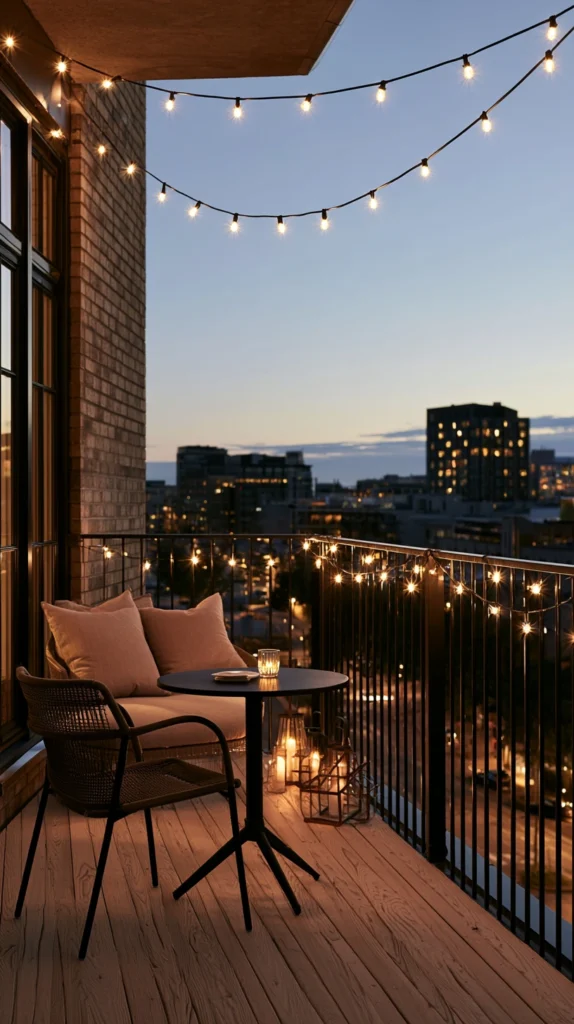
Budget: $15 – $50
String lights hung at railing height around the perimeter of a tiny balcony — rather than overhead — create a warm perimeter glow that defines the edges of the space and makes the balcony feel like a lantern-lit room after dark rather than a concrete ledge with some furniture on it. At railing height the lights create the illusion of a lit boundary rather than an illuminated ceiling — a spatial quality that makes the balcony appear more dimensional and more enclosed in the best sense than the same lights suspended overhead.
Solar warm white string lights in a 5-metre reel cost $15–$35 and provide enough coverage for the full perimeter of a standard small balcony. Weave through the railing balusters at mid-railing height using small adhesive clips ($5–$10 per pack) rather than tying directly to the metal — the clips allow repositioning without leaving adhesive residue. Use warm white at 2700K exclusively — the warm evening quality of a small balcony space is its most valuable and most distinctly residential quality and cool white light destroys it as completely and as immediately as any other design decision available at the same cost.
Balcony tip: Supplement the string lights with two or three LED candles in small hurricane glasses positioned on the railing top or on a folded side table. The combination of the string light perimeter glow and the individual candle flame quality of the LED candles at different heights creates a layered, atmospheric evening light effect that makes the tiny balcony the most pleasant room in the flat on any warm evening — which is the specific quality that every tiny balcony is entirely capable of providing when its evening lighting has been thought about with the same care as everything else.
5. Choose One Statement Plant in a Large Pot
Budget: $30 – $120
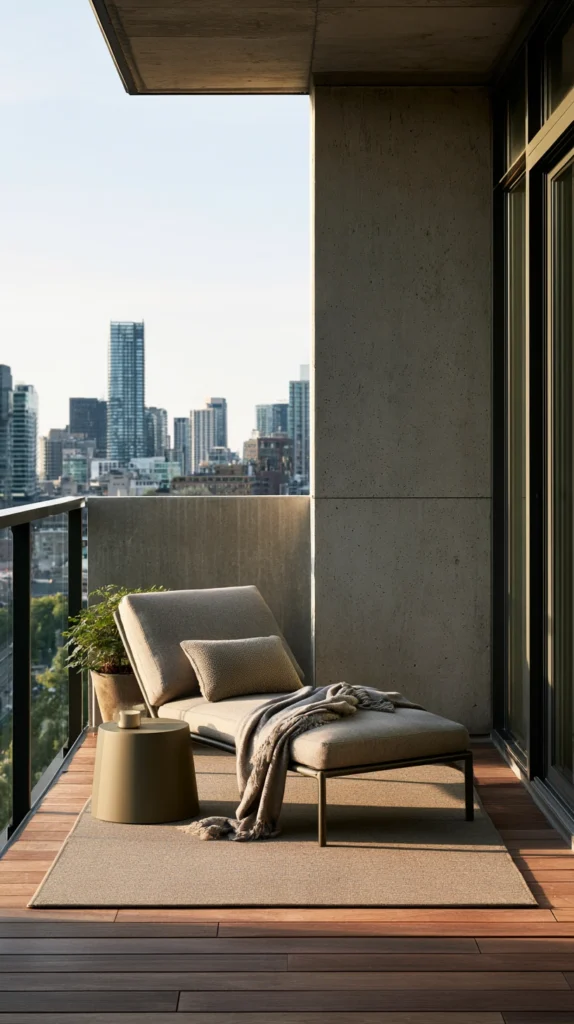
One large plant in one generous pot — rather than six small plants in six small pots — creates the most spatially effective planting arrangement for a tiny balcony. The single large plant has presence and character. It anchors the corner of the balcony where it is positioned and creates a vertical green element at a scale that six small plants distributed across the same corner cannot achieve collectively. The remaining floor space around the single large plant reads as deliberate negative space rather than as unused area.
A large olive tree in a 35 cm pot costs $40–$80. A standard bay tree runs $30–$70. A large ornamental grass — Cortaderia or Miscanthus — costs $20–$40. A large trailing geranium in a generous glazed pot costs $20–$50. Any of these provides a scale of plant presence on a tiny balcony that reads clearly from inside the flat as well as from the balcony itself — which is the primary viewing position for most tiny balconies for the majority of the year when outside temperatures make sustained balcony sitting impractical.
Balcony tip: Position the large statement plant in the corner diagonally opposite the balcony door — the corner that is furthest from the entry point and most directly visible from the main interior viewpoint through the glass door or window. A plant in this position is seen from inside the flat on every occasion when anyone looks toward the balcony, creating a constant green visual connection between the interior and the outdoor space that a plant in the corner adjacent to the door does not provide from the same interior viewpoints.
6. Use Railing Planters for Colour Without Floor Space
Budget: $30 – $100
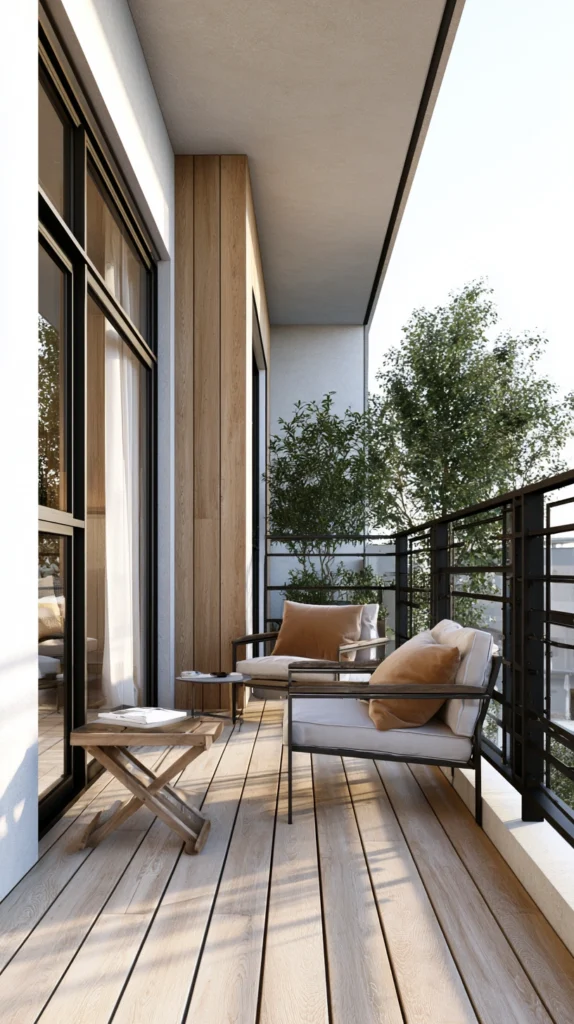
Planter boxes that hook over or clamp to the balcony railing occupy zero floor space — they use the one structural element of the balcony that would otherwise contribute only to safety rather than to the character of the space. A run of railing planters along the outer railing edge provides colour, fragrance, and greenery at exactly the height where they are most visible from inside the flat and most enjoyed from the balcony’s seating position without consuming a single centimetre of the precious floor area below.
Galvanised or powder-coated railing planters cost $8–$20 each. A full railing run of 2 metres requires four planters at $32–$80. Plant with trailing calibrachoa, lobelia, or bacopa for continuous colour from early summer to the first autumn frosts — all three are relatively drought-tolerant, long-flowering, and wind-resilient enough for an exposed railing position. Self-watering planter inserts ($5–$10 each) reduce watering to every two to three days rather than daily in the warmest summer weeks.
Balcony tip: Plant railing planters in a single consistent colour — all white, all deep pink, all purple — rather than in a mixed assortment. A single colour in the railing planters creates a bold, coherent display visible from both the balcony and the street below. A mixed colour assortment creates a scattered quality at small scale that reads as chaotic rather than abundant — the difference between a designed planting and a collection of plants placed in the only available position.
7. Add a Mirror to Expand the Apparent Space
Budget: $30 – $100
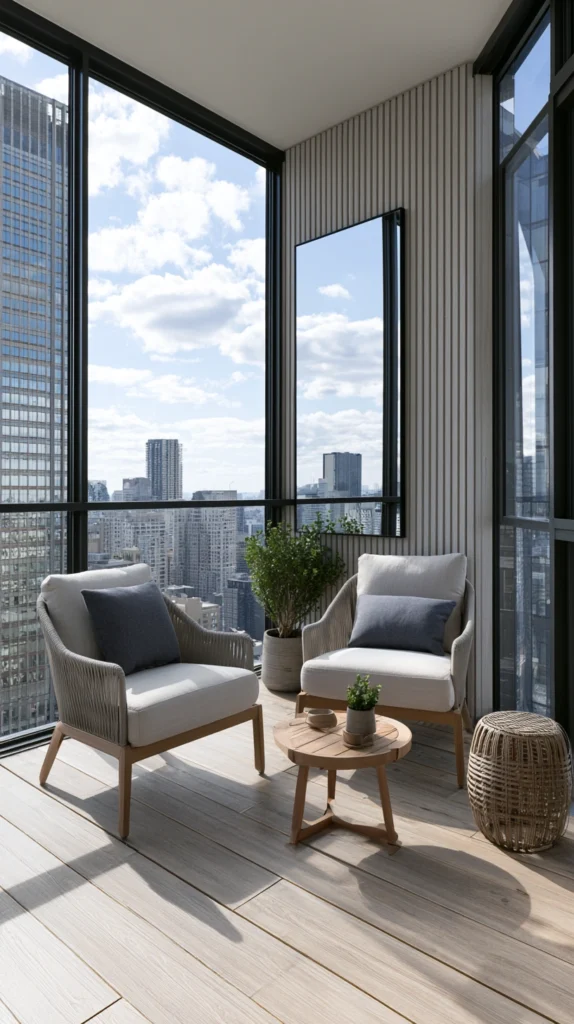
An outdoor-rated mirror fixed to the balcony wall — positioned to reflect the planting and the sky rather than the adjacent wall or the viewer — doubles the apparent depth of the tiny balcony from the primary viewing angle at the door. On a very small balcony where every centimetre of apparent space is valuable, the reflected depth a correctly positioned mirror provides is worth considerably more than its material cost suggests — it is the most space-adding improvement available for a tiny balcony that requires no physical construction at all.
An outdoor-rated mirror of 40×60 cm costs $30–$60. A larger 50×80 cm version runs $50–$100. Fix to the most solid available wall surface — the building wall rather than the railing — using stainless steel fixings rated for outdoor humidity exposure. Angle the mirror 5–10 degrees off perpendicular to the main viewing direction so the reflection captures the planting and sky rather than the viewer approaching from the door. Frame with a climbing plant to soften the visible edges and make the reflection appear as a view rather than a surface.
Balcony tip: Clean the balcony mirror monthly through the growing season — a dirty mirror on a small balcony loses its spatial effect before losing its functionality as a reflective surface, and on a tiny balcony where the mirror is one of the most important spatial tools available, maintaining its clarity is a maintenance priority rather than an aesthetic preference. Three minutes of cleaning with a damp cloth and the mirror provides its full spatial effect. An uncleaned mirror after several weeks of outdoor exposure provides significantly less.
8. Keep the Floor Colour Pale and Consistent
Budget: $20 – $80
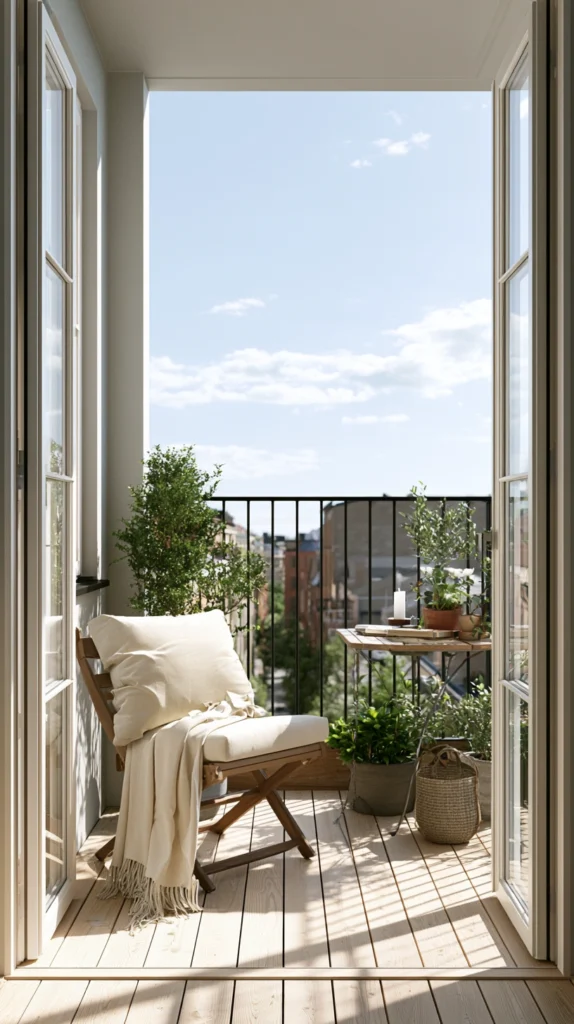
A pale, consistent floor surface — whether timber deck tiles in a warm honey tone, pale grey porcelain, or a natural stone tile — reflects available light upward from the balcony floor rather than absorbing it, creating a brighter, more spacious-feeling outdoor environment than a dark floor produces in the same confined space. On a tiny balcony where the floor represents a significant proportion of the total visible surface from every viewing angle, the floor colour is one of the most consequential decisions available for its effect on the experience of space.
Pale porcelain tiles in an outdoor-rated finish cost $20–$50 per square metre. Light-coloured rubber deck tiles cost $15–$40 per square metre. Natural bamboo deck tiles — the palest available outdoor timber option — cost $25–$55 per square metre. Avoid any floor surface in a dark or strongly saturated tone on a tiny balcony — dark floors make enclosed spaces feel smaller and on an already small balcony the effect is compressive rather than grounding, which is the quality that makes a space feel cramped rather than simply compact.
Balcony tip: Maintain consistency between the floor surface and the adjacent interior floor — if the flat interior has pale oak flooring running to the balcony door, a timber deck tile that closely matches the interior tone creates a visual continuity between the indoor and outdoor floor planes that makes the interior appear to extend outward onto the balcony. This continuity is one of the most effective space-expanding techniques available for any small apartment that opens directly onto an outdoor area.
9. Install a Wall-Mounted Vertical Garden
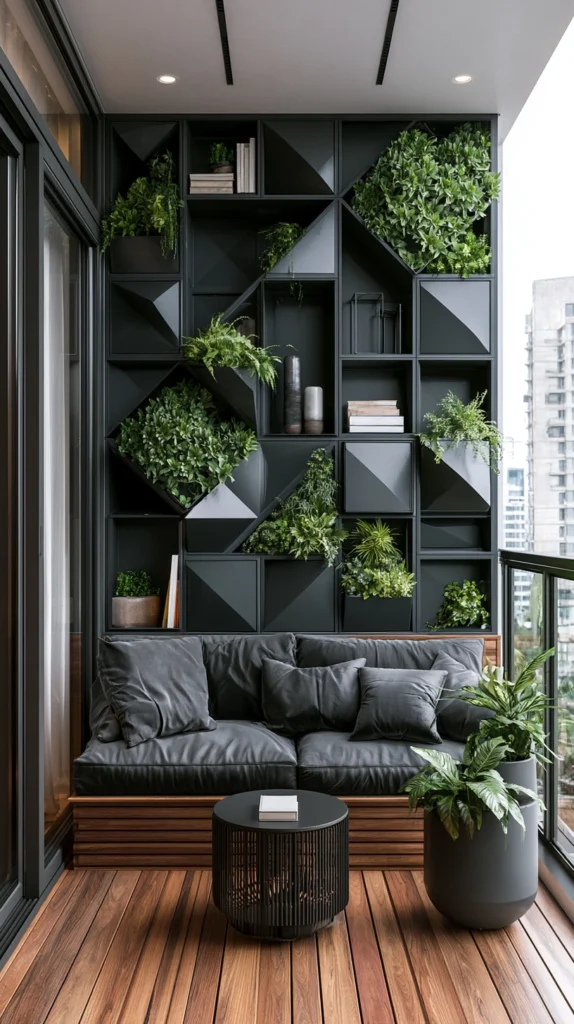
Budget: $30 – $150
A pocket planter system or a pegboard with clip-on pots mounted on the balcony wall creates a vertical growing surface that uses the wall as growing area rather than the floor — providing herbs, flowering annuals, or small succulents at eye level in a position that consumes zero floor space and significantly improves the quality of the balcony experience by creating an immediate proximity between the person sitting on the balcony and the living plant material that is the primary sensory benefit of any outdoor space.
A fabric pocket planter of 60×90 cm with twelve growing pockets costs $20–$40 and mounts on two wall screws. A metal pegboard panel with clip-on pot rings costs $30–$80 for a 60×60 cm panel. Plant with herbs — basil, chives, thyme, and mint — for a vertical growing surface that also functions as the balcony’s kitchen garden and provides fresh culinary material within arm’s reach of the door to the flat.
Balcony tip: Water vertical balcony planters from the topmost row downward and allow drainage to trickle to the row below in sequence — the cascading watering approach provides each level with the water it needs from the level above in a single top-down pass rather than requiring each pocket or pot to be individually watered. It significantly reduces watering time for a fully planted vertical system and ensures the lower planting pockets receive moisture during dry periods when only the most visible upper pockets are typically watered and the lower ones are overlooked.
10. Create One Focal Point at the Railing
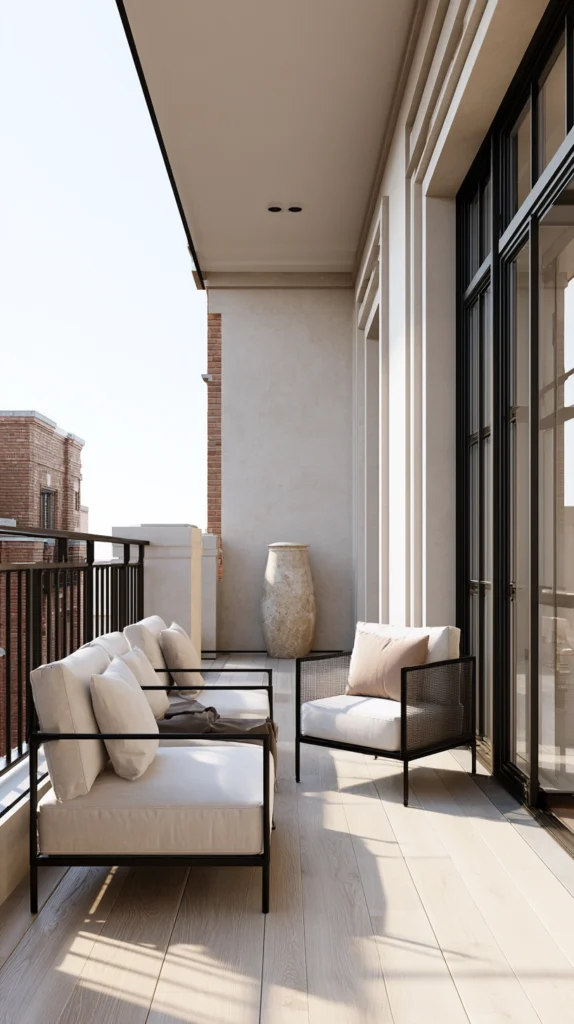
Budget: $20 – $80
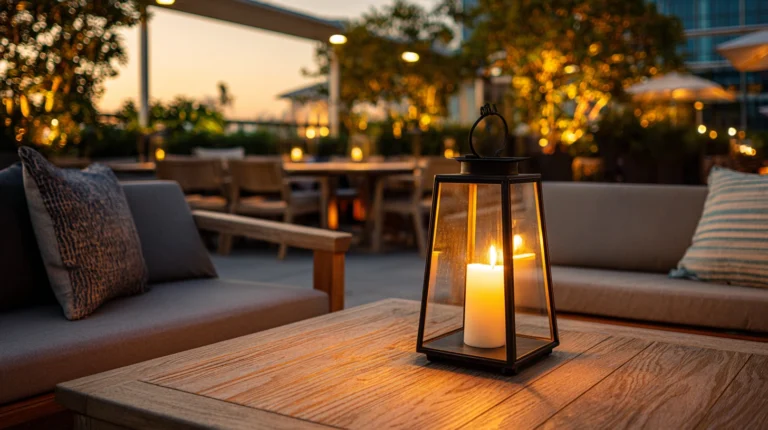
A single focal point object at the far end of the tiny balcony — at the railing, directly in the main sight line from the interior — gives the small space a visual destination that creates the experience of depth and arrival that an undifferentiated balcony without a focal point cannot provide. The focal point does not need to be large — a small lantern on the railing top, a distinctive pot with one flowering plant, or a small sculpture — but it needs to be genuinely distinctive enough to draw the eye across the full depth of the balcony from the interior doorway.
A lantern of 20–30 cm height with a LED candle inside costs $15–$35 and creates a warm evening focal point visible from the main room through the glass door. A distinctive ceramic pot of 20–25 cm with a single seasonal flowering plant costs $20–$50. A small sculptural object — a ceramic bird, a stone sphere, a driftwood piece — costs $10–$40. The focal point needs only to be the most interesting thing at the far end of the balcony to provide its full spatial effect — which is achievable at any quality level above the entirely undistinguished.
Balcony tip: Change the focal point with the season — a spring bulb in a simple ceramic pot replaced by a summer flowering annual replaced by an autumn arrangement of dried seed heads replaced by an evergreen with small LED lights for winter. The seasonal change communicates that the balcony is an active, maintained outdoor space rather than a set decoration that was arranged once and has not been reconsidered since, and it creates four distinct seasonal versions of the outdoor space from the same position, the same pot, and approximately the same annual total cost.
11. Use See-Through Furniture
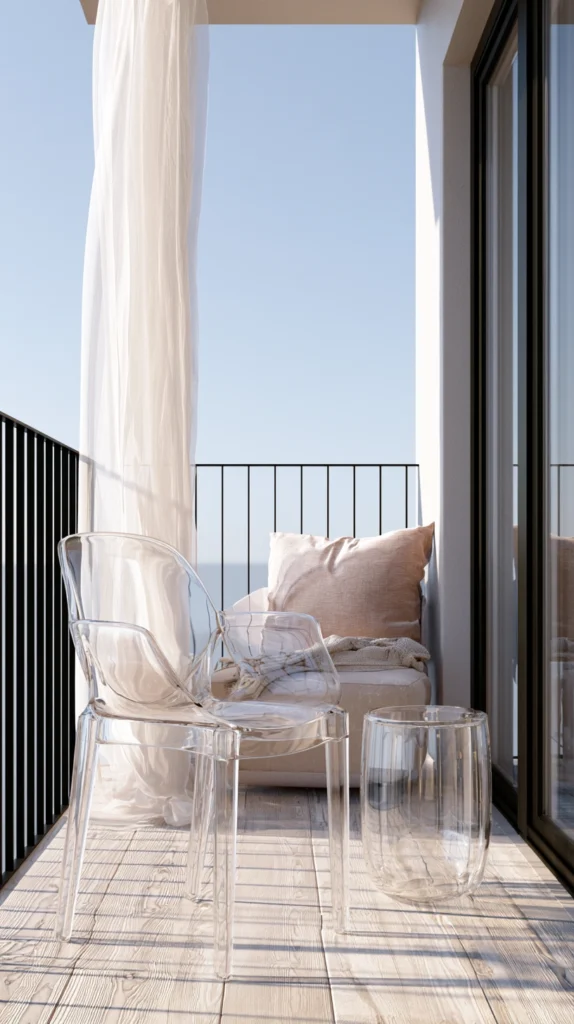
Budget: $40 – $200
Furniture in transparent or semi-transparent materials — acrylic, glass, or open-weave rattan — takes up the same physical floor space as any opaque equivalent but occupies significantly less visual space, because the eye sees through or between the furniture elements rather than stopping at a solid surface. On a tiny balcony where visual space is as important as physical space, see-through or open-weave furniture creates the impression of a more generous floor area than the same dimensions furnished with equivalent solid pieces.
A clear acrylic side table costs $30–$80. An open-weave rattan bistro chair costs $40–$100 each. A wire-frame garden chair in powder-coated steel costs $50–$120. Pair with a folding table that can be stored flat when not in use — the combination of see-through occasional furniture and fold-flat functional furniture gives the tiny balcony the maximum visual openness at all times while retaining the full functional capacity of a properly furnished outdoor seating area when the table is deployed and the chairs are in use.
Balcony tip: Add a small cushion or seat pad to any wire-frame or open-weave rattan chair on the balcony — the visual lightness of transparent and open-weave furniture comes at the occasional cost of comfort. A 3–5 cm outdoor cushion pad costs $10–$25 and transforms the comfort quality of any wire or rattan seat to a level comparable with a padded equivalent while maintaining the visual lightness that makes the open-weave material worth choosing in a space where visual generosity is the primary design priority.
12. Bring an Indoor Textile Outdoors
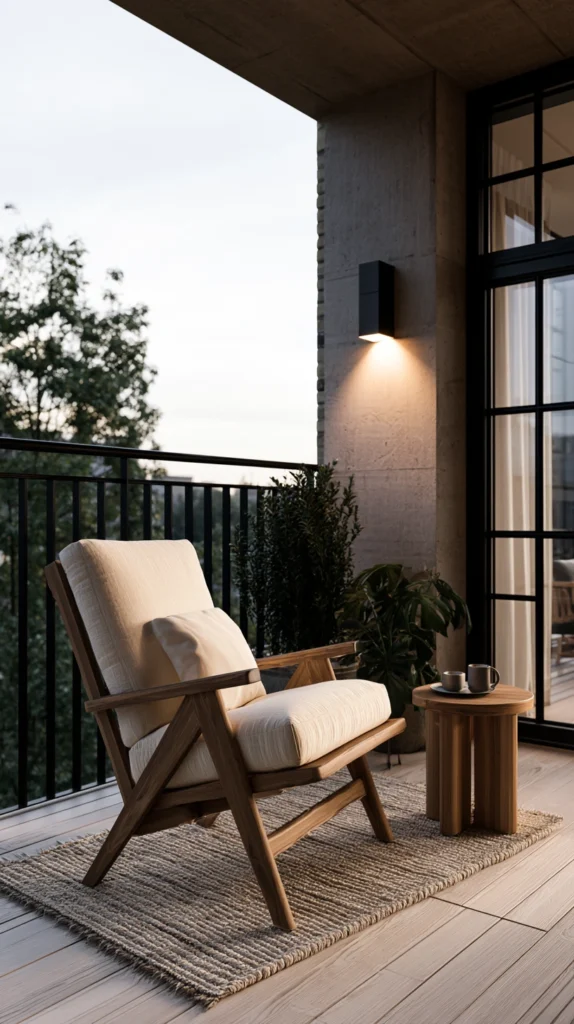
Budget: $20 – $80
A small outdoor rug — or an indoor flat-weave rug in a protected balcony position — beneath the balcony furniture defines the seating zone as a room within the already small outdoor space, creating the layered sense of an interior-quality outdoor area that bare concrete or deck tiles alone cannot produce. The rug does not need to be large — a 60×90 cm rug beneath two chairs and a small table is sufficient — but its presence changes the quality of the space from functional outdoor ledge to a small, considered outdoor room.
A small polypropylene outdoor rug of 60×90 cm costs $20–$50. A slightly larger 90×120 cm version runs $35–$80. Choose a warm neutral tone — natural jute, warm cream, or a simple stripe in sand and white — that suits the interior palette visible through the glass door. A rug whose colour reads as a continuation of the interior palette creates the visual connection between indoors and outdoors that makes both spaces feel more generous than they would if the material vocabulary changed abruptly at the threshold between them.
Balcony tip: Store the outdoor rug inside the flat through the winter months rather than leaving it on the balcony through rain and frost. An outdoor rug stored undercover through winter retains its colour, texture, and surface quality through three to four years of seasonal use. The same rug left outside year-round deteriorates within eighteen months to a quality that looks worn rather than weathered — and on a tiny balcony where every detail is visible from every position, a worn rug undermines the quality of everything else arranged within the same small space.
13. Edit to Three Elements and Trust the Space
Budget: $0
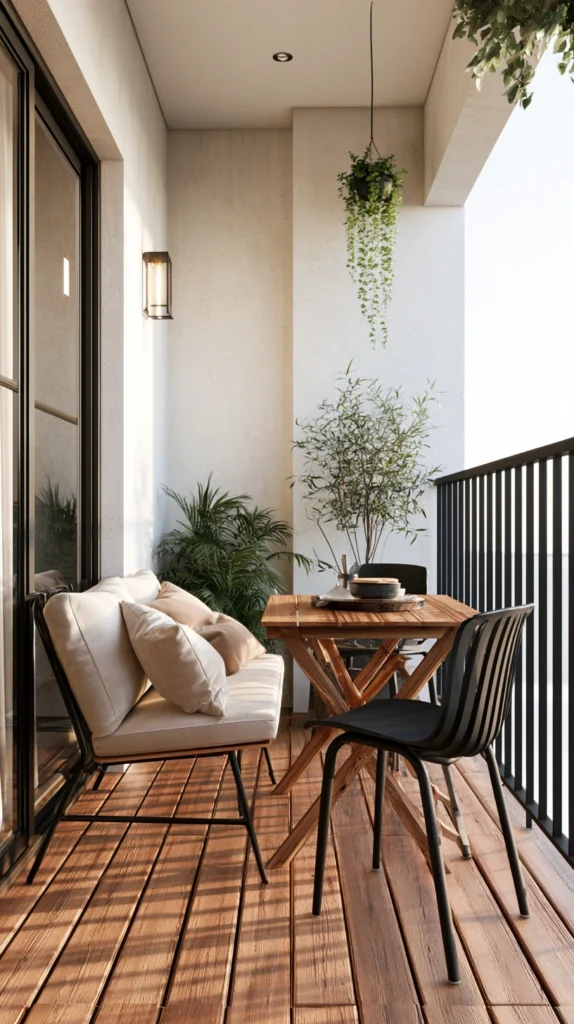
The tiny balcony that feels surprisingly spacious is almost never the one with the most furniture, the most plants, the most lighting, and the most accessories — it is the one where someone chose three things, placed them well, and had the discipline to stop there. A beautiful deck tile floor, one large plant in a generous pot, and a fold-down table with two bistro chairs creates a tiny balcony that is completely functional, visually coherent, and genuinely pleasant to spend time in. Adding a fourth, fifth, and sixth element to the same space creates a tiny balcony that is cluttered, visually confused, and significantly less pleasant to occupy for any sustained period.
The three-element balcony is always better than the ten-element one in a space this small, because the quality of each element is visible in isolation rather than absorbed into a collective impression of abundance. Choose the three elements that address the three most important aspects of the balcony experience — the floor, the seating, and the green element — and resist adding anything that does not directly improve one of those three. The empty space around the three chosen elements is not a problem to be solved. It is the quality that makes the three elements worth having.
Balcony tip: Photograph the tiny balcony from the interior doorway before and after each addition or rearrangement. The photograph shows the balcony as it is seen most frequently — from inside the flat through the glass door — and reveals the composition that the eye inside the balcony itself cannot assess objectively. Every balcony that feels surprisingly spacious from inside the flat looks spacious in this photograph. Every balcony that feels crowded or cluttered reveals its clutter in the same photograph. The camera is always the most honest assessor of whether a tiny balcony has been well enough edited to genuinely feel the size it should.
The tiny balcony that feels surprisingly spacious is always the one that accepted its size completely rather than fighting it. It stopped trying to contain everything a larger outdoor space would contain and committed instead to containing three or four things with complete quality and complete intention. The acceptance of the constraint is the beginning of the solution — and the solution, once found, always produces a space that is more genuinely pleasing to occupy than the one that tried to be something larger than it was.
Start with the floor and one plant. Those two decisions together change the character of the space more completely than any additional element added to an unconsidered floor on bare concrete. Get the floor warm and the plant generous. Then decide what else the space needs — which is always less than it seems before those two decisions have been made.