14 Above Couch Wall Decor Ideas for Living Rooms
The wall above the sofa is the most consistently mishandled surface in any living room. It is the first wall seen on entering the room, the backdrop of every conversation, and the surface visible behind every person sitting on the sofa in every photograph taken in the space.
Yet it is also the wall most often left completely bare or filled with something too small, too low, or too random to create the intentional, composed quality that the room’s primary wall deserves. Getting it right changes the entire character of the living room in a way that nothing else in the same space achieves as immediately or as lastingly.
The fourteen ideas below cover every approach to above-sofa wall decor — from a single large artwork to a textured wall treatment — each one grounded in the specific principles of scale, placement, and composition that determine whether the wall above the sofa looks genuinely designed or simply decorated. Costs and a practical tip are included throughout.
1. One Large-Scale Artwork
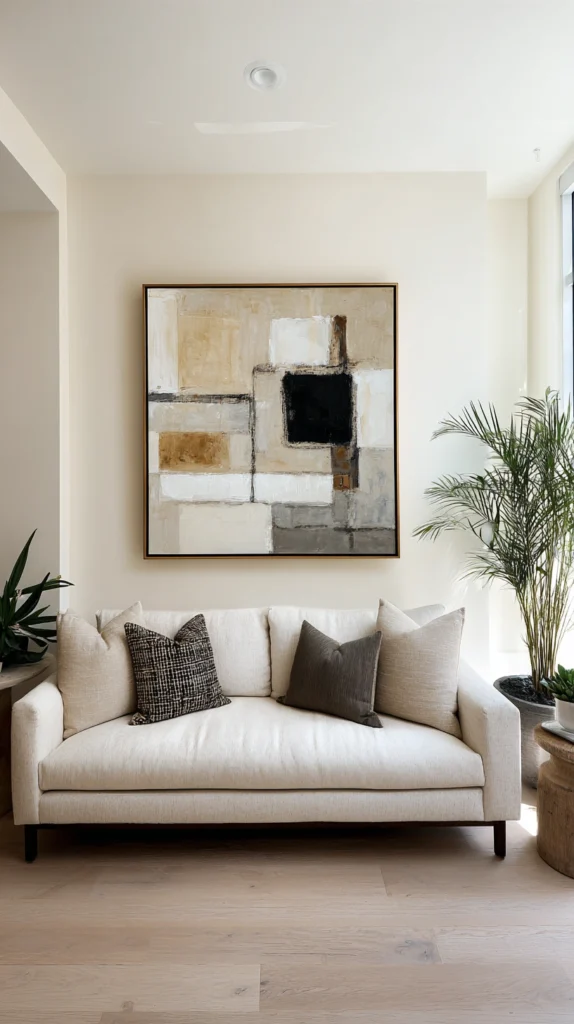
Budget: $100 – $1,500
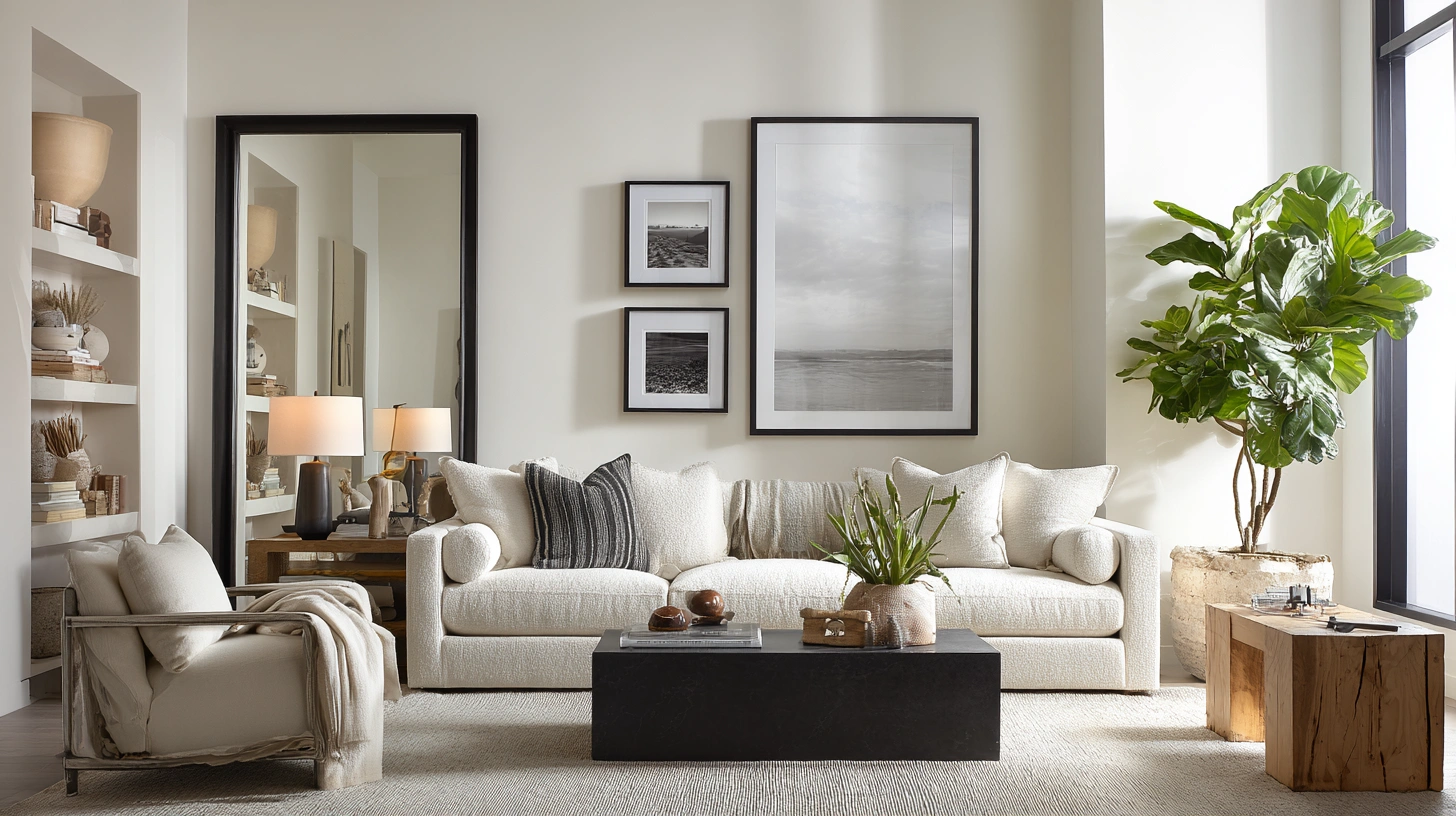
A single large artwork — at least two thirds of the sofa’s width — hung centred above the sofa back creates the most immediately authoritative and most confidently designed above-sofa wall treatment available. The scale communicates confidence. The centre creates order. The single piece gives the eye one clear, well-framed destination that the wall composition is organised around and that requires no other element to be present alongside it for the wall to feel complete.
A large abstract painting from an independent artist costs $200–$800 for a canvas of 120 cm width or above. A large-format fine art photograph in a simple frame costs $100–$500. A limited edition print at oversized scale runs $80–$400. The artwork should hang with its centre at 155–160 cm from the floor — museum hanging height — with the bottom edge of the frame no lower than 25–30 cm above the sofa back. An artwork hung too low over a sofa creates the uncomfortable visual impression that the sofa and the artwork are competing for the same wall position rather than occupying separate horizontal zones.
Decor tip: Choose an artwork whose longest dimension is at least 60 percent of the sofa’s width. An artwork narrower than this appears visually undersized relative to the sofa below it and creates the most commonly observed above-sofa proportion error — a small piece floating in an expanse of empty wall with no clear compositional relationship to the furniture beneath it. The 60 percent minimum is the rule that prevents this error regardless of the artwork’s individual quality or the room’s overall aesthetic.
2. A Gallery Wall of Mixed Frames
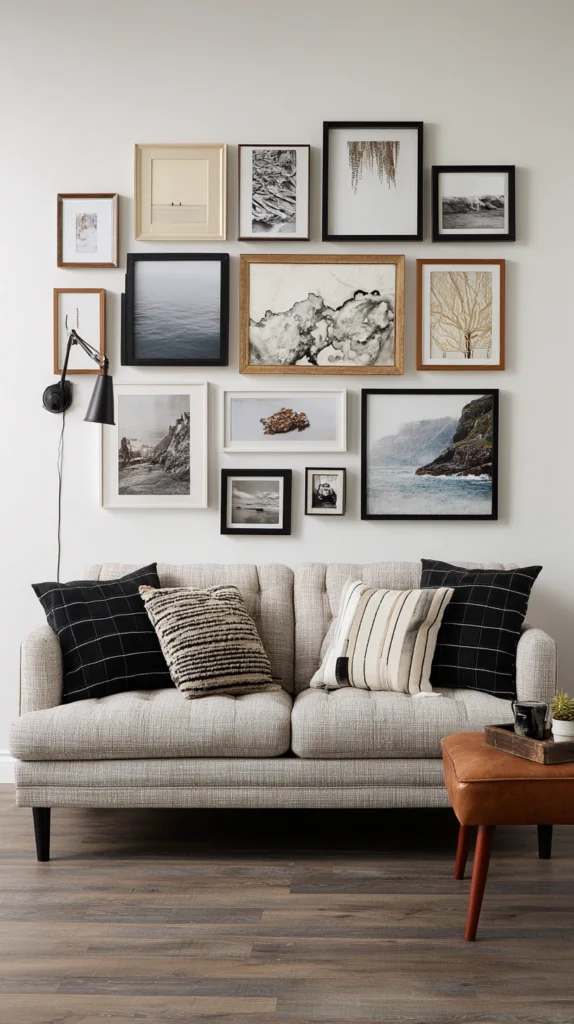
Budget: $60 – $400
A gallery wall — a grouping of five to nine framed pieces in coordinated but not identical frames — creates the most layered, most personally characterful, and most visually generous above-sofa wall treatment available. When correctly composed it has a breadth and depth that a single artwork at the same visual size cannot match and it allows for a mix of photograph, print, illustration, and object that reflects the specific sensibility of the household in a way that any single purchased piece cannot.
The gallery wall should span at least 80 percent of the sofa’s width and sit as a coherent block rather than scattered individual pieces across the full wall. Matching black frames cost $10–$30 each. Natural timber frames run $15–$40 each. An antique gold assorted frame collection costs $15–$50 each. A gallery wall of seven frames in consistent black with prints sourced from a mix of purchases and free downloads costs $80–$250 in total — the most cost-effective above-sofa wall treatment on this list that also provides the most customisable and most personally expressive composition.
Decor tip: Lay the gallery wall arrangement on the floor before fixing any nails to the wall. Arrange the pieces with the largest or most visually dominant piece slightly off-centre at approximately the mid-height of the arrangement, with smaller pieces distributed outward and upward from it. Photograph the floor arrangement and compare it to the available wall space above the sofa before transferring. This step produces a more considered and more resolved composition than arranging directly on the wall by eye, and it costs nothing beyond the time it takes to move seven frames around on the floor until the arrangement looks right from every angle.
3. A Horizontal Triptych
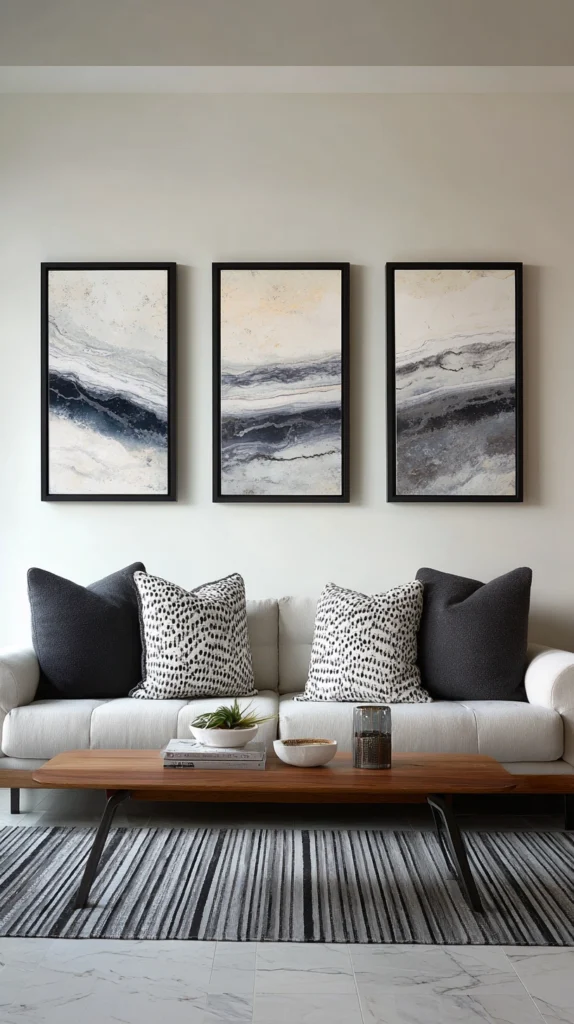
Budget: $80 – $500
A triptych — three identically sized and identically framed pieces hung at the same height in a horizontal row — creates the most formally composed and most cleanly geometric above-sofa wall treatment available. The three-piece format spans the sofa’s width more effectively than a single piece of equivalent total surface area and the repetition of the same frame dimension creates a visual rhythm that is immediately satisfying and specifically ordered in a way that no multi-size or multi-style grouping can replicate.
Three prints in identical frames of 40×50 cm create a triptych of 120–150 cm total width — appropriate for a standard three-seat sofa of 200–220 cm. Three prints cost $20–$60 each in the triptych format. Matching frames at $15–$35 each add $45–$105 to the total. The complete triptych costs $105–$285 in prints and frames for a wall treatment of specific visual coherence and specific compositional confidence. The three pieces should be related to each other — the same artist, the same colour palette, or the same subject series — rather than three unrelated pieces placed in matching frames that share nothing beyond their physical format.
Decor tip: Space the three triptych pieces at equal intervals of 5–8 cm — close enough to read as a single unified composition from across the room rather than three separate hanging pieces that happen to be in proximity. Intervals wider than 10 cm cause the triptych to lose its compositional unity and each piece begins to read as an independent hanging rather than as one element of a three-part composition. The spacing between pieces is the compositional decision that most determines whether a triptych reads as a gallery arrangement or as three separate pictures hung in a row.
4. A Large Decorative Mirror
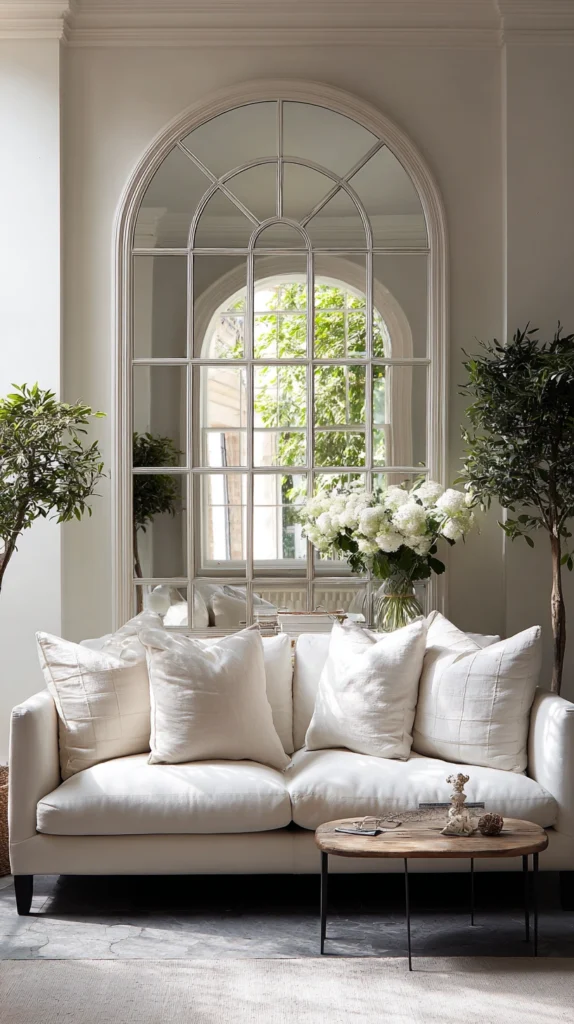
Budget: $80 – $500
A large mirror above the sofa — in an architectural, ornate, or sculptural frame — serves the above-sofa wall position with an object that provides both a decorative element and a spatial function simultaneously. The mirror reflects the room’s natural light into the space above the sofa, makes the living room appear deeper and more generously proportioned from every seated position that faces it, and creates a specific visual interest that artwork alone — which looks identical from every viewing position — does not provide.
A large arched mirror with a plaster or gesso frame costs $120–$400. An oversized rectangular mirror with a simple timber or metal frame runs $80–$300. A vintage or antique gilt-framed mirror costs $80–$400 from antique markets and salvage dealers. The mirror should be at least 80 cm in its widest dimension to read as an intentional above-sofa feature rather than an incidental hanging. A mirror that is too small above a sofa reads as a decorative object hung for lack of anything better rather than as a specifically chosen piece that was placed with compositional confidence.
Decor tip: Position the mirror so it reflects the most interesting element of the opposite wall or the room’s natural light source — a window, a lamp, or a piece of art — rather than simply reflecting the sofa and its occupants back toward themselves. A mirror that reflects beautiful room elements doubles the visual richness of what it captures. A mirror that reflects primarily the people sitting on the sofa beneath it creates an uncomfortable quality of self-consciousness that most households prefer to avoid in the room’s primary seating position.
5. A Woven Textile or Tapestry
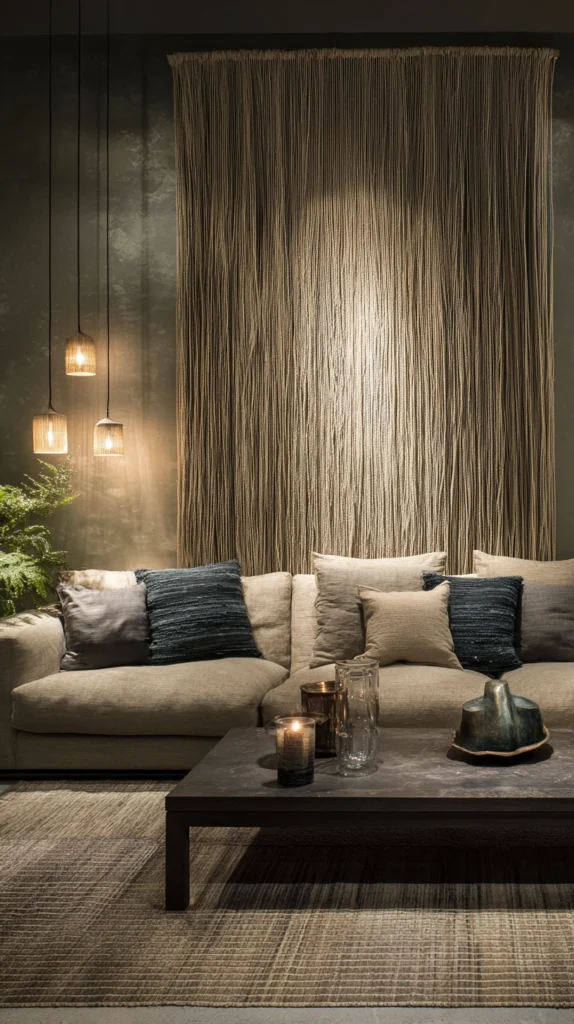
Budget: $60 – $400
A large woven textile — a Moroccan rug hung vertically, a handmade macramé panel, a flat-weave kilim, or a contemporary woven tapestry — brings a warmth, texture, and organic quality to the above-sofa wall that no framed artwork or mirror can provide in the same position. The textile’s material depth — the woven threads visible at close range, the slight variation in the surface as the weave catches different angles of light — creates a specifically tactile quality that communicates craft and warmth in a way that a printed and framed surface does not.
A vintage or reproduction Moroccan rug suitable for wall hanging costs $100–$400 depending on size and origin. A handmade macramé wall panel costs $60–$200. A contemporary woven tapestry from an independent textile artist costs $100–$500. Hang using a timber dowel through the natural fringe of a rug, or behind the upper edge of a tapestry in a casing sewn for the purpose — the dowel-and-hanging-cord approach suits any textile without visible hanging hardware that would interrupt the textile’s surface from the primary viewing position in the room.
Decor tip: Choose a textile whose colour palette echoes the dominant tones in the room’s cushions and rug rather than introducing an entirely new colour scheme at the wall level. A textile that shares two or three colours with the room’s existing soft furnishings creates a visual thread that runs from the floor through the sofa to the wall — the most coherent and most specifically designed colour relationship available in a room whose palette spans multiple horizontal levels from floor to ceiling.
6. Floating Shelves With Curated Styling
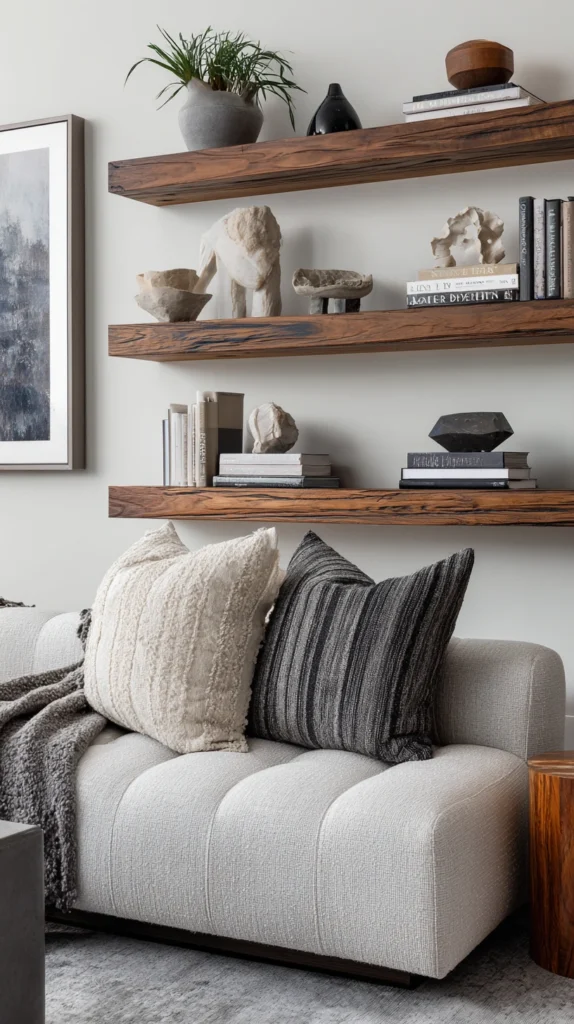
Budget: $80 – $300
Two or three floating shelves above the sofa — staggered at different heights in an asymmetric arrangement — create an above-sofa wall feature that provides both display and storage in a format that no flat wall treatment can replicate. The shelves bring three-dimensional depth to the wall above the sofa and the objects displayed on them — at multiple heights and in a curated selection of materials and forms — create a wall composition of visual richness that photographs and conversations benefit from equally.
A 90 cm floating shelf in solid timber costs $30–$60. Three shelves in an asymmetric arrangement — one at 140 cm, one at 160 cm, and one at 180 cm from the floor — create a wall composition of genuine visual interest for $90–$180 in shelf materials plus $20–$40 in brackets and fixings. Style each shelf with three to five objects at varying heights: a small plant, a ceramic vessel, a stack of books, a candle — the same principles that apply to any shelf display, applied specifically to the position that most directly affects the living room’s overall visual quality.
Decor tip: Install floating shelves above the sofa at heights where the lowest shelf is at least 25–30 cm above the sofa back — below this height the shelves create a physical encroachment on the seated position that makes the sofa uncomfortable to use by anyone of average or above-average sitting height. The display value of the shelves should not come at the cost of the practical quality of the seating below them, and the 25 cm minimum clearance is the measurement that preserves both functions without compromise in either direction.
7. A Statement Oversized Clock
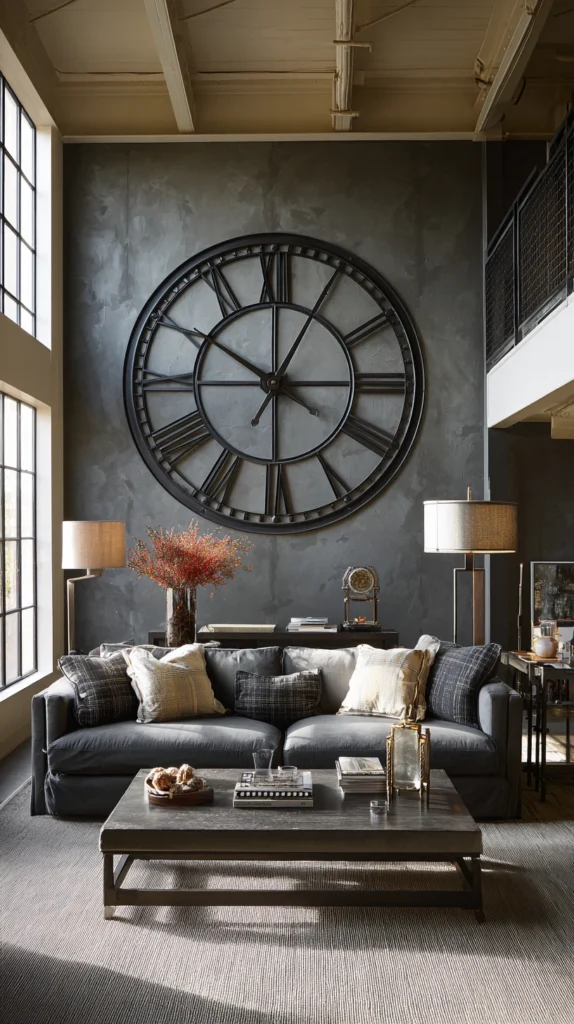
Budget: $60 – $300
A large industrial, vintage, or architectural clock — 60–90 cm diameter — hung centred above the sofa creates an above-sofa wall feature of immediate presence and genuine visual authority. The oversized clock is a classic living room wall statement that has remained consistently popular across every interior aesthetic from industrial loft to French farmhouse because it combines function, scale, and decorative presence in a single object that fills the above-sofa position with complete confidence.
A large iron-framed Roman numeral clock of 70 cm diameter costs $60–$150. A reclaimed factory clock in a distressed metal case runs $80–$200. A minimal modern clock in a large format costs $60–$180. The clock should be proportionate to the sofa’s width — a 70 cm clock above a 200 cm sofa is the minimum appropriate scale for a clock used as the sole above-sofa feature. A clock smaller than 50 cm in diameter over any standard three-seat sofa reads as a standard-sized household clock rather than as an intentional above-sofa feature scaled for its specific visual purpose.
Decor tip: Pair the oversized clock with two or three small supplementary wall objects — a small framed print, a small sconce, or a small mirror — on each side of it rather than leaving it as an entirely isolated object on an otherwise empty wall. The clock as sole above-sofa element reads as one piece hung above a sofa. The same clock flanked by two small complementary pieces reads as a curated composition organised around the clock as its primary element. The flanking pieces cost $20–$80 each and double the compositional interest of the arrangement from any viewpoint in the room.
8. Vertical Panelling or Shiplap
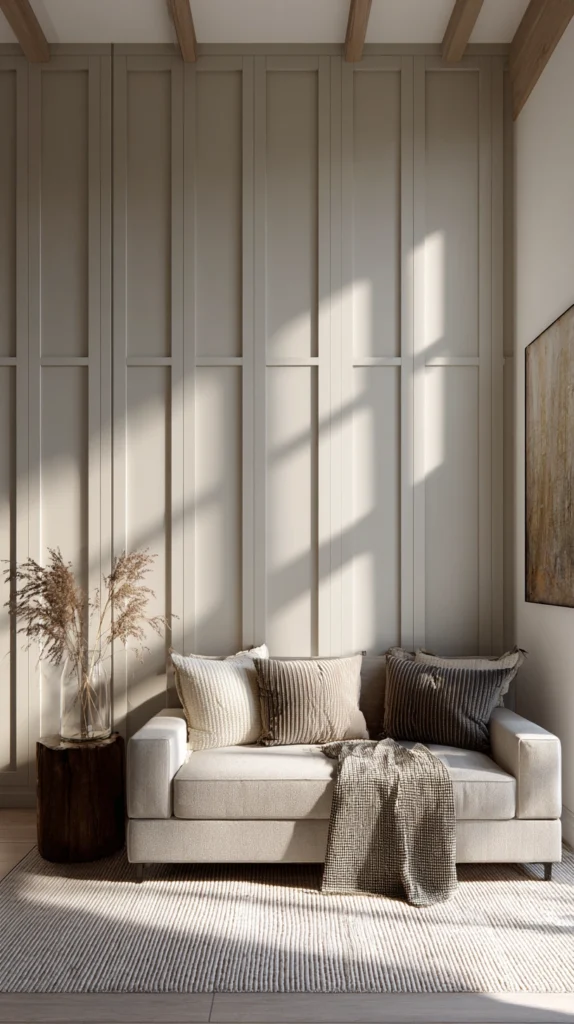
Budget: $100 – $400
Vertical timber panelling — shiplap boards, tongue-and-groove, or applied MDF battens — covering the full wall behind the sofa creates one of the most architecturally impactful above-sofa wall treatments available. The panelled wall reads as a designed interior feature rather than as a decorated surface and transforms the sofa’s backing wall from a painted plane into a textured, three-dimensional backdrop that makes the entire seating arrangement look specifically composed rather than simply furnished.
Shiplap timber cladding costs $8–$20 per square metre in materials. A full sofa wall of 3×2.5 metres requires 7.5 square metres at $60–$150 in timber. Applied MDF batten panelling — vertical battens at 15–25 cm spacing on a painted wall — costs $30–$80 in materials for the same wall area. Paint in the wall colour for a seamless architectural quality or in a contrast deeper tone for a specifically bold feature wall treatment. The panelled wall needs no additional decoration — the texture and pattern of the cladding is the decoration and adding art or shelves to a fully panelled wall creates visual competition between the panelling and its additions.
Decor tip: Run the panelling from floor to ceiling rather than only behind the sofa back height. Panelling that stops at the sofa height — or at a dado height — reads as applied decoration. Panelling that runs the full height of the wall from floor to ceiling reads as a genuine architectural feature of the room. The additional materials cost of extending the panelling to full ceiling height is modest and the visual upgrade from partial to full-height panelling is significant enough in every room to justify the additional installation effort it requires.
9. Botanical or Nature-Inspired Art Series
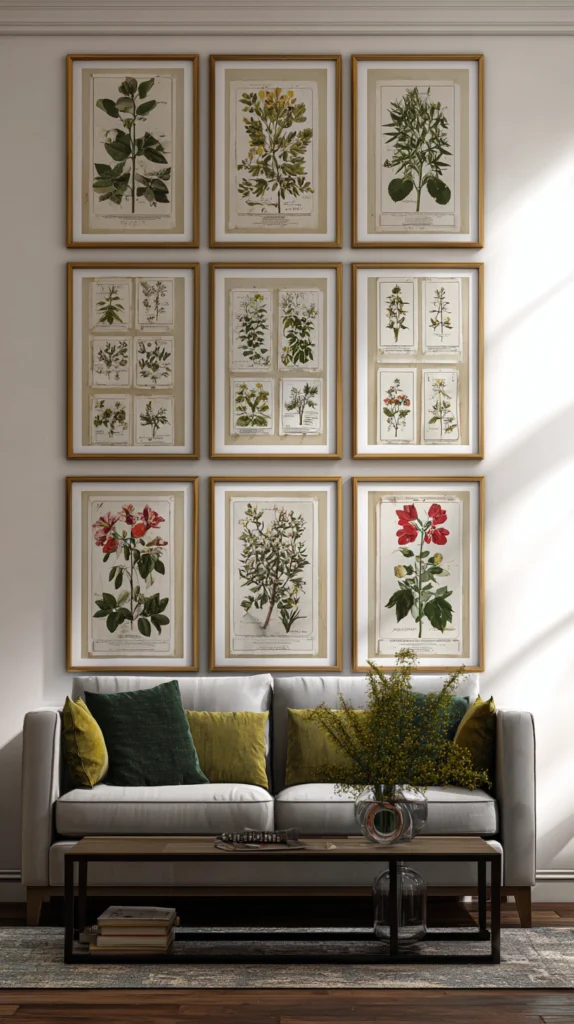
Budget: $40 – $250
A series of botanical prints — four to eight illustrations from the same publication series, in matching frames, hung in a grid or a horizontal row — creates one of the most cohesive and most specifically beautiful above-sofa wall arrangements available for a natural, cottage, or Scandinavian-influenced living room. The matching series quality of botanical illustration plates — each piece clearly related to every other through its shared graphic style and colour palette — creates a wall arrangement that reads as a collected group rather than a random assortment of individual prints.
Original Victorian botanical illustration plates from antique book dealers cost $5–$30 each — a set of six from the same publication costs $30–$180. Reproduction botanical prints in digital download format cost $2–$8 each and can be printed at any size from a local print shop. Simple white frames cost $8–$20 each. A set of six plates in matching white frames creates a grid of 3×2 or 2×3 at a total cost of $80–$300 — a specifically beautiful and specifically characterful above-sofa wall arrangement at a price point achievable by any household willing to source the plates carefully rather than purchasing them through a retail art print service.
Decor tip: Source botanical prints from the same original publication or series for the most visually cohesive arrangement. Botanical prints from different publication sources vary in illustration style, colour reproduction, and paper quality in ways that are immediately visible when pieces from different origins are placed in matching frames beside each other. A series sourced from the same original work — the same plates from the same publication — shares an illustrative quality and colour family that makes the arranged group look like a collection rather than a selection of similar-themed individual purchases.
10. A Neon or LED Sign
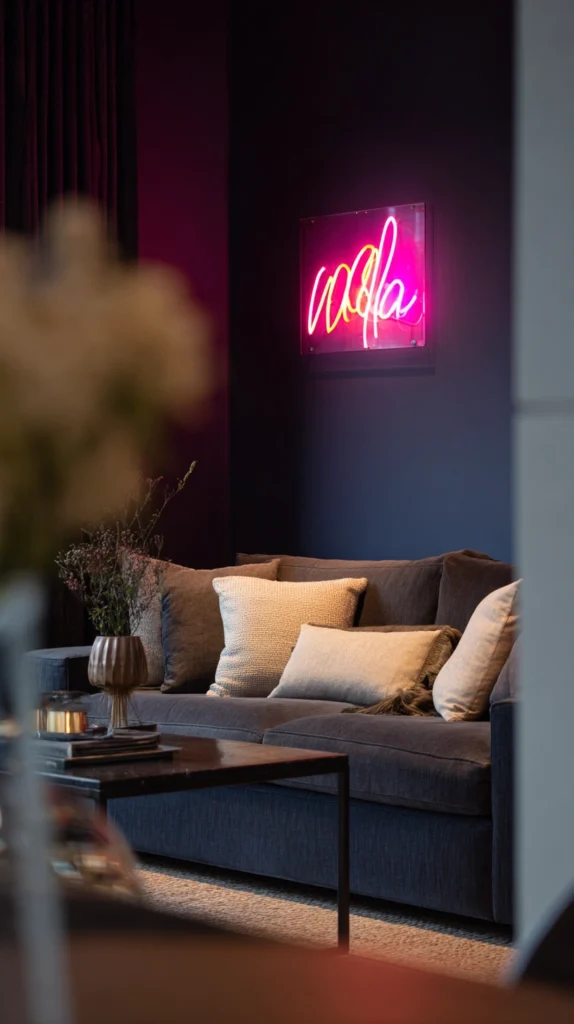
Budget: $50 – $300
A neon or LED sign — displaying a word, a phrase, or a simple shape in warm white, amber, or rose-toned light — creates the most atmospheric and most specifically evening-functional above-sofa wall feature available. The sign provides both a decorative daytime presence and a warm ambient light source in the evenings that transforms the sofa wall from a purely visual backdrop into a lit feature that contributes meaningfully to the room’s atmospheric quality after dark.
An LED flex neon sign in a custom word or simple shape costs $50–$150 for a 40–60 cm width. A genuine neon glass sign costs $150–$400 for the same size. A cursive word sign in warm white or amber costs $60–$200. Power via a USB connection or a standard wall socket with a 1–2 metre cable managed discreetly down the wall to the nearest socket position. The neon sign suits a maximalist, bohemian, contemporary, or urban-industrial living room aesthetic and suits a minimal or traditional aesthetic considerably less — the decision to use it should be grounded in the room’s existing character rather than in the sign’s individual appeal.
Decor tip: Choose the sign’s word or phrase with care — it should mean something genuinely personal to the household rather than being a generic phrase available from every neon sign retailer. A sign that says something specific — a family name, a meaningful place, a private reference — communicates personal meaning and reads as specifically chosen. A generic phrase available from a catalogue reads as a generic decoration selected for its appearance rather than its significance. The meaning behind the phrase is as important to the sign’s contribution to the room as its colour, size, and letterform.
11. An Architectural Salvage or Found Object Feature
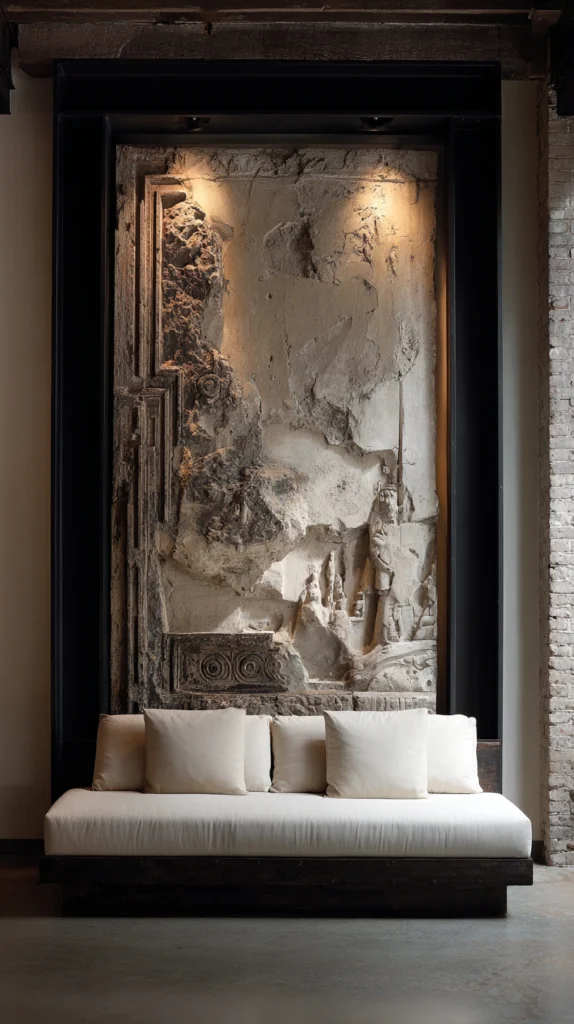
Budget: $30 – $200
An oversized found or salvaged architectural object — a decorative iron gate panel, a large carved timber architectural fragment, an old factory clock face, a section of ornate wrought iron railing — used as the above-sofa wall feature creates a living room with the most specifically characterful and most genuinely individual wall treatment on this list. No two found objects are identical and the above-sofa wall treated with a genuine salvaged architectural fragment communicates a quality of personal curation and design confidence that no catalogue purchase can replicate regardless of its individual quality.
A decorative iron gate panel costs $40–$150 from architectural salvage dealers. A carved timber architectural fragment runs $30–$120. A large factory clock face costs $50–$200. A section of decorative wrought iron railing costs $40–$150. The found object should be cleaned and treated but not restored to any appearance different from its genuine weathered state — the patina of age and use is the quality that justifies the choice of a salvaged object over a new decorative alternative at any comparable cost.
Decor tip: Position a single architectural salvage piece at the centre of an otherwise clear wall above the sofa — the empty wall on each side of the piece is the compositional context that allows the object’s form and character to be fully appreciated. A salvage piece surrounded by other wall objects loses the specific quality of singularity that makes it interesting — it becomes one of several things on the wall rather than the single thing the wall is organised around. The surrounding empty wall is the most important element of the composition and it costs nothing to provide.
12. Wallpaper on the Sofa Wall Only
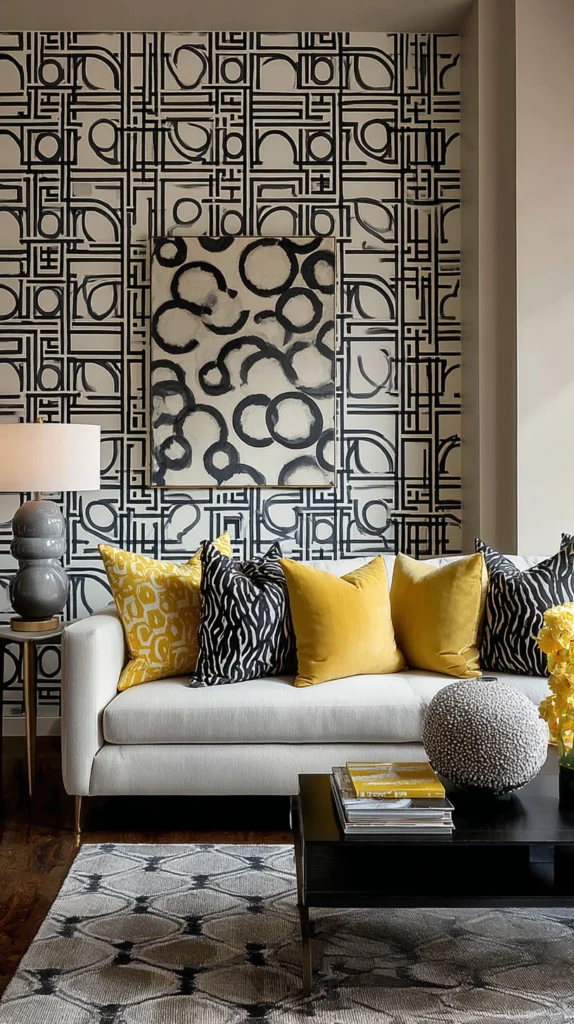
Budget: $80 – $400
Applying wallpaper to the sofa wall only — while the remaining three walls of the living room remain painted — creates the most visually impactful wall treatment available for a single-wall application. A richly patterned, textured, or coloured wallpaper behind the sofa transforms the room’s primary wall from a painted surface into a designed backdrop and creates the most immediately dramatic improvement in the room’s character available from a single surface treatment at the wallpaper’s cost per roll.
A quality wallpaper in a botanical, geometric, or textured pattern costs $30–$100 per roll. A standard sofa wall of 3×2.5 metres requires two to three rolls at $60–$300 in wallpaper materials. The sofa wall application uses less paper than a full-room application and allows a more expensive or bolder wallpaper to be used on the single most important wall without the full-room paper cost. Bold, large-scale patterns that would be overwhelming on all four walls read as confident and specifically designed on a single sofa wall where the surrounding painted surfaces provide the visual rest that the patterned wall requires.
Decor tip: Choose a wallpaper for the sofa wall that references at least two of the room’s existing dominant colours — appearing in the cushions, the rug, or the curtains — rather than introducing a completely new colour palette at the wall level. A wallpaper that echoes existing room colours creates a visual conversation between the pattern on the wall and the existing furnishings in the room. A wallpaper that introduces entirely new colours creates a visual separation between the sofa wall and the room it is in — making the treatment look like a different room’s wall installed in the current one.
13. A Stacked Book Display or Literary Wall
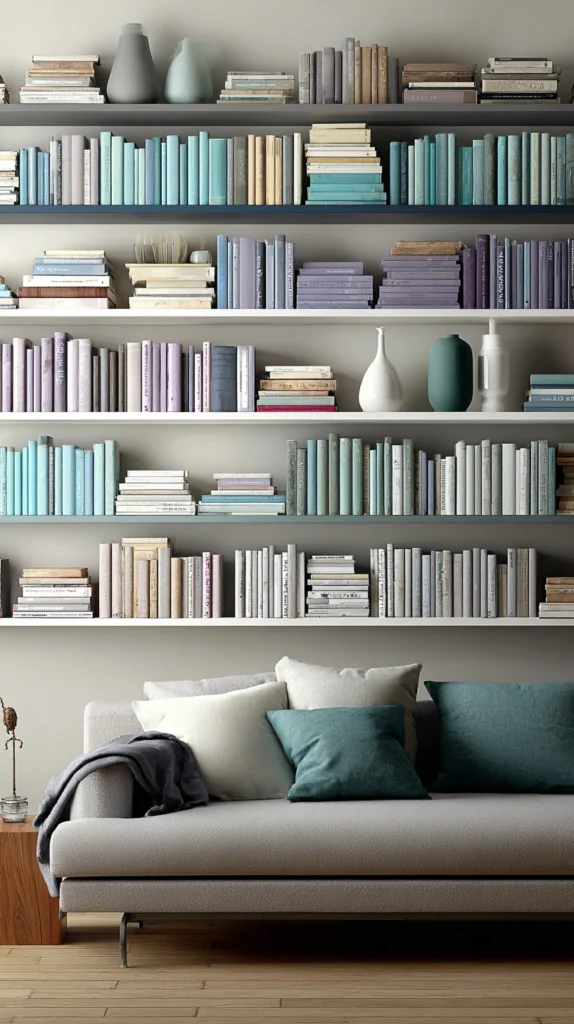
Budget: $0 – $80
A floating shelf above the sofa styled with a densely stacked collection of books — spines outward, arranged by colour or height, with the shelf’s full depth occupied from front to back — creates a specifically literary and specifically warm above-sofa wall feature using objects that the household already owns. The book wall communicates character and intellectual life in a way that no purchased decorative object can replicate and it is the above-sofa wall treatment most directly personalised to the specific household it belongs to.
A single floating shelf of 120 cm length at appropriate depth for books costs $30–$60. The books themselves are already in the household or available from charity shops at $0.50–$2 each. Style the shelf with books arranged by spine colour in a simple warm-to-cool colour gradient — the colour organisation is the styling decision that transforms a shelf of randomly arranged books into a designed above-sofa display. Add two or three non-book objects — a small plant, a ceramic figure, a candle — as accent elements that prevent the all-book shelf from reading as a library overflow rather than a curated display.
Decor tip: Mix horizontal and vertical book stacking on the shelf above the sofa — some sections with books standing upright, others with books lying flat in a stack topped by a small object. The variation between standing and stacked sections creates visual rhythm along the shelf length that prevents the all-book display from being uniformly flat from the primary seated viewing position. The mixed stacking is the single styling decision that most differentiates a curated above-sofa book display from a bookshelf that has been placed above the sofa because it was the available wall position.
14. An Abstract Painted Mural
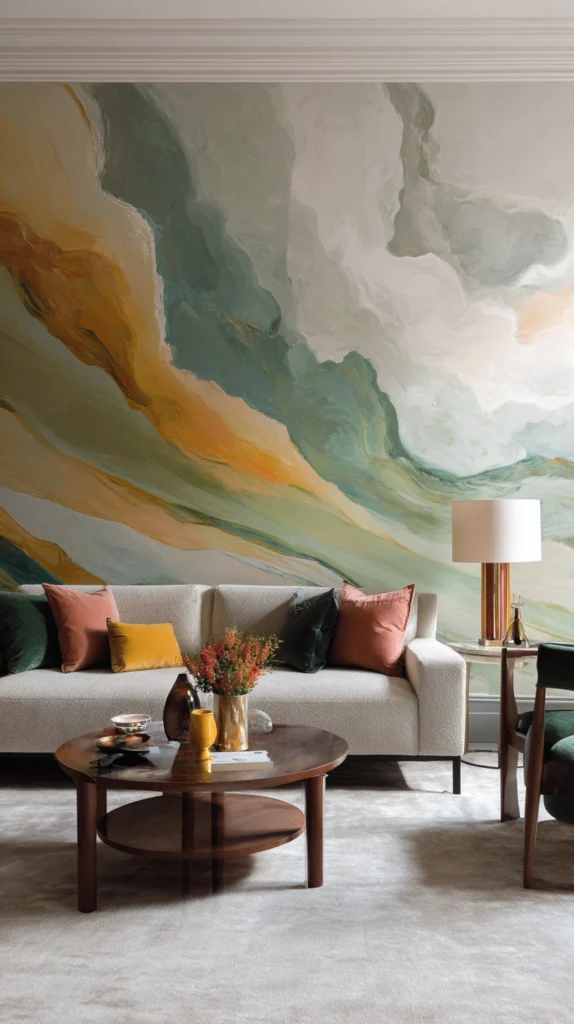
Budget: $20 – $100 in materials
A painted mural directly on the sofa wall — an abstract colour field, a simple botanical illustration, a geometric pattern, or a large-scale wash of colour — creates the most specifically unique and most non-replicable above-sofa wall feature available. A mural is the one wall treatment that cannot be found in any other home, because it was created in response to the specific room, the specific sofa, and the specific aesthetic sensibility of the household that occupies the space. It costs materials only and it produces results that photograph as significantly more expensive and more designed than the paint cost alone suggests.
Exterior paint in the required colours costs $15–$40 per tin. A large abstract colour field mural on a white wall requires one to two tins of paint in one to three colours at $15–$80 total. A simple botanical design — large-scale leaves or a branch — requires basic painting skills and a pencil sketch to guide the application. Apply paint with a broad brush for a loose, gestural quality that communicates that the mural was created by a person rather than produced by a machine. The imperfection of a hand-painted mural is its most specific quality — the quality that makes it genuinely original and genuinely personal in a way that every other above-sofa wall treatment on this list cannot achieve at any budget.
Decor tip: Photograph the intended sofa wall before beginning any mural application and sketch the design at scale on the photograph in a photo editing app before committing any paint to the actual wall. The digital sketch allows the scale, the position, and the approximate colour of the mural to be assessed relative to the sofa and the room before the paint is irreversibly applied. A mural whose scale and position were correct from the first brushstroke always looks more designed than one that was adjusted as it developed — and the digital sketch step takes thirty minutes and prevents the most common mural error of a design that looked right in the sketch and wrong at full scale on the actual wall.
The above-sofa wall is the living room’s most important compositional decision and the one that most consistently reveals whether the room was thought about or simply furnished. Every treatment on this list works — the specific one that works best for any given room is always the one most specifically chosen in relationship to the sofa, the room’s colour palette, and the aesthetic sensibility of the household rather than the one that is simply most popular or most commonly seen in interior photography.
Begin with scale — choose something whose width is at least two-thirds of the sofa’s width before choosing anything else. A correctly scaled above-sofa treatment that is imperfect in every other respect always looks better than a beautifully designed treatment at the wrong scale. Scale first. Everything else follows from getting that one dimension right.